

Find the best Inventory Management Software
Compare Products
Showing 1 - 20 of 987 products
Sort by
Reviews: Sorts listings by the number of user reviews we have published, greatest to least.
Sponsored: Sorts listings by software vendors running active bidding campaigns, from the highest to lowest bid. Vendors who have paid for placement have a ‘Visit Website’ button, whereas unpaid vendors have a ‘Learn More’ button.
Avg Rating: Sorts listings by overall star rating based on user reviews, highest to lowest.
A to Z: Sorts listings by product name from A to Z.


Fishbowl
Fishbowl
Fishbowl is the #1 manufacturing and warehouse inventory management software! Its powerful inventory control system gives your small or midsize business the exact tools needed to transform your inventory management and scale your ...Read more about Fishbowl
NetSuite
NetSuite
With an integrated system that includes ERP, financials, commerce, inventory management, HR, PSA, supply chain management, CRM and more – NetSuite enables fast-growing businesses across all industries to work more effectively by a...Read more about NetSuite

inFlow Inventory
inFlow Inventory
FrontRunners 2024
Looking for an inventory and order management system for your small or medium-sized business? inFlow is used in over 90 countries around the world for manufacturing, wholesale, distribution, ecommerce, and more. It's also simple t...Read more about inFlow Inventory

Leanafy
Leanafy
Leanafy WMS is a cloud-based solution that will help you manage your warehouse and inventory processes more efficiently. The solution provides real-time visibility into your orders, shipments, and inventory levels so that you can ...Read more about Leanafy
Talk with us for a free
15-minute consultationSoftware Advice is free because vendors pay us when they receive sales opportunities.
This allows us to provide comprehensive software lists and an advisor service at no cost to you.
This allows us to provide comprehensive software lists and an advisor service at no cost to you.


Meet Eric, a software expert who has helped 1,534 companies select the right product for their needs.
Talk with us for a free
15-minute consultationSoftware Advice is free because vendors pay us when they receive sales opportunities.
This allows us to provide comprehensive software lists and an advisor service at no cost to you.
This allows us to provide comprehensive software lists and an advisor service at no cost to you.
Tell us more about your business and an advisor will reach out with a list of software recommendations customized for your specific needs.
STEP 1 OF 4
How many employees are in your company?

Flowtrac
Flowtrac
FrontRunners 2024
Flowtrac is a cloud-based and on-premise warehouse management solution that helps companies manage their Inventory, Assets, Warehouse, Work In Process, and other specialty tracking requirements. The solution is suitable and deploy...Read more about Flowtrac

eTurns
eTurns
eTurns TrackStock is a modern VMI app distributors can use to replenish their customers' stockroom and truck inventory in an optimized way. Using QR code scans or SensorBins, eTurns tracks usage and auto-replenishes. Distributor r...Read more about eTurns
TOMS (Tejas Order Management System)
TOMS (Tejas Order Management System)
TOMS is a distributed order management system designed for online retailers and ecommerce companies with multi-channel operations. It consolidates orders from various sales channels, such as websites, marketplaces, and stores, int...Read more about TOMS (Tejas Order Management System)

ArbiMed Inventory
ArbiMed Inventory
ArbiMed Inventory is a cloud-based inventory management solution designed for the medical and other clinical industries. With ArbiMed Inventory, medical professionals and administrators can easily track valuable medical assets fro...Read more about ArbiMed Inventory
Kechie
Kechie
Kechie Distribution Management efficiently manages internal and external resources. Suited for growing businesses, the management tools provide control of replenishment, warehouse management, pick, pack, and ship, procurement, pro...Read more about Kechie
Agiliron
Agiliron
Agiliron is an all-in-one Retail Management System which allows you to manage all orders, inventory and CRM records, from all channels, in one place. Agiliron also integrates with many of your existing business tools like Quickb...Read more about Agiliron

Pomodo
Pomodo
Pomodo Software offers a cloud-based orders and inventory management solution suitable for businesses of all sizes. It offers the ability to add modules to expand the solution to suit the business’ needs. Pomodo offers produc...Read more about Pomodo

DigitBridge
DigitBridge
DigitBridge is a digital commerce operations system designed specifically for small-to-medium sized businesses (SMBs). DigitBridge is co-founded by our CEO, Petersen Zhu, who has over 30 years of experience in the wholesale, app...Read more about DigitBridge

Global Business Commerce
Global Business Commerce
Global Business Commerce (GBCommerce) is a business solution that is a single entry portal featuring multi-channel listings and ensuring product attributes comply with sales channels. It’s applicable to various industries like Acc...Read more about Global Business Commerce

Think Aisle
Think Aisle
GET FREE TRIAL FOR 3 MONTHS. Think Aisle is a cloud-based platform designed to help businesses in the hospital, fashion, industrial and other industries streamline the entire stock lifecycle, from inventory ordering to sales repor...Read more about Think Aisle

SellerChamp
SellerChamp
SellerChamp is a cloud-based eCommerce solution that enables businesses to streamline processes related to product repricing, cross-selling, shipping, inventory management and more. It facilitates integration with ShipStation for ...Read more about SellerChamp

MarginPoint Inventory
MarginPoint Inventory
MarginPoint Inventory is a cloud-based solution that provides the ability to track and manage inventory in real-time, regardless of where it’s located or who supplied it. With our easy-to-use mobile app, users will now be able to ...Read more about MarginPoint Inventory
NeverOut WMS
NeverOut WMS
NeverOut WMS is a complete warehouse management system, designed to manage all facets of a warehouse resulting in a virtually 100% accurate inventory. NeverOut WMS features include Inventory Management (real-time accuracy), O...Read more about NeverOut WMS

RFgen
RFgen
Tired of inefficiency, lack of visibility, missing inventory, and cost overruns? Gain control over your material handling processes in the warehouse, on the shop floor, and in the field with RFgen Mobile Edge™. RFgen is an industr...Read more about RFgen

Quickbase
Quickbase
Quickbase is a no-code collaborative work management platform that empowers citizen developers to improve operations through real-time insights and automations across complex processes and disparate systems. Here's why Quickbase i...Read more about Quickbase

Raptech
Raptech
Raptech is a SaaS-based collaborative business management platform that enables enterprises to grow faster by making smarter decisions using real-time data that is achieved by integrating the Lead-to-quote, Order-to-cash, Purchase...Read more about Raptech
Popular Comparisons


Buyers Guide
Last Updated: June 13, 2023What Is Inventory Management Software?
Inventory management software is software designed to track and manage items through various stages along the supply chain. Features include stock level management, inventory item categorization, sales order and purchase order tracking, barcode scanning, and automatic reorder point purchasing.
Retail businesses can typically use scaled-down systems focused on maintaining perpetual inventory data and inventory levels, whereas businesses with complex supply chains often use the inventory management functionality in ERP systems or with strong warehouse management integrations.
Depending on the complexity of your asset tracking and physical inventory needs, you may require features to support multiple sales channels, multiple warehouse management, and a mobile app. We'll get into more detail below.
Benefits of Inventory Management Software
While you can track inventory in Excel, spreadsheets only work for periodic inventory counts (i.e., the inventory system is only updated at intervals, say after physical stock counts). Inventory software is necessary to enable a true dynamic inventory system, where stock levels are updated continuously as sales are made and goods are received. Benefits include:
Improved inventory control and inventory optimization
Reduced reliance on stock takes
Simplified accounting
Competitive Advantages of Using Inventory Management Software
As a business owner, you need a good inventory management system that offers you a competitive edge. For e-commerce retailers, logistics providers, and businesses in other industries where margins can be razor-thin, you need inventory software that works hard for you.
Better synchronization: E-commerce retailers can synchronize inventory across digital channels (e.g., eBay, Amazon, Shopify etc.), physical retailers can synchronize multi-channel inventory across multiple stores and multi-channel retailers can synchronize e-commerce platforms with brick-and-mortar stores.
Greater efficiency: Inventory management systems can integrate with point-of-sale systems to update stock levels in real time as sales are made.
Reliable tracking: Advanced inventory features in ERP systems enables end-to-end tracking of goods, from raw materials to retail shelf. Asset management and product tracking greatly improve.
Business Sizes Using Inventory Management Software
Inventory management software is used by businesses of all sizes, across a variety of industries.
Our internal data shows that of a sample of 1,676 inventory management buyers who contacted us recently, most were small businesses, with 91 percent employing fewer than 100 people, and 75 percent generating less than $5 million annually.
Smaller businesses typically use a scaled-down solution in conjunction with a point of sale system and an accounting system.
Larger businesses (and enterprise businesses) typically use the inventory management tools of an ERP or supply chain systems, as these systems allow for inventory tracking across multiple links in the supply chain.
Software Related to Inventory Management
Inventory management functionality is included in a diverse group of software categories, such as:
Accounting software: Helps businesses automate their core accounting functions to more easily balance their books and provide proof of their financial standing. Systems typically include a centralized general ledger, accounts payable, accounts receivable, billing and invoicing and the ability to produce standardized reports.
Distribution ERP systems: These are required by a wide variety of businesses that operate in the middle of the supply chain between manufacturers and customers. Distribution software systems can feature a wide variety of functionality and features, including inventory control, warehouse management, CRM, order management and accounting.
Manufacturing ERP systems: Provides functionality to plan and execute projects from beginning to end, while automating materials planning, production tracking and scheduling and product lifecycle management.
Retail management systems: Many vendors combine point-of-sale systems with inventory management systems in a single platform. Retail ERP systems also include inventory functionality.
Warehouse management systems: These systems are inventory control systems specifically designed for warehouse inventory that also offer software automation for crucial warehouse processes. Automating processes such as warehouse picking has been conclusively shown to be vastly more efficient than manual methods.
Features Guide
A List of Common Inventory Management Solution Features/
Product categorization | Tracks stock levels according to item attributes such as size, color, lot/serial number etc. Generate bill of materials and streamline the reorder point process. |
Sales order and purchase order management | Tracks each product sale, order, wholesale purchase, build or delivery and automatically updates inventory quantities. |
Order management | Advanced systems like SAP, Oracle and Microsoft Dynamics can be set up to automatically reorder a product when it falls below a certain quantity. |
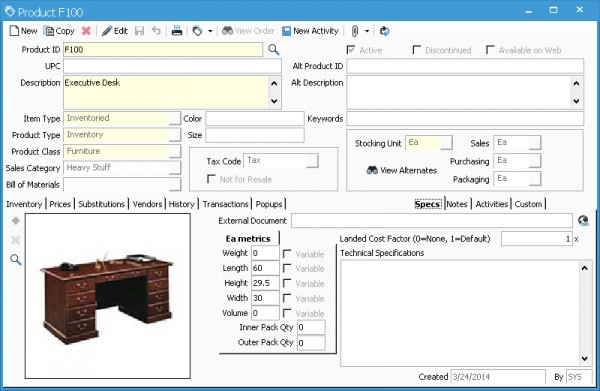
Specifying item attributes in Acctivate Inventory Management
Top-Requested Features
At Software Advice, we've helped thousands of buyers find the right software for their business. We've analyzed those interactions to determine the top-requested features by Inventory Management buyers, presented here:
Inventory Management Buyers' Top-Requested Features
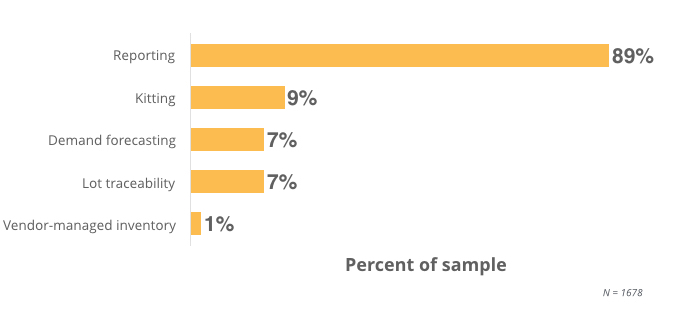
The Inventory Management Solution Features You Really Need
Small business | Perpetual inventory: Allows small retailers and e-commerce retailers to synchronize product levels across multiple locations and multiple sales channels, both online and brick-and-mortar. Support for purchase order processing, inventory report, and invoicing are key features needed for small businesses to make smart business decisions. |
Midsize business buyer | RF support: Barcode scanning, especially on a mobile device barcode scanner, allows for powerful inventory control, improves count accuracy, and substantially speeds up processes like receiving, FIFO, and pick/pack/ship. |
Enterprise business buyer | Lot traceability: Manufacturers and large distributors are increasingly using lot and serial numbers to track products through their supply chains from raw materials to retail shelf. |
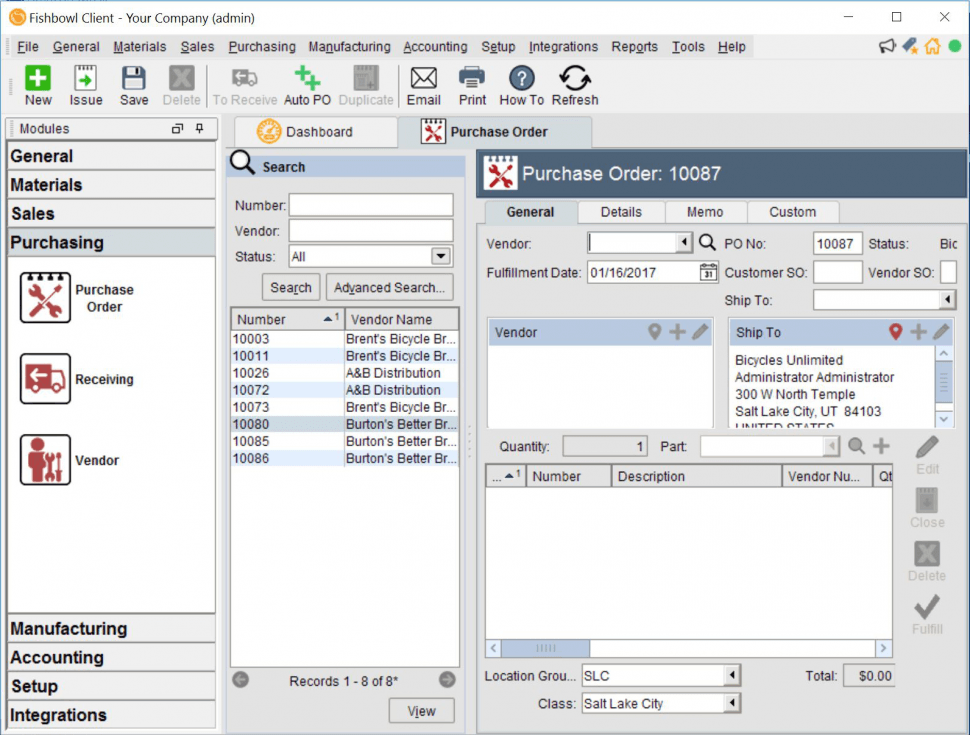
Processing a purchase order in Fishbowl Inventory
Pricing Guide
How Inventory Management Software Is Priced
Typically, inventory software is priced according to a number of factors. There are different pricing tiers for businesses of varying size, based on:
Number of users
Number of locations and sales channels (multi-channel inventory)
Number of SKUs/products
Number of orders processed per month
Number of devices (e.g., client PC, barcode scanner, mobile app and mobile device)
In addition, whether the software is hosted online or on-premise can make a difference in up-front versus recurring costs.
What Businesses Typically Budget for Inventory Management Software
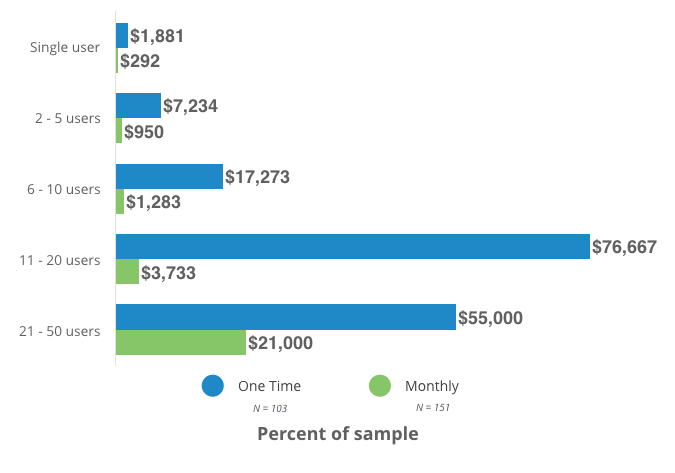
We looked at a sample of buyer interactions to compare how much businesses are willing to budget either for monthly fees for cloud platforms or upfront, one-time fees for on-premise platforms. We've broken this data down by business size in terms of number of licensed users, since licensed users is one of the primary factors affecting pricing for systems:
Typical Inventory Management Software Budget
Hidden Costs to Look Out for
Hardware. Many businesses will need barcode scanners and printers, and retailers may also need hardware point of sale (POS) terminals.
Accounting integrations. Some vendors price their solutions based on how many accounting systems the inventory system integrates with.
End-to-end lot/serial number tracking. Businesses that need full traceability throughout the supply chain will need a full-blown ERP system, which is much pricier than a scaled-down system.
FAQs
What Are the Key Functions of Inventory Management Software?
Dynamic inventory. With inventory control software, stock levels are updated in real time as you receive purchase orders and process sales orders. A good inventory management tool will support more advanced inventory management techniques no matter the sales channel or complexity of inventory levels and asset types.
Elimination of manual processes. Barcode scanning speeds up tedious processes such as stock takes/inventory counts. Support for mobile devices and the availability of a mobile app can be key features in finding the best tool for your business.
Inventory optimization. E-commerce retailers selling across multiple sales channels, retailers with multiple stores and distributors with multiple warehouses all need to synchronize product and asset tracking. This can't be done with spreadsheets, since product levels need to be updated in real time, and requires an inventory management system.
What Questions Should I Ask Vendors When Evaluating an Inventory Management Solution?
Do you integrate with my accounting software? Inventory management vendors typically support a range of accounting integrations out of the box, but they might not integrate with your particular system, or they might charge extra for the integration. If you're using QuickBooks, you should evaluate the many vendors that specialize in QuickBooks integrations.
How many active clients do you have in my particular industry vertical? Different industries track different things (e.g., color, size, expiration date, style, serial number). Many vendors specialize in industries such as apparel or pharmaceuticals. Vendors without experience in these verticals may claim to be able to handle an implementation in your industry, but implementation costs may be prohibitive and the functionality limited. Be sure your vendor has experience with businesses in your industry.
What level of support do you offer for warehouse processes? While many inventory management vendors claim to offer warehouse management functionality, typically it's basic, e.g., generating paper pick lists and tracking by warehouse location. If you need advanced features such as FIFO processes, voice-directed picking or slotting, you may need to look into specialized warehouse systems.
Do you sell POS systems? What other hardware will I need? Retailers in particular should evaluate vendors that also sell POS systems. Distributors will typically need barcode scanners, label printers and other hardware to go along with the inventory management system.
What Are Some Drawbacks I Should Watch Out For?
There are no real drawbacks to using inventory management systems, but there are drawbacks to choosing the wrong vendor for your business.
Only ERP systems offer lot traceability. Lot traceability requires the using a lot number as an item attribute for inventory tracking in all of the supply chain/accounting software a business uses. Realistically, businesses should consider an integrated ERP software solution for lot tracking.
Crucial functionality for certain industries is missing from many platforms. Businesses that price items by weight (e.g., meat vendors, produce distributors) need to weigh inventory at crucial points in the supply chain for costing and inventory tracking. This is known as "catchweight management," and it's only found in specialized products. Additionally, advanced expiration date tracking and costing will require specialized products.
Inventory software offers varying levels of support for supply chain functions. They may lack some support altogether for supply chain functions, such as procurement or route optimization (for businesses with their own fleets). Logistics providers or 3PLs should be particularly careful when choosing a platform, since they specialize in areas of the supply chain where some inventory management vendors lack functionality.
Tips & Tools
Build a Business Case for New Software
Here are three major ROI drivers for inventory management software:
Improved inventory tracking and accuracy. Periodic inventory systems based on spreadsheets are inefficient and prone to human error. Once businesses hit a certain size, they can realize major cost savings simply by improving accuracy.
Synchronized inventory. By synchronizing inventory levels across multiple physical stores and e-commerce channels, you can avoid stock-outs and satisfy customers.
Automation of manual processes. Spreadsheets are incredibly time-consuming, as are inventory counts and the pick/pack/ship process. By partially or fully automating these processes, inventory software can make your business run much more efficiently.