


Best Order Fulfillment Software of 2026
Updated January 27, 2025 at 9:59 AM
- Popular Comparisons
- Buyers Guide
- Related Software
Compare Products
Showing 1 - 25 of 214 products
Compare Products
Sort by
Reviews: Sorts listings by the number of user reviews we have published, greatest to least.
Average Rating: Sorts listings by overall star rating based on user reviews, highest to lowest.
Alphabetically (A-Z): Sorts listings by product name from A to Z.

SAP S/4HANA Cloud is a cloud-based and on-premise enterprise resource planning (ERP) solution. It is suitable for small, midsize...Read more about SAP S/4HANA Cloud


SAP S/4HANA Cloud's Best Rated Features
See All
SAP S/4HANA Cloud's Worst Rated Features
See All

Excalibur WMS by Camelot 3PL is a cloud-based or on-premise warehouse management solution (WMS), designed exclusively for third-...Read more about Excalibur WMS

NetSuite is an AI-powered cloud-based business management suite that incorporates ERP, financial management, CRM and eCommerce f...Read more about NetSuite


NetSuite's Best Rated Features
See All
NetSuite's Worst Rated Features
See All

CartonCloud — Logistics software you’ll master in minutes CartonCloud is an all-in-one logistics platform that brings warehouse ...Read more about CartonCloud


CartonCloud's Best Rated Features
See All
CartonCloud's Worst Rated Features
See All

Logiwa IO is a cloud-native warehouse management and order fulfillment solution built on a .NET framework. The solution supports...Read more about Logiwa


Logiwa's Best Rated Features
See All
Logiwa's Worst Rated Features
See All

Infios Warehouse Management System (WMS) is a mobile-enabled solution designed to help businesses manage processes, inventories,...Read more about Infios Warehouse Management Systems

Item is a cloud-based solution that streamlines supply chain, order, and warehouse management. Real-time visibility is at the co...Read more about Item


Item's Best Rated Features
See All
Item's Worst Rated Features
See All

Extensiv 3PL Warehouse Manager is a cloud-based warehouse management system designed for third-party logistics companies to mana...Read more about 3PL Warehouse Manager
3PL Warehouse Manager's Best Rated Features
See All
3PL Warehouse Manager's Worst Rated Features
See All

WISE is a cloud-based warehouse management system. It is designed to enhance business processes. This comprehensive solution is ...Read more about WISE


ProVision WMS is a comprehensive warehouse management system engineered to enhance supply chain operations across diverse indust...Read more about proVision WMS

Da Vinci is a cloud-based supply chain management (SCM) solution designed specifically for 3PLs, internet retailers and wholesal...Read more about Da Vinci Supply Chain Business Suite


At ShipHawk, we’re dedicated to improving and automating the world behind the buy button for growing companies. The reality toda...Read more about ShipHawk
ShipHawk's Best Rated Features
See All
ShipHawk's Worst Rated Features
See All

Cin7 Omni is a highly configurable inventory management and order management solution with built-in EDI and integrations to all ...Read more about Cin7 Omni

Cin7 Omni's Best Rated Features
See All
Cin7 Omni's Worst Rated Features
See All

Agiliron is an all-in-one Retail Management System which allows you to manage all orders, inventory and CRM records, from all ch...Read more about Agiliron
Agiliron's Best Rated Features
See All
Agiliron's Worst Rated Features
See All

Mecalux Easy WMS is a warehouse management solution that helps e-commerce manufacturers, distributors, and third-party logistics...Read more about Easy WMS
Easy WMS's Best Rated Features
See All
Easy WMS's Worst Rated Features
See All

Kechie Distribution Management efficiently manages internal and external resources. Suited for growing businesses, the managemen...Read more about Kechie
Kechie's Best Rated Features
See All
Kechie's Worst Rated Features
See All

Shipedge is a cloud-based platform designed to manage orders, inventory, shipping, and logistics through a centralized system. I...Read more about Shipedge
Shipedge's Best Rated Features
See All
Shipedge's Worst Rated Features
See All

SOLOCHAIN WMS is a highly flexible and adaptive warehouse management system built for companies that need their supply chains to...Read more about SOLOCHAIN WMS

SOLOCHAIN WMS's Best Rated Features
See All
SOLOCHAIN WMS's Worst Rated Features
See All

iM3 SCM’s Smart Warehouse Management (smartWMS) is a cloud-based software offered to its customers as a SaaS Application. iM3 SC...Read more about iM3 SCM Suite


iM3 SCM Suite's Best Rated Features
See All
iM3 SCM Suite's Worst Rated Features
See All

Latitude WMS is a warehouse management solution for retail and wholesale distributors of all sizes. Key features include cycle c...Read more about Latitude WMS

Trimble TMS solutions help carrier companies keep their costs and services competitive, while delivering significant value every...Read more about Trimble TMS


Trimble TMS's Best Rated Features
See All
Trimble TMS's Worst Rated Features
See All

Enterprise WMS and Interchange EDI by Ramp Systems is a warehouse management system (WMS) that provides tools for both asset-bas...Read more about Ramp Enterprise WMS
Ramp Enterprise WMS's Best Rated Features
See All
Ramp Enterprise WMS's Worst Rated Features
See All

ShipHero is a warehouse management system designed to streamline operations for direct-to-consumer brands and third-party logist...Read more about ShipHero

ShipHero's Best Rated Features
See All
ShipHero's Worst Rated Features
See All

Deposco is a cloud-based, omni-channel fulfillment software provider offering a suite of advanced solutions to small, midsize an...Read more about Bright Suite
Bright Suite's Best Rated Features
See All
Bright Suite's Worst Rated Features
See All

EPG's WMS is a scalable, configurable warehouse-management solution built to handle today’s complex logistics challenges. With f...Read more about EPG WMS
Popular Comparisons


Buyers Guide
This detailed guide will help you find and buy the right order fulfillment software for you and your business.
Last Updated on January 27, 2025Here's what we'll cover:
What Is Order Fulfillment Software?
Common Features of Order Fulfillment Software
Evaluating Order Fulfillment Software
What Is Order Fulfillment Software?
An order fulfillment system automates the order fulfillment process, from order entry to delivery, ensuring that a production order is completed with the highest level of accuracy and least amount of lead time necessary. It promises high quote accuracy, fulfillment efficiency and billing management tools to maximize billing and order effectiveness. It is often combined with transportation management software and warehouse management software to create a supply chain execution system that promises real-time visibility.
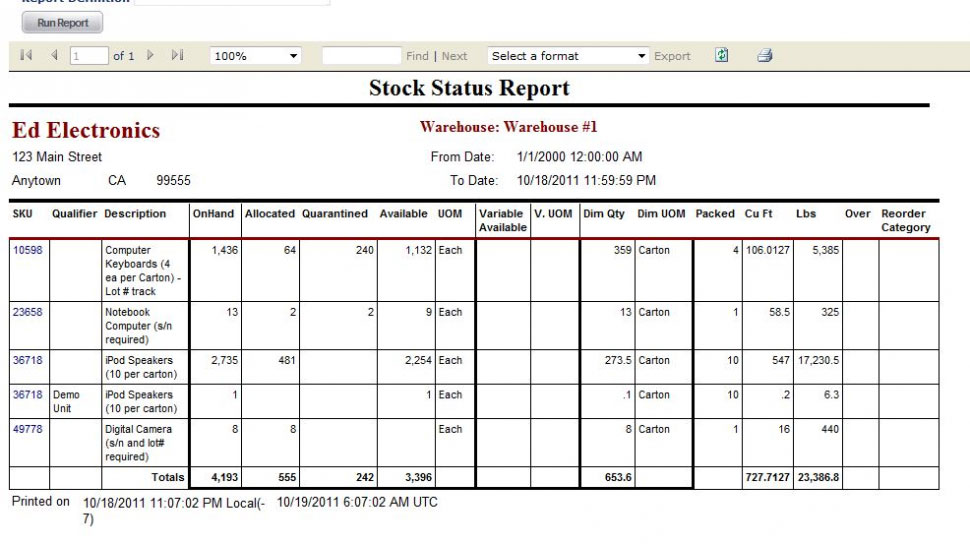
Inventory reports in 3PL Warehouse Manager
Common Features of Order Fulfillment Software
Order fulfillment starts with a smooth quote-to-order-to-cash transition, so the user can deliver a quote to the buyer that is both accurate and achievable, the implication being that customers expect no deviation from the original quote provided to them by the supplier.
Once the quote offer has been accepted, the next step is order fulfillment, which comes with four potential degrees of flexibility:
Made-to-stock (MTS) or build-to-forecast (BTF) | This option is for products that are mass produced in anticipation of future demand and will be used by vendors whose products are in constant demand and never customized. The software would likely suggest recurring billing cycles to meet ongoing sales and purchase needs. |
Build-to-order (BTO) or make-to-order (MTO) | BTO or MTO software is for standardized products that are produced only when ordered, but are never customized in the building process. This requires project-based billing, but simple efficiency, rather than customizability in the ordering process. |
Assemble-to-order (ATO) | The ATO option is for products that are assembled to order from a select number of possible components. ATO allows only as much customization as the available components can deliver, providing the minimum amount of flexibility required in this situation. |
Engineer-to-order (ETO) | The most customizable option, ETO gives the customer more control over the design of the product by engineering production to the customer’s needs. Order fulfillment software would likely assign time-based billing to ETO products and allow much greater overall functionality to meet the required customization. |
Finally, order processing software handles financial transactions through billing management, which prevents billing errors that would otherwise interrupt cash flow. The important thing for suppliers is to limit days sales outstanding (DSO) and obtain real revenue from customers. In this case, order fulfillment systems use accrued or deferred revenue recognition processes to keep track of accounts receivable and which customers have paid for products and services rendered.
Order fulfillment itself is often included as functionality within a slightly-broader order management system.
Evaluating Order Fulfillment Software
Obviously, the type of product(s) and degree of customization required will be the biggest deciding factor in evaluating order fulfillment software. A close second will be quoting billing needs, since quote accuracy and billing cycle requirements are such a key component of order fulfillment.
Consider the following when selecting an order fulfillment software vendor:
Are price quotes a major part of your ordering/fulfillment needs?
To what degree are products manufactured and/or customized to order?
Do you need time-based billing?
Do you mass-produce products in anticipation of future demand?
Market Trends to Understand
Over the past couple of years, there has been increased focus on improving order fulfillment by making the supply chain more efficient. Technological advancements can help companies achieve customer satisfaction with faster processes and ultimately, deliveries.
Here are a few market trends that buyers should keep in mind:
E-fulfillment of orders in the future. Improved channels of shopping for customers means that businesses will ensure faster shipments, accurately predict which products will be popular at what time and increased loyalty from customers.
Mobile devices to check up on orders. Mobile apps have been successful in enhancing the shopping experience. Therefore, many retailers are using mobile apps in their physical and/or online stores. Apps help them promote new products and inform customers about sales. The customer experience is further boosted through heavy discounts and coupons that are redeemable only on the mobile apps. This drives up the usage of the app.
More accurate predictions of seasonal demand and sales. The use of big data and analytics to gauge seasonal demand and sales has resulted in near-accurate predictions. Retailers are using this data to make sure that the staff are trained, inventories stocked, delivery schedules finalized and processes synchronized to ensure smooth operation before the demand soars.
Technology can help to improve operations. Businesses, especially e-commerce companies, track and manage their supplies, volume and transportation using their mobile devices and PCs. These tools have sped up the processes across the supply chain. The adoption of cloud-based software has also helped retailers and suppliers gather data to make business decisions. As cloud security improves, more businesses are expected to adopt cloud solutions.
Expanding warehouses will enable shipping of large items. Over the past few years, the boom in e-commerce has led to increased sales of larger items as well. To meet this demand, businesses need to expand the sizes of their warehouses and anticipate backup options for storage. They also need to utilize local fulfillment centers for faster deliveries, thus, increasing their competitiveness in the market.
Globalization helps to accommodate international demand. With market boundaries transcending national boundaries, international demand will drive speedy deliveries in the order fulfillment industry. Sellers and buyers in different corners of the globe can conduct business without worrying about exaggerated shipping and delivery charges. Various e-commerce companies will offer products from different countries, making it possible for customers to access international markets from the comfort of their homes. The order fulfillment solution should be able to deal with multiple currencies and allow digital payments, such as Bitcoin, so that small players can fairly compete with the bigger, international players.
Inventory should be managed in real time. Supply chains are expected to introduce technology, such as beacons and sensors, to quicken checkouts and restocking. Businesses will need solutions that automatically track on-shelf supplies, restocking, reordering and even manufacturing in real time on a regular basis.
Environment-friendly measures will increase sustainability. Businesses need to have minimal impact on the environment to be sustainable in the long run. They need to adopt green processes that reduce and prevent wastage. They can use order fulfillment software to change their delivery and sourcing practices and become environment friendly.