
Best Construction Categories
Best Facilities Management Categories
Best Human Resources Categories
Best Legal Management Categories
Best Manufacturing Categories
Best Medical Categories
Best Property Management Categories
Get 1-on-1 advice in 15 minutes. It's free.

Josh P.

How AI Can Enhance Manufacturing Quality Control and Assurance for Manufacturers
AI can transform how your team manages quality.
More than seven in ten manufacturers* already use software with quality control tools, yet many still face manual errors, inconsistent standards, and regulatory headaches.
Why it matters: AI automates inspections, tracks defects, and maintains clear audit trails—reducing risk and improving product quality. Plus, using AI will help your quality assurance team address common pain points and choose a solution that delivers lasting results.
TIP BOX
74% of manufacturers currently use manufacturing software that include quality control features.
Source: 2026 Software Buying Trends Survey
Q: Has your organization purchased or is planning to purchase manufacturing software (production scheduling, production tracking, quality control)?
n: 389 manufacturing professionals
Note: The responses 'Purchased more than 12 months ago' and 'Purchased in the past 12 months' were added together to give the total number of respondents currently using manufacturing software.
Why is quality control important in manufacturing?
Here’s a quick overview of the importance of quality control in manufacturing:
1. Reduces manual errors and ensures consistent standards
Manufacturing quality control helps eliminate mistakes that occur during manual inspections. Manual inspections rely heavily on human judgment, which can be affected by fatigue, distractions, or varying levels of experience among inspectors. This can result in inconsistent standards, overlooked defects, and errors in identifying non-conforming products, which may ultimately lead to product recalls and damage a manufacturer’s reputation. By implementing robust quality control processes, manufacturers can reduce the risk of human error, ensure greater consistency, and maintain high product quality.
2. Supports regulatory compliance
Quality control in manufacturing is essential for meeting industry regulations. As compliance requirements become more complex, manufacturers need reliable systems to control processes throughout product manufacturing and testing. However, manual documentation increases the risk of non-compliance and can result in costly penalties.
3. Protects product quality and business outcomes
Effective quality control directly impacts product quality, customer satisfaction, and overall business performance. Defects, delays, and compliance failures can erode customer trust and create opportunities for competitors.
4. Demonstrates industry adoption of technology-driven solutions
Many manufacturers are increasingly investing in quality control software to enhance their production processes. This shift toward technology-driven solutions demonstrates the commitment to improving product quality, reducing errors, and streamlining operations. By integrating advanced software tools, manufacturers can automate inspections, track defects in real time, and ensure compliance with industry standards. These improvements not only help maintain consistent quality but also enable manufacturers to respond more quickly to issues, reduce waste, and optimize overall efficiency.
How to improve quality control in production: AI systems to control processes in the manufacturing and testing of products
Manufacturers seeking to improve quality control in production are increasingly turning to AI-powered systems to control manufacturing and testing processes. These systems offer several advantages:
Automated inspections and real-time monitoring: AI-powered vision systems and sensors can inspect products on the production line with greater speed and accuracy than human inspectors. This reduces the likelihood of defective products reaching customers and enables immediate corrective action. Automated inspections are a cornerstone of quality control software for manufacturing, ensuring consistent standards and minimizing manual intervention.
Defect tracking and predictive analytics: Such tools analyze production data to identify patterns and predict where defects are likely to occur. Manufacturers can address issues before they escalate, improving product quality in manufacturing and reducing waste. Predictive analytics also support preventive maintenance, minimizing unplanned downtime and keeping production lines running smoothly.
Audit trails and compliance documentation: AI-driven software automatically records inspection results, process changes, and corrective actions, creating comprehensive audit trails. This not only streamlines compliance reporting but also ensures that records are always up-to-date and easily accessible during audits.
Solving manufacturing quality control pain points: How AI-powered software drives results
Conversations with over 1,810 manufacturing software buyers last year revealed that manufacturers face a range of pain points when implementing quality control in manufacturing. [1] Here’s a breakdown of those pain points and how AI-powered quality control software for manufacturing tackles these challenges:
Inefficiency
Our data reveals that inefficiency is the top pain point, cited by 38% of manufacturing software buyers. As a workaround, AI automates repetitive quality checks, reducing manual workload and speeding up inspection cycles. Plus, real-time analytics enable rapid identification and resolution of quality issues, ensuring that production stays efficient and on track.
Lack of functionality
It’s a common pain point, mentioned by 34% of buyers in our call notes. Additionally, survey data reveals that features are a top concern for software buyers; 56% rank them as the second-highest priority when searching for new tools, just after security.
AI-powered platforms offer advanced features, such as customizable inspection criteria and automated reporting, to meet the demand for robust systems to control processes in the manufacturing and testing of products.
Outdated systems
Nearly 10% of buyers point to outdated systems as a pain point. AI continuously learns from new data, ensuring quality control processes evolve with changing standards. This adaptability is crucial for maintaining compliance and staying ahead of industry trends.
Poor user experience
Poor user experience is cited by 7% of buyers. Moreover, our survey insights reveal that 48% of manufacturing software buyers look for feedback from real users on ease of use when searching for new tools. In terms of implementation, intuitive interfaces and guided workflows make it easy for staff at all levels to use advanced AI tools, reducing training time and improving adoption.
Missed business opportunities
Seven percent of buyers mention this pain point. As a solution, AI insights reveal process improvements and product trends, enabling innovation and market expansion. Enhanced product quality in manufacturing can also differentiate a brand and attract new customers.
Unreliable performance
Unreliable performance is cited by 6% of buyers. Additionally, our survey insights show that 60% of buyers look for security and reliability when searching for new software. AI-driven systems minimize human error and ensure consistent application of quality standards, building trust with customers and regulators.
High costs
Four percent of buyers cite high costs as a barrier. Automation reduces labor costs and waste, making quality control more cost-effective. Additionally, scalable AI solutions can be tailored to fit the budgets of both small and large manufacturers.
Limited integrations
Limited integrations are cited by 4% of buyers. Moreover, our survey insights show that 44% of manufacturing software buyers focus on integrations when considering new software. Third-party integrations and application programming interfaces (APIs) are also a top security concern for manufacturing software buyers. AI platforms integrate with enterprise resource planning (ERP), MES, and compliance systems, streamlining workflows. However, manufacturers must ensure integrations do not compromise security.
Scalability limitations
A small proportion of buyers (2%) mention scalability limitations. AI solutions are adaptable to manufacturers of any size, supporting growth and changing needs. Scalable architecture ensures that software investments remain valuable as the business expands.
How to choose the best quality control software for manufacturing
When selecting quality control software for manufacturing, manufacturers should focus on solutions that directly address their production needs and compliance requirements. Our survey data shows that 57% of buyers define must-have features and budget before purchasing, highlighting the need for a thoughtful selection process.
TIP BOX
57% of manufacturing software buyers define budget and must-have features during the tool selection process.
Source: 2026 Software Buying Trends Survey
Q: Which of the following steps does your organization formally perform during the software selection process (meaning there is a methodical and documented approach).
n: 389 manufacturing professionals
Key considerations include:
Security: Protects sensitive production data and ensures compliance with industry regulations through robust security protocols and access controls.
Features: Delivers comprehensive functionality, such as automated inspections, real-time analytics, and audit trails, to streamline quality control and process management.
Value for money: Maximizes return on investment (ROI) by increasing efficiency, reducing errors, and minimizing downtime, all while supporting your business goals.
Pricing: Provides transparent and flexible pricing options so manufacturers can select a solution that fits their budget without sacrificing critical capabilities.
Ease of use: Offers an intuitive design that makes it easy for staff at all skill levels to use the software effectively, speeding up adoption and reducing training time.
Customer satisfaction: Ensures reliable support and a positive user experience, as demonstrated by strong customer reviews and responsive service teams.
Integration capabilities: Allows seamless connection with existing ERP, MES, and compliance systems, facilitating smooth data flow and unified control over all manufacturing quality control activities.
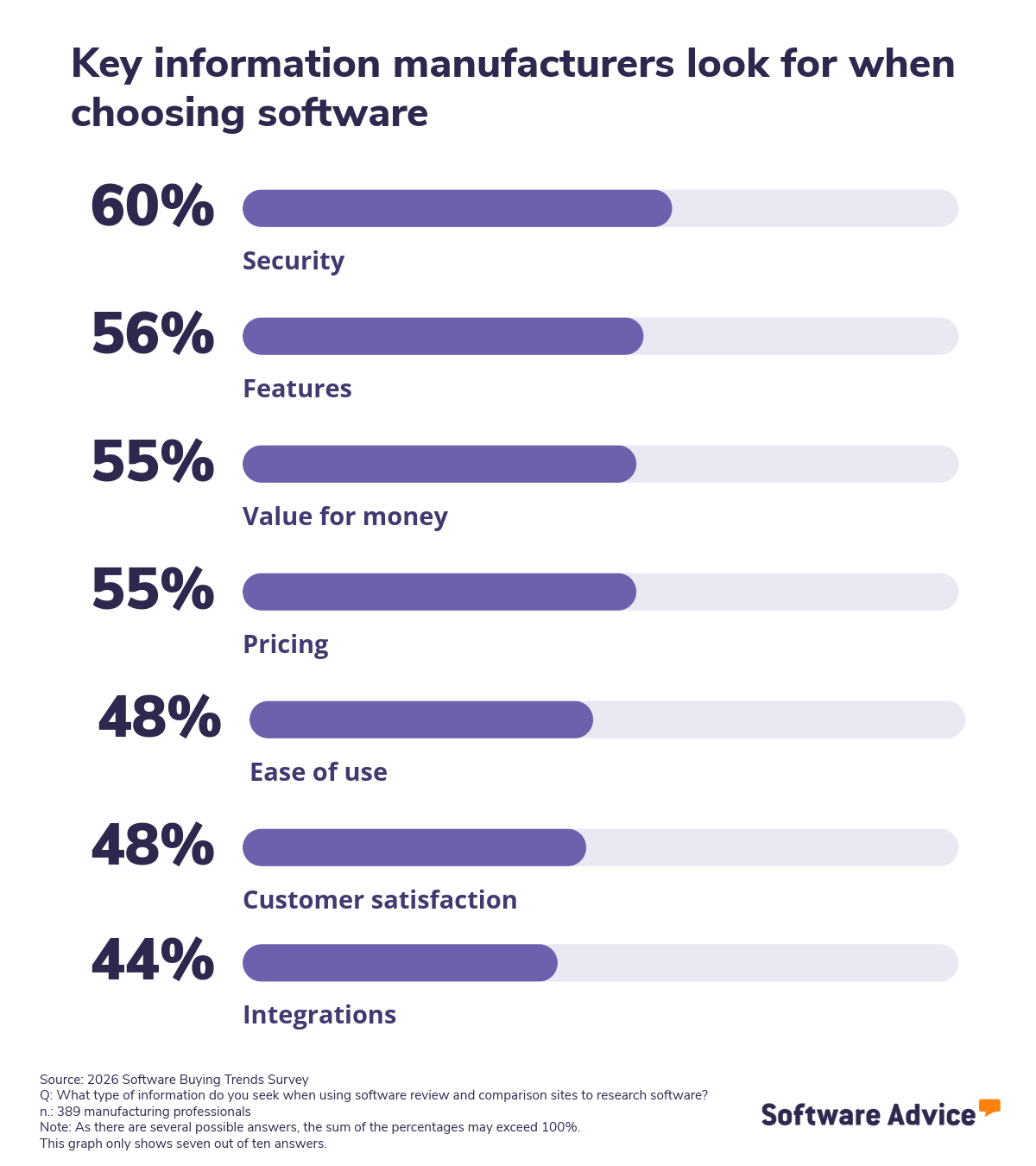
When evaluating quality control software for manufacturing, prioritize platforms that deliver the right features, support your business goals, and meet industry regulations. The right system to control processes in the manufacturing and testing of products will help you improve quality control in production, enhance product quality in manufacturing, and maintain a competitive advantage.
The impact of AI on manufacturing quality control: Key takeaways
AI-powered quality control software for manufacturing streamlines processes, reduces errors, and ensures regulatory compliance. Our survey data confirms manufacturers’ demand for efficient, reliable, and feature-rich systems to control processes in the manufacturing and testing of products. Choosing the right solution helps manufacturers improve quality control in production, enhance product quality in manufacturing, and gain a competitive edge.
Survey methodology
*Software Advice 2026 Software Buying Trends survey was conducted online in August 2025 among 3,385 respondents in Australia (n=281), Brazil (n=278), Canada (n=293), France (n=283), Germany (n=279), India (n=260), Italy (n=263), Mexico (n=288), Spain (n=273), the U.K. (n=299), and the U.S. (n=588), at businesses across multiple industries (including 389 respondents in manufacturing roles), ages (1 year in business or longer), and sizes (5 or more employees). Business sizes represented in the survey include: 1,676 small (5-249 full-time employees), 822 midsize (250-999), and 887 enterprise (1,000+). The goal of this study was to understand the timelines, organizational challenges, research behaviors, and adoption processes of business software buyers. Respondents were screened to ensure their involvement in business software purchasing decisions.
Sources
Software Advice advisor call notes: Findings are based on data from telephonic conversations that Software Advice’s advisor team had with small-to-midsize businesses seeking manufacturing tools. For this report, we analyzed phone interactions from February 20, 2025, to February 20, 2026. Read the complete methodology.