
Best Construction Categories
Best Facilities Management Categories
Best Human Resources Categories
Best Legal Management Categories
Best Manufacturing Categories
Best Medical Categories
Best Property Management Categories
Get 1-on-1 advice in 15 minutes. It's free.

Josh P.

Avoid Pitfalls During Your Dental Software Implementation by Learning From Buyers With Experience
Juggling appointments, managing patient records, and ensuring accurate billing can overwhelm even the most organized dental practices. A dedicated dental solution tackles these processes head-on by automating day-to-day practice management tasks, such as patient and inventory management, freeing up valuable time for dentists and staff to focus on providing exceptional patient care.
However, to make the right purchase, it is crucial to know what features you need, the average software price, and the common challenges faced when purchasing dental software.
Each year, Software Advice's advisors speak with thousands of software buyers evaluating new dental software for their businesses. We've gathered insights from these conversations to help small businesses understand the budget requirements, feature needs, and pain points of current users to choose the best tool for their needs.
Key insights:
Software buyers from the dental industry prioritize EHR and charting functionality during purchase, while those using the software currently consider appointment management as the top priority in dental practice management software.
Most businesses either have a system in place for their day-to-day dental practice management operations or rely on manual methods for managing their practices. Some buyers do not have a system in place at all.
Switching to dental software is driven by the need for functional sufficiency, efficiency, and new business opportunities.
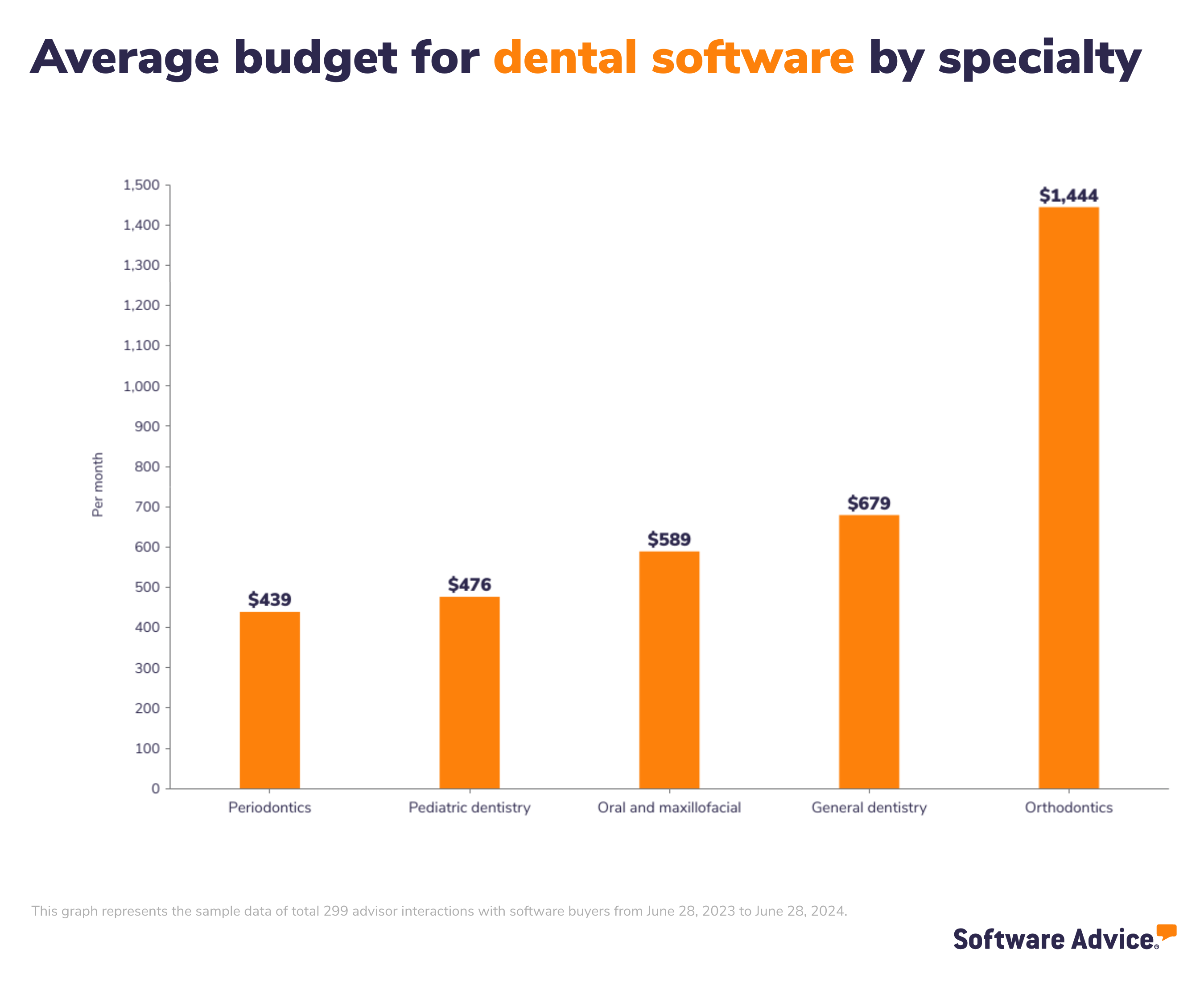
The top five industries investing in dental software allocate between $439 to $1444 per month, with an overall buyer average of $688 per month.
Prospective buyers and current users prioritize different features
After analyzing thousands of vacation rental software reviews available on Software Advice, our findings revealed a discrepancy between the priorities of dental software buyers and users.
Thirty-three percent of current software users rate appointment management as the most essential feature in dental software, compared to buyers who are majorly looking for EHR and clinical charting functionality in a dental management tool.
These findings indicate that businesses already using dental management software find immense value in appointment management functionality. The feature allows dental staff to book, reschedule, and cancel appointments while providing real-time availability updates. This feature often includes automated reminders via email or text messages to reduce no-shows and patient self-scheduling capabilities for easy appointment scheduling.
EHR and clinical charting, on the other hand, are features that enhance the efficiency and accuracy of patient care. While the EHR feature digitizes and stores comprehensive patient records, including medical history and treatment plans, clinical charting allows dentists to document clinical notes, treatment procedures, and patient progress directly within the software.
Pro tip
Consider a dental platform that offers an online portal to help patients view upcoming appointments, review treatment plans, access medical records, and make payments, all in one place.
Current pain points for dental software buyers
When our advisors ask buyers what methods they are currently using, they find that more than 50% have a system in place to manage their day-to-day dental operations. However, a significant portion of the buyers also rely on manual methods or do not have any system in place. The findings revealed:
Around 14% of buyers use manual methods, such as pen-and-paper charting and manual scheduling for their day-to-day operation workflows.
Another 14% of buyers do not have any system in place to automate their dental practice management processes.
These discussions shed light on businesses' real-life challenges with their existing methods. These included limited functionality (21%), inefficiency (20%), and new business opportunities (18%).
Limited feature options: Manual methods of dental practice management are time-consuming and prone to human errors. While they have served dental practices for a long time, they often fall short compared to modern tools. These methods lack the necessary features, such as automated appointment reminders, dental charting, treatment planning tools, patient portals, and integration with third-party tools, to meet the unique requirements of dental practices.
Inefficiency: Traditional methods of dental practice management, such as paper charts and appointment books, become inconvenient as the practice grows. Adding new patients or procedures may mean more paper and more time spent managing it. Moreover, the information becomes siloed across different physical locations, making it difficult to maintain a centralized view of the practice. These methods follow a one-size-fits-all approach, which does not cater to individual patient needs.
New business opportunities: Compared to manual methods, dental software offers specialization, comprehensive functionality, customization options, integration capabilities, support, and unique features that are tailored to the specific needs of dental practices. These tools provide valuable data on patient demographics, treatment trends, and practice performance that can be analyzed to identify areas for improvement and new avenues for growth.
Reasons for switching to a dedicated dental software
Compared to the existing methods used by professionals, a dedicated dental software solution offers the following benefits:
Task automation: The system automates several repetitive tasks and workflows, such as appointment scheduling, patient reminders, billing and invoicing, patient record management, and insurance claims processing. This automation reduces manual intervention in the processes and saves time. Additionally, it helps users with patient communication, including follow-up care instructions and personalized marketing messages to enhance patient engagement, satisfaction, and retention.
Scalability: A dedicated dental practice management system is designed to accommodate growth and increased patient volumes without a corresponding increase in administrative workload. As the practice expands, the software handles more appointments, patient records, and billing transactions with minimal human intervention. Compared to manual methods, a dedicated dental platform offers flexibility to scale efficiently while maintaining high standards of care and operational efficiency.
Better functionality: As compared to manual methods, dental software offers integrated and advanced features that simplify various aspects of practice management. These include billing and insurance claim processing, patient record management, clinical charting, inventory management, and reporting. Additionally, these allow for customization of user interfaces, forms, invoice templates, and treatment plans that help businesses tailor the system to their specific needs and preferences.
Enhanced data security: Compared to physical records and documents that are vulnerable to theft, loss, or unauthorized access, a dedicated dental software solution offers various security features, such as data encryption and secure backups, protecting sensitive patient information. It also offers compliance with healthcare regulations, such as the Health Insurance Portability and Accountability Act (HIPAA) to safeguard medical records and personal health information (PHI).
Pro tip
Shortlist a dental practice management solution with mobile access to help dental professionals manage appointments, access patient records, view clinical charts, and send reminders even on the go.
Average budget for dental software buyers
The budget for purchasing dental software varies based on factors such as the practice size and complexity, deployment model, number of users, customization level, and the required functionality.
However, the average budget for purchasing dental software was approximately $688 per month.
The chart below highlights the average buyer budget per month for the top five specialties interested in dental practice management software.
Use cases for dental software
Based on our advisors’ interactions, these are the top five specialties using a dental practice management tool for different use cases:
General dentistry practices need dental practice management solutions to simplify administrative tasks and enhance patient care. Their specific needs may include patient scheduling, billing and claims processing, and clinical charting. Therefore, they may look for features such as integrated appointment scheduling, EHR functionalities, and financial management tools in a dental platform.
Pediatric dentistry practices require a dental solution tailored to their needs, which focuses heavily on child-friendly patient management and parent engagement. Specific features important to these practices may include age-specific clinical templates, progress tracking, behavioral management tools, and online communication portals.
Oral and maxillofacial surgery practices rely on specialized dental software to manage complex procedures and patient care. Their specific needs may include comprehensive imaging capabilities for 3D scans, integration with medical records, and robust treatment planning modules tailored to oral surgeries.
Orthodontics practices focus heavily on treatment planning. These often prioritize software that supports precise treatment planning and monitoring of orthodontics appliances. Key features for these practices may include treatment progress tracking, case presentation tools, and advanced treatment planning.
Periodontics practices specialize in managing the health of gums and jawbones. These practices often need a dental management tool with features such as treatment planning tools and periodontal risk assessment modules to enhance clinical efficiency and ensure proactive management of periodontal conditions through personalized treatment plans.
Looking for more resources?
Click here to check out our dental software directory, FrontRunners Report, and Buyers Guide, and compare hundreds of products.
Methodology
Software buyers analysis methodology
Findings are based on data from conversations that Software Advice’s advisor team has daily with software buyers seeking guidance on purchase decisions. The data used to create this report is based on interactions with small-to-midsize businesses seeking dental tools. For this report, we analyzed approximately 250+ phone interactions from June 28, 2023 to June 28, 2024.
The findings of this report represent buyers who contacted Software Advice and may not be indicative of the market as a whole. Data points are rounded to the nearest whole number.