
Best Construction Categories
Best Facilities Management Categories
Best Human Resources Categories
Best Legal Management Categories
Best Manufacturing Categories
Best Medical Categories
Best Property Management Categories
Get 1-on-1 advice in 15 minutes. It's free.

Josh P.

The Future of Telehealth: AI, Technology Choices, and Barriers to Scale
Thanks to the rapid uptick in use during the pandemic, and the continued value patients and providers see from it, telehealth has truly become a standard part of our care delivery system. Not as the primary channel, but as a durable complement. For many providers, the next phase is less about adoption of this technology, and more about perfecting the fit: finding the right tools, designing the right workflows, and ensuring equitable access at scale.
How do we know this? Software Advice recently published our annual Medical Software Trends survey of 400 U.S. physicians, and telemedicine was a key trend in our findings.
Here’s what we learned about telehealth trends:
Telemedicine adoption is widespread: 71% of practices use telemedicine today, while another 13% plan to adopt it in the next 12 months.
Virtual visits are now routine: Virtual care now accounts for 17% of monthly appointments on average; only 7% of practices report conducting absolutely no virtual visits.
Very few practices are opting out: Remarkably, just 17% of practices say they do not currently use telemedicine and have no plans to adopt it.
This tells us that telehealth isn’t just a pandemic artifact—it’s a baseline capacity. The strategic question is optimization, not if or when.
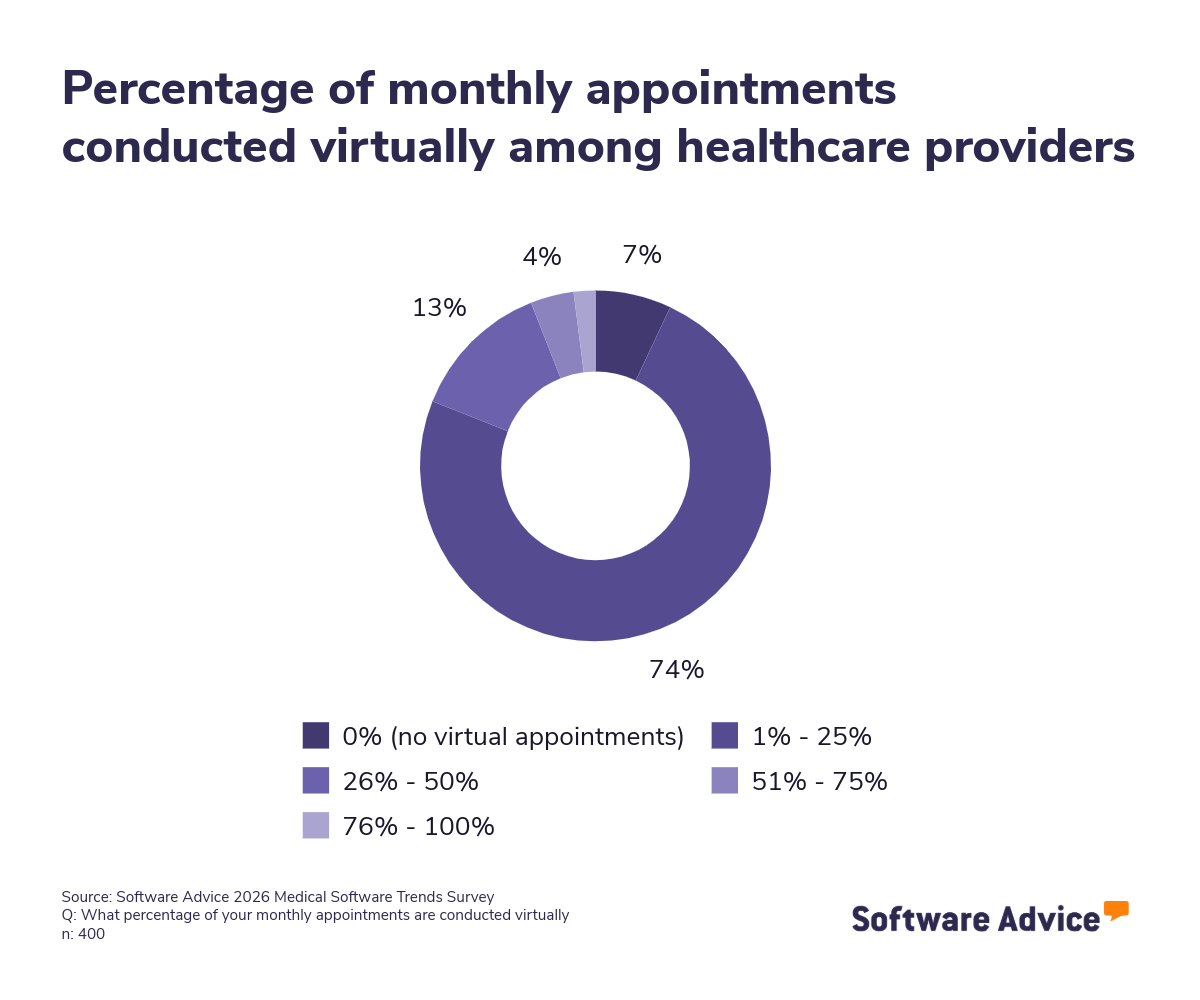
Why you should read on: In this report, we explore how nearly three‑quarters of U.S. practices use telemedicine today. We also examine the challenges teams face with telehealth tools and workflows. Finally, we share recommendations for getting more value from these platforms now and in the future as AI becomes more embedded in remote care delivery.
Ensure secure virtual appointments by choosing the right telehealth tools
Telehealth delivery depends on more than just video calls—it’s a mix of tools that vary widely across practices. Among those conducting virtual visits, 54% use healthcare-specific video conferencing platforms such as Doxy.me or Amwell. Yet nearly as many rely on general-purpose tools like Zoom or Microsoft Teams (40%), and 41% still use phone calls for remote consultations.
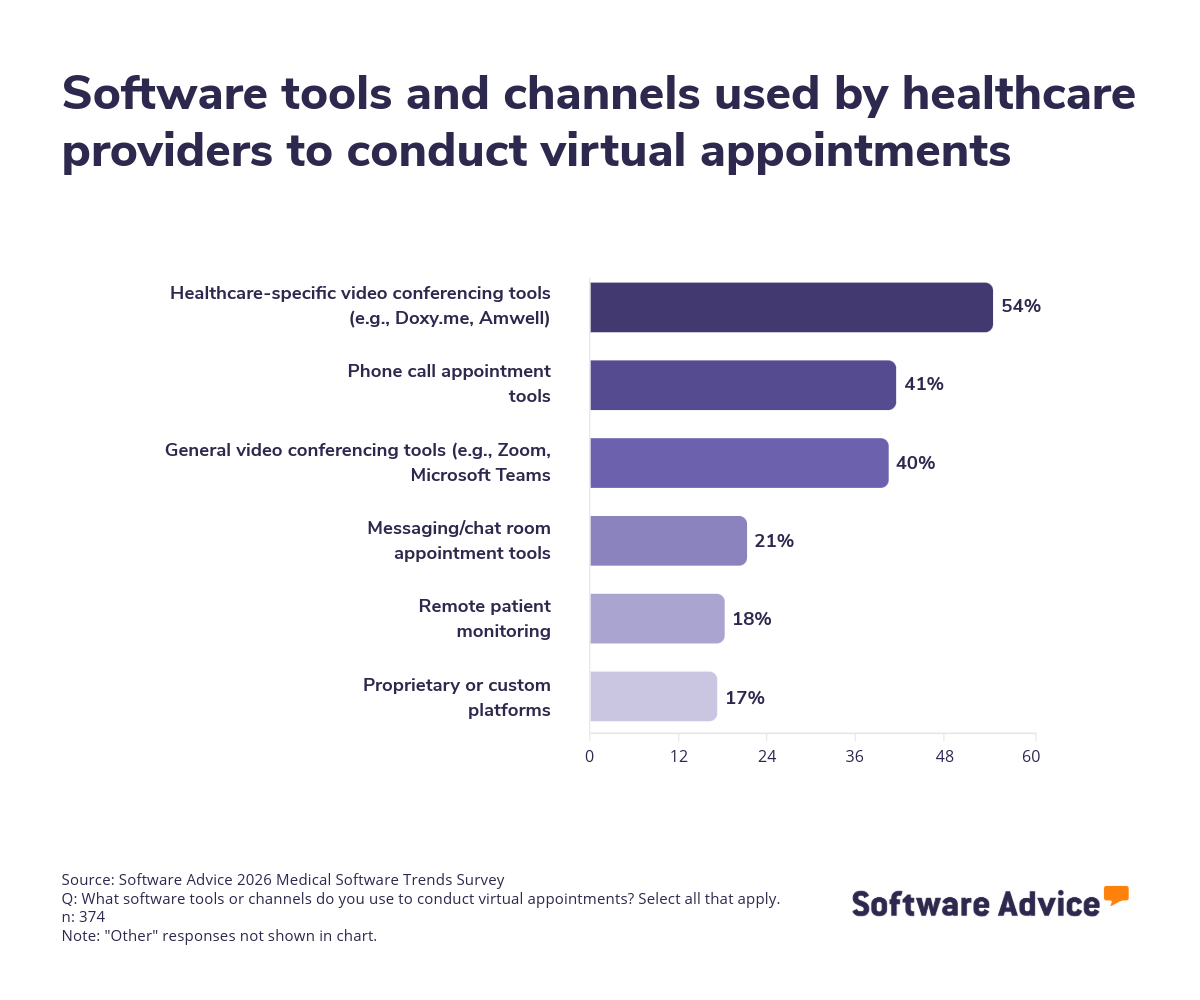
Why this matters: Reliance on non-specialized solutions indicates an alarming gap in telehealth optimization. While general video platforms offer convenience, they often lack features critical for compliance, integration, and patient engagement—such as secure data exchange or embedded clinical workflows. Practices using these tools may face challenges with documentation, billing, and interoperability with electronic health records (EHRs).
The takeaway: Technology choice is not just about enabling virtual visits; it’s about aligning tools with operational needs. As telehealth becomes a permanent fixture, practices should evaluate whether their current tech mix supports scalability, regulatory compliance, and patient experience. Vendors offering integrated, healthcare-specific platforms have an opportunity to differentiate by addressing these gaps.
How to overcome barriers to telehealth growth and scalability
While adoption is strong, scaling telehealth beyond its current footprint faces significant hurdles.
The most cited challenge is difficulty conducting physical exams remotely (52%), a limitation inherent to virtual care. Close behind are patient access issues (46%)—including unreliable internet or lack of devices—and patient discomfort with technology (44%), which can undermine engagement and outcomes.
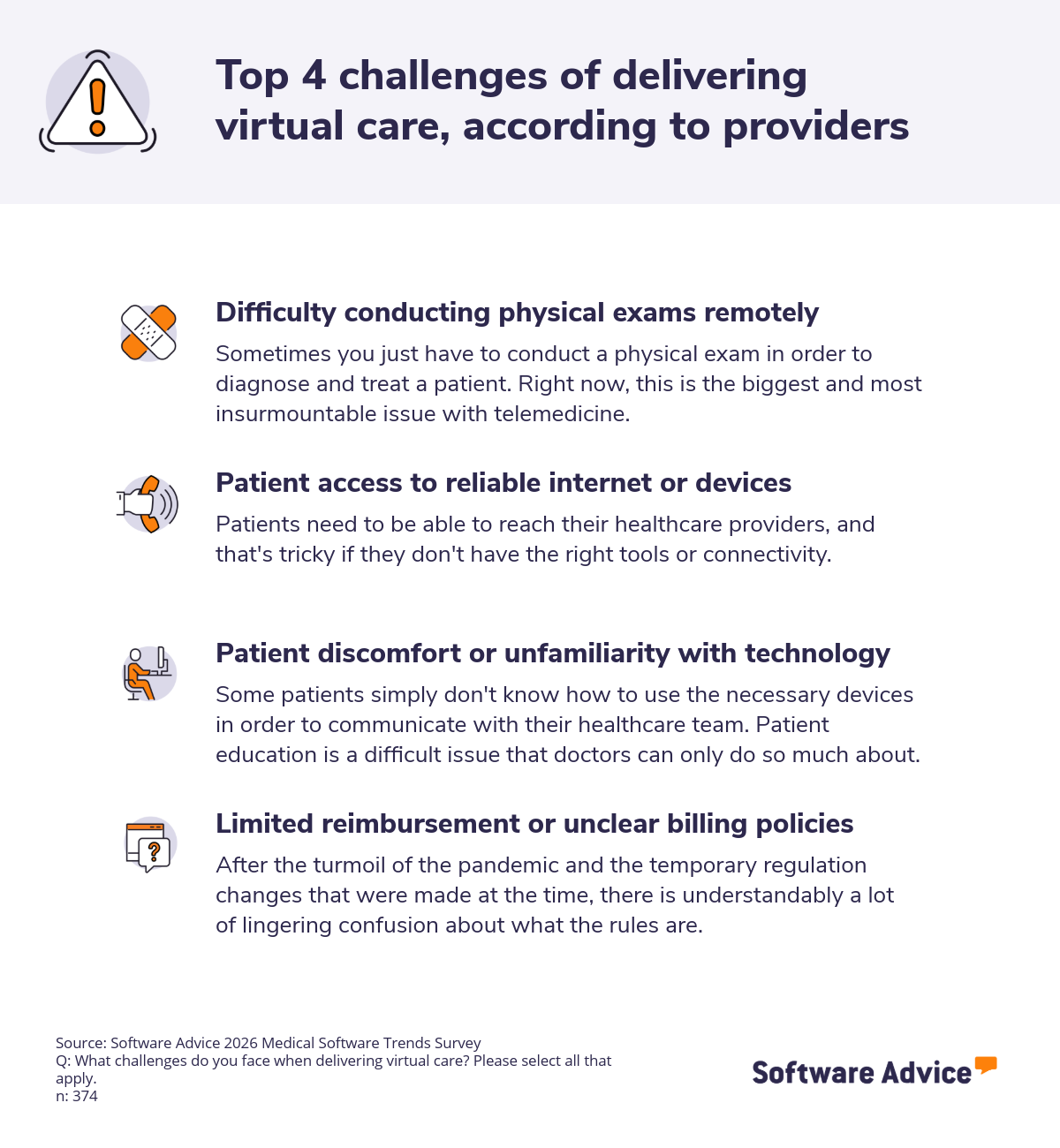
Financial and operational barriers also weigh heavily. Limited reimbursement or unclear billing policies affect 37% of practices, creating uncertainty around revenue models. Plus, integration challenges persist, with 30% reporting issues connecting telehealth platforms to electronic health records (EHRs). These gaps complicate documentation and continuity of care.
Regulatory and workforce factors add complexity. About a quarter cite licensing restrictions across state lines, while similar shares point to staff training needs and workflow adaptation (25%) and data privacy concerns (25%). These findings underscore that telehealth’s future isn’t just about technology—it’s about infrastructure, policy, and patient readiness combined.
For practices aiming to expand virtual care, addressing these barriers will require a multi-pronged approach.
How small practices can optimize telehealth
For smaller and independent practices, telehealth adoption often comes with resource constraints and operational complexity. Addressing these proactively can help smaller organizations maximize telehealth’s value without overextending budgets.
What you can do to overcome these barriers:
Improve patient digital access and literacy: Offer device loan programs or partner with community organizations to expand broadband access. Provide simple tutorials for patients unfamiliar with telehealth platforms. Offer clear instructions for virtual visits and consider offering tech support for patients unfamiliar with telehealth.
Invest in secure and integrated platforms: Choose solutions that embed compliance features and integrate seamlessly with EHRs to reduce workflow friction and data loss. Avoid general-purpose video tools for long-term use; healthcare-specific platforms offer built-in HIPAA compliance and better support for clinical workflows.
Advocate for reimbursement clarity: Engage with payers and professional associations to stay informed on evolving billing policies and explore alternative payment models.
Address regulatory and licensing hurdles: Monitor state-specific telehealth laws and consider multi-state licensure if expanding virtual care across regions.
Train staff for virtual workflows: Incorporate telehealth protocols into onboarding and continuing education to ensure smooth adoption and a good patient experience.
These steps can help smaller practices overcome common barriers while positioning telehealth as a sustainable part of care delivery—not just a convenience.
The future of telehealth: AI integration and remote patient care
Telehealth’s next evolution will be shaped by artificial intelligence (AI). While virtual visits have stabilized as a core service, AI promises to enhance efficiency and personalization.
Why this matters: Among practices already using AI tools, 30% leverage virtual assistants or chatbots for patient engagement—streamlining intake, reminders, and follow-up. Predictive analytics for remote monitoring is also gaining traction, supporting proactive care for chronic conditions.
Looking ahead: Providers expect AI to make its biggest impact in remote patient monitoring and wearables, ranked third among anticipated AI use cases for the next 12 months. This convergence of telehealth and AI could enable continuous data collection, early intervention, and tailored treatment plans, all without requiring in-person visits.
For practices, the opportunity lies in pairing telehealth platforms with AI-driven features that automate documentation, triage, and scheduling. These capabilities not only reduce administrative burden but also improve the patient experience by making virtual care more responsive and accessible. However, as mentioned previously, success will depend on addressing challenges such as data privacy, integration with EHRs, and staff training to manage AI-enabled workflows.
The bottom line: Telehealth is no longer just about video calls—it’s becoming a digitally intelligent care model.
Prepare your practice for the next chapter in telehealth
The future of telehealth will be defined by smarter workflows, better patient access, and platforms that deliver both compliance and convenience. As practices refine technology choices and address barriers to scale, the focus shifts to optimization and integration with emerging tools like AI.
Ready to find the right telehealth solution for your practice?
Explore more insights on Software Advice, like the full report on our 2026 Medical Software Trends Survey, and connect with one of our trusted advisors for personalized guidance on selecting tools that fit your needs and budget.