
Best Construction Categories
Best Facilities Management Categories
Best Human Resources Categories
Best Legal Management Categories
Best Manufacturing Categories
Best Medical Categories
Best Property Management Categories
Get 1-on-1 advice in 15 minutes. It's free.

Josh P.

5 Legal Technology Trends to Watch in 2026 and Beyond
Legal technology trends have shifted from exploratory to operational. Law firms are adopting artificial intelligence (AI), rethinking billing models, and tightening security controls while competition intensifies from platforms and startups.
The upside is clear: More efficient legal operations and client‑friendly outcomes.
The risk is equally real: Losing competitiveness or creating security gaps that affect trust and performance.
This article distills the five trends from our Software Advice's 2026 Legal Software Buying Trends report that matter most this year—and how law firms can act with confidence in this rapidly evolving technology landscape.
Legal tech trends #1: AI as a foundational presence in the legal workflows
AI has shifted from a simple add‑on to a core expectation inside legal software. Our study on legal tech trends shows that most firms already operate software that includes AI features, and a significant portion actively use them as part of their legal workflows.
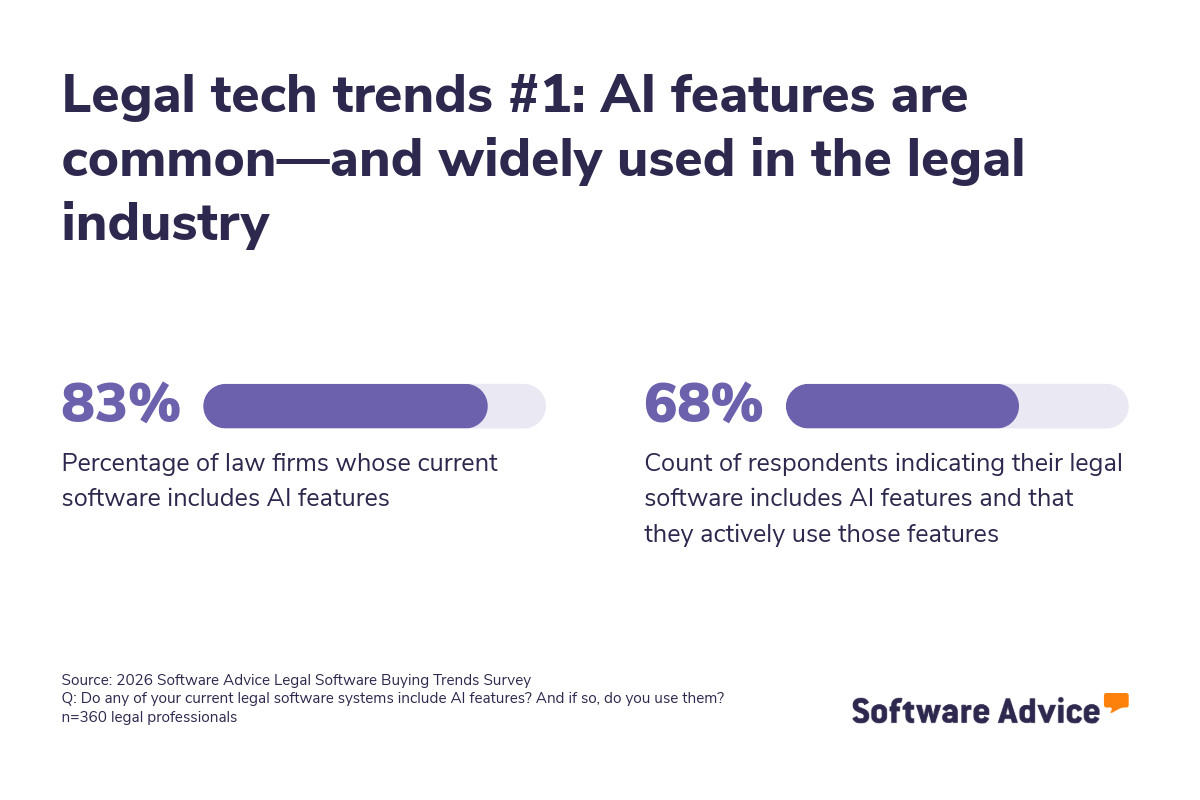
This reflects a broader market transition: AI is no longer treated as “future tech” but as an operational tool that supports many routine tasks, such as legal research, document drafting, summarization, calendaring, and contract management.
Why this trend matters: Legal platforms are embedding AI more deeply into daily work. Firms that postpone adoption may fall behind peers on speed, pricing, client satisfaction, and workload management.
How to act on this trend
Run a focused AI gap assessment: Identify workflows with repetitive or time‑consuming tasks and define the ‘must‑have’ AI features that could support automation.
Shortlist quickly: Select 3–5 vendors and set a 90‑day decision window. Use free trials and structured demos to evaluate fit for your legal workflow.
Leverage peer evidence: Use B2B software review platforms such as Software Advice to access verified buyer feedback and understand vendor performance during implementation, training, and ongoing use.
Contract with guardrails: Negotiate data‑handling commitments, including assurances that client data will not be used to train AI models, and define clear SLAs for migration and support.
Train your legal staff for tech adoption: Create guidelines for appropriate AI use cases. Offer short, scenario‑based training sessions and set escalation paths for reviewing uncertain or high‑risk AI outputs.
Legal tech trends #2: Tech-savvy legal professionals rise to the forefront
The legal profession is entering a skills transition where digital proficiency directly influences professional differentiation. Attorneys increasingly need to understand how AI works, how to verify its outputs, and how to interpret data generated by modern systems.
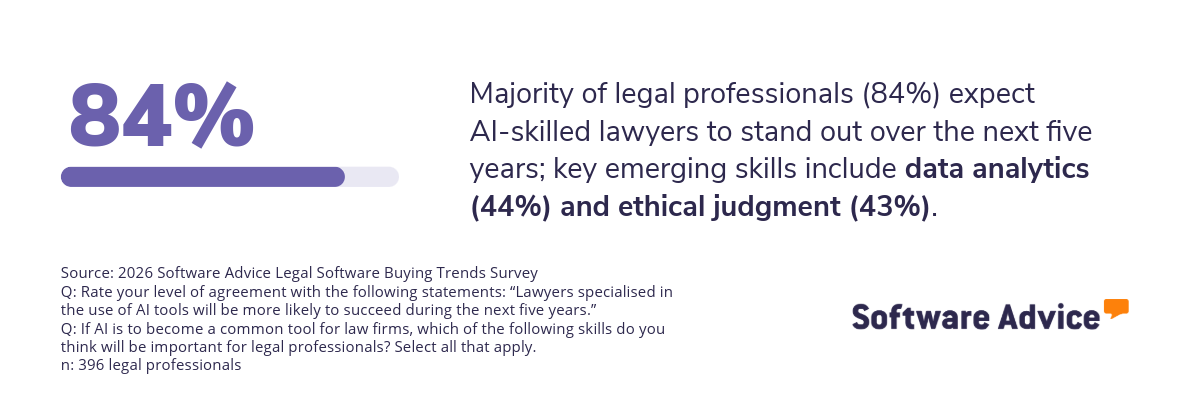
Software Advice’s 2026 legal‑tech trends report shows that many legal professionals expect lawyers with AI‑specific skills to stand out, and data management is becoming a core requirement as firms handle growing volumes of digital information.
Why this trend matters: This shift suggests that future competitiveness will rely not only on legal knowledge and core competencies—such as strategic advocacy or emotional intelligence—but also on the ability to guide AI tools, assess risk, and integrate technology into day‑to‑day practice.
How to act on this trend
Invest in upskilling: Offer internal training on AI review checkpoints, effective prompting, secure document handling, and clear boundaries for using client data in AI tools.
Hire for adaptability: Evaluate candidates on their ability to learn legal technology quickly, apply sound judgment when handling data, and interpret basic performance metrics.
Promote AI literacy: Publish a plain‑language AI handbook that outlines capabilities, limitations, bias risks, and appropriate use cases. Include examples of acceptable prompts and prohibited inputs such as sensitive client information.
Encourage responsible innovation: Direct professionals to use only company‑approved tools and motivate them to test new approaches as long as they follow internal guidance and documentation.
Strengthen foundational legal skills: Continue reinforcing core capabilities such as advanced legal reasoning, strategic judgment, and client communication—competencies that remain essential regardless of technological change.
Legal tech trends #3: Security stands out as a top priority in tech purchases
Our study shows that security considerations influence legal technology purchasing more than any other factor. This is driven by the nature of the information law firms manage—highly sensitive, regulated, and privileged data—which makes the sector a frequent target for cyberattacks.
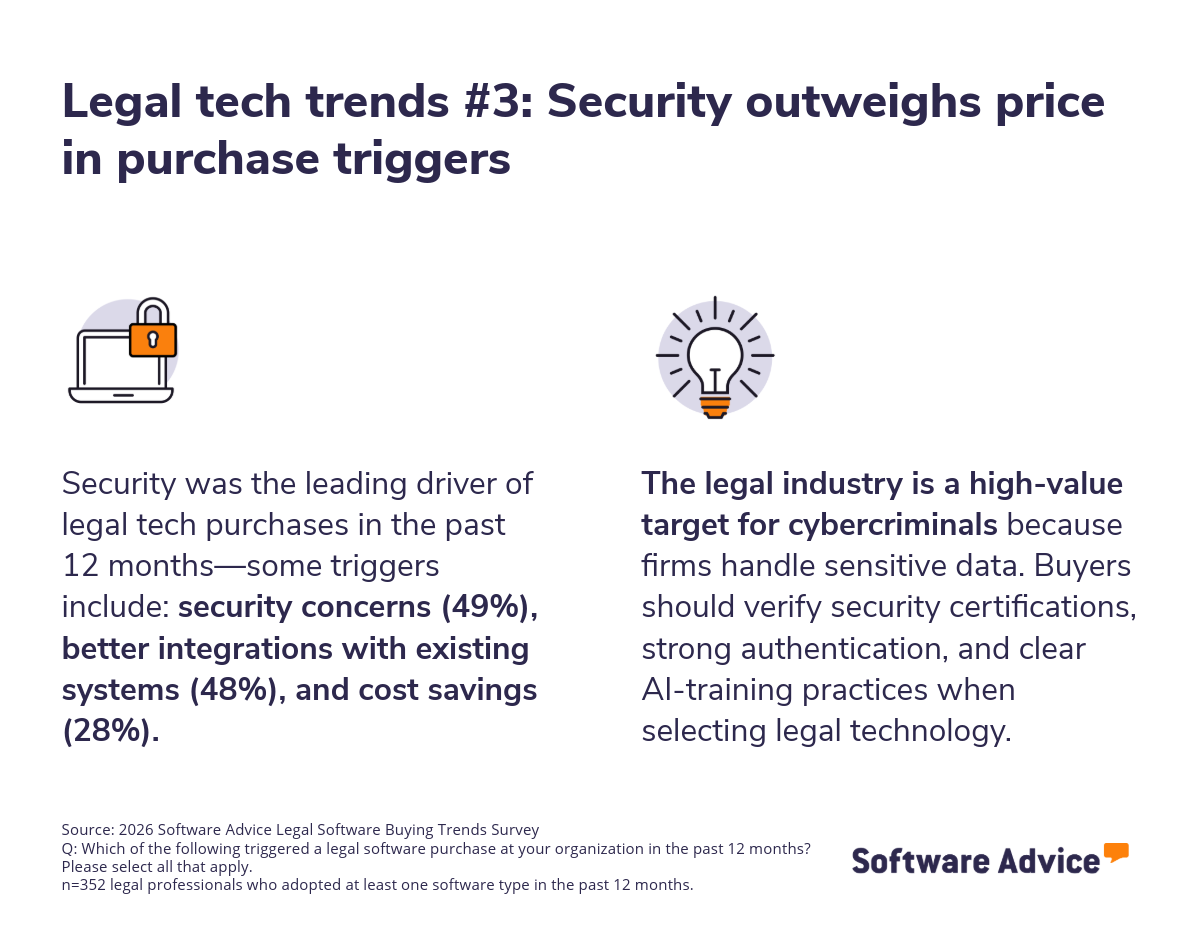
Recent data‑leak incidents involving law‑firm client information have increased scrutiny of legal software security, data access controls, and AI‑model training policies. [1] As firms compare tools, confidentiality, encryption, authentication, and vendor transparency often outweigh cost.
Why this trend matters: Law firms now approach technology decisions as part of a broader risk‑management strategy rather than routine operational upgrades. A data leak or other cyber incident can undermine client trust and negatively impact a firm’s reputation, making security a core driver of modern legal tech adoption.
How to act on this trend
Verify certifications: Ask vendors to provide evidence of their security standards, such as SOC 2 Type II or ISO 27001 certifications. If you work in a health‑related practice area, confirm that the vendor supports HIPAA‑aligned controls.
Demand guarantees: Require contractual assurances from your chosen vendor that the client-data handled by your firm will not be used to train third‑party or public AI models.
Enforce strong authentication: Reduce reliance on passwords by enabling multi‑factor authentication (MFA). When possible, use phishing‑resistant methods such as hardware security keys or platform‑level biometrics, and ensure access permissions are granular and aligned with each legal role’s responsibilities.
Probe AI training: Ask vendors to explain how their AI models are trained, including data sources, human review processes, and the safeguards they use to mitigate bias—especially important for sensitive practice areas.
Assess incident response: Review breach‑notification timelines, documented incident‑response procedures, and previous transparency around security events. For high‑risk matters, consider running tabletop exercises with the vendor to assess preparedness.
Prefer premium software offerings: Free or consumer‑tier AI tools often reserve the right to train on user inputs. Favor enterprise or legal‑specific platforms that provide clear commitments regarding confidentiality, data use, and client‑data protection.
Legal tech trends #4: Billing models are shifting away from hourly-first
Client expectations for price clarity and efficiency are pushing firms to reassess traditional billing structures. Our study shows that, while hourly billing remains the dominant model, growing portions of firms are adopting Alternative Fee Arrangements (AFA) that reflect business outcomes, predictability, or packaged services.
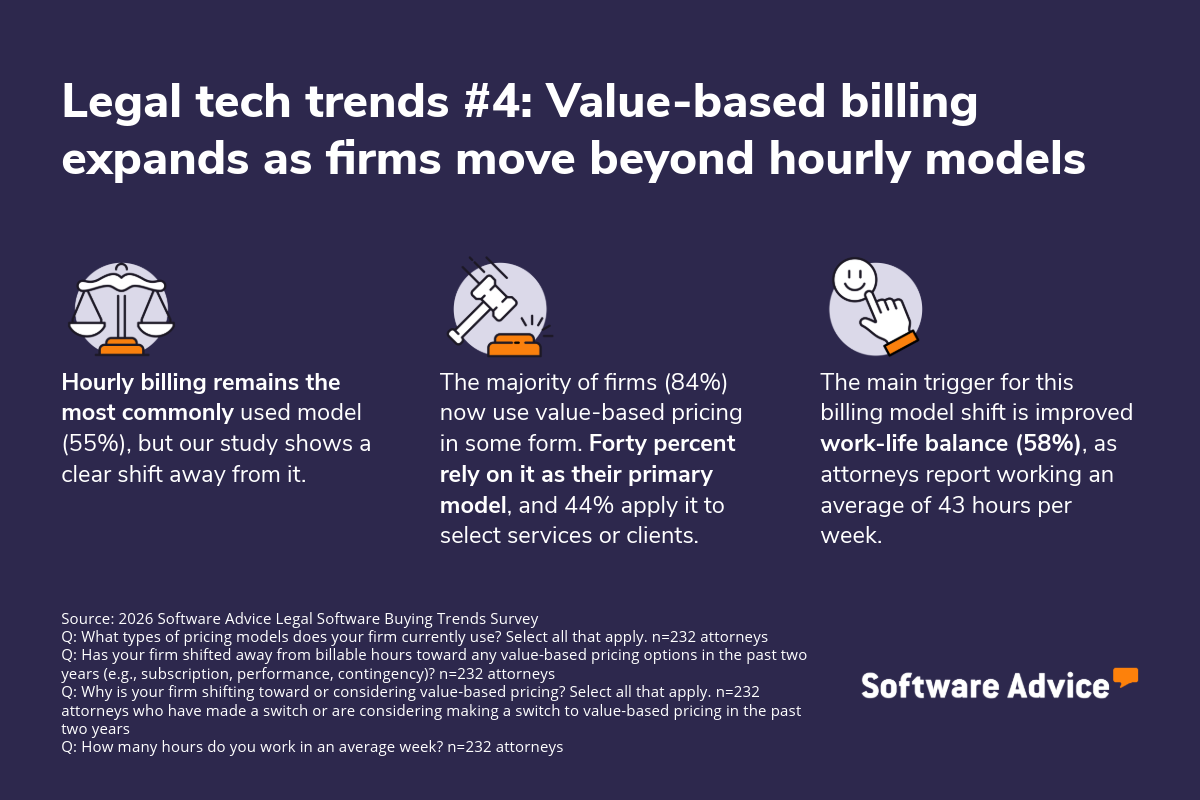
Advancements in automation and generative AI (GenAI) further influence this trend by reducing the time required for research, drafting, and document review—making hours‑based pricing less aligned with the value clients perceive.
Why this trend matters: As law firm's operational tasks become faster and more standardized, many firms are experimenting with flat fees, subscriptions, and outcome‑based arrangements to meet evolving client preferences and remain competitive.
How to act on this trend
Use technology as an ally. Adopt legal tools such as legal calendaring software, contact management software , and document management software to reduce time spent on repetitive tasks, allowing your team to focus on higher-value work.
Standardize your legal workflow. Create repeatable processes with predictable cycle times. Standardization makes it easier to scope work accurately and offer models like flat fees or subscriptions.
Rethink how you measure deliverables. Shift performance metrics away from time spent and toward outputs such as completed work, client satisfaction, and risk reduction. This helps your legal staff understand how value‑based pricing aligns with actual outcomes rather than hourly totals.
Use data to refine pricing. Track matter duration, revision rates, and client feedback to continuously adjust your pricing models. Over time, this develops into predictable, transparent pricing frameworks that support long‑term client relationships.
Educate your clients. Communicate why pricing is changing, what they can expect, and how technology enhances efficiency and consistency. Clear explanations help clients understand the benefits of value‑based alternatives and reduce uncertainty during the transition.
Legal tech trends #5: Law firms are growing despite tech uncertainty
The competitive landscape for legal services is widening as AI platforms, online legal service providers, and legal tech startups introduce alternate ways for clients to solve legal problems. Despite this, according to our legal technology trends report, law firms note stable or increasing client volumes, suggesting the market is growing rather than contracting.
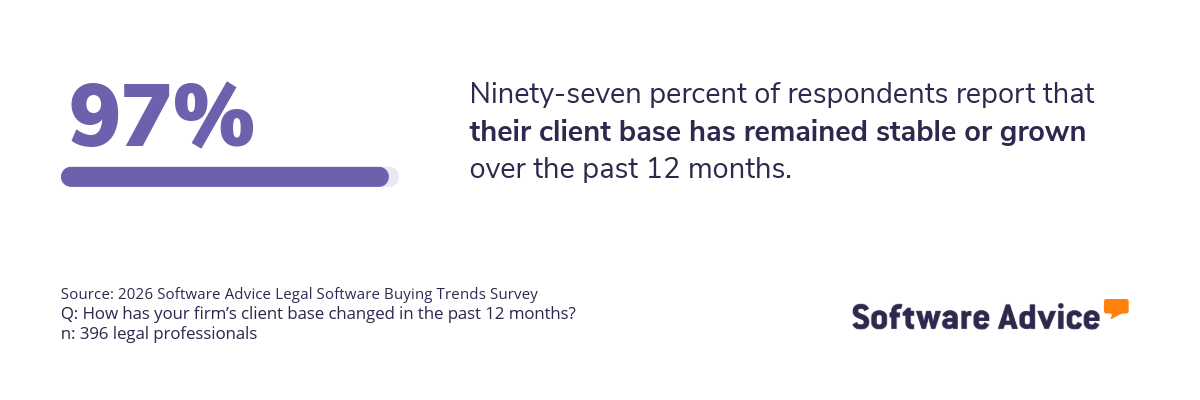
Technology adoption is happening during a period of relative stability, which indicates that firms are integrating new tools proactively—not as a defensive response to declining demand.
Why this trend matters: This momentum creates a strategic window for firms to modernize operations, strengthen client experience, and differentiate through technology‑enabled service delivery before competitive pressures intensify further.
How to act on this trend
Pilot with non‑sensitive matters. When modernizing your operations, start with 30‑day pilots on low‑risk use cases. Use these trials to refine prompts, permissions, verification steps, and overall workflow design before expanding firm‑wide.
Educate to de‑risk. Brief partners and practice leads on what AI can and cannot do, including its limitations and appropriate use cases. Set clear expectations for how technology should be used across practice areas.
Use feedback to refine workflows. Gather input from attorneys, paralegals, and staff to identify implementation challenges, training needs, and support gaps. Use this insight to shape future training sessions and adjust your rollout strategy.
Strengthen your firm’s positioning. Present your firm as one that adopts technology thoughtfully, with a focus on responsible use, data protection, and long‑term client value. This reinforces trust in a rapidly evolving environment.
Communicate your advantage. Explain to clients and the broader public how your technology choices improve timelines, transparency, and consistency—while maintaining realistic expectations and avoiding guarantees about outcomes.
Conclusion: Key takeaways for legal leaders
AI has become a foundational capability across legal systems, which means real advantage now comes from governing and operationalizing it well, not simply adopting tools. As you look ahead to 2026 and beyond, several themes become clear:
AI is table stakes.
Legal skills are shifting.
Security leads legal tech purchasing criteria.
Pricing is evolving.
Growth continues despite rapid technology advances.
To turn these trends into meaningful impact, planning is essential. Define specific goals, set expectations for responsible AI use, evaluate vendors through structured demos, and pilot new tools on low‑risk matters before scaling. This measured approach helps firms modernize with confidence, maintain client trust, and stay competitive as legal technology trends continue to evolve.