
Best Construction Categories
Best Facilities Management Categories
Best Human Resources Categories
Best Legal Management Categories
Best Manufacturing Categories
Best Medical Categories
Best Property Management Categories
Get 1-on-1 advice in 15 minutes. It's free.

Josh P.

Manufacturing has an AI upskilling problem. Here's how to address it
AI is showing up on manufacturing shop floors, with solutions designed to augment human work and keep machines and systems running smoothly.
What’s the challenge? With the increased use of AI comes the need for AI upskilling factory-level workers, so they can safely use the new tech, increase production, and build AI literacy through experience.
According to Software Advice’s 2026 Software Buying Trends Survey* aggressive adopters of AI have a head start on AI upskilling, due to their increased investment in both AI and learning management system (LMS) solutions. By making the early investment in AI literacy, these manufacturers have a competitive advantage both as producers that can more quickly reap returns from their AI investments and as employers that can cultivate, attract, and retain AI-savvy manufacturing labor.
The takeaway: Manufacturers can take a cue from early adopters by understanding their upskilling needs, choosing the right tools to train their teams, and knowing what challenges to expect when bringing AI onto the factory floor.
Key insights:
50% of manufacturers expect challenges around leveraging AI effectively in 2026
AI literacy is a critical component of AI upskilling programs for shop floor workers
AI-driven learning management system (LMS) tools simultaneously build AI literacy while teaching workers how to use AI on the shop floor
Aggressive AI adopters in manufacturing are ahead of the pack on effectively leveraging AI
Strong investment in AI yields an urgent need for AI upskilling in manufacturing
Manufacturers say technological advancements, including AI, are the number-one most significant external factor shaping their business goals in 2026.
They even beat macroeconomic turbulence and competitive pressures. What’s more, manufacturers have a strong appetite for investing in AI, with the vast majority already comfortable adopting proven AI technologies. They know that investing early in AI will keep them competitive.
While great for innovation, rapid AI adoption has created a daunting, multi-pronged productivity and labor issue for manufacturing employers in 2026:
An urgent need for AI upskilling: According to Software Advice’s 2026 Software Buying Trends Survey, half (50%) of manufacturers expect to experience difficulty leveraging AI effectively, and 43% anticipate significant challenges with training and upskilling. Another 39% say recruiting and retaining qualified talent will be a hurdle this year.
Rapid ROI demands: Shifting to AI-assisted production isn’t cheap, and manufacturers generally expect new software investments to provide returns within 10 months of adoption. Ineffective training and end-user resistance to change can delay ROI.
AI skepticism and resistance to change: Factory-level workers worry about being replaced by AI, leading to resistance to gaining AI skills and disengagement at work.
Increased competition for scarce labor: The increased need for AI competencies compounds the existing shortage of skilled factory-level labor in the US, which has been brought into sharp relief through tariff-driven reshoring efforts. Experts have called for greater investment in vocational schools to help produce a new generation of workers ready for today’s high-tech factories, though progress in this area isn’t close to meeting today’s need for skilled labor. [1]
As employers and producers, manufacturers need to meet the upskilling need, build trust in AI among their employees, and shift focus toward a future of human-AI collaboration on the shop floor so they can stay competitive.
In short: While the urgency to upskill is clear, it’s equally important to recognize that effective training goes beyond teaching workers how to interact with new AI interfaces. To fully realize the benefits of AI on the factory floor, manufacturers must focus on building true AI literacy among their employees. AI itself can help as a training support.
Why factory-level employees need AI literacy in addition to application-specific skills
AI upskilling is a holistic process that teaches workers how to use AI on both a macro and micro level. In other words, it’s not enough to simply train workers to press the right buttons on the AI tools they use for everyday tasks. To effectively work alongside AI in the near and long term, workers also need to build their AI literacy.
What is AI literacy?
AI literacy refers to the knowledge and skills humans need to understand and explain how AI works, critically evaluate its output, and recognize both its capabilities and limitations. In manufacturing, AI literacy allows human workers to stay safe around AI tools, effectively use AI-generated insights, and innovate better uses of AI in their day-to-day work.
AI literacy skills | New factory-floor skills |
|---|---|
Understanding algorithms | Accurately anticipating (not over-or under-estimating) AI capabilities to improve workflows and accurately predict productivity |
Working safely alongside AI and robots | Understanding and anticipating robot behavior to maintain physical safety around robotic arms or machines |
Manufacturing applications of AI | Familiarity with the purpose and processes of robotic process automation (RPA), industrial Internet-of-Things (IIoT) sensors, demand forecasting, digital twins, etc. |
Interpersonal soft skills | Communicating AI-related issues to managers and shop floor colleagues when errors or safety concerns arise |
AI fundamentally changes factory-level work
In their haste to address the challenges brought on by AI, manufacturers can’t afford to underestimate the transformative nature of AI adoption on the factory floor. Adopting AI is different from adopting other digital tools. It fundamentally shifts the way factory-level workers think, move, and communicate on the factory floor.
Take predictive maintenance tools for example. Designed to predict equipment failures before they occur, these tools compare training data to real-time performance data gathered from sensors attached to machines. Ideally, this allows shop floor workers to offload manual checks and routine maintenance scheduling while preventing machinery issues from ever happening. Workers need to adapt by learning how to interpret predictive maintenance alerts, validate data and correct issues, and ensure the quality of data inputs as the tools learn. Ultimately, they need to learn to rely on the tools to let them know when there’s an issue.
To build trust in AI, maintain safety, and promote an ethic of creative problem-solving as AI becomes more prevalent, employers need to understand and address each of the many ways AI changes the nature of work for factory-level employees.
Introducing AI to the factory floor can shift:
Roles and responsibilities: How workers complete their daily tasks and how they conceptualize their role alongside AI (i.e., from hands-on execution to supervising machine labor).
Decision-making: Understanding how AI works is critical to being an effective human-in-the-loop when problems arise.
Safety protocols: Working safely alongside autonomous robots and algorithms requires new awareness, troubleshooting skills, and workplace-specific considerations.
Morale and trust in leadership: Many workers view AI as a threat to their livelihoods and the integrity of human-led work. Employees need to trust that leadership will implement AI solutions without compromising safety and the quality of work performed.
Soft skills and communication: New vocabulary and prioritization frameworks are needed to communicate status updates and problems to colleagues and managers.
AI literacy helps workers adapt to these changes, each of which deserves attention in an AI upskilling strategy. Combining the right upskilling tools with a functional understanding of AI can connect factory-floor workers with the skills and knowledge they’ll need to thrive in an AI-supported manufacturing environment.
AI literacy can also help reduce resistance to change
Factory-level workers may be resistant to using AI for any of the following reasons:
They distrust autonomous robots and systems, viewing them as unsafe
They worry AI will take their jobs
Learning to use AI feels daunting
Concerns about surveillance, reduced human autonomy, and dehumanized work environments
They distrust leaders to effectively implement AI, anticipating downtime and technical issues
Fear of a lack of control and clear expectations contributes heavily to workers’ anxiety about learning to use AI, but building AI literacy can help assuage those concerns. Knowing what to expect from the AI tools they use helps workers envision a future of work alongside AI.
What leaders should know: AI upskilling is about sparking a cultural shift toward an AI-literate workforce that views AI as supportive of their daily work and can innovate new AI-supported processes. Building AI literacy is a continuous practice built through hands-on training and on-the-job experience with AI over time; as developers find new ways to apply AI to manufacturing, employees have new opportunities to expand their understanding and optimize workflows.
Aggressive AI adopters use AI-driven LMS to upskill factory-level workers
Learning management system (LMS) software speeds up the delivery and consistency of training, with standardized modules that employees can engage with through digital devices. Using LMS is generally cost-effective, flexible, and more efficient than strictly human-led training programs.
AI-enabled LMS tools go a step further, teaching users two critical components of AI upskilling concurrently: by embedding AI into training modules, AI LMS tools simultaneously build AI literacy while teaching task-specific skills. With personalization, gamified immersive experiences, and real-time feedback, an AI LMS can be incredibly engaging, leading to better retention of learned skills and positive training experiences for end users.
Aggressive AI adopters—the 20% of manufacturers who aggressively test and deploy emerging AI technologies—are ahead of the curve on meeting the dual challenge of investing in and effectively using AI on the shop floor. More so than balanced and cautious AI adopters, aggressive adopters have a strong appetite for emerging AI use cases such as personalization systems, computer vision, autonomous and expert systems, and automated scheduling. They also invest more in LMS tools.
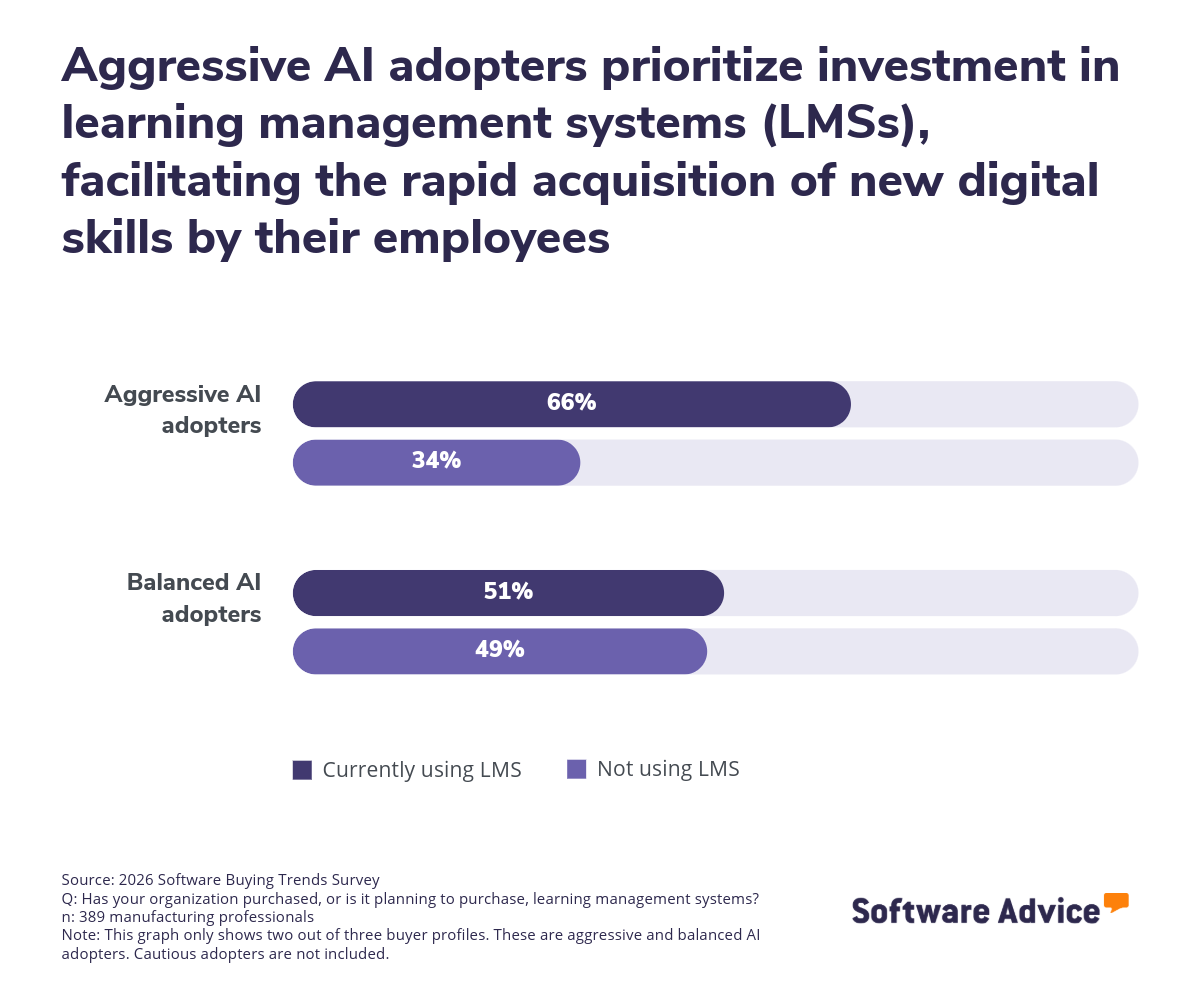
Not only are aggressive adopters exposing workers to more advanced AI use cases, they’re also doing more to support learning how to use those tools.
By leaning on AI-driven LMS, aggressive adopters:
Upskill workers on urgently needed AI skills and build an AI-literate workforce
Promote the safety of shop floor employees
Foster a culture of AI acceptance, easing anxiety around AI and creating a desirable environment for AI-savvy job candidates
Drive ROI for their other AI investments
Invest in AI upskilling to future-proof your manufacturing business and achieve AI ROI
Prioritizing AI upskilling for factory-level workers is no longer optional; it’s essential for staying competitive in 2026 and beyond. Manufacturers who invest early in building AI literacy and application-specific skills are better positioned to attract and retain workers, accelerate ROI, and foster a culture of innovation and trust on the shop floor. By following the lead of aggressive AI adopters and leveraging AI-driven LMS solutions, manufacturers can empower their workforce to adapt to rapid technological change.
Sources
Survey methodology
*Software Advice 2026 Software Buying Trends survey was conducted online in August 2025 among 3,385 respondents in Australia (n=281), Brazil (n=278), Canada (n=293), France (n=283), Germany (n=279), India (n=260), Italy (n=263), Mexico (n=288), Spain (n=273), the U.K. (n=299), and the U.S. (n=588), at businesses across multiple industries (including 389 respondents in manufacturing roles), ages (1 year in business or longer), and sizes (5 or more employees). Business sizes represented in the survey include: 1,676 small (5-249 full-time employees), 822 midsize (250-999), and 887 enterprise (1,000+). The goal of this study was to understand the timelines, organizational challenges, research behaviors, and adoption processes of business software buyers. Respondents were screened to ensure their involvement in business software purchasing decisions.