
Best Construction Categories
Best Facilities Management Categories
Best Human Resources Categories
Best Legal Management Categories
Best Manufacturing Categories
Best Medical Categories
Best Property Management Categories
Get 1-on-1 advice in 15 minutes. It's free.

Josh P.

Buyers Switch to Mental Health Software for Greater Efficiency and Functionality
Choosing mental health software goes beyond scheduling sessions or keeping patient records. Most tools support care delivery through AI-enabled treatment‑plan builders, teletherapy modules, outcomes tracking, and integrated billing. These features can help practices deliver consistent care while managing growing administrative demands.
Why does it matter? For many therapists, counselors, and psychologists, especially those with limited technical experience, evaluating these systems can feel overwhelming. Buyers often struggle to identify which features matter most for their practice size, how different deployment models impact daily workflows, or what an appropriate budget looks like.
Why should you read this guide? Thousands of software buyers visit Software Advice each year to compare mental health solutions, read verified reviews, and get personalized recommendations. Our advisors also speak directly with buyers, qualifying them based on budget, authority, need, and timeline (BANT). By analyzing these conversations, we’ve identified what small and midsize businesses (SMBs) should focus on when selecting mental health software.
Key insights
Buyers still use basic tools: Most rely on non-specialized, general-purpose tools to manage their daily operations, while some still use manual methods or have no system in place at all.
Why teams adopt mental health software: The need to explore new business opportunities, the availability of sufficient functionality, and workflow efficiency primarily drive adoption.
What matters most to buyers: Software buyers prioritize the therapy notes feature, while existing or current users of mental health software consider HIPAA compliance, document management, and appointment scheduling the most important features.
What’s the actual spend? The top five industries investing in mental health software spend between $41 and $91 per user, per month, with an overall average of $75 per user, per month.
Tools buyers are currently using to manage mental health practice operations
When our advisors asked buyers how they currently manage their day‑to‑day mental health practice operations, here’s what they shared:
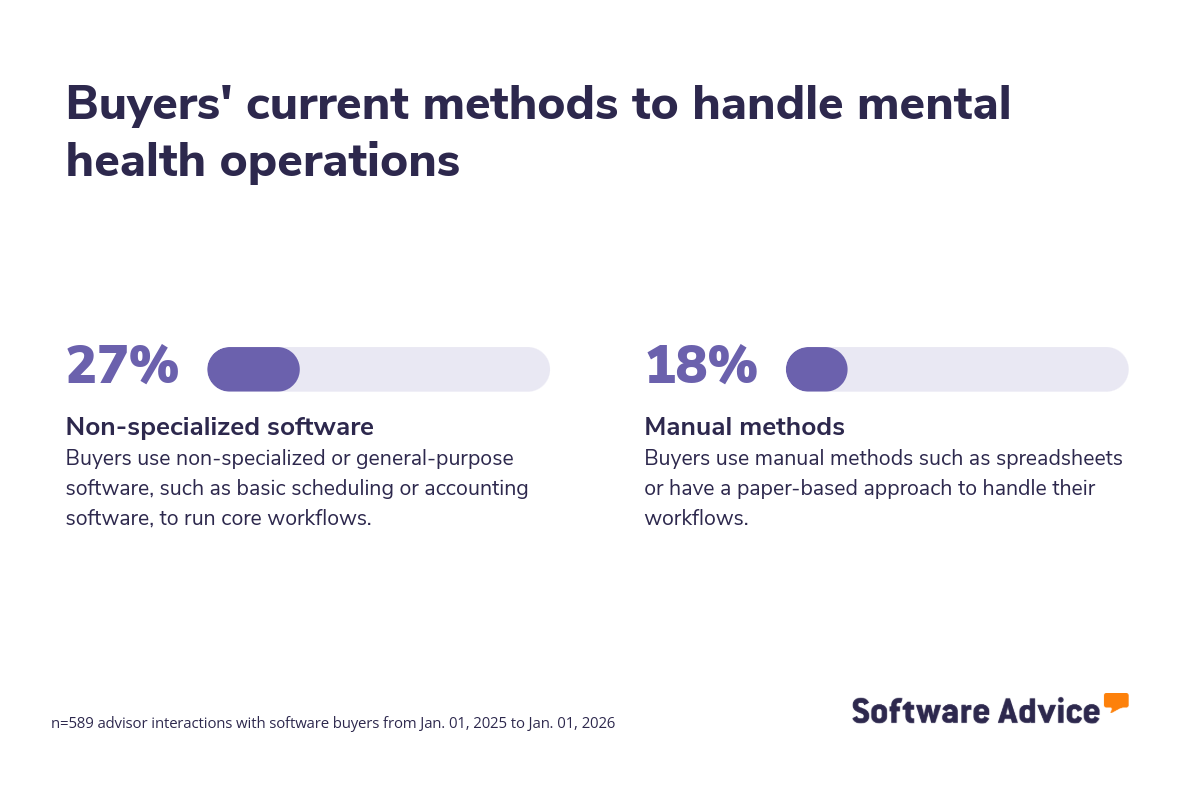
Around 27% of buyers use non‑specialized or general-purpose tools, such as basic scheduling or accounting software, to run core workflows.
Nearly 18% rely on manual methods, including spreadsheets or paper files.
Another 38% report having no structured system in place, often resulting in ad‑hoc combinations of email, phone calls, and basic documentation tools.
While spreadsheets and general-purpose tools may work for small practices, they create workflow gaps as patient volume increases. Manual processes make it harder to track treatment plans, document progress, or manage insurance‑related tasks. General‑purpose software also creates fragmented processes, as practices must switch between multiple systems to handle scheduling, documentation, billing, and teletherapy.
Pro tip
Look for mental health tools that let you compare core workflows, such as scheduling, documentation, and billing, side by side. Clear feature explanations and recent user insights will also help you gauge which products align with your practice’s daily needs.
Why buyers switch to mental health software
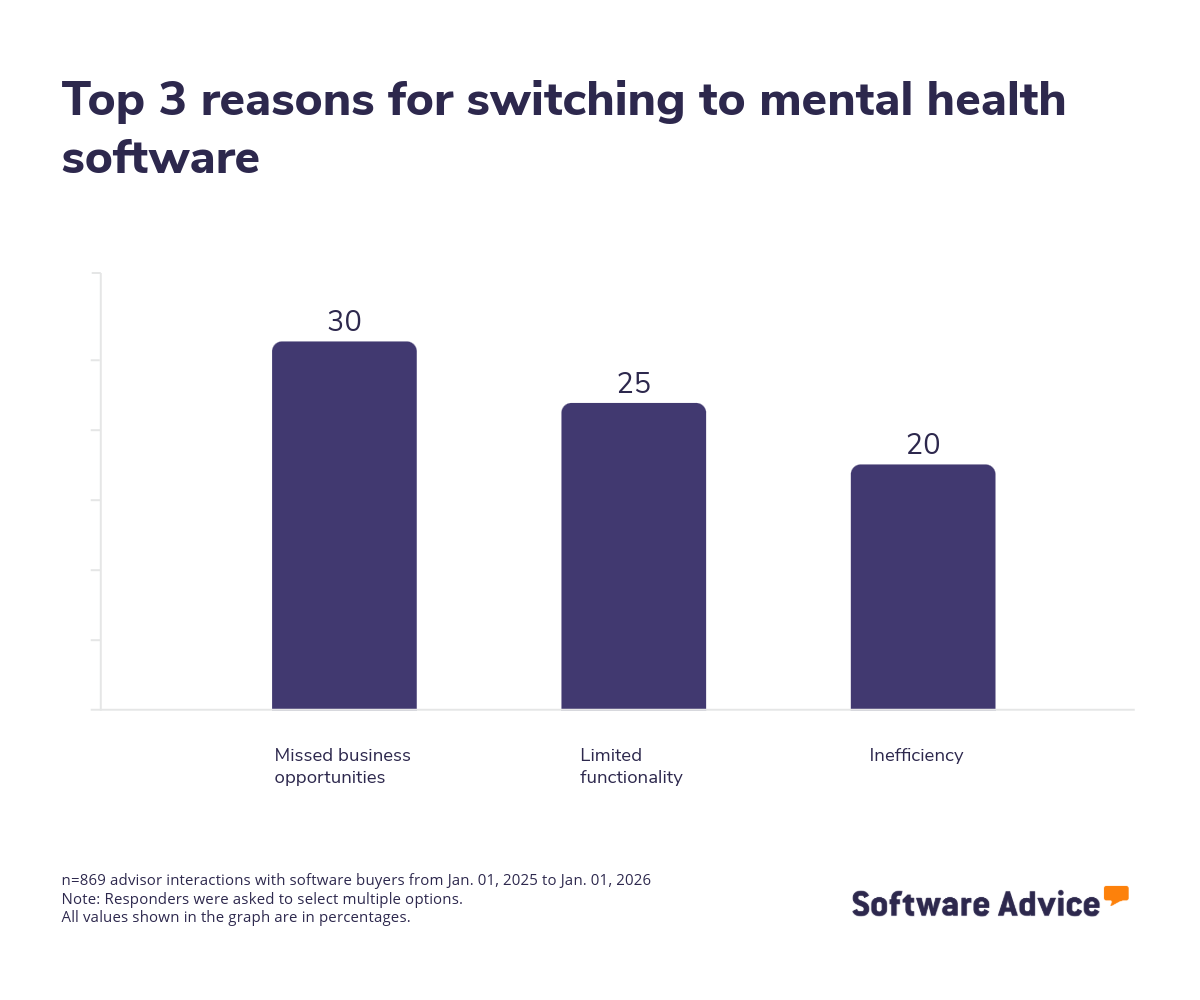
Our advisors spoke with buyers who are currently using manual methods or general-purpose tools and are considering a switch to mental health software. These conversations reveal the top pain points driving change: missed business opportunities (30%), limited functionality (25%), and inefficiency (20%).
Missed business opportunities: Buyers who depend on paper files, basic scheduling tools, or stand‑alone teleconferencing apps often lose potential clients because they can’t offer features that patients now expect. This includes online booking, automated reminders, or secure teletherapy. Without these capabilities, practices may experience higher no‑show rates and slower intake, which directly affects revenue and patient satisfaction.
Limited functionality: General‑purpose tools rarely support clinical workflows such as treatment‑plan creation, progress‑note templates, outcomes tracking, or integrated telehealth. They also lack built‑in security features needed to manage sensitive patient information. This forces practices to patch together multiple tools to meet basic needs, leading to inconsistent documentation and more time spent on administrative tasks.
Inefficiency: Manual workflows slow down everyday tasks, such as scheduling, note‑taking, billing, and insurance documentation. Practices report frequent errors, including misplaced paperwork, incomplete clinical notes, and delays in claims submission. These issues not only increase operational overhead but also affect care continuity when clinicians cannot easily and quickly access accurate, up‑to‑date patient information.
What buyers say mental health software helps them solve
Our conversations with buyers reveal a recurring theme: Many struggle to see how different products support the daily realities of running a mental health practice. Compared with manual processes or general‑purpose tools, dedicated mental health systems offer several practical advantages that directly support clinical care and administrative efficiency:
Centralized client information management: Mental health software gives practices a single, secure place to store and update client details, clinical histories, treatment plans, and progress notes. Centralized records reduce duplication, minimize documentation gaps, and ensure clinicians can quickly access accurate information during sessions or when coordinating care.
Streamlined intake and appointment workflows: Instead of juggling email, paper forms, and separate scheduling tools, practices can use built‑in modules for digital intake, appointment requests, consent forms, and reminders. These workflows reduce administrative back‑and‑forth, shorten wait times, and help clients move through the intake process more smoothly.
Integrated teletherapy and clinical documentation: Many buyers turn to mental health software for unified tools that combine teletherapy, note‑taking, and session‑tracking in one system. This helps clinicians document sessions in a consistent format, easily reference previous notes, and maintain continuity of care without switching between applications.
Simplified billing, claims, and compliance tasks: Dedicated systems support billing workflows with features such as automated invoicing, payment tracking, and insurance claims submission. These tools help practices reduce common errors, manage denials more effectively, and generate the documentation needed for audits or insurance reporting.
Pro tip
During vendor demos, focus on how well the system supports your specific mental health workflows, such as documentation, scheduling, teletherapy, and billing. Ask vendors to show real examples from similar practices so you can see whether the tool fits your daily operations.
What mental health software features are valued the most
There’s a notable gap between what buyers prioritize before purchase and what users value once they adopt a mental health system.
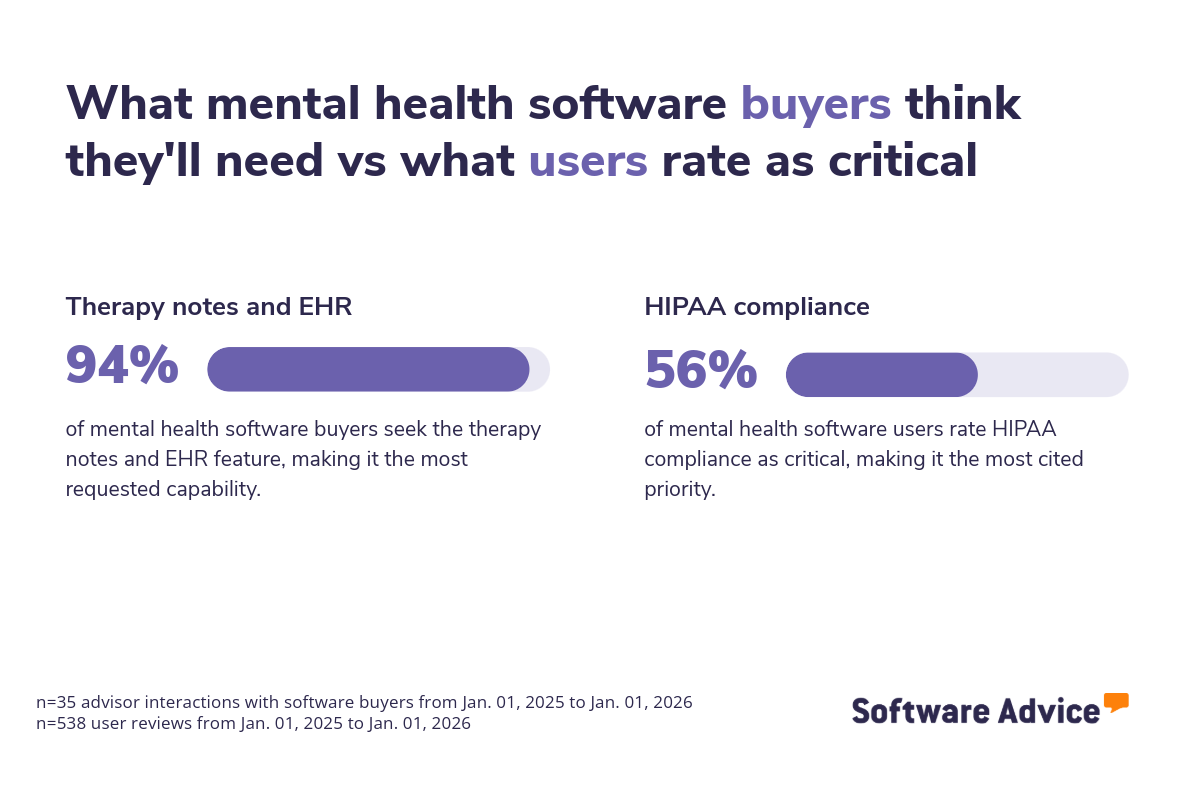
Buyers place the highest emphasis on therapy notes and electronic health records (EHR), features cited by 94% of buyers.
Scheduling (86%), billing and invoicing (80%), and telemedicine support (34%) follow as key decision drivers during evaluation.
Current users, however, rank HIPAA compliance as their top priority (56%), reflecting the importance of secure data handling in daily operations.
This discrepancy highlights a key insight:
Buyers tend to focus on features that solve immediate, visible problems, such as documentation, scheduling, and billing. At the same time, users place value on capabilities that support long‑term, everyday workflows, such as data security, compliant recordkeeping, and reliable session documentation.
Pro tip
Before shortlisting products, map your current clinical and administrative workflows. Use this workflow‑mapping checklist during demos to see whether the software aligns with how your team already works or requires major process changes.
Use cases for mental health software
Mental health software supports more than basic scheduling or recordkeeping. Different care settings rely on purpose‑built workflows to manage clinical documentation, client engagement, billing, and compliance. Here are a few examples:
Psychology and therapy practices use mental health software to document sessions, build treatment plans, manage scheduling, and offer secure teletherapy. These tools help standardize progress notes, reduce administrative effort, and keep client information organized in one place.
Applied behavior analysis (ABA) and autism therapy practices use mental health systems for data collection, behavior tracking, and session notes. Software features such as customizable behavior programs, progress dashboards, and electronic consent forms help teams monitor progress toward goals and coordinate care among therapists and supervisors.
Substance abuse clinics use such software to manage assessments, track medication‑assisted treatment, document group sessions, and support compliance needs. Integrated urine screening logs, treatment plan templates, and outcomes reporting help providers maintain accurate records for audits and insurance payer requirements.
Multi‑specialty behavioral health clinics offer services across psychiatry, therapy, counseling, and social work, using comprehensive systems that support multiple workflows on a single platform. Features such as role‑based access, integrated e‑prescribing, team communication tools, and cross‑discipline documentation help streamline coordination.
Other care settings, such as school‑based counselors, employee assistance programs (EAPs), community mental health agencies, and teletherapy‑only practices, rely on mental health software to manage caseloads, maintain secure communication, and support remote service delivery. These tools help teams stay organized while meeting privacy and documentation requirements.
Average budgets for mental health software across industries
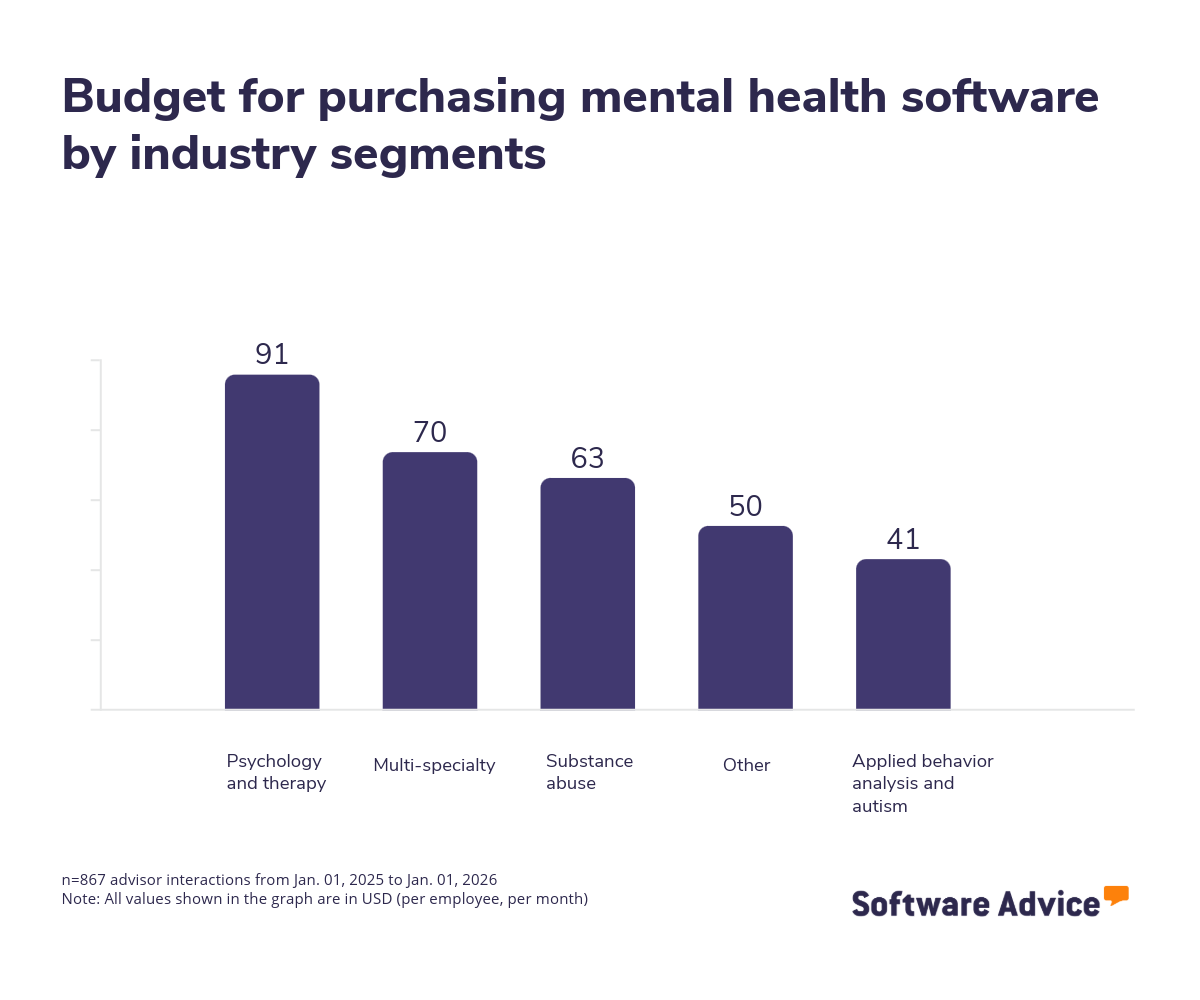
Across the top user segments, mental health practices typically allocate $41 to $91 per user, per month for dedicated mental health software. The overall average is about $75 per user, per month.
What are the variables? Budgets vary by segment based on several factors, including practice size, clinical complexity, regulatory requirements (e.g., HIPAA, e‑prescribing, or state‑specific reporting), and specialized capabilities, such as teletherapy, outcomes tracking, integrated claims, role‑based access, or mobile tools for field‑based services.
Here is how different segments budget for mental health software (figures shown are dollar amounts per user, per month).
Pro tip
When comparing pricing, look beyond the base subscription. Ask vendors about fees for teletherapy, claims submission, e‑prescribing, or additional storage to avoid unexpected costs as your practice grows.
More resources for your software search
Whether you’re looking to buy new mental health software or replace your existing tool, here are some additional resources to aid your software search:
Start with our interactive mental health software directory to compare hundreds of products, filter your search by specific features, and read comprehensive reviews from other SMB buyers.
Check out the top-rated mental health software based on user ratings and popularity in the 2026 Mental Health Software FrontRunners Report.
Go through the mental health software buyer’s guide to better understand the market.
Survey methodology
Methodology and buyer demographics
Findings are based on data from daily conversations the Software Advice advisor team has with software buyers seeking guidance on purchase decisions. The data used to create this report is based on interactions with small and midsize businesses seeking mental health management tools. For this report, we analyzed approximately 869+ phone interactions from Jan. 01, 2025, to Jan. 01, 2026.
The findings in this report reflect buyers who contacted Software Advice and may not be representative of the market as a whole. Data points are rounded to the nearest whole number.
The buyers we interacted with are largely small businesses representing a growing majority of mental health software purchases. Below, you’ll find the demographics of the buyers, including the size and type of businesses, as well as their annual revenue and industry.