
Best Construction Categories
Best Facilities Management Categories
Best Human Resources Categories
Best Legal Management Categories
Best Manufacturing Categories
Best Medical Categories
Best Property Management Categories
Get 1-on-1 advice in 15 minutes. It's free.

Josh P.

The Risks of AI Adoption in Manufacturing: What Aggressive Adopters Must Be Prepared For
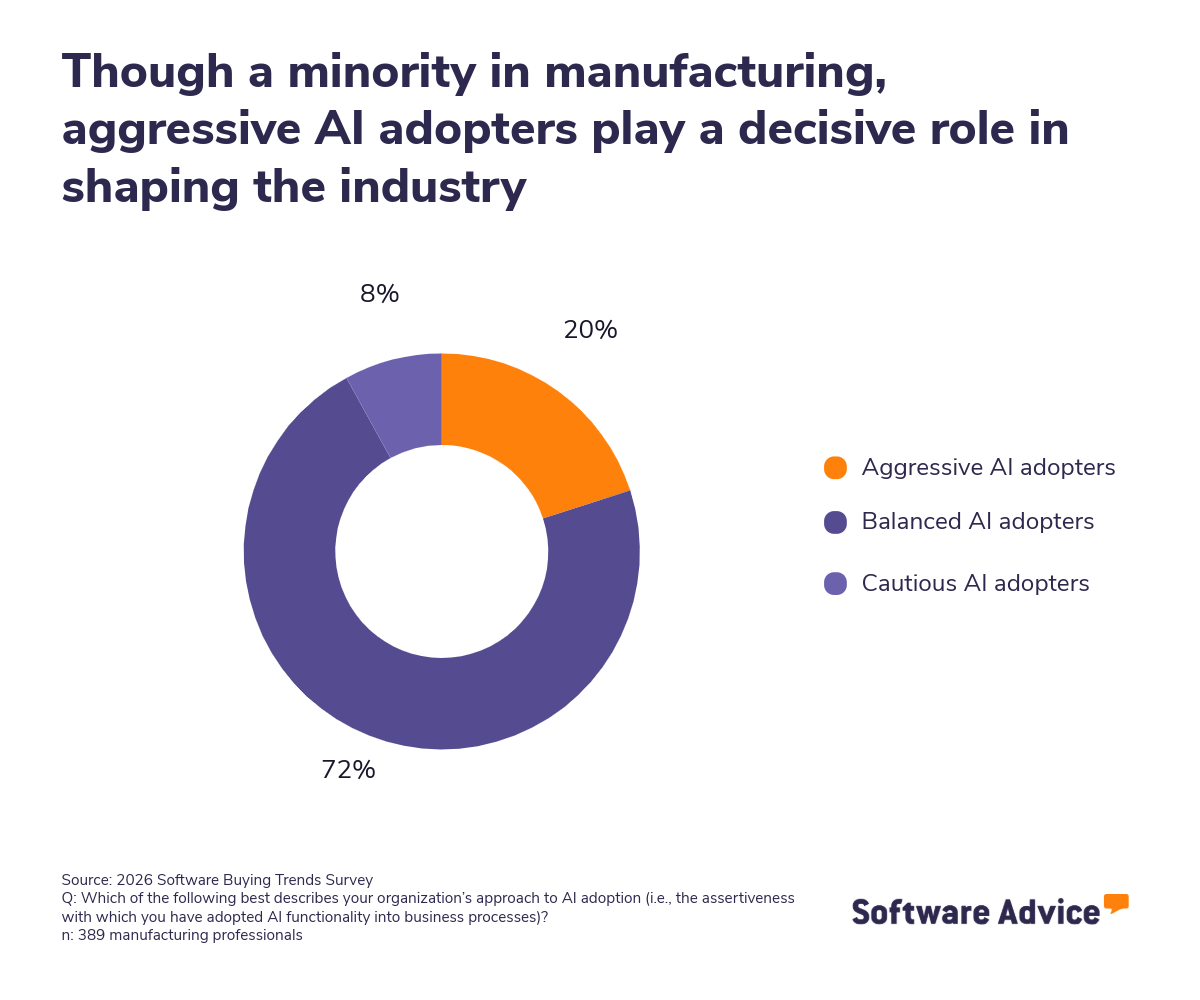
AI is becoming the new arms race in manufacturing. While 72% of manufacturers are approaching AI adoption with a balanced strategy, a decisive 20% have emerged as aggressive adopters to gain an edge. Our latest Software Advice report* shows this race is accelerating—but so are the risks. Aggressive adopters must understand what they’re stepping into before small missteps turn into costly setbacks.
Despite the potential benefits of aggressive AI adoption, significant challenges must be addressed. Disruption, integration complexities, cybersecurity threats, and workforce readiness are some issues that pose substantial risks to the progress sought by these trailblazers.
To understand the concrete risks faced by aggressive AI adopters in manufacturing, as well as strategies to maximize value while minimizing pitfalls, Software Advice has drawn insights from its 2026 Software Buying Trends Survey* of 3,385 manufacturing decision-makers.
What are the opportunities of aggressive AI adoption?
Aggressive AI adopters unlock several benefits that could drive success:
Supply chain resilience: 88% have invested in supply chain software, using AI for real-time visibility, better demand forecasting, and quick adaptation to disruptions.
Workforce upskilling: 66% have adopted a learning management system (LMS), accelerating skill development, onboarding, and retention.
Operational excellence: 32% deploy autonomous systems and 38% use robotic process automation (RPA), automating tasks and predictive maintenance to cut downtime and boost efficiency.
Strategic positioning: Early AI integration can help set industry standards, attract top talent, and outperform peers through strong governance and clear priorities.
Six risks of aggressive AI adoption that manufacturers must know
Manufacturing cybersecurity challenges threaten aggressive AI adoption
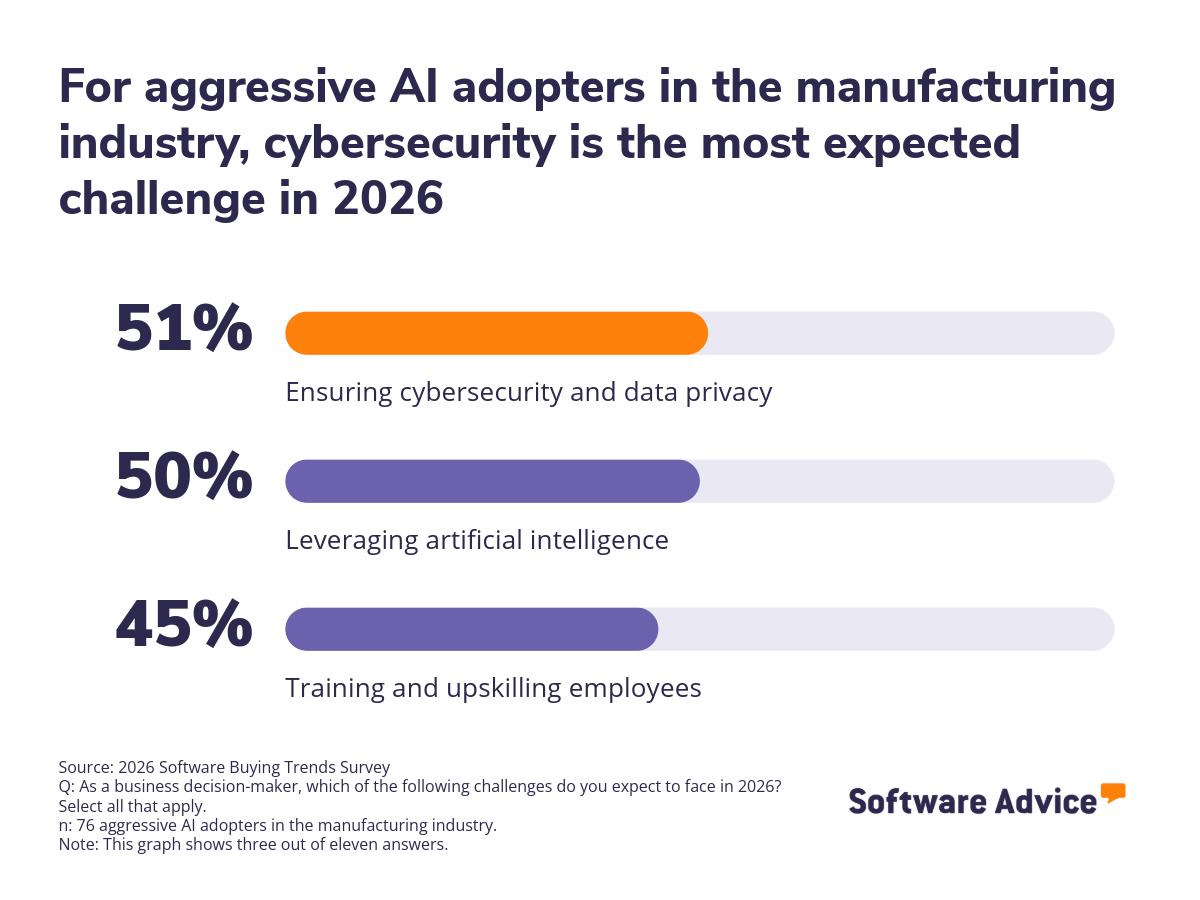
One of the most critical risks of AI adoption in manufacturing is the expansion of the cyberattack surface. 51% of aggressive AI adopters expect cybersecurity challenges in 2026.
Converging IT and operational tech, along with AI’s access to sensitive data, increases manufacturing’s exposure to cyber threats. While 84% have invested in IT security, 39% still see it as a top barrier when acquiring new technology. Manufacturing cybersecurity challenges include threats to intellectual property theft, compromised production data, and AI model manipulation.
Pro tip
Use AI-driven cybersecurity tools to monitor systems in real time and flag unusual activity early. Automated responses help reduce breach risk, protect sensitive data and free your IT team for higher‑priority work.
2. Workforce readiness determines the success of AI initiatives
Rapid AI adoption can outpace workforce adaptation, introducing additional risks of AI adoption in manufacturing. Research shows that 45% of companies embracing AI expect upskilling to be a significant hurdle. Even with 66% investing in LMS, role changes and workflow disruptions can lead to resistance and morale issues. Without proper change management and structured training, organizations are much more likely to see digital projects fail, highlighting the importance of supporting employees through these transitions.
Pro tip
Use digital adoption platforms to guide employees through new tools with step-by-step, in-app support. This reduces errors, speeds onboarding, and helps teams get more value from your digital investments to accelerate overall transformation success.
3. AI integration challenges create obstacles for aggressive adopters
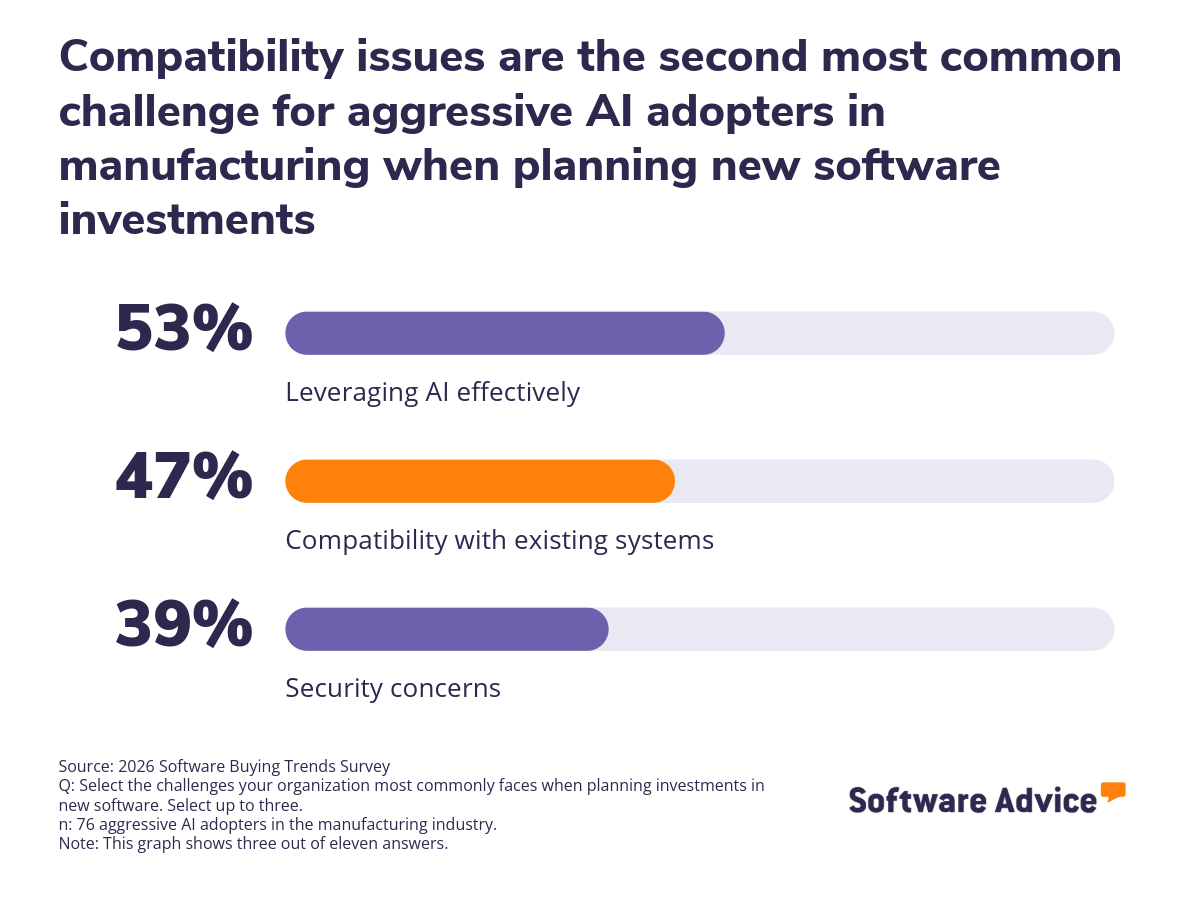
Nearly half of aggressive AI adopters face compatibility issues when they introduce new software. The implementation of new tools poses a significant risk for manufacturers, primarily due to the presence of inflexible legacy systems and fragmented data. This creates a technical mismatch that hinders the ability of AI to access the unified, real-time information it requires to function optimally.
For those businesses that are aggressive in adopting new technology, these compatibility gaps lead to the creation of "data silos" and operational bottlenecks, ultimately neutralizing the technology's ability to improve productivity or agility.
Pro tip
Invest in integration tools that automate data exchange between old and new systems. This cuts manual tasks, improves accuracy, and helps teams make faster, more informed decisions to support your future growth.
4. Rapid AI investment exposes manufacturers to financial risks
Aggressive AI adopters face heightened exposure to economic cycles and capital constraints. 24% cite funding constraints as a top barrier. If the expected return on investment takes longer than planned or if adoption outpaces the company’s capacity, it can lead to financial instability. This is a key example of AI adoption risks in manufacturing that can threaten long-term viability.
Pro tip
Use financial management tools to model ROI, track real‑time costs, and flag risks early. Clear financial insights help teams make data-driven decisions, optimize resource allocation, and ensure your organization stays financially healthy during periods of growth and change.
5. Organizational disruption undermines AI implementation
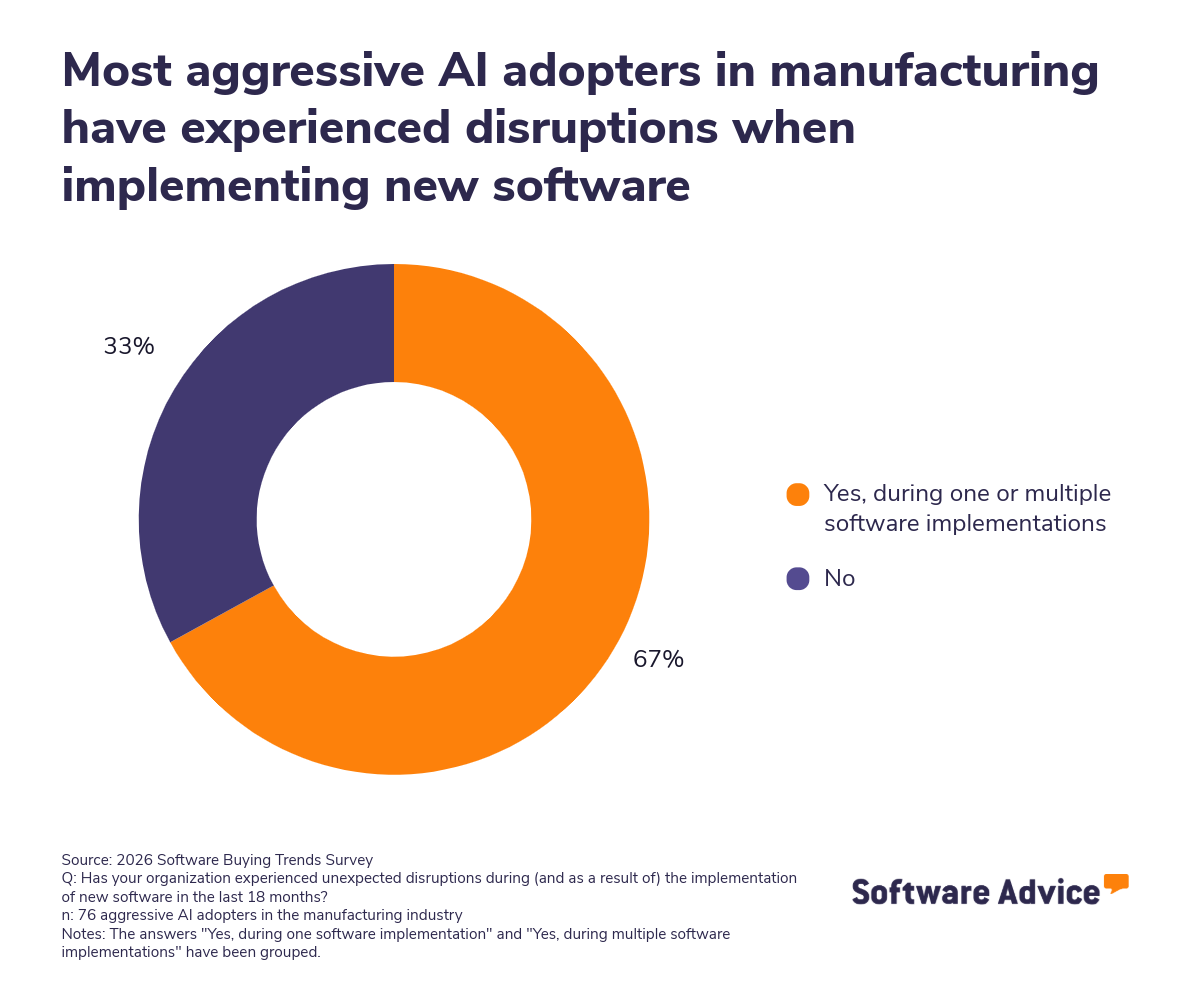
Aggressive AI adoption disrupts established processes and culture, creating further AI adoption risks in manufacturing. 67% report unexpected disruptions from new technology.
Without strong governance, rapid change can lead to inconsistencies and reliability issues.
Pro tip
Use governance platforms to monitor and standardize processes during transformation. Automated policy checks and change tracking help reduce risk, maintain quality, and support smoother transitions.
6. Sustaining and scaling AI value remains a persistent challenge
After early AI pilots, many organizations hit obstacles tied to siloed data, talent shortages, and misaligned priorities. Even with initial success, sustaining AI programs can be difficult, underscoring the long-term risks manufacturers face during adoption.
Pro tip
Align AI projects with strategic goals, invest in talent and data infrastructure, and track impact with clear metrics. This helps ensure AI delivers measurable value and remains adaptable as your organization evolves.
Five tips to mitigate risks in aggressive AI adoption
Prioritize security: Use AI-enabled detection tools and proactive monitoring to address manufacturing cybersecurity challenges.
Ensure integration compatibility: Adopt modular platforms and test in phases to overcome AI integration challenges.
Invest in workforce upskilling: Use LMS and digital adoption platforms to reduce AI adoption risks in manufacturing related to workforce readiness.
Monitor ROI and market signals: Align projects with measurable outcomes and adjust as needed to manage economic risks.
Foster cross-functional collaboration: Integrate IT, operations, and business leaders in governance to minimize organizational disruption.
Balancing opportunity and risk for aggressive AI adoption in manufacturing
Manufacturing stands at a pivotal crossroads in the AI revolution, where bold moves can unlock game-changing advantages, but only if matched with thoughtful preparation. In the race to harness AI, speed matters but so does steering. Manufacturers who balance ambition with discipline will not only seize today’s opportunities, but also build the resilience and agility to thrive in the future.
Survey methodology
*Software Advice 2026 Software Buying Trends survey was conducted online in August 2025 among 3,385 respondents in Australia (n=281), Brazil (n=278), Canada (n=293), France (n=283), Germany (n=279), India (n=260), Italy (n=263), Mexico (n=288), Spain (n=273), the U.K. (n=299), and the U.S. (n=588), at businesses across multiple industries (including 389 respondents in manufacturing roles), ages (1 year in business or longer), and sizes (5 or more employees). Business sizes represented in the survey include: 1,676 small (5-249 full-time employees), 822 midsize (250-999), and 887 enterprise (1,000+). The goal of this study was to understand the timelines, organizational challenges, research behaviors, and adoption processes of business software buyers. Respondents were screened to ensure their involvement in business software purchasing decisions.