
Best Construction Categories
Best Facilities Management Categories
Best Human Resources Categories
Best Legal Management Categories
Best Manufacturing Categories
Best Medical Categories
Best Property Management Categories
Get 1-on-1 advice in 15 minutes. It's free.

Josh P.

Learn From Buyer Insights to Steer Clear of Telemedicine Software Implementation Missteps
Healthcare providers face limited appointment availability, high patient demand, and administrative overload, making it hard to deliver timely care.
What’s the solution? Telemedicine software addresses these challenges by enabling virtual visits, automating scheduling, and reducing paperwork, helping practitioners focus on patient outcomes rather than operational hurdles.
However, to make the right purchase, it’s crucial to know what features you need, the average software price, and common challenges faced when purchasing telemedicine software.
How we can help: Each year, Software Advice talks to thousands of telemedicine buyers. We’ve distilled their insights on budgets, features, and pain points to help you choose the right tool.
Key insights
Both software buyers and current users from the industry prioritize HIPAA compliance in telemedicine software.
Most businesses do not have any dedicated system in place for managing their practices. While some rely on non-specialized tools to handle their day-to-day telemedicine operations, a small percentage of businesses also use manual methods.
Switching to telemedicine software is driven by the need for functional sufficiency, new business opportunities, and efficiency.
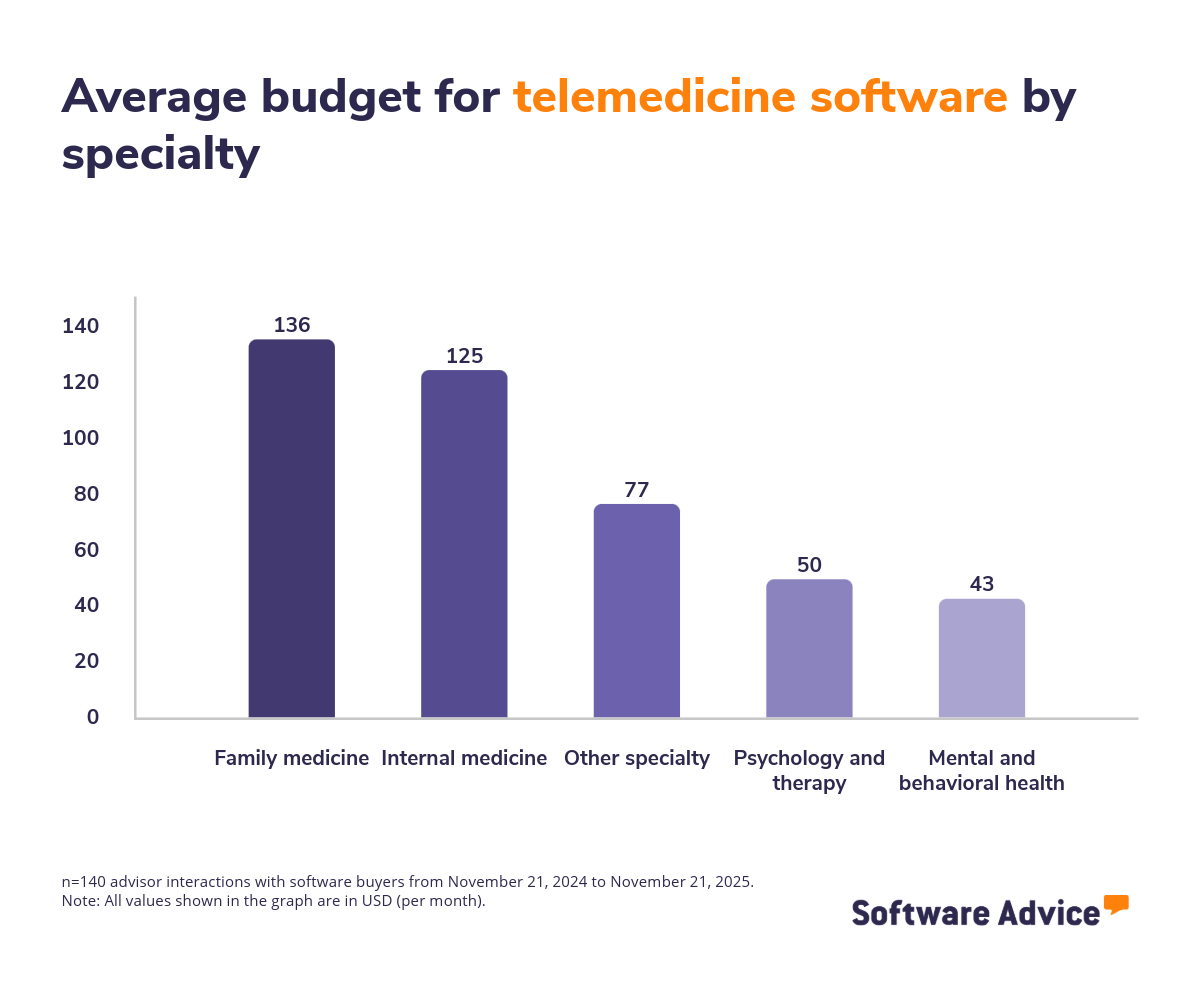
The top five specialties investing in telemedicine software allocate between $50 to $136 per month with an overall buyer average of $100 per month.
Prospective buyers and current users prioritize the same feature
After analyzing thousands of telemedicine software reviews available on Software Advice, our findings reveal that both buyers and current users of telemedicine software prioritize the same feature.
HIPAA compliance tops the list: Around 52% of current software users consider HIPAA compliance to be the most essential feature in telemedicine software. Consequently, virtually all buyers seek this feature in a telemedicine tool.
Access controls and audit trails for peace of mind: HIPAA compliance ensures that all patient data and communication within the telemedicine platform comply with the required standards. This includes having features such as end-to-end encryption for video calls, secure data storage, controlled access permissions, and audit trails, reducing the risk of unauthorized access and safeguarding sensitive health information.
Pro tip
Shortlist a telemedicine solution that provides access to patient medical history prior to virtual consultations. This allows users to create electronic prescriptions and check for potential drug interactions to ensure safe and effective medication use.
Current pain points for telemedicine software buyers
When our advisors asked buyers what methods they were currently using to handle their day-to-day telemedicine operations, here's what they found:
Many buyers start with no system or generic tools: Nearly 43% of buyers do not have any system to manage their telemedicine operations, and around 33% use non-specialized tools, such as electronic medical record (EMR) and online meeting systems, for their day-to-day operation workflows.
Some still rely on spreadsheets despite dedicated options: While 46% buyers already have a dedicated system, around four percent of buyers still rely on manual methods such as spreadsheets to handle their operations.
These discussions shed light on businesses' real-life challenges with their existing methods, which include limited functionality (53%), new business opportunities (23%), and inefficiency (10%).
Limited feature options: Generic tools and manual methods lack features essential for telemedicine, such as secure video consultations, electronic health record (EHR) platform integration, and automated appointment reminders. Paper-based systems and spreadsheets can store basic patient details but cannot support HIPAA-compliant communication or real-time updates, which are critical for virtual care delivery.
New business opportunities: Manual methods and non-specialized tools restrict growth because they cannot support virtual consultations, remote monitoring, or integrated billing systems. This limits a practice’s ability to expand services beyond in-person visits. Telemedicine software, in contrast, enables online care programs, chronic condition management, and wider patient reach, creating new revenue streams without adding physical infrastructure.
Inefficiency: Spreadsheets and one-size-fits-all tools often lead to double data entry, scheduling conflicts, and missed follow-ups, increasing administrative burden and error risk. They also struggle to handle growing patient volumes and complex workflows, making it harder for practices to maintain accuracy and timely care. These inefficiencies can result in longer wait times and reduced patient satisfaction.
Reasons for switching to a dedicated telemedicine software
Compared to the existing methods used by professionals, a dedicated telemedicine software solution offers the following benefits:
Improved operational efficiency: Telemedicine software automates repetitive tasks such as appointment scheduling, patient reminders, and billing processes. This reduces manual workload and minimizes errors, allowing healthcare staff to focus on patient care rather than admin tasks.
Enhanced patient accessibility: Unlike manual systems or generic tools, telemedicine software enables secure video consultations and remote care, making it easier for patients in rural or underserved areas to access medical services without traveling long distances.
Better compliance and data security: Paper workflows and non-specialized systems often lack HIPAA-compliant security features. Telemedicine software ensures secure data storage, encrypted communication, and regulatory compliance, reducing the risk of breaches and legal issues.
Scalability for growing practices: Manual methods and general-purpose tools struggle as patient volume increases. On the contrary, telemedicine software supports high-volume scheduling, integrated EHR management, and multi-provider coordination, helping practices scale without operational bottlenecks.
Improved patient engagement and satisfaction: Telemedicine platforms offer features like real-time messaging, prescription management, and follow-up reminders, which generic tools cannot provide. These capabilities improve communication and enhance the overall patient experience.
Pro tip
Prioritize communication tools, such as secure in-app messaging, video conferencing, file sharing, screen sharing, and interactive whiteboards. These features facilitate effective communication, collaboration, and patient engagement during virtual consultations.
Average budget for telemedicine software buyers
Telemedicine software budget depends on users, features, deployment type, and ongoing support. The average budget across specialties for purchasing telemedicine software was approximately $100 per month.
The chart below highlights the average buyer budget per month for the top specialties interested in telemedicine software.
Use cases for telemedicine software
Based on our advisors’ interactions, these are the top industries using a telemedicine tool for different use cases:
Family medicine practitioners handle a wide range of patient needs, from preventive care to chronic disease management. They need telemedicine software for virtual consultations, integrated EHR access, and prescription management, ensuring continuity of care for diverse age groups and conditions.
Specialty practitioners, such as cardiologists or dermatologists, require telemedicine software to share diagnostic reports securely, conduct remote consultations, and integrate with specialty-specific devices or apps. HIPAA-compliant messaging supports condition-specific workflows and data exchange.
Mental and behavioral health practitioners rely on telemedicine software for secure video sessions, private messaging, and progress tracking tools. Session notes and encrypted communication ensure confidentiality and compliance, critical for therapy and counseling.
Internal medicine practitioners manage complex adult health issues and chronic conditions. They need telemedicine software with remote monitoring tools, detailed EHR integration, lab result sharing, and follow-up scheduling to support long-term care and multi-provider coordination.
Psychology and therapy practitioners require telemedicine software with goal-setting modules, secure video conferencing, and session documentation tools. Features such as progress tracking and secure storage for sensitive notes help maintain patient trust and therapy outcomes.
Looking for more resources?
Click here to check out our telemedicine software directory, FrontRunners Report, and buyers guide, and compare hundreds of products.