
Best Construction Categories
Best Facilities Management Categories
Best Human Resources Categories
Best Legal Management Categories
Best Manufacturing Categories
Best Medical Categories
Best Property Management Categories
Get 1-on-1 advice in 15 minutes. It's free.

Josh P.

Empowering the “Super-Manager”: How Technology Can Free Time for Coaching
Managers can’t coach if they’re buried in admin. A manager’s week is often eaten up by scheduling, tracking updates, moving work forward, and piecing together signals from multiple tools. 70% of companies expect their HR software costs to increase this year, a sign that organizations are investing more heavily in tools that reduce administrative load and improve manager effectiveness. Those tasks keep teams running, but they also pull managers away from coaching, clarity, and development.
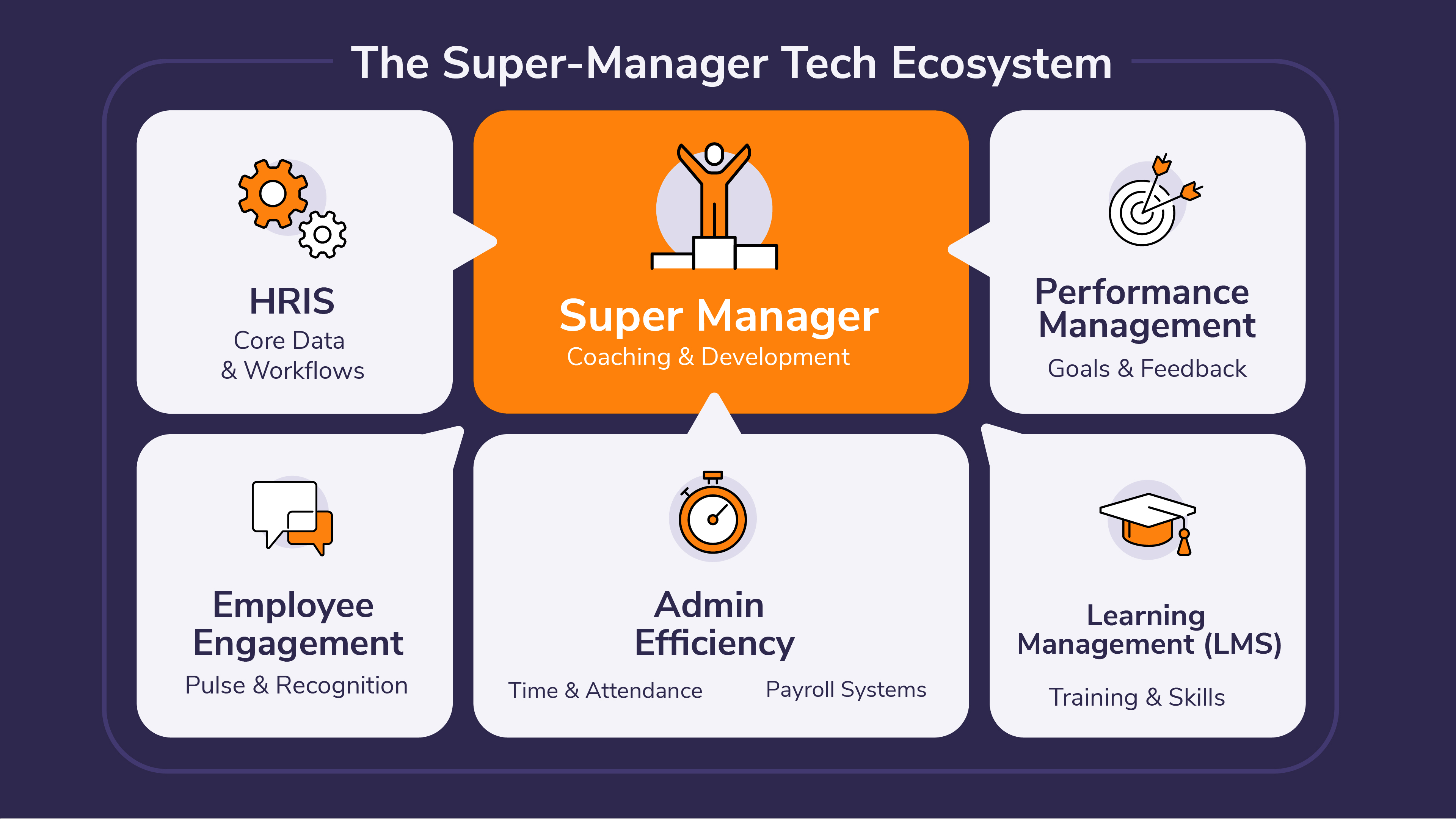
A modern HR stack changes that. When performance management, employee engagement, LMS, and a reliable HRIS work together—and when light‑touch manager AI removes steps and surfaces the right signals—managers get back the time and focus they need for better conversations every week.
Most managers don’t lose time in chunks—it slips away in minutes. A quick check‑in here, a status update there, and hours disappear into scheduling, tracking, and jumping between tools.
It’s no surprise that 70% of companies expect HR software costs to rise this year. Organizations are investing in systems that reduce administrative work so managers can spend more time on coaching and development.
A connected HR stack helps make that happen. When performance management, engagement tools, learning systems, and a dependable HRIS work together—and when manager-focused AI removes steps and surfaces key signals—managers reclaim the time needed for better conversations every week.
A story to start: Nina’s week before and after
Meet Nina, a frontline manager with 12 direct reports across two locations. She spends Mondays scraping updates from email threads, Tuesdays chasing 1:1 reschedules, and the rest of the week trying to remember who asked for what. She also spends hours inside spreadsheets and project boards: shifting deadlines when one task slips, redistributing work when someone is overloaded, and trying to see who has the capacity to take on something new. Feedback happens, but it’s late and vague. By Friday, she’s exhausted—and her team feels the drift.
Now rewind the same week after Nina’s company rolls out a coherent HR + project‑management stack:
HRIS holds role, org, and policy data.
Performance management captures goals, quick feedback, and calibrated summaries.
Employee engagement surfaces pulse signals and recognition in one view.
LMS recommends learning tied to skill gaps.
Time & attendance stabilizes schedules and prevents calendar chaos.
Project management AI rebalances workloads, updates deadlines, flags blockers, and adjusts timelines based on real progress.
Manager AI compiles a one‑page “coaching snapshot” before each 1:1.
On Monday morning, Nina opens each 1:1 card and sees: last week’s commitments, progress on two goals, a peer recognition note, a capacity‑adjusted project view, and an LMS suggestion for a skill her report is building. That 15‑minute prep used to take an hour. Now it’s there, every time. Conversations shift from “What did you do?” to “What will help you do it better?”
This is the super‑manager shift: not a superhero, but a manager whose week has been re‑engineered so coaching, clarity, and development are the default—not the exception.
Why freeing managers from admin work matters
Admin is a tax on attention. When routine tasks—scheduling, follow‑ups, document routing, status checks—pile up, managers lose the time and mental energy needed for coaching. The cost shows up as slower feedback cycles, vague goals, and stalled development. Training and upskilling remain among the top global HR challenges, selected by 45% of surveyed leaders—work that becomes harder when managers lose hours to admin. Employee engagement and well‑being also appear near the top of the challenge list, chosen by 38% to 39% of respondents worldwide, respectively.
Efficiency is not the goal in itself. Saving minutes only matters if those minutes are reinvested into better decisions, clearer expectations, and more consistent 1:1s. The right HR stack should be judged by a simple test: Does this convert administrative effort into coaching time and better conversations?
Coaching drives performance, clarity, motivation, and retention. People stay where they’re growing.
Admin drains attention. When scheduling, follow‑ups, routing, and status checks pile up, managers lose the time and mental space needed for coaching.
The impact shows up fast. Nearly half of surveyed leaders say work becomes harder when managers carry too much administrative load. Issues like engagement and well‑being also rise when feedback cycles slow. . Employee engagement and well‑being also appear near the top of the challenge list, chosen by 38% to 39% of respondents worldwide, respectively.
What efficiency should unlock: clearer expectations, better decisions, and more consistent 1:1s.
The test that matters: Does the HR stack turn administrative effort into better coaching?
Coaching fuels performance, clarity, and development. People grow where support is consistent—and that becomes possible when admin takes up less space.
What makes a “super‑manager” today
Super‑manager attribute | What it looks like in practice |
|---|---|
Accessible | Consistent 1:1s, clear agendas, predictable follow‑ups |
Data‑informed | Goals, feedback, engagement signals, and learning insights in one place |
Development‑focused | Conversations lead to concrete actions and targeted learning |
This is not personality—it’s system design. When software reduces clicks, compiles signals, and prompts the right next step, great management becomes the default.
How technology changes the week (and the quality of conversations)
Here’s how manager AI and modern HR software transform Nina’s week:
1) Scheduling and cadence
Automated 1:1 blocks, reminders, and “reschedule within the week” options protect coaching time instead of letting it be squeezed out by urgent tasks.
2) Performance tracking
Quick feedback notes, goal check‑ins, and summary prompts capture the story of work as it happens. AI assists by drafting summaries or highlighting trends, while Nina stays in control of tone and decisions.
3) Feedback and recognition together
Peer praise and comments appear directly in the coaching snapshot, helping Nina start conversations with specific wins tied to real goals.
4) Learning connected to the work
LMS recommendations appear alongside goals and feedback. Instead of sending people into a training library, Nina can assign one small, relevant next step.
5) Less clerical, more coaching
AI compiles. Nina coaches. Efficiency is a widely observed benefit of HR software adoption: 60% of companies report improved efficiency and 51% report productivity gains after implementing new tools. That division keeps humans focused on nuance, context, and motivation.
But coaching isn’t the only area where Nina used to lose time—project coordination consumed even more hours.
How AI in project management software frees even more manager time
Project coordination is another hidden drain on a manager’s week. Integration problems are a major driver of HR software purchases: 56% of organizations adopted new HR tools in the last 12 months to improve system integrations. Before AI, Nina spent hours adjusting deadlines, redistributing work, and checking who was overloaded—tasks that felt like leadership but were really coordination.
AI‑enabled project management tools reduce that load with three key shifts:
Work visibility without chasing updates
Real‑time progress, blockers, and slipped tasks appear in one dashboard. Nina no longer pieces updates together from calls or chat threads; AI surfaces what changed and what needs attention.
Automatic timeline and workload adjustments
When a task runs late, AI recalculates timelines, shows the ripple effect, and proposes updated deadlines. It also reviews individual capacity and recommends reassignments before overload develops, so Nina intervenes early instead of reacting to burnout.
Proactive risk detection and fewer micro‑tasks
The system flags patterns—recurring delays, dependencies at risk, teams reaching capacity—so Nina can plan, not firefight. Routine micro‑tasks (updating cards, notifying owners, sending reminders) happen automatically, letting her focus on coaching and clarity.
What this unlocks for Nina’s day‑to‑day leadership
With clearer visibility and fewer coordination tasks, Nina enters her 1:1s better prepared and with a sharper view of progress, capacity, and bottlenecks. She spots issues earlier, supports team members sooner, and redirects her time toward development instead of status tracking.
Her conversations become more specific and forward‑looking. Her team experiences fewer surprises, more predictable workflows, and quicker support. AI handles the coordination rhythm; Nina focuses on clarity, support, and growth—the parts of management only a human can do.
The software stack for super‑managers (and why each layer matters)
HRIS: The foundation
Accurate employee data, roles, reporting lines, and permissions keep workflows running smoothly. Clean basics prevent confusion and time‑wasting errors downstream.
69% of companies currently use HRIS.
Performance management: The coaching engine
This is where goals, feedback, and development conversations live. It transforms reviews from once‑a‑year events into weekly check‑ins that drive real improvement. Manager AI can draft summaries, highlight progress, and surface insights.
63% use performance management software.
Employee engagement: The signal layer
Pulse surveys, sentiment themes, and recognition streams tell managers where to lean in. Early signals help them intervene before frustration or misalignment grows.
57% of companies currently use employee engagement tools.
LMS: Development at scale
LMS converts insights into action. Targeted learning, micro‑modules, role‑specific paths, and practice tasks help employees grow in the direction conversations uncover.
57% of companies currently use learning management software.
Time and attendance + payroll: Admin stabilizers
Without stable scheduling and clean payroll processes, 1:1s slip and managers waste their week on operational chaos. These systems free calendar space and cognitive space.
78% of companies currently use payroll software. 73% use time & attendance/scheduling tools.
Project management software: A complementary layer
While not part of the core HR stack, AI‑supported project management tools reduce the coordination load that often consumes a manager’s week. They rebalance workloads, surface blockers, and adjust timelines automatically, creating more space for coaching.
A realistic implementation path (with Nina’s story beats)
Phase 1 — Build the coaching heartbeat | Configure quarterly goals and lightweight feedback notes. Add 30‑minute biweekly 1:1s and AI‑generated coaching snapshots. Nina’s shift: Her 1:1s stop slipping; she stops hunting for updates and starts unblocking work. |
Phase 2 — Add engagement signals | Introduce simple pulse questions and a recognition flow. Let AI cluster themes and propose two questions for team retros. Nina’s shift: She identifies a recurring “handoff” issue across teams and fixes it with one structured retro. |
Phase 3 — Connect learning to coaching | Map skills to roles and tie learning suggestions to goals. AI recommends micro‑modules when patterns emerge. Nina’s shift: A team member struggling with concise updates improves within two weeks through targeted learning and practice. |
Phase 4 — Stabilize the calendar | Use scheduling rules and automated reschedules to protect coaching time. Nina’s shift: Her 1:1 completion rate rises and stays high. |
AI assists; humans decide. AI now shapes purchase decisions: 41% of organizations expect AI to have a significant impact on their HR software choices in the next year.
AI should handle: compiling inputs, drafting summaries, suggesting questions, recommending learning.
Humans must handle: tone of feedback, performance decisions, career paths, compensation, and coaching direction.
To maintain trust:
Keep explanations visible (“This summary used your last three notes and goals”).
Always let managers edit.
Use plain, friendly language.
Give managers control over what gets recorded.
Metrics that prove you’re moving from admin to impact
Leading indicators:
On‑time 1:1 rate
Time to schedule
Frequency of feedback notes
Recognition frequency
Learning assignments
Lagging indicators:
Goal attainment
Pulse scores on clarity and workload
Voluntary turnover
Time from feedback to behavior change
A closing story: Nina’s team, three months later
Nina’s 1:1s are on time. Her team knows their next milestones and how their work connects to them. Recognition is specific, not generic. Two team members completed short learning paths and elevated the quality of their project updates. When workload pressures spiked, Nina caught the early signal in her pulse dashboard and rebalanced assignments before burnout set in. Her project timelines auto-adjust smoothly now, so her team experiences fewer fire drills and more predictability. Globally, improved efficiency (60%), better productivity (51%), and fewer errors (42%) are among the most common benefits companies report after adopting HR technology.
Nothing magical happened to Nina. The system changed so the right behavior became the easy behavior. That’s what a super‑manager looks like in practice: less admin, more coaching, better weeks—repeated.
Sources
* Software Advice's 2025 HR Software Trends Survey was conducted in April 2025 among 3,256 respondents in Australia (n=278), Brazil (n=300), Canada (n=289), France (n=300), Germany (n=300), India (n=294), Italy (n=300), Mexico (n=300), Spain (n=300), the U.K. (n=296), and the U.S. (n=300). The goal of the study was to understand the HR software that companies are buying, their benefits and challenges, and the impact of AI on HR. Respondents were screened for employment at companies with more than one employee, working in management-level roles or above. Respondents were also confirmed to be at least partially responsible for HR software purchase decisions within their organization.