
Best Construction Categories
Best Facilities Management Categories
Best Human Resources Categories
Best Legal Management Categories
Best Manufacturing Categories
Best Medical Categories
Best Property Management Categories
Get 1-on-1 advice in 15 minutes. It's free.

Josh P.

How To Track Project Progress and Make Better Decisions
Every project has its story, and sometimes, unexpected shifts in time and budget can turn a success story into a lesson in what not to do. If you’re handling projects, you're probably all too familiar with these risks. They’re not just minor setbacks—they can derail your entire project and negatively impact your company's financial health.
But there's a way forward. By knowing how to track project progress efficiently, you can identify potential problems early and make smart, timely decisions. Think of project tracking as your map through the unknown, guiding you away from trouble and toward success.
This blog taps into the wisdom of Megan DuBose [1], a seasoned PMP expert from the Project Management Institute (PMI). She shares her know-how to keep your projects on track and your decisions sharp.
Megan DuBose
Project manager at Project Management Institute (PMI)
How to track project progress like a pro and set yourself up for better decisions
To navigate your project to its destination, tracking project progress is pivotal. It's key to ensuring you're not just moving, but progressing in the right direction. Let's lay the groundwork to sharpen your decision-making with precision.
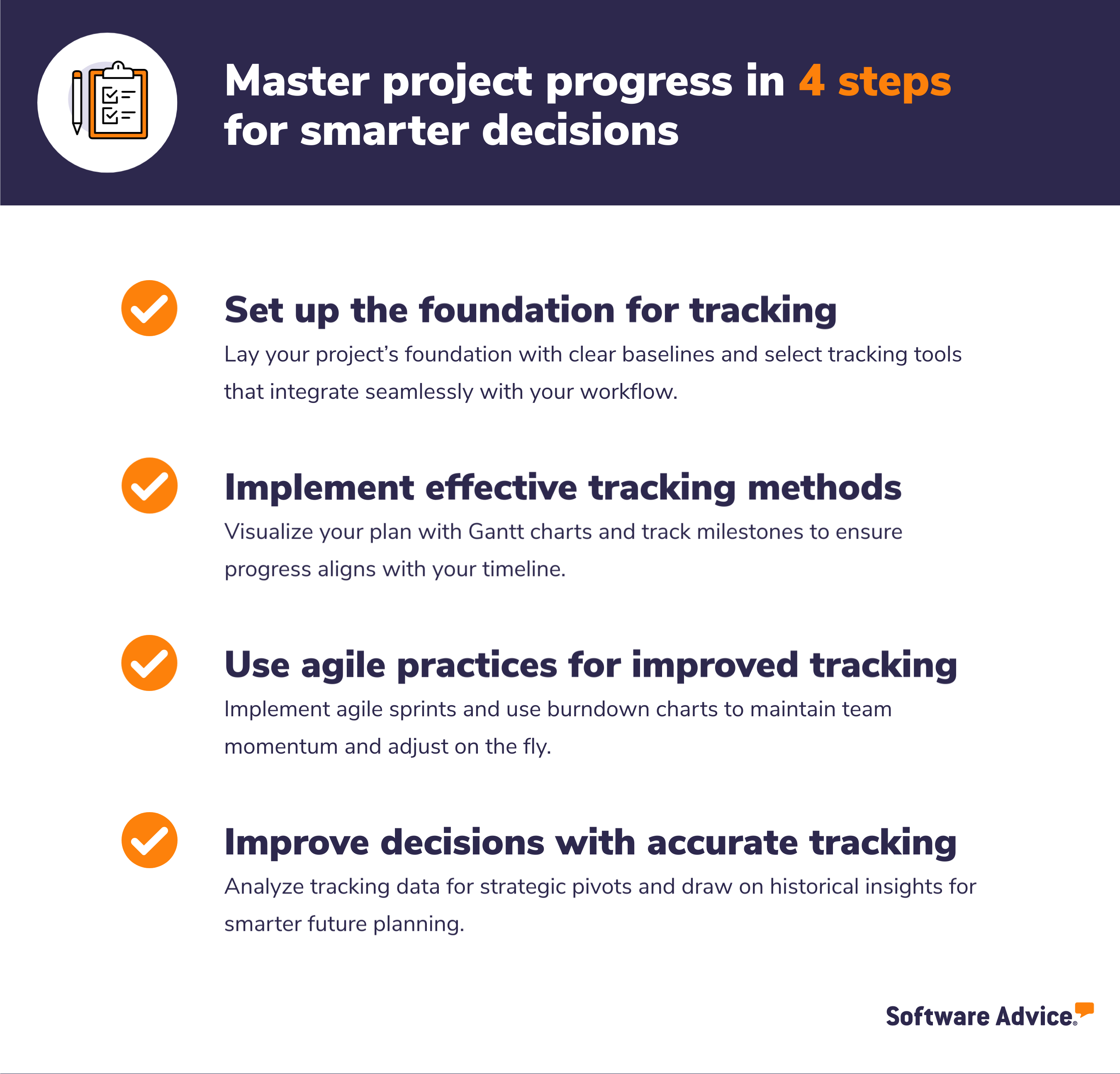
Step 1: Set up the foundation for tracking
Tracking project progress accurately is about moving forward purposefully. The initial step is crucial: building a strong tracking framework leads to informed and calculated decisions. Here’s the best way to get started:
Set your baselines
Your baselines are well-thought-out reference points that chart the course of your project. DuBose highlights that while project timelines are flexible, understanding your project's critical path—the minimum time needed to finish the project—is vital.
She recommends reassessing these baselines if significant project changes occur. This process offers clarity and control over your project's progression, taking into account cost, scope, and time—ultimately mitigating risks along the way.
Select the right software
After setting your baselines, it’s time to select the appropriate project-tracking software. DuBose suggests looking at what your organization already uses to maintain integration and uniformity. She also mentions considering your workflow requirements, which might benefit from automated tools like GenAI for routine tracking tasks.
However, she warns against making your tech setup too complex, as it can cause overlap and confusion. The key, according to DuBose, is to use the tools as a support system to enhance—not replace—your unique project management skills.
Pinpoint your key performance indicators (KPIs)
With your tracking tools in place, the next step is to identify your project KPIs. DuBose proposes a collaborative approach, engaging with project stakeholders to pinpoint success measures and relevant KPIs.
She urges looking beyond surface-level metrics to assess deeper impacts, like user engagement versus mere website visits. This ensures that KPIs are more closely tied to your project goals, giving you a comprehensive view of the project's status and momentum.
Consider these essential KPIs as outlined by DuBose:
Project schedule variance (PSV): Are you on schedule, ahead, or behind?
Cost performance index (CPI): Are you managing to stay within the budget?
Milestones completion: Are you finishing key project stages as planned?
Quality metrics: Is the project's output up to the expected standards?
Step 2: Implement effective tracking methods
The next step is about employing strategies that provide comprehensive insights into your project. This involves choosing methods that allow for continuous and thorough tracking, equipping you with the vision and adaptability needed for managing your project's timeline and resources effectively.
Visualize progress with Gantt charts
For a clear view of how your project is advancing, introduce Gantt chart software. These charts are a visual tool that simplifies the complexity of a project, as noted by DuBose. She notes their effectiveness in showcasing the relationships between tasks, resources, and deadlines, helping all team members understand the overall project plan and how their responsibilities contribute to timely delivery.
Track milestones for clear benchmarks
After taking in the broad perspective with Gantt charts, focus on milestone tracking. Milestones, according to DuBose, signify key points of achievement and serve as indicators of your schedule's accuracy. Monitoring these milestones helps you understand whether your project is on course or if your time estimates need adjustment, keeping your tracking progress in line with your plan.
Ensure time tracking for operational health
Following milestone tracking, implement time-tracking tools for detailed oversight. Time tracking offers a glimpse into the operational side, identifying if project tasks are proceeding efficiently or if bottlenecks are emerging, highlights DuBose. With this information, you can make necessary adjustments, such as reallocating resources or revising timelines, ensuring the project maintains momentum.
Create dashboards for real-time overview
Lastly, bring together your visual maps, milestone data, and time-tracking metrics on a comprehensive dashboard. A dashboard acts as a control center, similar to a command center as DuBose implies, offering a real-time snapshot of the project's status.
This centralized source of information provides the critical data you need at a glance, ensuring you're equipped to make well-informed decisions swiftly.
Step 3: Use agile practices for improved tracking
Agile methods offer more than rules; they provide a flexible framework that boosts responsiveness and effectiveness in tracking projects. When you weave agile techniques into your tracking, you establish a proactive culture that embraces continuous enhancement and agility in managing projects.
Conduct impactful sprint reviews
Sprint reviews are essential to agile tracking, serving as more than routine gatherings; they are pivotal for evaluation. DuBose notes that these reviews delve into both accomplishments and areas needing improvement, fostering a culture of open dialogue and reflection. Such sessions are vital because they promote ongoing development, ensuring the project team is proactive in meeting client expectations and adjusting to shifting business goals.
Measure progress with burndown charts
Burndown charts do more than track remaining work; they provide a visual measure of your team's progress and momentum during agile sprints. DuBose regards these charts as a measure of the team's pace and a storyline of the sprint's progress. These charts show not only the work completed but also how the team is progressing toward goals.
If the burndown trend deviates from the expected, it signals the team to investigate and tackle any issues, whether they relate to expanding project scope or resource utilization/distribution, thus ensuring the project remains on course. These instruments play a crucial role in inspiring and directing the team to a successful sprint completion.
Step 4: Improve decisions with accurate tracking
Good decision-making in project management hinges on the precision of your tracking. As you adjust your project's path, it’s the quality of your decisions that drives success. Here’s how you can use detailed tracking to refine your decision-making:
Interpret data for strategic decisions
Project data is more than figures; it tells your project’s story. Analyzing this data uncovers crucial insights, providing the foresight needed to make strategic decisions. According to DuBose, a deep dive into current trends versus your plan can reveal what’s effective and what could become a stumbling block. This analysis is crucial for proactive decision-making, ensuring your choices are data-driven.
Adapt with insight
When you have precise tracking data, you’re ready to make adjustments that count. DuBose views this information not just as a track progress report but as a springboard for adaptation. Should data suggest a need to reallocate resources or tweak timelines, you're well-positioned to implement those changes decisively. The art, as DuBose suggests, is in turning data into actionable insights that keep the project true to its goals.
Use retrospective insights for forward planning
The role of historical data in decision-making shouldn’t be overlooked. DuBose points out that examining previous projects can shed light on patterns and results that inform tracking and decisions of future projects.
She encourages learning from the past to refine future management tactics—taking note of the most telling metrics and tackling similar future challenges with more finesse. This reflective practice sharpens both your tracking approach and your strategic prowess.
Case study: Elevating business readiness with strategic project tracking
See how DuBose's methodical approach to project tracking helped a company smoothly integrate technology upgrades with employee readiness, setting a new standard for operational agility.
Background:
DuBose faced a challenging process improvement project aimed at synchronizing system upgrades with the business's adaptability.
Challenge:
The objective extended beyond achieving project milestones; it was about fostering sustainable success through user adoption and system efficiency.
Strategy:
Dubose's strategy was twofold, including:
System and process check: She ensured that the new systems were bug-free and the processes were practical for the users’ actual workflow.
Business adoption monitoring: She assessed staff awareness and training, prioritizing the human element of the project readiness.
She wove these elements into her tracking methods, aligning them closely with project KPIs to create a strong foundation for informed decision-making.
Result:
Her detailed tracking enabled proactive fine-tuning before launch, resulting in a smooth rollout, enthusiastic user acceptance, and implementation that earned stakeholders' approval.
Key takeaway:
DuBose's case demonstrates that comprehensive tracking must account for both technical project performance and employee engagement to achieve lasting project success.
Enhance project oversight while remaining budget-aware
Effective project progress tracking goes beyond routine updates; it’s a critical element in the strategic decision-making fabric of project management. Clear benefits arise from diligent tracking: it promotes transparency, supports agile adaptation to project changes, and ensures continued alignment with the project’s objectives.
Incorporating a detailed budget plan using the right template is essential, safeguarding the project's financial health as it progresses toward its goals.
Reflect on these key insights drawn from DuBose’s methodology for enhanced project management:
Assess intersections: Evaluate the ongoing interaction among time, scope, and budget to sustain project balance.
Maintain awareness: Anticipate and react to project fluctuations early to guide it with foresight.
Foster open dialogue: Cultivate constant communication with your team and stakeholders to ensure mutual awareness of overall progress.
Strategic tool utilization: Employ project tracking tools effectively to keep a vigilant watch on the project’s trajectory.
Cultivate flexibility: Embrace the ability to alter the course based on current, reliable data.
Embracing these strategies can elevate your project oversight, delivering results that resonate with precision, efficiency, and stakeholder approval—all within the financial framework that defines your project's success.