
Best Construction Categories
Best Facilities Management Categories
Best Human Resources Categories
Best Legal Management Categories
Best Manufacturing Categories
Best Medical Categories
Best Property Management Categories
Get 1-on-1 advice in 15 minutes. It's free.

Josh P.

Buyer insights to guide your medical implementation right
Rising patient volumes and tighter regulations make running a medical practice more complex than ever. Administrative overload often pulls attention away from care delivery. Medical software helps practices regain control by simplifying operations, reducing compliance risks, and creating space for providers to focus on patient health instead of paperwork.
However, to make the right purchase, it is crucial to know what features you need, the average software price, and common challenges faced when purchasing medical software.
How we can help: Each year, Software Advice talks to thousands of medical buyers. We’ve distilled their insights on budgets, features, and pain points to help you choose the right tool.
Key insights
While medical software buyers prioritize electronic medical records (EMR) functionality in this tool, current users from the industry consider HIPAA compliance as the most important feature in medical software.
Most businesses do not have any dedicated system in place for practice management. While some rely on non-specialized tools to handle their day-to-day medical operations, a small percentage of businesses also use manual methods.
Switching to medical software is driven by the need for new business opportunities, functional sufficiency, and efficiency.
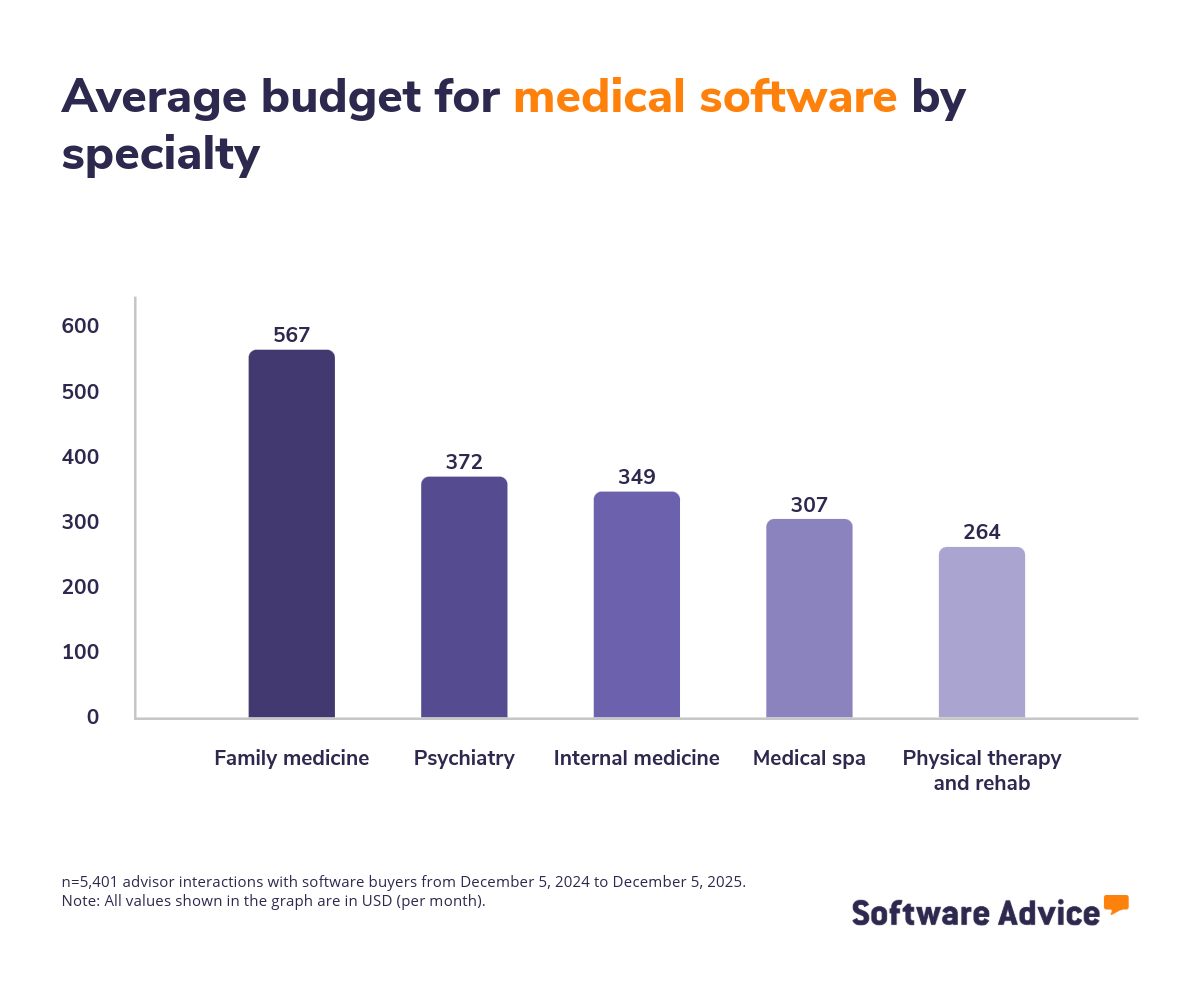
The top five specialties investing in medical software allocate between $264 to $567 per month with an overall buyer average of $402 per month.
Prospective buyers and current users prioritize different features
We analyzed thousands of medical software reviews available on Software Advice to identify the features that software users consider most critical for their business. Our findings revealed a gap between what software buyers and users prioritize.
Around 47% of current software users consider health insurance portability and accountability act (HIPAA) compliance to be the most essential feature in medical software. On the other hand, around 86% software buyers are looking for EMR features in this tool.
This gap signals a critical insight: buyers tend to prioritize features that ensure compliance and structured documentation during purchase decisions, while end-users lean toward tools that simplify everyday tasks and foster collaboration.
HIPAA compliance helps healthcare organizations safeguard protected health information through access controls, audit logs, and secure data handling, supporting regulatory requirements and reducing risk across intake, documentation, and communication.
Electronic Medical Record (EMR) centralizes patient histories, orders, labs, and clinical notes in one chart, improving documentation accuracy, coding, and care coordination while enabling e-prescriptions, results review, and provider-to-provider handoffs.
Pro tip
Make a list of ‘must-have’ versus ‘good-to-have’ features based on your unique practice requirements. For instance, patient records management, telemedicine, and scheduling are non-negotiable requirements for remote healthcare providers. Also, consider your workflows’ complexity and other unique specialty requirements to pick the right tool.
Current pain points for medical software buyers
When our advisors asked buyers what methods they were currently using to handle their day-to-day medical operations, here's what they found:
Nearly 40% of buyers do not have any system to manage their medical operations, and around 30% use non-specialized tools, such as billing and scheduling platforms, for their day-to-day operation workflows.
While 38% buyers already have a dedicated system, around nine percent buyers still rely on manual methods such as spreadsheets to handle their operations.
These discussions shed light on businesses' real-life challenges with their existing methods, which include new business opportunities (37%), limited functionality (27%), and inefficiency (19%).
New business opportunities: Medical practices that rely on manual methods or non-specialized tools often struggle to adapt when new opportunities arise such as partnering with additional insurance providers or adding new service lines. Manual processes are slow, rigid, and hard to scale, while non-specialized tools typically focus on a single function. This forces practices to juggle multiple disconnected systems, creating delays and limiting flexibility.
Limited functionality: Manual methods and generic tools lack integrated capabilities for scheduling, billing, and reporting. Without these features, practices struggle to coordinate staff and patient appointments, manage revenue cycles, and track performance. This fragmented approach prevents data-driven decisions and slows down workflows, ultimately impacting patient experience and operational efficiency.
Inefficiency: Paper charts, appointment books, and spreadsheets make managing a growing practice cumbersome. Adding patients or procedures means extra paperwork and scattered information, making a centralized view hard to maintain. These methods also raise the risk of errors, misfiled records, and compliance issues.
Reasons for switching to a dedicated medical software
Compared to the existing methods used by professionals, a dedicated medical software solution offers the following benefits:
Improved operational efficiency: Medical software automates repetitive tasks such as appointment scheduling, patient reminders, and billing processes. This reduces manual workload and minimizes errors, allowing healthcare staff to focus on patient care rather than administrative tasks.
Enhanced patient accessibility: Unlike manual systems or generic tools, medical software enables secure video consultations and remote care via integrated telehealth features, encrypted communication channels, and patient portals. This makes it easier for patients in rural or underserved areas to access medical services without traveling long distances.
Better compliance and data security: Generic tools and paper-based methods often lack HIPAA-compliant security features such as role-based access controls, encrypted data transmission, and detailed audit trails. Medical software, on the other hand, offers all these features, ensuring secure data storage, encrypted communication, and regulatory compliance, and reducing the risk of legal issues.
Scalability for growing practices: Manual methods and non-specialized tools struggle as patient volume increases. Contrarily, a dedicated medical software solution supports high-volume scheduling, integrated EHR management, and multi-provider coordination, helping practices scale without operational bottlenecks.
Improved patient engagement and satisfaction: Medical platforms offer features such as real-time messaging, prescription management, and follow-up reminders, which generic tools cannot provide. These capabilities improve communication and enhance the overall patient experience.
Pro tip
Ensure your shortlisted software includes data backup and recovery features, including encryption, versioning, testing, access control, and data retention policies. These features will enable you to recover your protected health information (PHI) without compromising its integrity in case of data loss or a security incident.
Average budget for medical software buyers
The budget for purchasing medical software varies from one specialty to another based on the software's functionality, number of users, deployment model, and integration requirements. However, based on our advisors’ interactions, the average budget across specialties for purchasing medical software was approximately $402 per month.
The chart below highlights the average buyer budget per month for the top specialties interested in medical software.
Use cases for medical software
Based on our advisors’ interactions, these are the top industries using a medical tool for different use cases:
Family medicine practitioners handle diverse patient needs, from preventive care to chronic disease management. They use medical software to maintain comprehensive patient records, manage appointments, and coordinate care across age groups. Features such as integrated EMR, lab connectivity, and patient portals are essential for delivering holistic, continuous care.
Psychiatry relies heavily on confidentiality and remote accessibility. Medical software supports secure telehealth sessions, HIPAA-compliant messaging, and detailed progress notes for therapy and medication management. Unlike other specialties, psychiatry emphasizes privacy and virtual care tools to ensure patients receive consistent support without in-person visits.
Internal medicine practitioners focus on complex adult health conditions and chronic care. They use medical software to manage diagnostic workflows, lab results, and referrals while providing analytics for treatment planning. This specialty requires advanced EMR capabilities and strong reporting features to handle multi-condition patients and ensure accurate documentation.
Medical spas prioritize client experience and compliance for aesthetic treatments. They use this software for appointment scheduling, consent form management, inventory tracking, and marketing tools. Unlike clinical practices, medical spas need features that blend operational efficiency with customer engagement to support wellness and cosmetic services.
Physical therapy practices depend on progress tracking and patient engagement. Medical software offers them treatment plan templates, exercise documentation, and tele-rehab options for remote sessions. Billing and scheduling features tailored for therapy sessions are critical, as this specialty focuses on measurable outcomes and continuity of care beyond the clinic.
Looking for more resources?
Click here to check out our medical software directory and Buyers Guide, and compare hundreds of products.
Survey methodology
Software buyers analysis methodology
Findings are based on data from conversations that Software Advice’s advisor team has daily with software buyers seeking guidance on purchase decisions. The data used to create this report is based on interactions with small-to-midsize businesses seeking medical tools. For this report, we analyzed approximately 4000+ phone interactions from December 5, 2024 to December 5, 2025.
The findings of this report represent buyers who contacted Software Advice and may not be indicative of the market as a whole. Data points are rounded to the nearest whole number.