
Best Construction Categories
Best Facilities Management Categories
Best Human Resources Categories
Best Legal Management Categories
Best Manufacturing Categories
Best Medical Categories
Best Property Management Categories
Get 1-on-1 advice in 15 minutes. It's free.

Josh P.

What You Need to Know About Achieving Food Truck Profitability: 2 Experts Sound Off
If you’re looking to start your own food venture but don’t want to go the traditional brick-and-mortar restaurant route, then a food truck is likely right up your alley.
But food truck owners will be the first to say it isn’t any easier than opening a restaurant. According to the Restaurant MBA, 25% of food trucks fail within their first year and 60% fail within three years.
Knowing your food costs by heart and staying on top of your margins is key to achieving business profits for your food truck, according to two experts in the food truck industry.
What does it take for a food truck to be profitable? We speak to Neil O’Quinn, owner of Tommy Want Wingy, which specializes in chicken wings, and Christopher Grozdon, who is launching a dessert food truck and advises restaurants on their digital marketing strategy.
7 Factors that affect food truck profitability
1. Cost of food and ingredients

Christopher Grozdon
Food truck consultant
“By having a system and process in place for managing limited menu items, you’ll be able to optimize ingredient costs by seeing a 10-15% drop in food and ingredient waste costs.”
Keep ingredients minimal and high-quality
Focus on all-natural and organic, if possible, says Grozdon. “Many will think it’s costlier to use real ingredients in place of pre-made components of a recipe, but that cannot be further from the truth,” says Grozdon. This is especially true if food truck operators have a disciplined system and process in place. If so, they can expect as much as a 15% decrease in food waste costs.
Know, track, and account for your food costs
Have a number in mind for how much you can afford to pay for your food and maintain a comfortable margin. Your food costs should be between 28%-35% of the price you sell your product for.
“The basic rule of thumb I learned in culinary school and working at a wine bar is that if it costs me $5, I’ve got to sell it for $15. $10 goes to paying business costs and employees, and the last $5 goes to me,” says O’Quinn.
Pro tip: Get your food costs under control with restaurant POS and management systems that can help you track food costs and measure profit margins for individual menu items.
Throw nothing away
Nothing goes to waste at Tommy Want Wingy. Not even chicken bones.
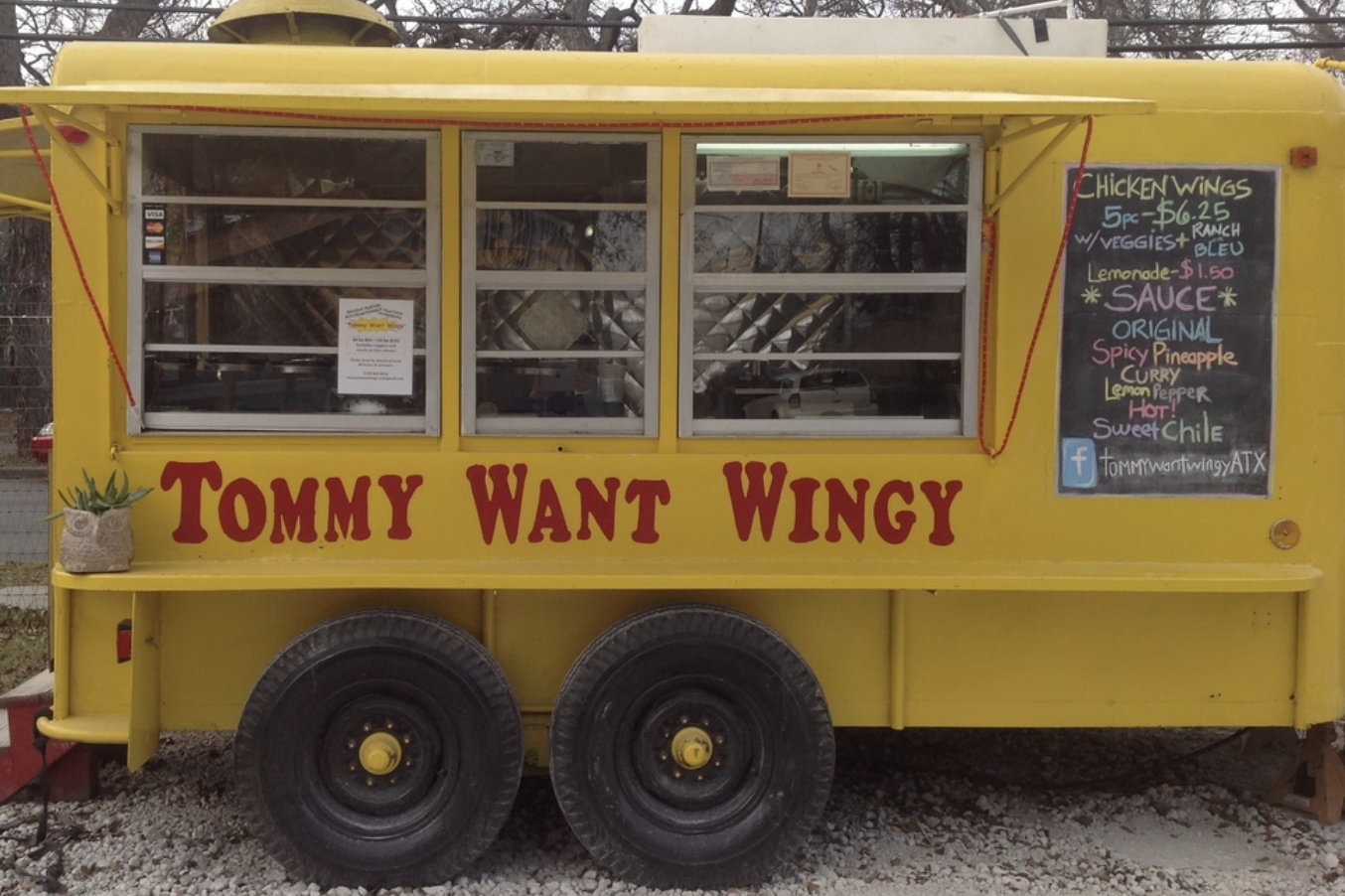
Based in Austin, Texas, Tommy Want Wingy launched in November 2012
Every week the chicken wings food truck ends up with a bunch of chicken bones, which O’Quinn saves for its soup bowls. “We’re taking scraps and making something else of it. Something that costs $1.50 to produce, we sell it for $6. That’s a very good profit margin,” says O’Quinn.
“Absolutely nothing gets thrown away, and that’s especially important as your menu grows and staff increases.”
2. Cost of packaging materials

Neil O’Quinn
Founder of Tommy Want Wingy
“We try to get everything in one trip so we’re not running around. That saves me hours of time in traffic. I value my time and effort versus going to different stores to get stuff.”
Save by ordering in bulk for wholesale prices
When you’re just starting out, buying all your packaging and utensils at Costco or Sam’s Club may seem to be the easy option.
However, ordering in bulk wholesale pricing from the distributor or manufacturer with a one-time upfront fee can be more cost effective. “This way, you’ll have all the packaging materials required for the year and save on a per unit cost basis,” says Grozdon.
For example, each to-go container from Costco costs $0.20 on average. That cost is reduced by five cents when you purchase directly from an account manager within a paper or plastic packaging group. “This could add up to thousands of dollars in savings over the course of a year, depending on your volume,” says Grozdon.
Account for time and effort
Time on the road means time away from your food truck. “We try to get everything in one trip so we’re not running around. I value my time and effort versus going to different stores. I like to pick up everything at once and that saves me hours in traffic,” says O’Quinn.
Pro tip: Being able to maintain the right level of inventory on hand is key to managing a successful food truck. Not doing so can result in potential losses that could be detrimental to your business. An efficient inventory management system can help determine the proper levels of inventory you’ll need.
3. Cost of labor
Neil O’Quinn
Founder of Tommy Want Wingy
“That’s the big money suck, but what I’ve found is you’ll always get what you pay for.”
Be prepared to pay for quality talent
When you’re just starting out, it can be tempting to skimp on expenses. But hiring is not a place for cutting costs.
Attracting the right people for your food truck, even if it’s costlier in the beginning, is well worth it, says Grozdon, especially when it comes to paying people to represent and operate your food truck business when you’re not physically present.
“You’ll attract committed, prompt, respectful, and professional individuals more often than not when you pay a higher wage. Nothing is worse as a food truck owner than having low-quality employees ruining your business’ name and reputation because they’re upset they’re only making minimum wage.”
Pro tip: Learn how you can build a strong core team with tips from the owner of Peached Tortilla.
Hire for hard work and customer service–and reward your hires
Your fans are the lifeblood of your food truck. The ability to engage customers with friendly conversation while they wait on their food is an understated—but crucial—skill.
As Tommy Want Wingy operates into the nights next to a bar, a good portion of customers visit the truck after a night out. Situations can get rowdy at times.
“[Some nights] we deal with a lot of drunk people, so it’s important that we have our seasoned veterans at the window,” says O’Quinn. “They’re able to handle anything that comes their way.”
Quality talent doesn’t go unnoticed by O’Quinn. “We pay our people well and they make good tips, so they’re happy.” Often times, he arranges team nights to keep morale up and thank employees for their hard work.
Pro-tip: Manage your team with food truck management software, whether it’s posting a job to the top job boards to reach the most qualified candidates, or monitoring employee schedules to see who’s approaching overtime and who’s available to fill in.
4. Cost of leased space
Christopher Grozdon
Food truck consultant
“If you’re a food truck owner in a food truck lot, the costs are much more minimal than compared to a brick-and-mortar retail location—yet it’s still a monthly cost where you’ll most likely have to commit for a year or more.”
Weigh out location costs versus marketing
This is another area where you don’t want to cut corners. The less you spend on location, the more you’ll spend on marketing and awareness.
“It may seem great to choose the barren piece of land that is only $100/month, but if it’s nowhere near any type of regular customer base, you’re going to end up spending the same—or more—on marketing efforts [as on better real estate] to generate the awareness needed to bring customers to your far-away location,” says Grozdon.
Turn over tables quickly and stay busy
While O’Quinn’s first food truck spot cost just $650 per month, he struggled in the early days to find a crowd. “Nobody would show up to the court. We were on social media, going, ‘Hey come see us! We are behind this building, and we know you can’t see us.'”
O’Quinn’s big move came when his yellow truck moved near one of the biggest bars downtown. “We got a pretty good deal on rent and keep up with the amount of people in the court. What it comes down to is being busy: You can have the biggest budget in the world, but you’ve got to keep busy and turn over quickly,” says O’Quinn.
5. Cost of insurance
Neil O’Quinn
Founder of Tommy Want Wingy
“We learned a lot along the way because everything that can go wrong will go wrong.”
Get a high-quality insurance plan
Food trucks are exposed to a unique set of risks that owners need to protect themselves against. The list of things that can go wrong in a food truck business is extensive—think food poisoning, slip and fall accidents, and even choking deaths.
“Protect yourself with a high-quality insurance plan for all aspects of your business and if/when something goes wrong, you’ll thank yourself a thousand—or a million—times over,” says Grozdon. Expect to pay upwards of $300 or more for annual insurance costs for your food truck.
Research food truck-focused insurance companies
O’Quinn recommends talking to insurance companies that cater to food trailers. The insurance company will consider the type of food made and equipment used, as well as annual revenues and years of experience owning a food truck. List and add up the value of business property and supplies you have. This information will help you to get the most accurate quote.
6. Cost of utilities and miscellaneous expenses
Christopher Grozdon
Food truck consultant
“These are things you’ll have to pay if you want to be compliant with local county and city ordinances.”
Administration: Permits, inspection costs
“It’s just the name of the game and if you want to win, you have to play ball with admin expenses,” says Grozdon. These expenses can vary, depending on county, city, or state. For O’Quinn, a food permit costs about $500 a year, followed by propane inspection at around $200 and overall inspection costs between $700-$800 a year.
Utilities: Water, electricity, propane
If you’re in the business of making fresh and tasty food, then these are basic requirements and non-negotiables to be factored into your monthly calculations. “These will typically be quite affordable considering you’re occupying a very small subset of the space you’d occupy if you were a brick-and-mortar restaurant,” says Grozdon.
Pro tip: Calculate propane usage. It’s important to prepare for how much propane you’ll use every week in your food truck so that you don’t run out at an inopportune time. Tommy Want Wingy uses as much as three 100 lb. propane tanks per week. Each tank costs about $75, amounting to around $225 week.
7. Cost of marketing
Christopher Grozdon
Food truck consultant
“These costs vary wildly and will ultimately be determined by how fast you’d like to see your business grow.”
Consider your long-term plan
Do you view your food truck as a passion project where you bring joy to customers with delicious food? If so, a simple website and social media presence showcasing your truck’s latest happenings should suffice.
On the other hand, if you have plans to expand from food truck to a brick-and-mortar in a few years, expect to invest a significant amount in digital marketing, says Grozdon.
Personable service goes a long way
Aside from a couple of $15 Facebook ads, a website and basic social media, O’Quinn says his main marketing is simply through good food and good service. “I make sure to table touch everybody and ask everyone how the food is. It makes a big difference. I see the same customers all the time,” says O’Quinn. “If your food and service is good, everyone has the potential to be a regular. There’s no reason for them not to come back.”
Pro tip: Just starting out and new to marketing your business? The good news is that there are email marketing platforms that offer free versions to help you get started. Once you get a sense of what’s best for your business, you can commit to one. Prices vary widely, ranging from $10 to over $200 a month.
Final words: How to ensure food truck profitability
Both O’Quinn and Grozdon refer to food costs and pricing as key to increasing profit margins and achieving business profits. Read on for their parting messages:
Christopher Grozdon
Food truck consultant
“After a few months of operating your food truck and adapting to customer volume trends, you’ll be able to optimize costs by increasing your margins by 30% to over 60%.
“An example of achieving this margin: it costs $2 to make a breakfast sandwich—this includes ingredients, labor, packaging, lease cost broken down by opening hours, etc.
“You can sell it for $7.50 to customers to make a profit margin of 73%. This is not unheard of at all. There are lots of food trucks out there who are cashing in. It’s bizarre to me when I hear people who’ll say, ‘You’ll only want to start a food truck if you’re passionate about the food because you’re not going to make any money.’ It all comes down to an efficient process and system in place and a strong focus on margins and volume.”
Neil O’Quinn
Founder of Tommy Want Wingy
“Know your food cost through and through. If it costs too much to make, don’t make it. For example, if a plate costs $9 to make, it is not the dish you want to sell. Nobody wants to pay more than double digits at a food truck. They’re paying restaurant prices and eating outside.
“Sure, your food’s delicious but is it worth it? Will they want to come back? Don’t bite off more than you can chew. When you’re starting a food truck, you get one chance to make it work.
“Also, when you’re starting out, practice cooking these dishes for as many as 50 people. Once you get out there, things change and people start to cut corners. Learn how to make more, while keeping the quality consistent. And remember, the more that you make—the bigger the bulk order—the cheaper it’s going to be.”
Next step: Monitor your food costs with restaurant management software
Selecting the right restaurant management tool with food cost tracking can improve forecasting to boost your profit margins.
Click here to check out our detailed list and reviews of restaurant management software.
Or, if you prefer to talk with a real person, our expert software advisors are here to help you find the most suitable software to launch your food truck. Call (844) 680-2046 for a free consultation today.