


Best Higher Education ERP Systems Software of 2026
Updated March 18, 2026 at 3:29 PM
- Popular Comparisons
- Buyers Guide
Compare Products
Showing 1 - 25 of 41 products
Compare Products
Sort by
Reviews: Sorts listings by the number of user reviews we have published, greatest to least.
Average Rating: Sorts listings by overall star rating based on user reviews, highest to lowest.
Alphabetically (A-Z): Sorts listings by product name from A to Z.

ePROMIS FutureGen Enterprise Cloud is an all-in-one cloud platform that provides businesses with comprehensive management functi...Read more about ePROMIS ERP
ePROMIS ERP's Best Rated Features
See All
ePROMIS ERP's Worst Rated Features
See All

Striven is a cloud-based enterprise resource planning (ERP) solution suitable for many industries and organizations of all sizes...Read more about Striven


Striven's Best Rated Features
See All
Striven's Worst Rated Features
See All

Invoicing software and so much more. With Holded, you can handle electronic invoicing for your business and manage everything e...Read more about Holded


Holded's Best Rated Features
See All
Holded's Worst Rated Features
See All

ERPAG is a cloud-based enterprise resource planning (ERP) solution. It is suitable for small and midsize businesses in various i...Read more about ERPAG
ERPAG's Best Rated Features
See All
ERPAG's Worst Rated Features
See All

BQE CORE is a cloud-based accounting and invoicing software designed for architecture, engineering, and consulting firms. The pl...Read more about BQE CORE Suite

BQE CORE Suite's Best Rated Features
See All
BQE CORE Suite's Worst Rated Features
See All

aACE is a powerful, comprehensive business management solution designed for companies that have outgrown small-business packages...Read more about aACE


Cloud ERP Software is an enterprise resource planning solution that integrates core business management functions into a single ...Read more about Cloud ERP


ERPNext is an enterprise resource planning (ERP) solution that offers financial accounting, project management, human resources ...Read more about ERPNext
ERPNext's Best Rated Features
See All
ERPNext's Worst Rated Features
See All

QT9 ERP is a highly-scalable manufacturing platform for connecting and automating business data from multiple systems into one s...Read more about QT9 ERP


Hubble is an integrated financial performance management solution. It can be deployed on-premise and is also available as a clou...Read more about Hubble


SAP Business ByDesign is a cloud-based enterprise resource planning (ERP) solution. It unifies core business functions such as f...Read more about SAP Business ByDesign

SAP Business ByDesign's Best Rated Features
See All
SAP Business ByDesign's Worst Rated Features
See All

Sage X3 is a powerful ERP software solution designed for midsized national and global manufacturers, distributors, and after-sal...Read more about Sage X3


Sage X3's Best Rated Features
See All
Sage X3's Worst Rated Features
See All

Averiware offers an integrated cloud-based enterprise resource planning solution. Key features include accounting and financial ...Read more about Averiware

Starta is a cloud-based enterprise resource planning (ERP) solution that helps businesses manage their documentation, informatio...Read more about Starta

Composity is a cloud-based enterprise resource planning (ERP) solution that caters to small and midsize businesses across variou...Read more about Composity

Erpisto is cloud-based enterprise resource planning (ERP) platform designed for midsize to large enterprises. It caters to multi...Read more about Erpisto

NolaPro by Noguska LLC is a customizable accounting solution, featuring order tracking, inventory, POS and more. It provides a t...Read more about NolaPro

Paragon ERP is a cloud-based enterprise resource planning (ERP) suite suitable for small to midsize businesses in all industries...Read more about ParagonERP


WinWeb is a Cloud based Enterprise Resource Planning (ERP) suite for small and midsize businesses in multiple industries includi...Read more about WinWeb


Xledger is a cloud-based enterprise resource planning (ERP) solution that caters to midsize and large businesses and helps them ...Read more about Xledger


EXEControl is an enterprise resource planning (ERP) solution that helps organizations manage their core business operations incl...Read more about EXEControl

Aysling is a cloud-based enterprise resource solution that can run an entire business, from leads to sales, through delivery to ...Read more about Aysling


EAMbrace is a facility management software platform available for either cloud-based or on-premise deployment. It is intended to...Read more about EAMbrace

VIENNA Advantage is one unified business management suite available on-premises and on the cloud. VIENNA Advantage customers are...Read more about Onfinity

RamBase is a cloud-based enterprise resource planning (ERP) solution that caters to mechanical, electronic and high-tech manufac...Read more about RamBase


Popular Comparisons


Buyers Guide
This detailed guide will help you find and buy the right higher education erp systems software for you and your business.
Last Updated on January 27, 2025The overall quality of a higher education institution depends largely on how well it's run. Institutions can concentrate on providing excellent services to students only when their own processes are running smoothly.
A dedicated higher education ERP software system can help eliminate manual intervention in everyday operations. This allows you to focus on ensuring that your students succeed in their academic careers.
We've created this Buyer's Guide to help you better understand how a higher education ERP system works. The guide details everything you need to know before purchasing an ERP solution.
Here's what we'll cover:
What Is a Higher Education ERP System?
Common Features of Higher Education ERP Systems
Benefits of Higher Education ERP Systems
What Is a Higher Education ERP System?
A higher education ERP system helps manage business workflows at colleges and universities. It streamlines the flow of information between all business functions and departments within the institution. It also makes it easier to manage interactions with outside stakeholders.
This type of software plays a big role in planning, designing the operations of all academic resources. It automates aspects of the student life cycle and helps faculty members manage their teaching agendas, along with their administrative tasks.
Common Features of Higher Education ERP Systems
Vendors in this market offer a variety of functional breadth and depth in their systems. To help you understand these features better, let's look at the common capabilities found in higher education ERP software:
Admissions management | Eliminate manual processes involved in managing student inquiries, application processing and student registration. Integrate email and SMS functionality. |
Attendance management | Integrate students' daily schedules and track attendance. Create attendance reports, class rosters and send email/SMS alerts to students. |
Tuition/fee management | Create multiple plans for different courses. Enroll students in single or multiple plans, track payments and generate receipts. |
Alumni management | Create, maintain and update alumni database. Create online alumni event registration pages to connect with alumni and keep them informed. |
Curriculum/course management | Create and manage different courses. Define the sections, credits and number of hours for all courses. |
Faculty management | Manage faculty recruitment, faculty profiles and their schedule/workload. |
Student information/records system | Create and maintain detailed student profiles. Generate student ID cards with unique barcodes. Integrate student information from all other modules in a central location. |
Academic analytics | Get deep insights regarding the activities of students and faculties, e.g., what courses are in high demand. |
Student portal | Lets students enroll, register and pay for courses with an easy-to-use online portal. |
Certificate/document management | Students, faculty and other staff members can request certificates to be issued. Users can set up system for auto approval, manual approval and rejection of the certificate requests. Documents can also be stored and printed on institute letterhead. |
Inventory management | Create and manage a list of items such as books, stationery, computers and lab equipment with serial numbers and vendor details. |
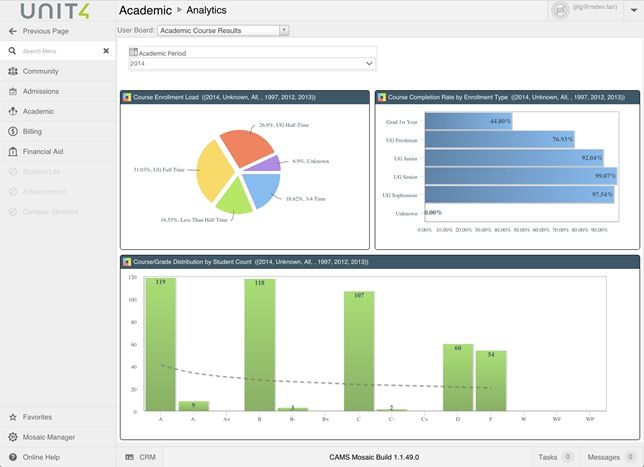
Academic analytics in Unit4 CAMS Enterprise Software
To find out which vendors offer specific applications, call our advisors at (844) 680-2046. They can also help you determine your business needs better by matching the software features to your exact needs.
What Type of Buyer Are You?
Before you start evaluating different higher education ERP systems, you should know the buyer category that best describes you. Most all buyers will fall into one of the following categories:
Small higher education institutes (fewer than 1,000 students). These buyers are focused on day-to-day requirements such as managing student admissions, the curriculum and faculty members. They require a simple higher education ERP system that fulfills these basic needs, but that is capable of scaling up when required.
Such buyers will be more interested in software that offers features such as admission management, curriculum management, faculty management and tuition/fee management.
Midsize higher education institutes (1,000 to 5,000 students). Buyers that fall into this category need more complex functionality and features for managing a large number of students and faculty members.
They should look for software that provides the basic features mentioned above as well as alumni management and a student portal.
Large higher education institutes (more than 5,000 students). These buyers require data integration across all departments and multiple locations. They'll want an ERP suite that consolidates most functions. This allows them to avoid the technical challenges of integrating many disparate applications.
Buyers in this category will require advanced features such as academic analytics and certificate management.
Benefits of Higher Education ERP Systems
Some of the benefits of higher education ERP systems should already be evident. Here's a summary of the most key benefits:
Increase daily productivity. A higher education ERP system helps administrators accurately organize campus data and reduce time and effort spent on managing the institution. These systems also give administrators access to various data insights for better allocation of resources.
Connect multiple departments and campuses. This software allows administrators to manage departments, functions or affiliate institutions operating in different locations. It connects all campuses and departments on a single integrated platform to make data access and management more efficient.
More effective internal communication. Effective communication ensures that your institution runs like a well-oiled machine. A higher education ERP system facilitates smooth communication between students, teachers, administrators, management and parents. It also ensures that all stakeholders are on the same page.
Key Considerations
Keep the following considerations in mind when you evaluate vendors for shortlisting:
Is the software scalable? You'll need to check whether the software is scalable and will adapt as your institute grows. The software must be compatible with existing systems and able to manage a growing number of users. Also, ask the vendor what to expect as far as an increase in license costs when you add new users and/or modules in the future.
Does the software support integrations? Check with the vendor whether the software supports integrations with your existing or preferred third-party applications, such as publishing software, a library management system or a content authoring system. Be specific about the types of stakeholders who will be using the software.
Does the vendor offer customer support? Based on your specific requirements, check whether the vendor offers support 24/7, only during business hours or not at all. In addition, look into all the available support options, such as email, phone or live chat. Also ask the vendor about their average response time to resolve issues.