
Best DDoS Protection Software of 2026
Updated April 24, 2025 at 2:41 PM

Written by Supriya Deka
Market Research Specialist

Edited by Rina Rai
Senior Editor
- Popular Comparisons
- Buyers Guide
Compare Products
Showing 1 - 25 of 35 products
Compare Products
Sort by
Reviews: Sorts listings by the number of user reviews we have published, greatest to least.
Average Rating: Sorts listings by overall star rating based on user reviews, highest to lowest.
Alphabetically (A-Z): Sorts listings by product name from A to Z.

Fidelis Elevate, an Open XDR (Extended Detection and Response) platform, enables cyber security by automating defense operations...Read more about Fidelis Elevate

GeeTest's advanced CAPTCHA and bot management solutions shield websites, mobile apps and APIs from automated bot attacks like AT...Read more about GeeTest CAPTCHA


GeeTest CAPTCHA's Best Rated Features
See All
GeeTest CAPTCHA's Worst Rated Features
See All

CHEQ is the global leader in Go-to-Market Security. Trusted by more than 15,000 companies, ranging from emerging brands to the ...Read more about CHEQ

CHEQ's Best Rated Features
See All
CHEQ's Worst Rated Features
See All

IPQS is a leading fraud prevention solution tailored for businesses like yours. Powered by the most up-to-date and comprehensive...Read more about IPQS

Cloudflare is a cloud-based web performance and security tool, which helps firms in the public and private sectors with protecti...Read more about Cloudflare

Cloudflare's Best Rated Features
See All
Cloudflare's Worst Rated Features
See All

Log360 is a SIEM or security analytics solution that helps you combat threats on premises, in the cloud, or in a hybrid environm...Read more about ManageEngine Log360


ManageEngine Log360's Best Rated Features
See All
ManageEngine Log360's Worst Rated Features
See All

DefensePro provides automated DDoS protection from fast-moving, high-volume, encrypted or very-short-duration threats and is par...Read more about Radware DDoS Protection
Radware DDoS Protection's Best Rated Features
See All
Radware DDoS Protection's Worst Rated Features
See All

Unify SIEM, endpoint security, and cloud security Elastic Security modernizes security operations — enabling analytics across ye...Read more about Elastic Security
Elastic Security's Best Rated Features
See All
Elastic Security's Worst Rated Features
See All

We deliver data to a billion unique users every day. With over a decade of expertise, cash-flow positivity, and sustained profit...Read more about CDN77


Prophaze WAF is a cloud security software designed to help businesses in various sectors such as education, healthcare, manufact...Read more about Prophaze WAF


Modshield SB is a web application firewall (WAF), which helps small to large businesses filter and monitor traffic and protect d...Read more about Modshield SB

Netacea Bot Management is a bot attack protection solution for businesses. It uses machine learning to detect malicious bots, re...Read more about Netacea Bot Management


Security & Event Manager by SolarWinds is a log management solution that caters to businesses across various industries. Key fea...Read more about Security Event Manager

Kount is a financial fraud detection and DDoS solution that helps businesses reduce chargebacks, prevent account takeovers, dete...Read more about Kount

Bot Manager, part of the Akamai Intelligent Edge Platform, designed to protect web applications against sophisticated bots. It u...Read more about Bot Manager

Myra Security is a cloud-based cybersecurity provider specializing in comprehensive protection for digital applications and infr...Read more about Myra Security

Incapsula is a cloud-based application delivery controller (ADC) platform, which uses a global content delivery network (CDN) to...Read more about Incapsula

NetFlow Traffic Analyzer is a network mapping software designed to help businesses in the IT sector monitor bandwidth and analyz...Read more about NetFlow Traffic Analyzer


AppTrana is a website and application security tool, designed to help businesses manage and maintain cloud security using scanni...Read more about AppTrana

AWS Shield is a vulnerability management solution that helps businesses streamline processes related to inline attack mitigation...Read more about AWS Shield

Cloudbric is a cloud-based web security provider, offering a web application firewall (WAF), DDoS protection and SSL. Its compre...Read more about Cloudbric

NordVPN is a computer security software designed to help businesses encrypt internet connectivity to securely access personal in...Read more about NordVPN

NordVPN's Best Rated Features
See All
NordVPN's Worst Rated Features
See All

DataDome is setting the new standard in online fraud and bot management. With a mission to free the web from fraudulent traffic ...Read more about DataDome


Haltdos helps users protect websites and web services by providing DDoS mitigation. It helps monitor, detect and mitigate DDoS a...Read more about Haltdos

Webroot DNS Protection is a cloud-based solution that helps businesses reduce DNS hijacking, enforce web access policies, provid...Read more about OpenText Core DNS Protection
Popular Comparisons


Buyers Guide
This detailed guide will help you find and buy the right ddos protection software for you and your business.
Last Updated on April 24, 2025A distributed denial-of-service (DDoS) attack is a type of cyberattack that crashes your business website by flooding it with traffic. It sends multiple service requests to a target device or network to the point that it fails to sustain the volume and shuts down. And if your website becomes inaccessible, you could end up losing customers and revenue. Businesses such as ecommerce firms that depend on their websites to stay operational are more prone to DDoS attacks.
DDoS protection software helps secure your websites, applications, and networks from such attacks, without compromising on traffic. It provides user activity monitoring, network security monitoring, and botnet detection, among other capabilities, to identify and block malicious DDoS traffic from reaching your websites and applications.
With an array of products available on the market, buying a DDoS protection tool can be confusing. To help you figure out which tool matches your business needs, we’ve created this buyers guide that has all the essential information related to purchasing DDoS protection software.
Here’s what we'll cover:
What is DDoS protection software?
DDoS protection software is a software tool that helps secure a target network, an application layer, or an IT environment from DDoS attacks and intrusions. It monitors event logs from a variety of sources, including firewalls, servers, authentication services, and workstations, to filter incoming traffic to business websites or networks.
The software monitors web traffic, detects botnets, configures rules and alert situations, and analyzes attack patterns to secure websites and applications. It allows only legitimate traffic to pass through, and traffic that’s not legitimate is denied access. This helps businesses maintain website functionality, prevent downtime, reduce the risk of data thefts, and minimize the cost of web security.
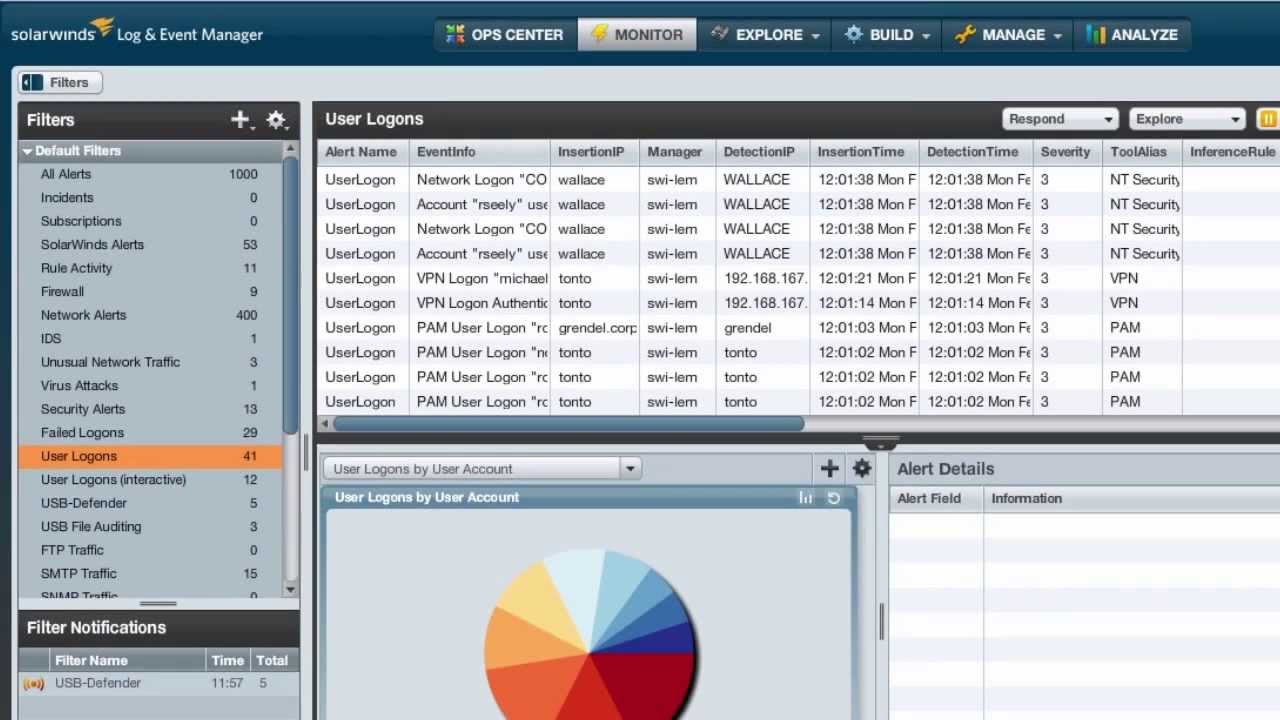
Reporting and analytics in SolarWinds Security Event Manager (Source)
Common features of DDoS protection software
Software features vary by product or vendor, but most DDoS protection tools have the following features:
Track, record, and report abnormal traffic in applications, websites, or software systems. Restore service operations as quickly as possible to minimize the impact of service downtime on business operations. | |
Reporting/analytics | Generate detailed reports on security events, network activity, activity time, access attempts, and security failures, among others. These reports can be used for analysis, records management, and compliance purposes. |
Web traffic monitoring | Review and analyze traffic to evaluate website performance, stability, and the overall user experience. You can monitor the number of website visitors within a specific period, overall visit duration, website speed, most popular pages or website components, etc. |
Alerts/notifications | Get notifications about errors or performance issues in your applications, servers, networks, or websites. Alerts are sent via emails, desktop alerts, SMSes, etc. |
Dashboard | Use a centralized dashboard to view insights into website traffic patterns, threats observed and blocked, and visitor behavior, among other metrics. |
Server monitoring | Gain visibility into the performance of your physical or virtual servers. Track in-depth performance data, including memory utilization, CPU load levels, and disk storage levels. |
Access information about the threats to your networks, infrastructure, or endpoint devices. Get details such as who’s attacking you, what their motivation and capabilities are, and which indicators of compromise to look for in your systems. |
What type of buyer are you?
Before purchasing DDoS protection software, you should assess which buyer category you belong to. The majority of buyers fall into the following categories:
Small and midsize enterprises (up to 500 employees): Small and midsize businesses (SMBs) are more vulnerable to DDoS attacks because they generally have limited resources, budget, and expertise to fight cyberthreats. Also, they don’t often have large amounts of bandwidth or server capacity to handle huge traffic volumes. These buyers should opt for a cloud-based DDoS security solution. Cloud-based tools are easier to install and maintain and have lower upfront investment than on-premise software. Moreover, the scalable architecture of cloud-based apps can handle severe and sophisticated attacks and protect against volumetric DDoS attacks as an SMB grows in size over time.
Large enterprises (over 500 employees): Compared with SMBs, large enterprises have more capital to spend on security infrastructure and processes, but given their size, they also have a large number of devices, endpoints, networks, and users to protect from DDoS attacks. A fully featured DDoS protection solution can be beneficial for such buyers. They should opt for a tool that offers real-time reporting, threat intelligence, and self-learning capabilities to detect evolving attacks and adapt their response accordingly.
Benefits of DDoS protection software
Listed below are some benefits you can expect from using a DDoS mitigation software tool:
Consistent customer experience: If customers find your website not living up to their expectations, chances are they’ll visit another site and you’ll eventually lose them. DDoS protection software helps provide a consistent service experience to your customers by preventing DDoS attacks that can lead to denial of service or your website shutting down. It ensures customers can browse your site and access the services they need despite heavy website traffic.
Reduced costs: Restoring services after a DDoS attack is costly. It can involve ransom money, penalty for noncompliance with data protection and privacy laws, or the cost of hiring experts to implement security technology and regain control. DDoS protection software can detect attacks on your IT systems or networks before or while they occur. This helps reduce the cost associated with web security and data thefts, without compromising your site’s performance.
Real-time threat detection: DDoS protection software can detect attacks in real time and provide detailed information about blocked hosts, an attack’s country of origin, and historic trends. This data allows your security team to better understand the attack pattern and implement security controls in real time, as well as devise strategies to prevent similar attacks in the future.
Key considerations
Here are a few considerations to keep in mind when deciding on a DDoS tool:
Scalability: As your business grows in terms of the number of applications, the volume of data, and the size of IT infrastructure, it’ll become more vulnerable to DDoS attacks. Therefore, select a DDoS protection solution that can adapt to the needs of your growing business and accommodate more networks, servers, and website visitors in the future.
Flexibility: Preparing for common DDoS attacks is no longer enough, as attackers have become more sophisticated and are using advanced techniques to exploit security weaknesses. Ensure the DDoS attack prevention software you choose can adapt to such evolving threats in real time. It should be capable of analyzing the attack pattern to create ad-hoc security policies for protecting your websites, servers, and networks in real time.
Security needs: Analyze and understand the current state of your IT security and risk profile before shortlisting any DDoS protection software. Look at all possible sources of attacks that can cause your website to crash. Also, take infrastructure investment, staff costs, and support and training expenses into consideration so that you choose a solution that suits your budget and existing IT environment.
Market trends to understand
Here are some DDoS protection software market trends you should be aware of:
Increasing demand for cloud-based DDoS protection software tools. Cloud-based DDoS protection software is a fit for any business size because of its ability to absorb mass volumetric DDoS attacks. It doesn’t require any investment in maintenance and provides better protection by ensuring scalability. Market vendors have already realized the demand for cloud technology, and in the future, this demand is expected to keep growing.
Machine learning (ML) is helping improve DDoS attack detection. ML-based DDoS detection can intelligently and automatically analyze traffic behavior to reduce reliance on human expertise, which isn’t an ideal solution when the traffic is huge in volume, complex in structure, and diverse in behavior. DDoS protection software powered by ML algorithms can collect, analyze, and learn from historical and real-time traffic data to detect whether a website is under attack.
Note: The application selected in this article is an example to show a feature in context and is not intended as an endorsement or recommendation. It has been obtained from sources believed to be reliable at the time of publication.