


Best IoT Analytics software of 2026

- Popular Comparisons
- Buyers Guide
Compare Products
Showing 1 - 25 of 53 products
Compare Products
Sort by
Reviews: Sorts listings by the number of user reviews we have published, greatest to least.
Average Rating: Sorts listings by overall star rating based on user reviews, highest to lowest.
Alphabetically (A-Z): Sorts listings by product name from A to Z.

Rayven designs and delivers operational systems for industrial and asset-intensive businesses. Most operations run on a mix of ...Read more about Rayven


Rayven's Best Rated Features
See All
Rayven's Worst Rated Features
See All

Sumo Logic is a cloud-based log management platform that helps small to large businesses create, manage and archive event logs f...Read more about Sumo Logic
Sumo Logic's Best Rated Features
See All
Sumo Logic's Worst Rated Features
See All

Memfault’s embedded observability platform brings the agility and flexibility of software development to hardware development. O...Read more about Memfault
Memfault's Best Rated Features
See All
Memfault's Worst Rated Features
See All

Secomea is a Secure Remote Access (SRA) solution specifically designed for industrial networks and OT equipment. It is utilized ...Read more about Secomea


Secomea's Best Rated Features
See All
Secomea's Worst Rated Features
See All

Looking for simple and affordable software to get key production data from your machines? FourJaw's plug-and-play manufacturin...Read more about FourJaw
FourJaw's Best Rated Features
See All
FourJaw's Worst Rated Features
See All

Factbird is a manufacturing intelligence solution that simplifies data gathering and analysis for all manufacturers. Our mission...Read more about Factbird

Factbird's Best Rated Features
See All
Factbird's Worst Rated Features
See All

Flex83 is an application enablement platform (AEP) that helps businesses create, validate and deploy custom web applications. Th...Read more about Flex83

Built on a foundation of free and open, Elasticsearch, Logstash, Kibana, and Beats pave the way for diverse use cases that start...Read more about Elastic Stack


Elastic Stack's Best Rated Features
See All
Elastic Stack's Worst Rated Features
See All

AWS IoT is an audit and IoT analytics solution that helps businesses streamline processes related to predictive maintenance, dat...Read more about AWS IoT

Ubidots STEM is a non-commercial license that supports Ubidots' mission of making IoT easier and more accessible for everyone an...Read more about Ubidots STEM

Sensolus offers a tracking solution from asset management to supply chain and lets users track and manage non-powered assets suc...Read more about Sensolus


Rybit is a cloud-based fleet management software that helps small to large food delivery, eCommerce, shared e-bike, and courier ...Read more about Rybit

Skysens is a predictive monitoring platform designed for asset monitoring and performance improvement through AI-connected indus...Read more about Skysens

Datadog is the monitoring, security and analytics platform for developers, IT operations teams, security engineers and business ...Read more about Datadog

Datadog's Best Rated Features
See All
Datadog's Worst Rated Features
See All

Microcall is a unified call analytics solution that helps organizations analyze and clarify complicated voice data by producing ...Read more about Microcall


Microcall's Best Rated Features
See All
Microcall's Worst Rated Features
See All

AWS provides the most comprehensive set of artificial intelligence (AI) and machine learning (ML) services. With a fully manage...Read more about Machine Learning on AWS

Say hello to PRTG Network Monitor, our award-winning and all-inclusive monitoring solution. Let us start by telling you what PRT...Read more about PRTG

PRTG's Best Rated Features
See All
PRTG's Worst Rated Features
See All

IQLECT is a cloud-based real-time analytics solution for midsize and large businesses that collects and correlates data from app...Read more about BangDB


Paessler PRTG Hosted Monitor allows you to monitor your network from any browser. You get all the benefits of Paessler IT monito...Read more about PRTG Hosted Monitor

Seebo is a cloud-based internet of things (IoT) development platform that helps businesses in the manufacturing industry design ...Read more about Seebo

AWS IoT Analytics is an analytics solution that helps businesses of all sizes in retail, healthcare, transportation, education, ...Read more about AWS IoT Analytics

Designed for a wide variety of verticals across the energy, agriculture, government, and retail industries, SkySpark is an IoT a...Read more about SkySpark

Google Cloud IoT is a cloud-based internet of things (IoT) platform that helps businesses securely analyze, manage and ingest da...Read more about Google Cloud IoT

Modern production relies on KPIs and dashboards to monitor performance. When scrap, energy use, or cycle times worsen, deviation...Read more about Visplore


Insights Hub is an industrial IoT platform that connects manufacturing assets to a centralized system, providing operational tra...Read more about Insights Hub
Popular Comparisons


Buyers Guide
This detailed guide will help you find and buy the right iot analytics software for you and your business.
Last Updated on April 24, 2025The IoT devices you use for your business, such as smart lighting systems, wireless inventory trackers, connected security cameras, smart fleet sensors, and smart thermostats, generate large volumes of unstructured device data. If analyzed properly, this device data can provide insights into the performance of your assets and processes as well as help predict future outcomes.
IoT analytics software automates the process of collecting and analyzing the IoT data generated by internet-connected devices. You can use the generated insights to optimize operations, improve business processes, predict inventory needs, track the condition of assets and equipment, and much more. The software helps you make data-backed decisions for your business.
Given the many options available on the market, it can be confusing to decide which software to choose. In this buyers guide, we provide all the information you need to purchase an IoT analytics tool that suits your business needs.
Here's what we'll cover:
What is IoT analytics software?
IoT analytics software is a software tool that automates the process of collecting and analyzing sensor data from internet-connected IoT devices. It allows businesses to evaluate historical device data and derive actionable insight from it to predict future outcomes, such as potential failure or breakdown of machinery.
The software offers data analytics capabilities to help businesses better understand unique data parameters such as temperature, motion, and sound from IoT devices such as connected appliances, smart factory equipment, and wearable health monitoring devices. It prepares, filters, transforms, and drills into sensor data to extract insights for decision-making.
The software has many applications, including facility management, asset management, retail customer experience management, quality management, and fleet management.
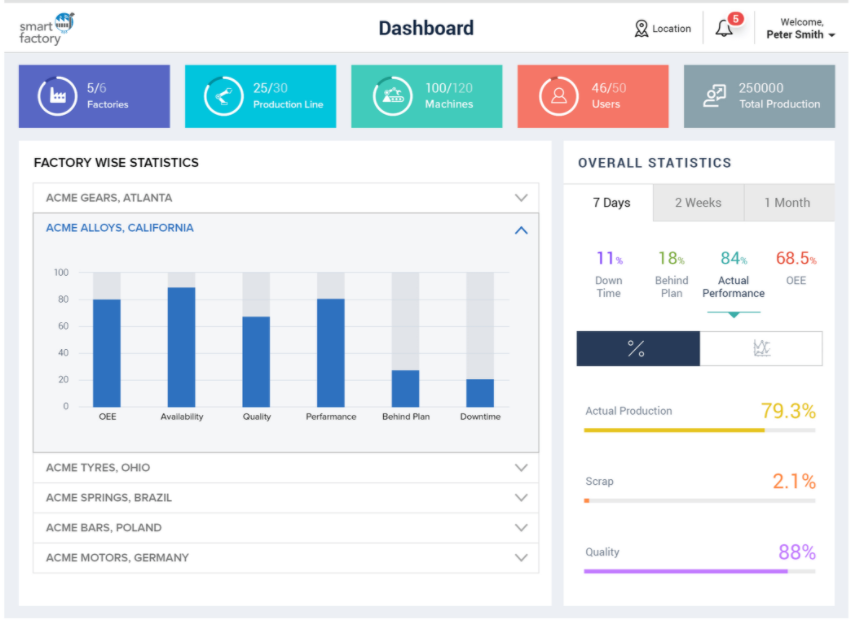
The analytics dashboard in IoTConnect (Source)
Common features of IoT analytics software
Most IoT analytics software platforms have the following common features:
Asset tracking | Analyze usage data of assets, such as software and hardware systems, throughout their lifecycle to track performance and address issues proactively. |
Data collection | Collect data directly from internet-connected devices, sensors, and time-series databases to generate insights for your business. |
Real-time analytics | Analyze the data generated by any IoT device in real time to extract insights and predict future outcomes. |
Activity dashboard | Access a centralized dashboard that compiles the data collected from IoT devices and visualizes key data points from it. |
Predictive analytics | Analyze historical and current data from IoT devices and sensors to predict future outcomes and take corrective action proactively. |
Real-time notifications | Receive real-time notifications about equipment failures, breakdowns, or any other critical event. |
Real-time monitoring | Continuously monitor the data generated by IoT devices to track device performance and stay updated on all developments. |
Extract, transform, load (ETL) | Collect data from IoT devices and load it into a centralized database to ease the process of data analysis. |
What type of buyer are you?
Before evaluating IoT analytics software options, determine what you plan to use it for. Most buyers of the software belong to the following industries:
Manufacturing: These buyers are manufacturers in industries such as automotive, electronics, and chemicals. They use equipment with intelligent sensors for smart manufacturing. For example, sensors embedded in roads or train tracks can relay ultrasonic and vibrational data in real time, allowing maintenance teams to repair vulnerable sections of the road or track before they get damaged. These buyers need IoT analytics software to improve production efficiency. They should opt for a solution that integrates structured and unstructured quality data from all sources to provide an enterprise view of equipment performance and offer advanced analytics for identifying potential issues even before they occur. These capabilities will allow manufacturers to perform root-cause analysis and take corrective action proactively.
Financial: These buyers include banks and other financial firms that gather large volumes of customer data. They need IoT analytics software to assess risks, predict credit scores, and ensure fraud prevention. For financial firms, IoT analytics solutions can analyze customers’ preference and behavior data in real time to help improve the customer experience, manage risk, and enhance banking security. These buyers should opt for a tool that provides capabilities for data collection, real-time analytics, asset tracking, and real-time monitoring. These features will assist with decision-making and customer experience planning.
Retail: Retail businesses use smart devices to gather location-based information and online customer behavior data, among others, to get a deep understanding of customers’ patterns and preferences. They should select an IoT analytics solution that provides a comprehensive view of customer data using dashboards and interactive visualizations. An IoT platform with automated forecasting and predictive analytics capabilities to create personalized retail experiences for customers would suit the needs of these buyers. The tool should also integrate with multiple online and offline data sources to analyze sensor, device, customer, merchandise, and location information in real time.
Healthcare: IoT analytics software is finding wide use in the healthcare industry, particularly as a means to enhance patient care, prevent diseases, and improve hospital management and administration. The development of health apps and connected medical devices has led to patient-centered analytics functionality that provides alerts in real time and automatically initiates a response when a health problem is detected. Besides patient-centered analytics, these buyers should opt for features such as real-time monitoring of the health data of patients and the performance data of medical devices.
Benefits of IoT analytics software
Implementing an IoT analytics platform has various benefits, including:
Predictive maintenance of equipment: An IoT analytics solution monitors how your assets and equipment are performing in real time and alerts you about any issues that may arise. It analyzes parameters such as vibration and heat data to check if your assets need maintenance. Data monitoring also lets you predict, plan, and take proactive steps to solve any identified issues.
Automation of manual processes: IoT analytics software helps automate processes that you’d have to otherwise track manually. Features such as automated data ingestion, real-time monitoring, anomaly detection, and IoT data analytics provide a complete view of how your assets and processes are performing. With automation, you can maintain a continuous flow of information, identify bottlenecks, and reduce the risk of human errors.
Improved customer experience: With IoT data analytics software, you can collect and analyze customers’ behavior and preference data to predict their needs in real time. This will help improve operational performance as well as provide a personalized experience to your customers.
Key considerations
Here are a few things to keep in mind when purchasing an IoT analytics platform:
Integrations: If you’re looking to capture insights from data across your business ecosystem, the software you select should integrate well with your existing systems. Integration functionality will ensure the software captures and analyzes data from all sources, including apps, devices, sensors, or databases.
Customer support: Even in the most user-friendly IoT analytics platforms, it’s not uncommon to face some technical difficulty. If you don’t have a trained IT team to handle issues that may arise while using the software, be sure to evaluate the training and support services the vendor offers, before making an actual investment. The support options may include 24/7 live chat, online case submissions, webinars, or in-person training.
Market trends to understand
Here are a few latest trends in the IoT analytics software market:
Connected events are an emerging field for IoT analytics. Businesses can leverage IoT technology to gain actionable insights into their audiences’ behavioral and emotional response at connected events—the ones in which large-scale sensor deployments help understand and enhance the experiences of participants—such as sports matches, fashion shows, and exhibitions. At connected events, sensors are used to measure temperature and heart rate from a particular distance, video cameras to monitor motion, and microphones to detect cheering. IoT analytics solutions can analyze the captured data, and the insights obtained can be used for increasing future engagement, improving the effectiveness of marketing campaigns, and boosting brand awareness in social media.
The aquafarming industry is leveraging IoT analytics. Aquafarming, the cultivation of plants and animals in water, is an emerging area for IoT analytics. IoT analytics solutions are helping aquafarming businesses gain more insights into their harvesting conditions. Businesses are using a variety of sensors to collect big data about the quality of the aquatic ecosystem, including the temperature, nutrients, and oxygen levels of water. These data points can help determine the best practices and optimal conditions for aquaculture.
Note: The application selected in this guide is an example to show a feature in context and is not intended as an endorsement or recommendation. It has been taken from sources believed to be reliable at the time of publication.