
Best Laboratory Information Management System Software of 2026
Updated January 27, 2025 at 9:53 AM
- Popular Comparisons
- Buyers Guide
Compare Products
Showing 1 - 25 of 94 products
Compare Products
Sort by
Reviews: Sorts listings by the number of user reviews we have published, greatest to least.
Average Rating: Sorts listings by overall star rating based on user reviews, highest to lowest.
Alphabetically (A-Z): Sorts listings by product name from A to Z.

Lockbox LIMS is a laboratory information management system designed to help clinical organizations manage sample tracking, stora...Read more about Lockbox LIMS

Labgen is a complete lab information system (LIS) designed for any commercial medical laboratories, hospital laboratories, physi...Read more about Labgen LIS
Labgen LIS's Best Rated Features
See All
Labgen LIS's Worst Rated Features
See All

LIMSey is a cloud-based software for engineering, environmental, mechanical, and other product testing labs, designed to automat...Read more about LIMSey

LabWare LIMS is a cloud-based Laboratory Information Management System used by over 10,000 laboratories worldwide, with a 98% cu...Read more about LabWare LIMS

Polytech LIS Polytech is laboratory information software. The modern laboratory requires automation to maximize efficiency and ...Read more about Polytech LIS

Uncountable is a cloud-based laboratory information management system (LIMS), which helps small to large material, chemical and ...Read more about Uncountable

Dendi LIS is designed for providers, including hospitals and clinics. It offers an easy-to-use interface that makes it easy to n...Read more about Dendi LIS
Dendi LIS's Best Rated Features
See All
Dendi LIS's Worst Rated Features
See All

CellPort stands as the ultimate lab management solution tailored specifically to meet the intricate needs of cell culture, passa...Read more about CellPort
No reviews yet

CGM LABDAQ is a laboratory information system (LIS) designed to help reference laboratories, hospitals, clinics, veterinary offi...Read more about CGM LABDAQ

Avalon Laboratory System (LIS) is a HIPAA-compliant, modular system designed to manage the production and billing needs of labor...Read more about Avalon Laboratory System

SciSure is a Scientific Management Platform (SMP) designed to unify research, safety, compliance, training, and lab operations i...Read more about SciSure
SciSure's Best Rated Features
See All
SciSure's Worst Rated Features
See All

Agilent SLIMS is a laboratory information management system that enables businesses to streamline processes related to the colle...Read more about Agilent SLIMS

CDD Vault is a cloud-based informatics platform designed to help research foundations, hospitals, academic labs, pharmaceutical ...Read more about CDD Vault

FindMolecule is a laboratory information management system designed to help chemical laboratories handle inventory, orders, data...Read more about FindMolecule

LabCollector LIMS is a cloud-based and on-premise laboratory information management system, which assists research organizations...Read more about LabCollector LIMS

QReserve is a scheduling application used by organizations and workplaces with complex resource dependencies and workflows. QRes...Read more about QReserve
QReserve's Best Rated Features
See All
QReserve's Worst Rated Features
See All

Benchling is a cloud-based platform for biotechnology research and development. It offers various features such as request fulfi...Read more about Benchling

Designed for healthcare and pharmaceutical organizations, Disa*Lab is an on-premise laboratory information system (LIS) that hel...Read more about Disa*Lab

NEXUS Pro is a modular laboratory information management system (LIMS) in Pakistan. It was specifically made to help pathology l...Read more about NEXUS Pro
NEXUS Pro's Best Rated Features
See All
NEXUS Pro's Worst Rated Features
See All

Salute is a comprehensive solution for safety leaders managing increasingly complex risk with limited resources. Their cloud-b...Read more about Salute Safety

IGOR is a cloud-based research documentation platform that provides an electronic lab notebook for biotechnology companies, rese...Read more about IGOR
IGOR's Best Rated Features
See All
IGOR's Worst Rated Features
See All

Di-LIMS software plays a fundamental role in enhancing and streamlining laboratory operations. This is achieved through a compre...Read more about Di-LIMS
Di-LIMS's Best Rated Features
See All
Di-LIMS's Worst Rated Features
See All

Wavefront LIMS >> Future-Proof Your Lab Wavefront LIMS allows you to future-proof your lab which is why we are trusted by advan...Read more about Wavefront LIMS
Wavefront LIMS's Best Rated Features
See All
Wavefront LIMS's Worst Rated Features
See All

LABY is a simple solution that is suitable for all scientific fields and designed by scientists. It enables professionals to man...Read more about LABY
Labguru is specifically built for life science & pharmaceutical companies and offers a unified research data and operations mana...Read more about Labguru
Popular Comparisons


Buyers Guide
This detailed guide will help you find and buy the right laboratory information management system software for you and your business.
Last Updated on January 27, 2025Laboratory information management systems (LIMS) have become an essential technology in sample-based testing fields for clinical labs (such as immunology, and microbiology), production labs (such as biotech and pharmaceutical), food and beverage labs, and natural sciences labs (such as environmental and metallurgy).
With the wide range of laboratory information management systems available on the market, choosing the one that best meets your needs and budget is important. Use this guide to understand all the factors you need to consider when choosing your LIMS.
Here's what we'll cover:
What is LIMS software?
LIMS software helps laboratories manage and track samples, organize workflows, and store and analyze all laboratory data. These tools make labs more efficient and productive by gathering, managing, and analyzing huge volumes of lab data in a centralized location.
An LIMS streamlines lab operations by automating repetitive and error-prone data entry tasks and alerting staff members about issues with samples or testing operations.
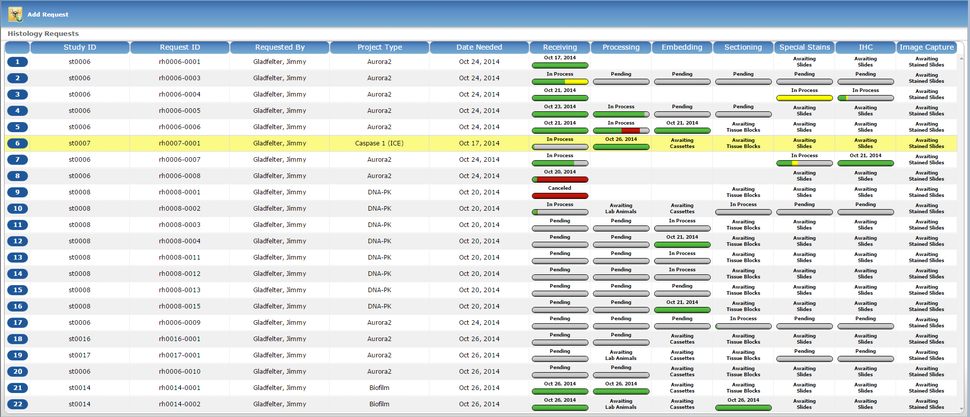
Manage histology requests in Exemplar LIMS (Source)
Common features of LIMS software
In the LIMS market, different vendors offer different features as part of their LIMS offerings. Selecting software with the right features for your business is easier when you know what the most common features are and what they do. Here’s a look at common features of LIMS tools:
Feature | Description |
Reporting and analytics | Capture lab data in a secure environment built for further analysis. View and track metrics for reporting purposes. |
Sample management | Store and manage laboratory sample details such as source, location, condition, and results. |
Compliance tracking | Create and manage records verifying that your lab follows all industry regulations and standards. |
Document management | Collect and upload documents to a central, secure location for easy stakeholder access. |
Electronic data interchange (EDI) | Receive data from laboratory equipment and transfer it to other destinations, such as electronic medical records software. |
Inventory management | Track and manage your resources to maintain proper supply. |
Quality management | Check for any mistakes, defects, brand and product alignment, and opportunities for improvement across lab processes. |
Workflow management | Create, design, and automate lab processes. |
What type of buyer are you?
Before you start evaluating LIMS options, you'll want to know which buyer category you belong to. Most buyers fall into one of the following categories:
Small independent labs. These buyers are likely looking to deploy an LIMS to help grow their customer base. Their primary need is automating data storage and inventory management to make processes more efficient and deliver faster results to their customers.
Medium and large-sized labs. These buyers are on the verge of upgrading their basic LIMS to get more data storage and automate lab inventory management. For these buyers, seamless integration with their existing systems is usually more important than specific or niche features.
Specialty buyers. These buyers need specific features that suit their specialty/niche. For example, specialty-specific clinical laboratories (such as hematology, immunology, or microbiology) require an LIMS that offers a database of common terms used in their lab processes, samples, and tests.
Benefits of LIMS software
Increased revenue. These systems allow labs to conduct efficient sample management and complete more tests in less time. Since most labs make money based on the number of samples they process, an LIMS can increase revenue by helping increase volume.
Real-time results tracking. These systems consolidate all lab data into searchable records. With your data in one place, you can then visualize the data using tables and graphs, and set alerts for metrics if they don’t meet expectations.
Key considerations when selecting LIMS software
Mobile app availability: Check whether the LIMS you’re planning to purchase offers mobile apps for iOS and Android devices (e.g., smartphones, tablets). A mobile app lets users input data even when offline or with limited internet access. Data collected offline will automatically sync with the system once internet connectivity is restored.
Customer support: Ask about the type of support provided by your shortlisted software providers: 24/7, 24/5, or only during business hours. Also, verify whether they offer your preferred support channels (e.g., email, phone, live chat). Sufficient support services are crucial to address any software issues that can lead to compromised or lost confidential data.
Market trends to understand
Cloud-based LIMS deployment will outpace on-premise systems: The adoption of cloud-based LIMS deployment is expected to grow at a faster rate than on-premise deployment, mainly due to the increased flexibility and shorter implementation time offered by cloud-based systems. Cloud-based deployment allows labs to access data remotely via web browser, thus reducing implementation costs and improving buyers' ROI.
Note: The application selected in this article is an example to show a feature in context and isn’t intended as an endorsement or a recommendation. It has been obtained from sources believed to be reliable at the time of publication.