
Best Telecom Expense Management Software of 2026
Updated January 27, 2025 at 9:54 AM
- Buyers Guide
Compare Products
Showing 1 - 25 of 32 products
Compare Products
Sort by
Reviews: Sorts listings by the number of user reviews we have published, greatest to least.
Average Rating: Sorts listings by overall star rating based on user reviews, highest to lowest.
Alphabetically (A-Z): Sorts listings by product name from A to Z.

Clearview is a cloud-based telecom expense management (TEM) solution designed for midsize and larger businesses. The TEM solutio...Read more about Clearview

Mobil(X) is a mobile device management software designed to help businesses get a 360-degree view of their entire mobile environ...Read more about Mobil(X)


Microcall is a unified call analytics solution that helps organizations analyze and clarify complicated voice data by producing ...Read more about Microcall


Microcall's Best Rated Features
See All
Microcall's Worst Rated Features
See All

Enterprise Information Management Software (EIM) by HPCI is a cloud-based telecom expense management solution that helps IT and ...Read more about SpikeFli Analytics

Built on the Microsoft Azure platform, Datagate is a SaaS-based telecom billing platform designed to assist MSPs with automating...Read more about Datagate


Genuity IT Admin Suite is a cloud-based solution that allows businesses to generate actionable insights and manage workflows acr...Read more about Genuity IT Admin Suite


Genuity IT Admin Suite's Best Rated Features
See All
Genuity IT Admin Suite's Worst Rated Features
See All

ExpenseLogic is a cloud-based expense management software that allows the accounts payable team to view invoices and expenses wh...Read more about ExpenseLogic
ExpenseLogic's Best Rated Features
See All
ExpenseLogic's Worst Rated Features
See All

OneBill is an end-to-end subscription management, billing, and revenue management platform that powers the entire customer lead-...Read more about OneBill


Temforce is a cloud-based telecom expense management solution. Key features allow users to automate inventory management, create...Read more about Temforce

WidePoint is a telecom lifecycle management solution designed to help businesses handle expenses, orders, devices, assets, logis...Read more about WidePoint


IT teams are our unsung heroes, and we think it's time to sing. brightfin helps IT and Finance leaders get the recognition they ...Read more about brightfin

Spenza is a cloud-based AI-driven connectivity management platform that caters to medium to large enterprises looking to optimiz...Read more about Spenza

zLinq is a cloud-based telecom and technology lifecycle management solution that helps IT teams solve communications challenges ...Read more about zLinq

LINQ Qonnect is an online portal designed to simplify billing, invoicing, and reporting processes for enterprises. This solution...Read more about LINQ Qonnect
LINQ Qonnect's Best Rated Features
See All
LINQ Qonnect's Worst Rated Features
See All

Kloudville is a cloud-based enterprise resource planning (ERP) solution that caters to wholesalers, distributors and e-commerce ...Read more about Kloudville


mytem360 is a cloud-based telecom expense management software that helps businesses automate data integration processes, identif...Read more about mytem360

WinBill is an on-premise and cloud-based telecom expense management solution that helps users analyze, control and monitor telec...Read more about WinBill

Motus is a web-based platform that streamlines administrative tasks, provides fair and accurate mixed-use asset reimbursements, ...Read more about Motus


Motus's Best Rated Features
See All
Motus's Worst Rated Features
See All

Sierra Gold is a cloud-based telecom expense management solution that caters to the needs of infrastructure analysts and IT comm...Read more about Sierra Gold

Tellennium is an enterprise expense management company – traditionally known as telecom expense management (TEM) - that provides...Read more about Management of Things

Mindglobal is a web-based platform that provides real-time, anywhere access to holistic wireless management solutions that impro...Read more about Mindglobal

eXsight by MTS is a telecom expense management suite. In the system, telecom expenses are attached to telecom assets, so that co...Read more about eXsight

vManager is a cloud-based telecom expense management solution from vCom that helps users manage communications spending across i...Read more about vManager

Tangoe TEM is a telecom expense management platform designed to manage the lifecycle of telecommunications services. It supports...Read more about Tangoe TEM


Billingbooth is a cloud-based telecom billing and accounting solution designed to manage subscription customers. Key features in...Read more about Billingbooth
No reviews yet
Buyers Guide
This detailed guide will help you find and buy the right telecom expense management software for you and your business.
Last Updated on January 27, 2025Telecom spending is one of the biggest expenses for businesses and corporations. There's no doubt that telecom infrastructure is absolutely critical to any organization—both for internal communications as well as communicating with external parties, including customers. In addition, new tools are required to manage fast changing requirements and telecom infrastructures.
Telecom expense management is the process by which you manage your wireless, voice and data environment while keeping your business's overall operating costs down. It includes the following:
Building a telecom infrastructure inventory
Storing telecom bills in one place
Monitoring overcharges and contract violations through telecom audits
Negotiating with telecom vendors for better rates
In this Buyer's Guide, we'll look at what telecom expense management software offers and the benefits of incorporating it into your telecom expense management strategy. We'll also look at considerations for specific types of users and some market trends buyers need to know about.
Here's what we'll cover:
What Is Telecom Expense Management Software?
Common Features of Telecom Expense Management Software
Benefits of Telecom Expense Management
What Is Telecom Expense Management Software?
Telecom expense management software enables businesses to control, manage and understand their overall telecom spending. This software processes and records large volumes of telecom data, such as costs, usage, billing and administration.
It covers both landline as well as mobile or wireless telecom expenses across their complete life cycles, from procurement until retirement or replacement.
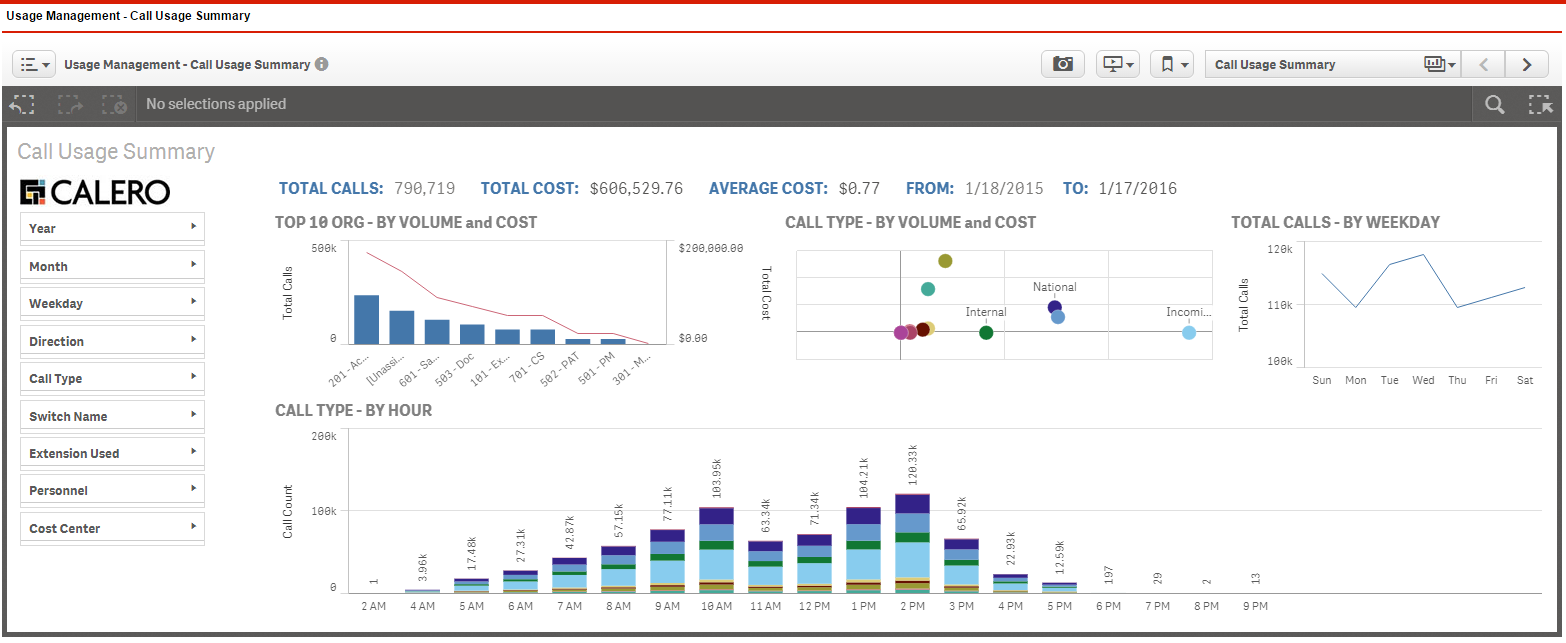
Call usage management in Calero
Common Features of Telecom Expense Management Software
Vendors offer a variety of functional breadth and depth in their telecom expense management software. Here are some of the most common capabilities:
Invoice management | Automates the processing and payment of electronic and paper invoices including allocation of charges to different departments, payment approvals and bill payments. |
Inventory and asset management | Centralizes your assets database, covering all steps in the asset life cycle, such as requisition, distribution, warranty management, replacement and retirement. Also includes purchase tracking and cost center assignment. |
Call accounting | Facilitates the gathering, analysis, monitoring and reporting of call usage details. Eliminates telecom misuse, enhances telecom security and ensures accurate and quick call routing. |
Helps maintain call quality standards, identify call problems and improve overall business and customer experience. | |
Includes contract negotiation and request-for-proposal (RFP) management. Enables users to store and access data on contracts and renegotiate to get the best return on investment. |
What Type of Buyer Are You?
Before you start evaluating different telecom expense management systems, you'll want to know what buyer category you belong to. This process will help you understand what type of buyer you are and let you know which features will be most useful to you. It also provides the opportunity to examine what considerations you need to make now and what you need to consider if you want to scale.
Most buyers fall into one of these categories:
Small businesses (up to 15 users). Due to limited budgets, these buyers focus on eliminating telecom call misuse and thus reducing operating costs. They should purchase a telecom expense management system that offers "call accounting" as a must-have feature. Call accounting helps businesses identify call usage patterns and eliminate any type of telecom abuse within an organization such as calls exceeding a predetermined cost or other unauthorized calls.
Midsize businesses (15 to 50 users). These are usually well established in their business and are dealing with larger call volumes and more sophisticated needs. They're looking for efficiency and productivity improvements and want to gain a competitive advantage through new technologies. They should opt for systems with invoice management, call monitoring and contract management features to make their overall telecom processes more efficient.
Large businesses (50+ users). These buyers require customized business communication and management features to suit their complex needs. They manage large telecom infrastructures, so in addition to call accounting and monitoring, they also require inventory and asset management features.
Benefits of Telecom Expense Management Software
Though we've already covered some of the benefits of telecom expense management software, the following are major advantages businesses will gain from using this technology:
Telecom usage optimization. One of the most important benefits of using telecom expense management software is the light it sheds on telecom data. The software enables users and administrators to see call usage information and identify areas where the most money is being spent. Businesses can use this insight and apply it to improve the management of users and suppliers. For example, an organization can optimize telecom rate plans to match usage patterns or leverage it's buying power to get better pricing from a supplier. In addition, telecom spending insights are useful for making better budget planning decisions.
Streamlined operations. Many businesses lack a streamlined process for handling telecom invoices. This leads to large stacks of invoices that may require validation by one department and payment processing by another. Time is wasted and errors are more likely when these tasks are carried out manually across multiple departments. Telecom expense management software lets users handle these tasks from a centralized location, saving time and eliminating error.
Decreased operating costs. Telecom expense management systems are designed to reduce wasteful spending and costs. These systems capture all costs related to the processing of telecom expenses and enable organizations to save money. This is achieved through various activities such as cost center allocation, managing billing disputes and verification of charges. All of these small savings lead to improved profits and oftentimes the total amount saved is significant.
Market Trends to Understand
As you begin your software comparison and evaluation, there are a couple trends in the market buyers should know about:
Investments in telecom expense management are growing. Organizations are increasingly investing in telecom expense management software, perhaps by virtue of the significant and tangible telecom cost reduction that is being seen. From being able to control incorrect or fraudulent billing, to being able to negotiate and optimize telecom service plans, businesses are seeing huge benefits by implementing these systems, which gives them a competitive advantage over those that fail to invest in telecom expense management.
Constantly evolving business requirements. Businesses of all sizes are continuously relying on their telecom expense management system providers to help them create and maintain an enterprise technology strategy. The definition of telecom expense management and what businesses need from such a solution is changing fast and has come to include almost all elements of technology and business management. For instance, from the usual telecom asset tracking and billing, to managing procurement, keeping inventory up to date with required licenses, automating tasks, machine to machine (M2M) communication and much more.
Key Considerations
Here are some important factors to think about before you purchase a telecom expense management solution:
Cloud or on-premise deployment. This is one of the most important and consequential decisions you'll make when purchasing software. On-premise systems will typically have higher initial costs and may also require periodic system maintenance. On the other hand, cloud-based solutions will cost less upfront and will be managed by the vendor, but will have higher recurring costs. Users need to compare the total cost of ownership for all potential systems.
Integration requirements. You must also consider whether the software integrates with your current VoIP and communication systems along with other solutions that you are using in your organization such as Microsoft Office 365 and G Suite (Google Apps for Work).
Software complexity. Buying an overly complex system can be as bad as buying one that has too few features. Apart from paying for features that won't be used, complex systems present usability issues. So, before purchasing telecom expense management software, perform a clear assessment of exactly which functions you need.