
Best Endpoint Detection and Response Software of 2026
Updated March 19, 2026 at 9:47 PM
- Popular Comparisons
- FrontRunners
- Buyers Guide
Compare Products
Showing 1 - 25 of 101 products
Compare Products
Sort by
Reviews: Sorts listings by the number of user reviews we have published, greatest to least.
Average Rating: Sorts listings by overall star rating based on user reviews, highest to lowest.
Alphabetically (A-Z): Sorts listings by product name from A to Z.

Heimdal eXtended Detection and Response is managed XDR solution that adds expert analysis and input from a team of cybersecurity...Read more about Heimdal XDR


Jamf Protect is an endpoint security solution designed to help businesses identify, prevent and resolve threats across Mac devic...Read more about Jamf Protect

Jamf Protect's Best Rated Features
See All
Jamf Protect's Worst Rated Features
See All

Guardz was specifically built to empower MSPs with the tools to holistically secure and insure SMEs against ever-evolving threat...Read more about Guardz


UnderDefense MAXI is a holistic security-as-a-service powerhouse that combines AI-native technology with expert-led, proactive t...Read more about UnderDefense MAXI
No reviews yet


Heimdal Endpoint Detection and Response is a unified EDR solution where threat prevention, patch and asset management, ransomwar...Read more about Heimdal Endpoint Detection and Response (EDR)
No reviews yet

Iru is the AI-powered IT & security platform used by the world's fastest-growing companies to secure their users, apps, and devi...Read more about Iru
Iru's Best Rated Features
See All
Iru's Worst Rated Features
See All

Stop ransomware! ThreatLocker helps organizations reduce their surface areas of attack with policy-driven endpoint security. Ins...Read more about ThreatLocker

ThreatLocker's Best Rated Features
See All
ThreatLocker's Worst Rated Features
See All

Designed with Fortune 500 and Global 2000 companies in mind, SentinelOne is a leading autonomous cybersecurity platform speciali...Read more about SentinelOne
SentinelOne's Best Rated Features
See All
SentinelOne's Worst Rated Features
See All

Shared computer access control with 2FA and automatic user-switching. Login to shared computers using phoneless-2FA and automati...Read more about GateKeeper Enterprise


Designed for organizations operating in the cloud who need complete, centralized visibility of their entire cloud estate and wan...Read more about Orca Security

Orca Security's Best Rated Features
See All
Orca Security's Worst Rated Features
See All

Malwarebytes for Business is a cloud-based cybersecurity suite comprising Malwarebytes Endpoint Protection and Malwarebytes Endp...Read more about Malwarebytes for Business
Malwarebytes for Business's Best Rated Features
See All
Malwarebytes for Business's Worst Rated Features
See All

Huntress is a cloud-based cybersecurity solution, designed to help small to midsize businesses determine and respond to threats ...Read more about Huntress

Huntress's Best Rated Features
See All
Huntress's Worst Rated Features
See All

RoboShadow is a full security management platform built to be Free / Ultra Low Cost but deliver enterprise grade Vulnerability A...Read more about RoboShadow
RoboShadow's Best Rated Features
See All
RoboShadow's Worst Rated Features
See All

ESET Home Office Security Pack is a cloud console that provides visibility, administration and detailed information in a central...Read more about ESET Home Office Security Pack
ESET Home Office Security Pack's Best Rated Features
See All
ESET Home Office Security Pack's Worst Rated Features
See All

INLYSE Malware.AI is a visual AI-based malware detection solution that uses cutting-edge technology to detect malware. It offers...Read more about INLYSE Malware.AI
INLYSE Malware.AI's Best Rated Features
See All
INLYSE Malware.AI's Worst Rated Features
See All

Blackpoint Cyber is a technology-focused cybersecurity company headquartered in Maryland, USA. The company was established by fo...Read more about Blackpoint MDR


Blackpoint MDR's Best Rated Features
See All
Blackpoint MDR's Worst Rated Features
See All

Safetica’s Intelligent Data Security protects sensitive data where teams work, using powerful AI to deliver contextual awareness...Read more about Safetica


Safetica's Best Rated Features
See All
Safetica's Worst Rated Features
See All

Automox is the Autonomous Endpoint Management platform built for autonomous from day one. Policy-driven, human-controlled autom...Read more about Automox

Automox's Best Rated Features
See All
Automox's Worst Rated Features
See All

Teramind offers employee monitoring, insider threat detection, and data loss prevention (DLP) solutions. Teramind UAM monitors u...Read more about Teramind

Teramind's Best Rated Features
See All
Teramind's Worst Rated Features
See All

ESET PROTECT MDR offers comprehensive managed detection and response services designed to secure businesses with 250+ employees....Read more about ESET PROTECT MDR
ESET PROTECT MDR's Best Rated Features
See All
ESET PROTECT MDR's Worst Rated Features
See All

Heimdal Next-Gen Endpoint Antivirus is an advanced antivirus solution with next-generation capabilities. Its unmatched threat in...Read more about Heimdal Next-Gen Endpoint Antivirus

Enginsight helps protect businesses from the ever-evolving landscape of cyber threats and ensures the security and stability of ...Read more about Enginsight

Jazz Platform is a cloud-based and on-premise network security solution designed to assist small to large businesses with threat...Read more about Jazz Platform

Axonius is an information technology asset management (ITAM) solution designed to assist small to large enterprises with monitor...Read more about Axonius


Secomea is a Secure Remote Access (SRA) solution specifically designed for industrial networks and OT equipment. It is utilized ...Read more about Secomea
Secomea's Best Rated Features
See All
Secomea's Worst Rated Features
See All
Popular Comparisons



Your Guide to Top Endpoint Detection and Response Software, November 2022
Software Advice uses reviews from real software users to highlight the top-rated Endpoint Detection and Response products in North America.
Learn how products are chosenExplore FrontRunners


“Usability” includes user ratings for Functionality and Ease of Use.
“Customer Satisfaction” includes user ratings for Customer Support, Likelihood to Recommend and Value for Money.
Reviews analysis period: The reviews analysis period spans two years and ends the 15th of the month prior to publication.
Buyers Guide
This detailed guide will help you find and buy the right edr software for you and your business.
Last Updated on January 27, 2025In late 2018, global hospitality chain Marriott fell prey to a major security breach that exposed the personal information of 500 million guests. Compromised data included a combination of names, addresses, passport numbers, and dates of birth of guests. Further, hackers gained access to the credit card information of an unspecified number of guests. And although the card details were encrypted, hackers might also have stolen the information needed to decrypt these details.
Could Marriott have saved itself from landing in this mess? Yes; an endpoint detection and response (EDR) solution could have helped.
Technology advancements have paved the path for modern hacking techniques and advanced malware that can easily bypass basic anti-virus and anti-malware software. This has resulted in a need for enhanced threat protection, making EDR a necessity for all businesses. EDR tools continuously monitor business endpoints to detect vulnerabilities and protect organizations from cyberattacks.
There are many EDR software tools available on the market, and choosing the right solution for your business can be challenging. We’ve created this buyers guide to help you understand the options available for your business.
Here's what we'll cover:
What is EDR software?
EDR software is a set of tools used to detect, investigate, and analyze potential security threats in and around hosts/endpoints. It helps businesses prevent security breaches.
Endpoints are remote computing devices, such as laptops, tablets, mobile phones, and other wireless devices, that are connected to business networks. And since business networks are shared by several people, they are prone to security threats, including phishing attacks, malvertising—i.e., using online advertising to spread malware—and ransomware.
The term EDR, initially named endpoint threat detection and response, was coined in 2013 by Gartner executive Anton Chuvakin. EDR software continuously monitors endpoints and network events and records the received information in a centralized database. This information is analyzed in real time to alert businesses about suspicious activities.
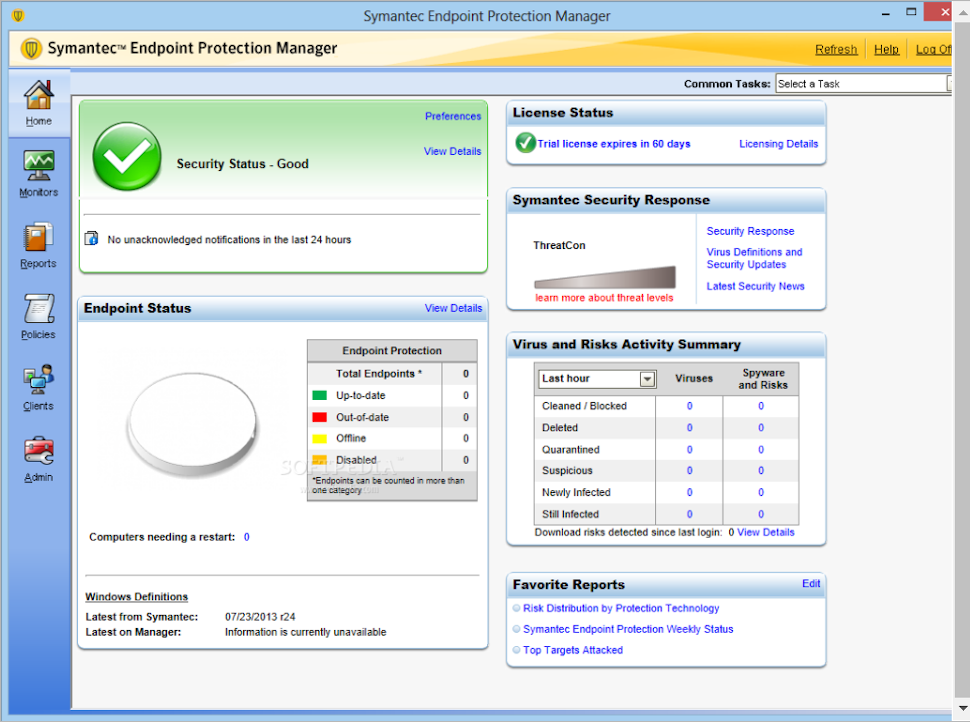
Detailed endpoint security status in Symantec Endpoint Protection (Source
Common features of EDR software
The EDR solution you choose should provide the highest level of protection against network threats and vulnerabilities. Here are some common features that you should take into account while selecting EDR software for your business.
Anomaly/malware detection | Monitor new, unexpected, or unusual network activities to detect any malware or vulnerabilities. |
Threat analysis | Identify advanced threats using behavioral analytics and machine learning technologies. |
Event analysis | Investigate security threats, detect malicious activities, and analyze such events to find ways to avoid them in the future. |
Remediation management | Remove malicious files, repair devices, and provide instructions for further actions as required. |
Route optimization | Notify administrators of suspicious activities and receive confirmation when a security incident is identified. |
What type of buyer are you?
Businesses with a higher number of employees have more endpoints to monitor. Based on the number of employees, EDR software buyers can be divided into two categories: small businesses, and midsize and large businesses. We’ll take a look at both types below.
Small businesses (less than 200 employees): In 2019, 43% of security breaches involved small businesses. As small businesses have a lower number of employees, they have fewer endpoints to secure. Most EDR software vendors charge users on a per-endpoint basis. Software that covers all network endpoints; provides visibility into hosts, files, and users; and is equipped with a wide set of remediation tools will be a good investment for small businesses.
Midsize and large businesses (200 or more employees): Over 53% of midmarket companies faced a security breach in 2018. Due to a higher number of endpoints, midsize and large businesses need higher levels of protection. Software equipped with advanced technology, such as machine learning (ML) and data analytics, can offer enhanced protection to such businesses. These software solutions can analyze data faster and automate certain remedial actions when endpoints are attacked by threats.
Benefits of EDR software
Understanding the advantages of EDR software will help you assess why your business needs one and build a strong case for an investment. Listed below are the key benefits offered by EDR software.
Higher endpoint visibility: EDR software continuously monitors all endpoints at the network level to ensure businesses don’t miss out on any potential threats. Most threats attack network blind spots, and through continuous monitoring, EDR software ensures these blind spots are highly reduced or eliminated.
Lower losses due to security breaches: Security breaches can have a massive impact on operations and result in significant losses. The average cost of a cybersecurity attack is estimated to be $1.1 million. EDR solutions collect cybersecurity events' data and analyze it in real time to identify threats and send timely alerts. These alerts assist security teams in devising risk mitigation plans that ensure threats don’t escalate into attacks, which in turn minimizes security-related losses.
Faster resolution of security breaches: EDR software accelerates the process of security breach resolution using threat detection, incident investigation, and event alerts. It stores the analysis of previous threat events, and IT experts can use this analysis to create efficient and proactive risk mitigation policies. When facing a similar attack, experts can use the available data to quickly resolve the breach, and no extra time is spent on threat investigation.
Key considerations for choosing EDR software
EDR is a key component of your organization's cybersecurity mechanism. Therefore, you must analyze all available options and their distinct capabilities to find one that is right for your security needs. Let’s go through a few key considerations that you should take into account when purchasing EDR software.
Alert filtering capability: EDR solutions that are unable to filter out false positives can lead to alert fatigue, a situation wherein monitoring professionals ignore or fail to respond to a security alert, as they deal with large numbers of alerts and consequently become desensitized to them. Alert fatigue increases the chances of critical threats being ignored and can also lead to a higher response time for threat alerts.
Role-based access: EDR software equipped with role-based access allows you to control the access rights of your system users based on their roles, such as administrator or manager. This ensures that only authorized personnel are allowed to change the configuration or settings of your EDR software, and your business remains protected from threats at all times.
Availability as a mobile application: Since EDR software monitors threats continuously, it generates a large number of alerts that need to be tracked. Missing out on any of these alerts can expose your business to a threat that could have been easily dealt with. With mobile applications, you can access threat alerts any time and from any location. Mobile applications allow you to respond to malicious threat events even while you’re on the go, thereby ensuring real-time threat protection.
Note: The application selected in this article is an example to show a feature in context and isn’t intended as an endorsement or recommendation. It has been obtained from sources believed to be reliable at the time of publication.