


Best Database Software of 2026
Updated March 23, 2026 at 2:53 AM
- Popular Comparisons
- FrontRunners
- Buyers Guide
Compare Products
Showing 1 - 25 of 184 products
Compare Products
Sort by
Reviews: Sorts listings by the number of user reviews we have published, greatest to least.
Average Rating: Sorts listings by overall star rating based on user reviews, highest to lowest.
Alphabetically (A-Z): Sorts listings by product name from A to Z.

Help Desk Migration is a software solution that migrates help desk data from one system to another. Help Desk Migration is desig...Read more about Help Desk Migration


Help Desk Migration's Best Rated Features
See All
Help Desk Migration's Worst Rated Features
See All

Universal Data Access Components (UniDAC) is a powerful library of nonvisual cross-database data access components for Delphi, C...Read more about Universal Data Access Components
Universal Data Access Components's Best Rated Features
See All
Universal Data Access Components's Worst Rated Features
See All

Rubrik is a data management solution that helps businesses streamline data backup, archiving, offsite replication and compliance...Read more about Rubrik
Rubrik's Best Rated Features
See All
Rubrik's Worst Rated Features
See All

MyDAC is a library of components that provides direct access to MySQL database servers from Delphi, C++Builder, and Lazarus. MyD...Read more about MySQL Data Access Components
MySQL Data Access Components's Best Rated Features
See All
MySQL Data Access Components's Worst Rated Features
See All

DbVisualizer is a database management solution that helps businesses monitor and analyze the performance of multiple databases t...Read more about DbVisualizer


DbVisualizer's Best Rated Features
See All
DbVisualizer's Worst Rated Features
See All

Ispirer Toolkit performs automated cross-platform database and application migration. It makes easy the move to the latest techn...Read more about Ispirer
Ispirer's Best Rated Features
See All
Ispirer's Worst Rated Features
See All

Helping businesses reclaim valuable time. Tadabase is committed to 10X-ing your company-wide productivity by eliminating redunda...Read more about Tadabase


Build beautiful forms, access-controlled databases, and highly customizable business apps without any code - all in one place. ...Read more about Formaloo


Formaloo's Best Rated Features
See All
Formaloo's Worst Rated Features
See All

BNC’s IBIS CRM platform is designed to help businesses digitize the project sales process, while addressing the major pitfalls o...Read more about BNC IBIS
BNC IBIS's Best Rated Features
See All
BNC IBIS's Worst Rated Features
See All

Redis Enterprise is a cloud-based and on-premise database management software that helps businesses handle operations related to...Read more about Redis Enterprise
Redis Enterprise 's Best Rated Features
See All
Redis Enterprise 's Worst Rated Features
See All

Mingo is a full-featured MongoDB admin application running on Win, Linux and Mac. Mingo's documents browser is well organized, f...Read more about Mingo
Mingo's Best Rated Features
See All
Mingo's Worst Rated Features
See All

TeamDesk is an advanced, secure and fully customizable low-code web-based database platform allowing rapid online database creat...Read more about TeamDesk


Lightsail is an Infrastructure as a service (IaaS) service solution designed to help small businesses, students, developers and ...Read more about Amazon Lightsail

Google Cloud is a suite of cloud computing services that allows businesses to build, deploy, and scale applications. The platfor...Read more about Google Cloud


Google Cloud's Best Rated Features
See All
Google Cloud's Worst Rated Features
See All

Aiven PostgreSQL is a database-as-a-service platform that helps businesses in retail, IoT and energy sectors integrate into exis...Read more about Aiven for PostgreSQL


Aiven for PostgreSQL's Best Rated Features
See All
Aiven for PostgreSQL's Worst Rated Features
See All

PHP CRUD Generator - https://www.phpcrudgenerator.com - is an easy-to-use web application that includes two main modules: - The...Read more about PHP CRUD Generator
PHP CRUD Generator's Best Rated Features
See All
PHP CRUD Generator's Worst Rated Features
See All

Conzept 16 is an integrated development environment (IDE) designed for Windows, offering out-of-the-box tools for rapid software...Read more about conzept 16


Percona Server for MySQL is a database solution that helps businesses streamline performance, scalability and instrumentation. I...Read more about Percona Server
Percona Server's Best Rated Features
See All
Percona Server's Worst Rated Features
See All

Piloterr is a software company that specializes in web scraping API with custom endpoints and rotating proxies. It helps busines...Read more about Piloterr API

Piloterr API's Best Rated Features
See All
Piloterr API's Worst Rated Features
See All

Amazon Relational Database Service (RDS) is a cloud-based software that helps businesses leverage existing database engines to a...Read more about Amazon RDS


Amazon RDS's Best Rated Features
See All
Amazon RDS's Worst Rated Features
See All

MongoDB is a data platform that combines operational data, vectors, and streaming data within a unified database system. It is d...Read more about MongoDB


MongoDB's Best Rated Features
See All
MongoDB's Worst Rated Features
See All

Amazon Elastic Compute Cloud (Amazon EC2) is a web service designed to help businesses with cloud computing, video encoding, bat...Read more about Amazon EC2


Amazon EC2's Best Rated Features
See All
Amazon EC2's Worst Rated Features
See All

TrackVia is a low-code workflow management platform designed to automate approvals, data capture, and reporting processes across...Read more about TrackVia
TrackVia's Best Rated Features
See All
TrackVia's Worst Rated Features
See All

ODAC is an Oracle connectivity solution that has been actively developed and supported since 1998. ODAC comes with full document...Read more about Oracle Data Access Components
Oracle Data Access Components's Best Rated Features
See All
Oracle Data Access Components's Worst Rated Features
See All

Lobster is a 360° digital ecosystem that streamlines data integration, orchestration, and connectivity across enterprises. Tru...Read more about Lobster Data World
Lobster Data World's Best Rated Features
See All
Lobster Data World's Worst Rated Features
See All
Popular Comparisons



Your Guide to Top Database Software, June 2025
Software Advice uses reviews from real software users to highlight the top-rated Database products in North America.
Learn how products are chosenExplore FrontRunners


“Usability” includes user ratings for Functionality and Ease of Use.
“Customer Satisfaction” includes user ratings for Customer Support, Likelihood to Recommend and Value for Money.
Reviews analysis period: The reviews analysis period spans two years and ends the 15th of the month prior to publication.
Buyers Guide
This detailed guide will help you find and buy the right database management software for you and your business.
Last Updated on January 27, 2025In the digital age, data is king. The businesses that can successfully store, maintain and make sense of their data have a clear competitive advantage, while those that let the flow of information overwhelm them are destined to fall by the wayside.
With businesses sitting on more data than ever before, the demand for software to handle this vital task is at an all-time high. According to Gartner, the database management system market totaled over $34 billion in 2016 (report available to Gartner clients).
All that to say: If you're in the market for a new database management system, you're not alone. If you're confused on what to look for or where to start with this software, you're certainly not alone there either.
We're here to help. In the Buyer's Guide below, we'll go over definitions, functionality, pricing models and more to help first-time database management system buyers like yourself make sense of this complex software arena.
Click a link below to jump to that section:
What Are Database Management Systems?
Two Types of Database Management Systems
Benefits of Database Management Systems
Database Management System Pricing
Database Management System Trends
What Are Database Management Systems?
Database management systems, also known as DBMSs, are software programs that act as a connecting point between databases and the various users and applications that need to access them. The purpose of a DBMS is to provide businesses with an access point to create, retrieve, modify and organize their vast amounts of data.
Though the terms have become somewhat synonymous over time, a database and a DBMS are not the same thing. A database is simply a collection of related data. A DBMS, on the other hand, is a tool to manage and organize multiple databases. In other words, the database stores the data, while the DBMS accesses and manipulates it.
Two Types of Database Management Systems
The database management system market is rarely static. As businesses' data capabilities and needs have grown over the past 40 years, the database management system has taken on many different forms.
Here are the two most common types of DBMSs you should know about:
1) Relational database management systems (rDBMSs)
Relational database management systems connect disparate data using tables with columns (“fields") and rows (“records"). The main advantage that rDBMSs bring is the ability to spread a single database across several tables, which provides benefits in terms of data storage and access capabilities. Most rDMBSs use what's called “structural querying language" (SQL): a series of commands that allow users or applications to retrieve or update data.
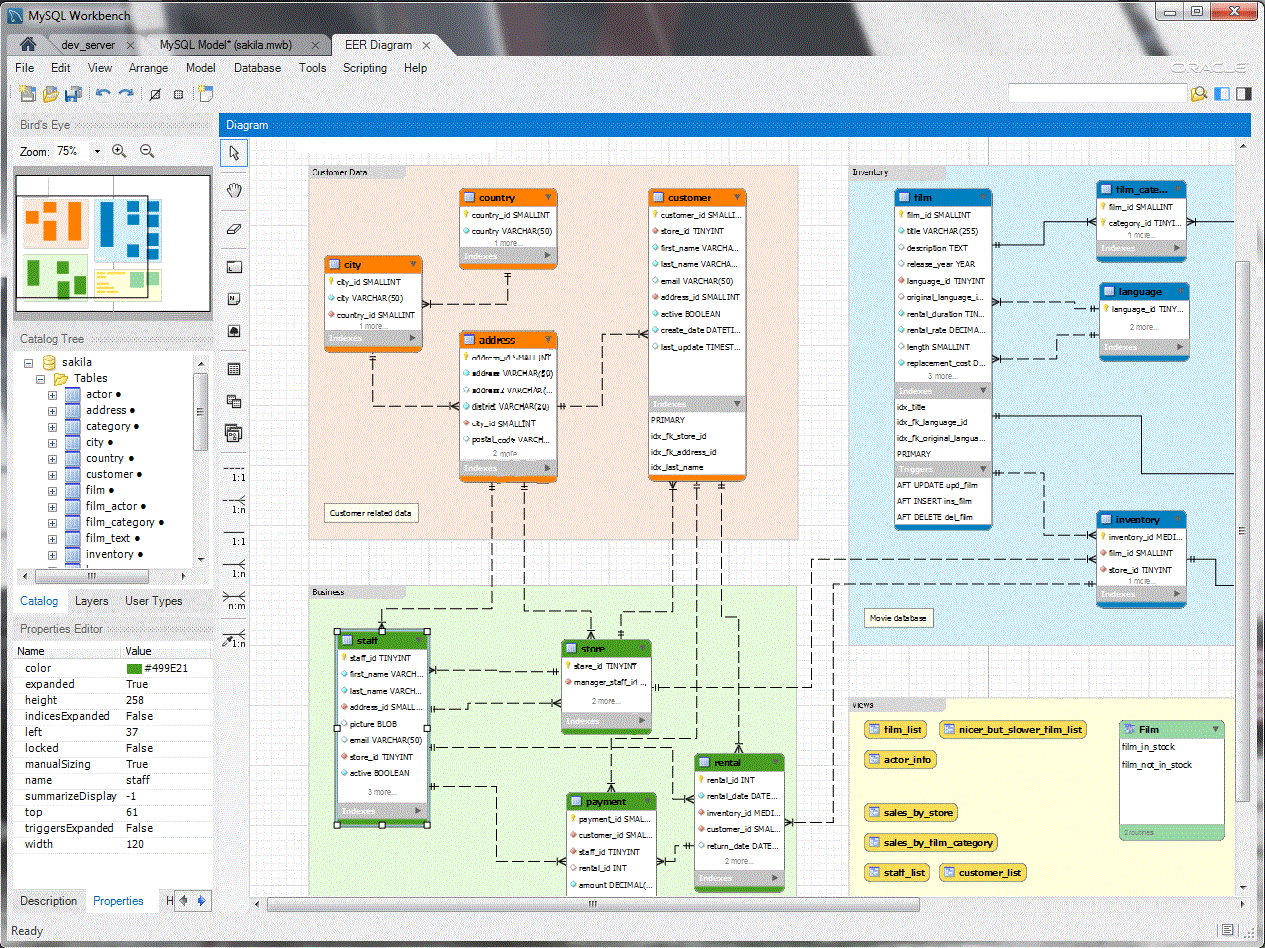
Visual database design in MySQL Workbench
According to Gartner, rDBMSs account for 89 percent of the total DBMS market, making them the bread and butter of the industry. Popular systems here include Oracle Database, Microsoft's SQL Server, MySQL and IBM's DB2.
2) Semi-structured database management systems
In contrast to the rigid tables of rDBMSs, semi-structured database management systems offer more flexibility. Data can be structured as much or as little as possible depending on the purpose, usually with tags or other markers to define attributes and categories. In the age of the internet where data takes many forms, semi-structured database management systems have become increasingly important, as they enable applications to communicate with one another with ease and without loss of information.

Service status in Cloudera Manager
Semi-structured DBMSs are on the rise. While they only represent five percent of the total DBMS market, their growth rate (78 percent) was the highest of any type of DBMS in 2016 according to Gartner. Big players here include Amazon, Cloudera and MapR.
The other major type of DBMS is called a “Prerelational-era DBMS"—an antiquated category that no longer has any relevance to first-time buyers.
Benefits of Database Management Systems
DBMSs provide a number of benefits to both internal users and external parties like customers or clients. If you're having trouble convincing stakeholders in your organization that new software is a worthwhile investment, let them know that a DBMS can provide:
Improved data access. A DBMS can make it possible for all your internal and external business applications to quickly retrieve information from a single source using ad hoc queries. Whether it's an online customer wondering if you still have that shirt in blue or someone on your marketing team wanting to know last month's ad spend, a DBMS can supply the right data in real-time.
Sustained data integrity. Data organized using different methods across multiple databases can result in a ton of errors when applications need to communicate with one another. A DBMS can provide data standardization and structure to ensure these costly errors don't occur.
Increased data security. Businesses big and small are concerned about data loss and hackers. A DBMS can ease these fears with features like dual authentication and data encryption to ensure that only those with authorization can access and manipulate different data sets.
Database Management System Pricing
A big headache when researching DBMS vendors is the lack of concrete pricing information. A lot of companies don't want to reveal how much their system costs for a number of reasons. The final price might vary from business case to business case or the vendor might simply want to get you on the phone to sell their system.
In general though, DMBSs will have one of two pricing models, which we explain in the table below:
Per-user subscription pricing | This type of pricing is more common with cloud-based systems. You pay a monthly or annual fee based on how many users will have access to the DBMS. Airtable is a good example of this approach. |
Perpetual pricing | This type of pricing is more common with on-premise systems. With this model, you pay one large fee upfront to own the software in perpetuity. Oracle Database is a good example of this model. |
Database Management System Trends
As I mentioned before, the DBMS market is always changing. Here are some trends to keep an eye on as you research different systems:
Database platform-as-a-service (dbPaaS). More and more, businesses are dropping their bulky, expensive, in-house servers to host their DBMSs in the cloud. Scalable and flexible, dbPaaSs are increasingly popular options to handle back-end data needs for e-commerce and mobile applications.
Open-source database management system (OSDBMS). The OSDBMS market is increasing in both system options and sophistication of features. If you have the IT bandwidth, consider an open-source DBMS for your business. Capterra breaks down some of the most popular offerings here.