
Best AIOps Platforms Software of 2026
Updated March 19, 2026 at 9:58 PM

Written by Supriya Deka
Market Research Specialist

Edited by Mehar Luthra
Team Lead, Content
- Popular Comparisons
- Buyers Guide
Compare Products
Showing 1 - 25 of 39 products
Compare Products
Sort by
Reviews: Sorts listings by the number of user reviews we have published, greatest to least.
Average Rating: Sorts listings by overall star rating based on user reviews, highest to lowest.
Alphabetically (A-Z): Sorts listings by product name from A to Z.

Site24x7 is a cloud-based website and server monitoring platform that helps small to large size businesses monitor websites, ser...Read more about Site24x7


Site24x7's Best Rated Features
See All
Site24x7's Worst Rated Features
See All

ManageEngine OpManager Plus is an integrated IT operations management solution that offers comprehensive monitoring capabilities...Read more about ManageEngine OpManager Plus

ManageEngine OpManager Plus's Best Rated Features
See All
ManageEngine OpManager Plus's Worst Rated Features
See All

Runecast is a provider of one solution designed to help IT Security and Operations teams like yours effectively manage and mitig...Read more about Runecast


Introducing AI agents that can get real work done, autonomously or in a team. They learn your process, use your data, have infin...Read more about SmythOS


SmythOS's Best Rated Features
See All
SmythOS's Worst Rated Features
See All

SysTrack is an on-premise and cloud-based solution that helps businesses collect data from various endpoint environments to stre...Read more about SysTrack


Zenoss is an AIOps platform designed to help businesses in the healthcare, finance, IT and other sectors analyze streaming data ...Read more about Zenoss


AutoRABIT is the only complete DevSecOps platform for Salesforce developers. Incorporate static code analysis, data security, an...Read more about CodeScan


Motadata AIOps is a powerful enterprise platform that helps I&O teams process and store data for better decision-making. The pla...Read more about Motadata AIOps
Motadata AIOps's Best Rated Features
See All
Motadata AIOps's Worst Rated Features
See All

Netreo is a cloud-based IT infrastructure management solution, which helps organizations manage applications, networks and syste...Read more about Netreo

The Fosfor Decision Cloud provides everything you need to make better business decisions by unifying the components of your data...Read more about Fosfor Decision Cloud


Avantra is an on-premise and cloud-based software designed to help businesses using SAP leverage AI technology to automate and s...Read more about Avantra


Data finds purpose with Squirro, the first enterprise-ready generative AI for search, insights, and automation. Squirro develop...Read more about Squirro


Kentik is a cloud-based network management solution which assists network managers, network engineers and operators with data en...Read more about Kentik
Kentik's Best Rated Features
See All
Kentik's Worst Rated Features
See All

PagerDuty is an incident management solution for monitoring systems and triggering alerts. Key features include monitoring aggre...Read more about PagerDuty

PagerDuty's Best Rated Features
See All
PagerDuty's Worst Rated Features
See All

AWS provides the most comprehensive set of artificial intelligence (AI) and machine learning (ML) services. With a fully manage...Read more about Machine Learning on AWS

BigPanda is an AIOps solution that helps businesses streamline processes related to event correlation, outage resolution, incide...Read more about BigPanda


DX Application Performance Management allows businesses to monitor, discover and detect microservices-based clusters, projects, ...Read more about DX Application Performance Management


Edge Delta is a new way to do observability. We process your data as it's created and give you the freedom to route it anywhere....Read more about Edge Delta

CloudFabrix Composable Analytics is an analytics platform that provides data observability, AI-powered insights, and cloud cost ...Read more about Fabrix.ai

LogicMonitor’s SaaS-based observability and IT operations data collaboration platform helps ITOps, developers, MSPs and business...Read more about LogicMonitor

LogicMonitor's Best Rated Features
See All
LogicMonitor's Worst Rated Features
See All

HPE GreenLake is a cloud management platform that allows businesses to create, manage and deploy applications in the cloud. It i...Read more about HPE GreenLake

The Splunk Enterprise platform allows users to process and index most forms of data in their native format. It includes data ind...Read more about Splunk Enterprise

Splunk Enterprise's Best Rated Features
See All
Splunk Enterprise's Worst Rated Features
See All

Cybus Connectware integrates production and IT with a centralized, scalable data hub that collects, processes and distributes in...Read more about Cybus Connectware


Datadog is the monitoring, security and analytics platform for developers, IT operations teams, security engineers and business ...Read more about Datadog
Datadog's Best Rated Features
See All
Datadog's Worst Rated Features
See All

ServicePilot is a high-performance IT monitoring system supporting highly detailed observability of critical applications, surve...Read more about ServicePilot

Popular Comparisons


Buyers Guide
This detailed guide will help you find and buy the right aiops platforms software for you and your business.
Last Updated on April 23, 2025As an IT professional, you work with dozens of tools that generate huge volumes of complex data in the form of logs, metrics, event records, and more.
With traditional IT operation monitoring techniques, it can take too long for your team to inspect the data from various systems and tools (in hybrid, diversified environments) to identify the root cause of issues. This will eventually affect service delivery and customer user experience.
AIOps is the application of artificial intelligence (AI) for IT operations. It helps IT Ops, DevOps, NetOps, and SecOps teams detect digital service issues faster and resolve them quickly, before it affects business operations and customers. This helps prevent outages, maintain uptime, and provide optimal service delivery.
This software can integrate with IT service management software, issue tracking, IT management software, and application performance management software to aggregate and summarize data from multiple sources in order to improve visibility across business services and applications within the IT infrastructure.
Given the many options available on the market, deciding which software to choose can be confusing. In this buyers guide, we’ve provided all the information you need to make the right purchase decision for your IT needs.
Here’s what we'll cover:
What is AIOps platform software?
AIOps platforms, known as artificial intelligence for IT operations, is an application that automates and streamlines IT operations by applying artificial intelligence, machine learning, and analytics to big data. AIOps platforms collect massive amounts of IT data (big data) from various tools and devices, correlate data in a contextual form, and identify root causes of problems and recurring issues.
The insights from AIOps platform software can be turned into intelligent actions performed automatically, allowing IT professionals to make decisions faster and more accurately. Such platforms can alert SecOps, NetOps, DevOps and other IT teams of problems and opportunities which they can collectively observe, engage, and act on. This results in continuous improvements and fixes in core IT functions of an organization, which help avoid downtime and improve customer satisfaction.
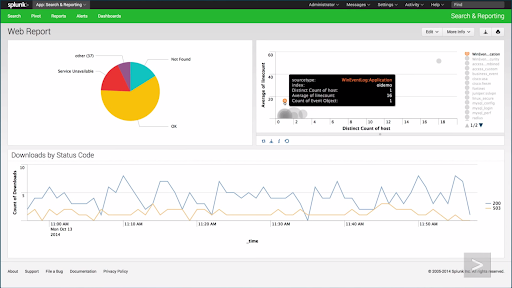
Reporting/analytics in Splunk Enterprise (Source)
Common features of AIOps platform software
Data aggregation | Collect, process, and summarize data from multiple sources in a report-based form for further data analysis. |
IT monitoring | Gather metrics about the operations of an IT environment’s hardware and software to assess the performance of an IT infrastructure and network in real-time. |
Root cause analysis | Determine the underlying cause of problems in hardware and software of an IT infrastructure. AIOps goes deep into the root of the problem more quickly than manual analysis. |
Analyze large data sets to find correlations and patterns and use these patterns to make predictions and provide valuable insights. | |
Alerts/notifications | Provide a means of alerting IT professionals faster by automatically generating alert messages and notifications when an issue is detected by the AIOps software. |
Detect, investigate, and respond to incidents of unplanned events or service interruption. This helps the IT team restore a service to normal as quickly as possible after a disruption. | |
Performance monitoring | Diagnose performance and availability problems within the IT infrastructure and network. It is used to observe applications, log issues, trace, and alert DevSecOps teams about irregularities or issues with cloud or on-premise infrastructure. |
Reporting/analytics | Deliver reports in the form of dashboards, graphics, or other forms to your IT teams and management in an easy-to-understand format. These reports about key metrics on IT infrastructure issues and performance can help you take action to resolve and improve the organization’s IT operations. |
Third-party integrations | ntegrate with current tools within the organization, bringing together information, insights, and capabilities to improve visibility across all tools. Such tools typically integrate with ITSM, monitoring tools, issue tracking, IT management software, and application performance management software. |
Application security | Identify and respond to security threats within developed applications. AIOps manages massive amounts of data collected from multiple sources to a central location, allowing better process and application security. |
What type of buyer are you?
Before evaluating AIOps platforms, you should assess what kind of buyer you are. The majority of buyers in this market belong to one of these categories:
IT service providers: IT organizations work on thousands of events that come from siloed systems in order to find issues that are the root cause of their client’s business service failure. Such organizations using legacy IT operations tools and manual processes can take hours to figure out the actual causes. This can result in service degradation, which will ultimately harm their clients who are dependent on their IT resources. AIOps solutions can help IT service providers proactively identify potential issues with the services and technology they deliver and correct them before they become major problems.
Such buyers should opt for an AIOps platform that provides flexible deployment, third-party integrations, and event and incident management capabilities. These capabilities will allow service providers to understand and predict business performance degradations and manage service level agreements (SLAs) related to business service availability and performance.
Business with existing IT teams: Buyers in this category belong to large organizations that have dedicated in-house IT teams for service management, performance management, and automation. Such companies often have their data siloed in multiple cloud environments and on-premise data centers. Due to this, the IT teams are often stuck in a loop of incidents and fixes. Using an AIOps platform will help the IT operations team improve risk management, deliver new services faster, and gain actionable reporting.
These users should look for a fully featured AIOps platform along with monitoring capabilities, automated problem detection, and data ingestion and storage capabilities. The tool should be able to handle multiple data sources such as log data, wire data, text data, metrics, and APIs. These capabilities will help in cost and capacity planning, increase end-to-end visibility of IT operations, and make these teams more efficient.
Benefits of AIOps platforms
Below is a list of benefits you can expect from implementing AIOps platforms:
Faster digital transformation: AIOps platforms use self-learning algorithms backed by machine learning to identify and remediate any possible incidents in real-time via behavioral and historical data analysis. This provides you with greater control over your IT infrastructure and business applications. By allowing you to make better use of data, AIOps solutions will accelerate the digital transformation of your organization by enabling automation across areas of IT. As a result, it will help you innovate new products and services faster, reduce risks, and increase agility and resilience.
Time and cost savings: Your IT teams spend a lot of time managing mundane tasks and repetitive incidents that could be automated. Investing in an AIOps platform will help your IT operations teams detect and resolve problems faster, prioritize issues, and improve overall business performance. AI can automatically analyze volumes of data and network to find patterns in order to identify problems, and predict and prevent future ones. This not only saves a huge amount of time but also saves the cost by avoiding downtime and critical IT incidents.
Data-driven decision-making: AIOps help your organization correlate data from diverse sources and visualize key performance indicators and issues in a dashboard, providing a holistic view of your IT infrastructure. It leverages machine learning techniques in your IT operations for pattern matching, predictive analysis, and historical data analysis. As a result, it delivers data-driven automated responses to incidents, which eliminates human error. This allows your staff to focus more on solving the issues rather than detecting them.
Key considerations
Breadth of functionalities
Some AIOps tools work with any type of data, known as data-agnostic tools, while other AIOps tools work only with certain types of data in specific use cases. These are known as domain-specific tools. It is important to know your business needs before purchasing a software tool.
If your organization has a dedicated IT team for monitoring and developing applications, and your employees work with a variety of data types, it is advisable to purchase a data-agnostic AIOps tool. Such tools can be applied in a wide variety of use cases such as application performance monitoring, maintenance and upgrades of network infrastructure, and analysis of business or marketing data.
But, if your team operates within a specific domain with finite needs, then a data-agnostic AIOps platform might not offer all the dedicated features and functionalities required for your specific domain. You should go for a domain-specific tool that caters to your specific need, such as a tool focused on application performance monitoring, security operations, cloud capacity management, or network infrastructure.
When buying AIOps tools, expect to pay more for platforms that offer more than just the basic features. Tools that only offer domain-specific features will cost less than those of data-agnostic AIOps tools which provide more advanced functionalities.
Market trends to understand
AIOps solutions are integrating with observability platforms: Observability platforms help examine the internal state of a system by examining the outputs. These tools collect data in the form of logs, metrics, and traces, and connect the dots between them to determine insights. Integrating AIOps with observability platforms will reduce the time to predict and fix problems by automating the analysis of streams of data aggregated by observability tools in real-time, and turning them into actionable insights. By enabling better diagnostics, the technology empowers IT teams to have a deeper understanding of an organization’s operational data and system. Together, they provide insights required for automated issue remediation and zero-disruption operations, which helps DevOps teams to properly focus on the customer experience.
Note: The application selected in this article is an example to show a feature in context and is not intended as an endorsement or recommendation. It has been obtained from sources believed to be reliable at the time of publication.