


Best Fuel Delivery software of 2026

- Popular Comparisons
- Buyers Guide
Compare Products
Showing 1 - 25 of 39 products
Compare Products
Sort by
Reviews: Sorts listings by the number of user reviews we have published, greatest to least.
Average Rating: Sorts listings by overall star rating based on user reviews, highest to lowest.
Alphabetically (A-Z): Sorts listings by product name from A to Z.

Focus X is an all-inclusive enterprise resource planning (ERP) system that helps you connect every aspect of your business opera...Read more about Focus X
Focus X's Best Rated Features
See All
Focus X's Worst Rated Features
See All

Versa is Modern all-in-one Cloud ERP software created for fast growing inventory heavy manufacturing, distribution, and e-commer...Read more about Versa Cloud ERP


aACE is a powerful, comprehensive business management solution designed for companies that have outgrown small-business packages...Read more about aACE


Sage X3 is a powerful ERP software solution designed for midsized national and global manufacturers, distributors, and after-sal...Read more about Sage X3


Sage X3's Best Rated Features
See All
Sage X3's Worst Rated Features
See All

Infor Distribution SX.e is an easy-to-use, modern ERP solution purpose-built for the highly specialized, core processes of distr...Read more about Infor Distribution SX.e


SAP S/4HANA Cloud is a cloud-based and on-premise enterprise resource planning (ERP) solution. It is suitable for small, midsize...Read more about SAP S/4HANA Cloud


SAP S/4HANA Cloud's Best Rated Features
See All
SAP S/4HANA Cloud's Worst Rated Features
See All

AcctVantage ERP is a distribution and manufacturing software solution. It helps businesses streamline their operations. The soft...Read more about AcctVantage ERP


Royal 4 Enterprise is an integrated enterprise resource planning (ERP) solution with built-in modules for distribution, manufact...Read more about R4 Enterprise

Online Computing designs and develops a proprietary ERP software called MasterTools. MasterTools combines all aspects of product...Read more about MasterTools
No reviews yet
recommendations

Infor M3 is a cloud-based ERP solution for global manufacturers and distributors with complex value chains. It offers analytics ...Read more about Infor M3

Datacor ERP (formerly Chempax) is an integrated enterprise resource planning (ERP) and customer relationship management (CRM) ap...Read more about Datacor ERP

Datacor ERP's Best Rated Features
See All
Datacor ERP's Worst Rated Features
See All

BatchMaster Software offers process manufacturing software solutions for the food, chemical, nutraceutical and pharmaceutical in...Read more about BatchMaster ERP

BatchMaster ERP's Best Rated Features
See All
BatchMaster ERP's Worst Rated Features
See All

Jolt is an operations management software designed to help businesses in the food, retail, and hospitality industries. The softw...Read more about Jolt


Jolt's Best Rated Features
See All
Jolt's Worst Rated Features
See All

Cloud ERP Software is an enterprise resource planning solution that integrates core business management functions into a single ...Read more about Cloud ERP


Quickbase is a work management and application platform designed to help organizations centralize and manage complex projects an...Read more about Quickbase


Quickbase's Best Rated Features
See All
Quickbase's Worst Rated Features
See All

Celigo Integrator.io is a cloud-based app integration platform. It helps businesses automate business processes from a unified p...Read more about Celigo Integrator.io
Celigo Integrator.io's Best Rated Features
See All
Celigo Integrator.io's Worst Rated Features
See All

Gofrugal POS is a hybrid point of sale (POS) solution that helps retailers across various industries, to manage their distributi...Read more about Gofrugal

Gofrugal's Best Rated Features
See All
Gofrugal's Worst Rated Features
See All

About TrueCommerce EDI Solutions TrueCommerce EDI Solutions is a cloud-based distribution platform that helps businesses automa...Read more about TrueCommerce EDI Solutions


TrueCommerce EDI Solutions's Best Rated Features
See All
TrueCommerce EDI Solutions's Worst Rated Features
See All

DATASCOPE WMS is a warehouse management solution, which helps distribution centres and manufacturing plants such as apparel, aut...Read more about DATASCOPE WMS


SapphireOne is a premier integrated Enterprise Resource Planning (ERP) and accounting software solution, meticulously crafted to...Read more about SapphireOne

Transform your inventory processes into modern workflows with technology workers already know & love. Meet mobe3 WMS: intuitive,...Read more about mobe3


NolaPro by Noguska LLC is a customizable accounting solution, featuring order tracking, inventory, POS and more. It provides a t...Read more about NolaPro

FreightPath is the easiest-to-use TMS system built specifically for the needs of freight brokers and 3PLs. Not only does it hel...Read more about FreightPath

OmPrompt is a cloud-based order management software designed to help businesses in various industries automate supplier and cust...Read more about OmPrompt EDI as a Managed Service

Oneir Solutions is an enterprise resource planning (ERP) platform designed to help organizations manage and coordinate critical ...Read more about Oneir
Popular Comparisons


Buyers Guide
This detailed guide will help you find and buy the right fuel delivery software for you and your business.
Last Updated on January 27, 2025The fuel business has traditionally been heavy on manual labor and capital expenses, and carries many safety concerns and compliance issues. This is why mostly big businesses have gotten into this field in the past. Technological advances are helping small and midsize businesses (SMBs) venture into the fuel business and carve a niche for themselves with services such as fuel delivery.
Fuel delivery software aims to simplify the process of delivering fuel from the storage location to various businesses like gas stations, convenience stores and independent fuel outlets. This guide will cover the various features of fuel delivery software and how SMBs can benefit from using them.
Here's what we'll cover:
What Is Fuel Delivery Software?
Common Features of Fuel Delivery Software
What Is Fuel Delivery Software?
Fuel delivery software automates many of the time- and labor-consuming tasks in the delivery process. These tasks include creating schedules for vehicles and drivers, tracking storage and customer inventory, mapping efficient delivery routes and accounting.
Drivers can create invoices at the delivery location, which can be uploaded to the accounting system in real-time, resulting in more timely and accurate payments. With this information, businesses can calculate their state fuel taxes and pay them in advance. Fuel delivery software also helps track your customers' needs by analyzing their fuel stocks.
These are among some of the benefits of using fuel delivery software. But before we get into these details, let us look at some of the main features that potential fuel delivery software users should consider.
Common Features of Fuel Delivery Software
On top of managing the business, fleet owners and managers have to track a number of additional factors. Fuel delivery software can automate or simplify a number of these time-consuming tasks:
Billing and invoicing | Helps eliminate double or inaccurate entries with barcode scanning and real-time updates. Can be used as a stand-alone system or integrated with your accounting system. |
Digitizes the manual process of checking fuel inventory, sales information, truck deployments, project load time quantities and other metrics so that the supply doesn't run out. | |
Scheduling and tracking | Automates driver schedules and tracks vehicle inspections. Drivers can be given mobile devices that provide directions. RFID and barcode scanning functionality helps track refuels and deliveries, while GPS tracking in the vehicle will allow you to track movements. |
Route optimization | Uses real-time GPS and traffic data to create the easiest and most fuel-efficient delivery routes. This keeps expenses low, reduces driver fatigue and ensures timely deliveries. |
Fuel cost management | Manages costs of fuel and related expenses so that drivers don't exceed the set limit on each trip. Can account for various compliance costs (i.e., regular vehicle maintenance to avoid high breakdown/repair costs), vehicle fuel efficiency, employee perks (such as take-home vehicle privileges) etc. |
What Type of Buyer Are You?
Fuel delivery software combines functions such as fleet management, distribution, fuel management and accounting. That's why companies sometimes use different software suites to manage parts of the business before they adopt a single, full-fledged fuel delivery software solution.
While this approach works in the short term, it's not tenable in the long term. You can't have an effective digitized accounting system while still creating driver schedules manually. In the long term, you'll either need software that addresses all your needs on a single platform, or integrates with your existing systems with minimal disruptions.
Keeping these things in mind, here are the three most common types of fuel delivery software buyers, and their particular needs:
Businesses outsourcing to third-party vendors. This group includes smaller businesses that own one part of the process and depend on partnerships with third-party vendors or service providers for all other functions. Since they are so dependent on other providers, they need a fuel delivery solution that integrates with their partners' third-party systems.
Businesses that own all assets in-house. Businesses that own the whole process—inventory, delivery vehicles, contracted drivers, accounting—often prefer a full suite that covers all their need and functions. Such a setup usually requires a lot of investment upfront, but can be beneficial in the long-run.
Businesses that facilitate the process for their partners. These businesses operate as consultants or facilitators for other companies. They collaborate and contract with various vendors to get the best and cheapest deals.
These businesses don't necessarily need the full suite, so they may choose a software vendor that offers specific features, or a full suite that's priced by the number of users or their roles. For example, their fleet management partner wouldn't need access to the inventory management feature, but would require the personnel management feature.
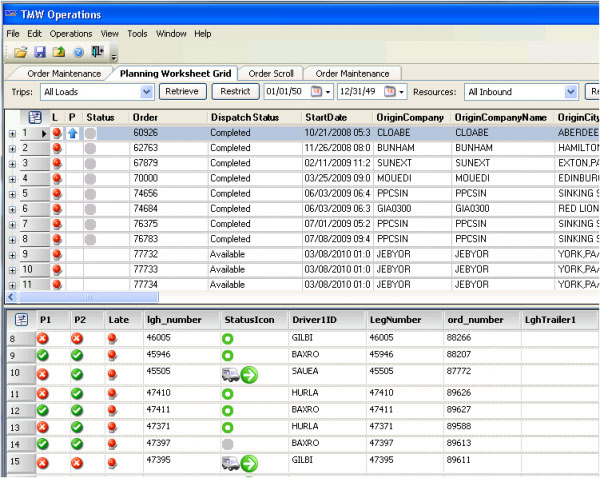
Oversee your transportation and loading on TMW Systems
Benefits and Potential Issues
The primary benefits that companies can derive from fuel delivery software are:
Streamlined processes. Fuel delivery software automates menial, time-consuming tasks (such as creating delivery schedules) and streamlines the entire delivery process. Since users can update each step in the process from any location, business owners and managers can oversee the whole operation and receive immediate alerts if there are issues.
Faster and more efficient deliveries. Automated delivery scheduling reduces fuel costs, improves travel time estimates and simplifies bookkeeping.
Better records of all transactions. Owners and managers can budget more accurately by having detailed digital records of all transactions, which are updated in real-time across different departments such as accounting, inventory, scheduling etc.
Cost savings to you and your customers. Streamlined processes and better scheduling reduce costs by increasing efficiency and reducing the chance for human error.
With all these benefits, there are also some issues that you should consider:
Accounting for driver expenses. Any business that deals with fleets and vehicles has to account for expenses on the road, such as refueling, vehicle maintenance, driver lodging and local taxes. While fuel delivery software simplifies expense tracking, your business will need to determine which expenses are legitimate.
Overpaying for features. The more number of features you add to your basic fuel delivery software choice, the more expensive it becomes. Make sure that you identify which features are most important to your business, and look for vendors who provide that specific feature set. Also be sure to account for IT costs for implementation and upkeep.
Limits to automation. Even though you can automate several tasks, some functions still require manual intervention, such as accounting and personnel management.
Market Trends to Understand
A number of recent news items speak to larger market trends that are driving fuel delivery software adoption.
Unchecked leak costs town $2 million. A simple leak from corroded pipes, which went undetected for more than a year, cost the town of Newington, Connecticut dearly. The leak went undetected for more than a year. This demonstrates the importance of frequent compliance checks—in this case, the report discovered that the software purchased to report fuel volumes was never installed.
Carbon footprint reduction. As businesses and consumers increasingly consider the carbon footprint of the products and services they purchase, automobile companies and fleet management businesses are prioritizing sustainability. Fuel delivery software can increase efficiency and reduce your carbon footprint, which can in turn help you grow your business.
Fuel deliveries to customers' cars. It may seem like a far-fetched idea, but some startups are delivering fuel and vehicle maintenance to individual vehicles in parking lots. Some employers are looking at these programs as a way to offer new employee perks. While the appeal of these services may seem self-evident, they may face regulatory hurdles—gas stations are required to follow strict fire safety rules, after all.