


Best Fire Department Software of 2026
Updated March 13, 2026 at 6:36 AM
- Popular Comparisons
- Buyers Guide
Compare Products
Showing 1 - 25 of 43 products
Compare Products
Sort by
Reviews: Sorts listings by the number of user reviews we have published, greatest to least.
Average Rating: Sorts listings by overall star rating based on user reviews, highest to lowest.
Alphabetically (A-Z): Sorts listings by product name from A to Z.

AMCS Fleet Maintenance (formerly Dossier) is a fleet maintenance solution that helps fleet owners and managers to manage busines...Read more about AMCS Fleet Maintenance


Community Development is a mobile friendly, cloud-based, end-to-end software solution for managing your permitting, planning, li...Read more about CivicPlus Community Development


Station Check is an asset and workflow management solution designed to help fire departments handle checklists, track vehicle st...Read more about StationCheck

Adashi FirstResponse MDT is a fire department management solution that helps the department of public safety and first responder...Read more about Adashi FirstResponse MDT

RedAlert NMX is a fire department management solution designed to help fire departments and ambulance services report and record...Read more about RedAlert NMX

FireServiceRota is a cloud-based software designed to help firefighters streamline operations related to scheduling, dispatching...Read more about FireServiceRota

First Due is a complete solution to streamline your Fire & EMS agency's workflow. First Due suite unifies all your agency's crit...Read more about First Due
First Due's Best Rated Features
See All
First Due's Worst Rated Features
See All

Emergency Reporting is a cloud-based fire department and emergency medical service (EMS) solution that helps businesses manage r...Read more about Emergency Reporting


ESO Fire RMS is a records management solution designed to help fire departments handle incidents, personnel, inspections, checkl...Read more about ESO Fire RMS

PhaRmLogs is designed to help ambulance companies, fire departments, law enforcement and other EMS-based organizations manage an...Read more about Emergency Logs


Emergency Logs's Best Rated Features
See All
Emergency Logs's Worst Rated Features
See All

PSTrax maximizes first responders' readiness with tailored software for efficiently managing vehicles, stations, equipment, supp...Read more about PSTrax

eSchedule is a web-based solution designed to help emergency medical services, fire departments, nurses, law enforcement agencie...Read more about eSchedule


eSchedule's Best Rated Features
See All
eSchedule's Worst Rated Features
See All

AssetPool is a digital asset management and inspection tool that can be used on your phone and computer. There is no need for pa...Read more about AssetPool


AssetPool's Best Rated Features
See All
AssetPool's Worst Rated Features
See All

InTime is a cloud-based scheduling and workforce management software designed specifically for public safety professionals. It i...Read more about InTime


InTime's Best Rated Features
See All
InTime's Worst Rated Features
See All

The Rave Alert mass notification system gets the right message to the right user at the right time from any internet-connected d...Read more about Rave Alert
Rave Alert's Best Rated Features
See All
Rave Alert's Worst Rated Features
See All

Aladtec, powered by TCP Software, is a cloud-based employee scheduling system created specifically for Public Safety agencies. I...Read more about Aladtec

Fire Rescue Systems offers a full suite of software for the fire service. The software is modular, meaning you only need to buy ...Read more about Fire Rescue Systems

PowerDMS is a cloud-based document control platform designed to assist public safety and healthcare organizations. The solution ...Read more about PowerDMS


PowerDMS's Best Rated Features
See All
PowerDMS's Worst Rated Features
See All

GovPilot is a cloud-based solution that helps municipalities automate daily tasks and streamline communications between multiple...Read more about GovPilot


Code3 Firewatch is a resilience analytics solution, which helps fire departments and emergency medical services (EMS) analyze th...Read more about Code3 Strategist

D4H is the cloud platform for emergency response; proudly supporting emergency operations in government, public safety, oil and ...Read more about D4H


The Silent Partner Technologies IntelliView is a comprehensive solution designed for enterprises seeking to track their assets f...Read more about IntelliView for Fire & EMS

Operative IQ is an operations management platform that helps law enforcement, EMS, fire services, hospitals, educational program...Read more about Operative IQ

AngelTrack is EMS and fire software in the cloud, for ambulances, wheelchair vans, fire stations, air, and telemedicine. It feat...Read more about AngelTrack

Pace Scheduler is a scheduling solution for fire/police departments, campus security, emergency dispatch, corrections facilities...Read more about Pace Scheduler
Popular Comparisons


Buyers Guide
This detailed guide will help you find and buy the right fire department software for you and your business.
Last Updated on January 27, 2025In the U.S., a fire department responds to a fire incident every 24 seconds.
With so many incidents to cater to, fire departments need to enhance their operational efficiency by improving incident and fleet management capabilities. If your fire department relies on clunky spreadsheets and manual data entry, you're hurting your ability to respond in a timely, efficient manner—and save lives.
Fire department software can help your fire station improve overall operational efficiency by automating core tasks such as incident, fleet, and personnel management.
In this guide, we'll cover:
What is fire department software?
Common features of fire department software
What is fire department software?
Fire department software is designed to help fire stations manage operations, personnel, equipment, and inventory. These tools help fire departments automate manual tasks such as record keeping and dispatch management, helping them respond to emergencies much more efficiently.
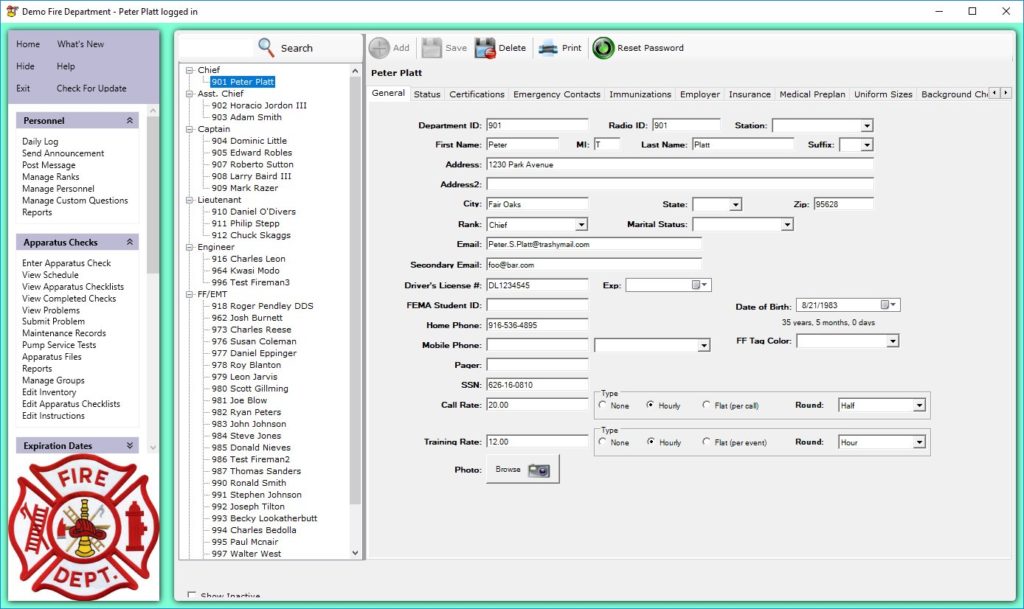
An example of a personnel management dashboard in fire department software (Source)
Common features of fire department software
Most fire department software products have common features, which can make it difficult to narrow your search and find a specific tool that meets the unique operational needs of your fire department.
Whatever product you pick, be sure it includes these most common fire department software features:
Incident management | Records all fire-related incidents reported by the public and escalates situations to the fire department nearest the incident location. |
Fleet management | Helps fire departments manage their fleet of firetrucks and emergency vehicles, including maintenance, mileage, locations, and department allocation. |
Personnel management | Tracks personnel schedules, availability, and performance. |
GPS tracking | Tracks the location of firetrucks and other emergency vehicles to coordinate operations from a central control room. |
Dashboard | Centralized view to capture and track how all GDPR sensitive data is classified, labeled, protected, used, and stored. |
Inventory management | Helps fire departments manage equipment such as extinguishers, fire hoses, and helmets to ensure all equipment is accounted for and available for incident response. |
Scheduling | Schedule vehicle maintenance, equipment repair, and internal and external training for employees and the public. |
What type of buyer are you?
Fire departments vary in size and type depending on the density and requirements of the population where they are based.
Larger cities, for example, require more personnel, equipment, and vehicles than smaller towns. Airports, on the other hand, often employ private fire departments to handle emergency incidents.
Before you invest in fire department software, make sure you identify what type of buyer you are and what unique operational requirements you need your software to meet.
Nonprofit fire departments: Also known as volunteer fire departments, nonprofit fire departments are often based in remote towns and smaller communities. Due to their distance from larger cities, local residents often create a dedicated team of volunteers to respond to emergency incidents on short notice. These nonprofit fire departments should look for free software that can integrate with fundraising tools to keep operational costs down.
Small fire departments: Fire departments with fewer than 100 personnel and a small fleet of vehicles fall within this category. Often located in small cities or towns with a small population density, fire departments in this group require the core common features of fire department software such as incident, fleet, and personnel management.
Midsize fire departments: These fire departments have between 100 and 500 personnel and are often located in larger suburbs close to metropolitan areas. Since these fire departments have more staff than the two smaller categories, they often require core features as well as optional features such as scheduling and inventory management.
Large fire departments: Fire departments located within metropolitan areas and large cities often have over 500 staff members and a plethora of firetrucks and emergency vehicles. Since they are located in densely populated areas, these departments often have multiple stations spread throughout a city and require a fully featured software suite to cater to their increased operational requirements.
Benefits and potential issues
No matter which category you fall in, it's important to understand the benefits of fire station software. These tools provide the following benefits (among others):
Faster response time to dispatch fire personnel: Once an incident is reported, the nearest station is notified through the software's incident management feature, and firefighters are dispatched quickly.
Increased operational efficiency: Fire department software often offers a dashboard that highlights key performance indicators (KPIs), such as equipment inventory, fleet information, and incident location. By reviewing KPIs in one location, fire department managers can optimize the operational efficiency of their fire stations.
Increased training and awareness of fire hazards: Most fire department software integrates with learning management systems, letting users create courses and training material to help new personnel understand fire hazards and safety measures.
Key considerations
When investing in fire department software, here are some considerations to keep in mind to make the most of your purchase:
Pricing: Fire department software is available in various pricing options based on included features. These options are often divided into three plans: basic, intermediate, and advanced. If you are purchasing software for the first time, start with the basic plan to assess if it meets your requirements before upgrading.
Third-party integration: Integrating fire department software with other tools increases the functionality of your current system(s) without making additional purchases. For example, if you already have a fleet management solution to manage firetrucks and are looking for fire department software to manage operations, make sure that the tools integrate with each other before making your purchase.
Mobile apps: Since fire station employees spend most of their time in the field responding to incidents, a mobile app can help them stay synchronized and in contact with their station. Determine whether mobile app functionality would benefit your station and your employees, and look for fire department software that offers a mobile app.
Note: The applications selected in this article are examples to show a feature in context and are not intended as endorsements or recommendations. They have been obtained from sources believed to be reliable at the time of publication.