
Best Construction Categories
Best Facilities Management Categories
Best Human Resources Categories
Best Legal Management Categories
Best Manufacturing Categories
Best Medical Categories
Best Property Management Categories
Get 1-on-1 advice in 15 minutes. It's free.

Josh P.

Top 10 Medical Practice Management Software With AI-Enabled Features
Forget crowded waiting rooms and endless paperwork; AI medical software is changing how medical care is delivered. These software solutions use predictive analytics, machine learning, and generative AI so healthcare professionals can manage records, schedule appointments, and assess patient health—faster and more accurately.
Why does it matter? AI can transcribe voice notes into clinical documents, assist with appointment booking using previous data, and even measure vitals via webcam. This type of automation allows doctors and nurses to spend less time on administrative tasks and more time engaging directly with patients, discussing treatment plans, answering questions, or providing hands-on care.
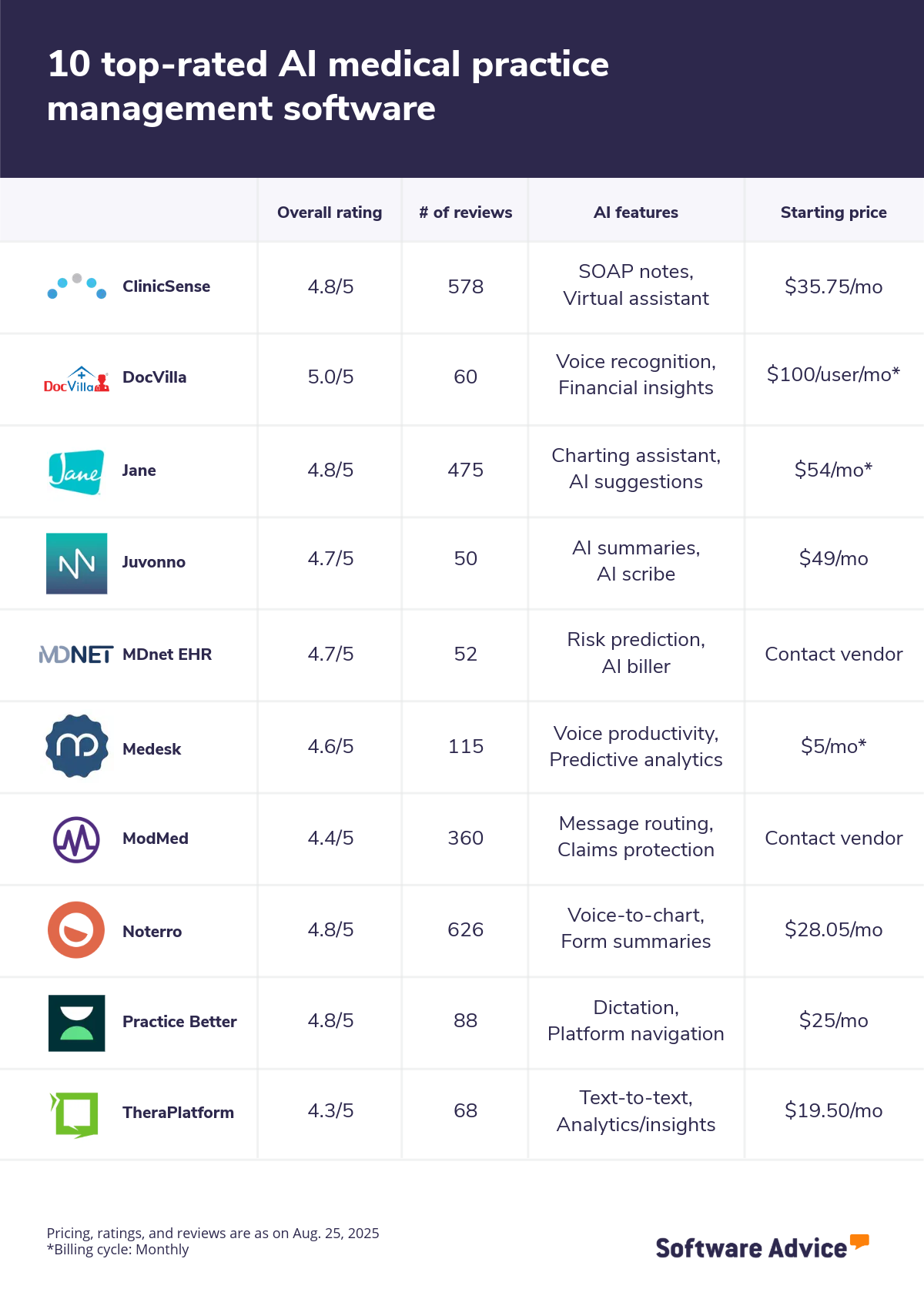
Below is a list of 10 top-rated AI medical tools, sorted alphabetically, based on verified user reviews and our research team's analysis. These tools cater to medical needs, including electronic medical records (EMR), medical billing, and patient scheduling.
1. ClinicSense
ClinicSense uses AI to help wellness clinics automate documentation, streamline client communication, and personalize outreach. Its AI features support faster Subjective, Objective, Assessment, and Plan (SOAP) note creation, virtual scheduling assistance, and targeted email campaigns. The software analyzes client behavior and appointment history to improve operational efficiency and retention.
AI-enabled medical features*:
AI soap notes: Transcribe voice input into structured SOAP documentation for faster and more consistent recordkeeping.
Virtual assistant: Handle client calls and bookings 24/7 via Goodcall integration, reducing missed appointments and manual scheduling.
Email segmentation: Filter clients by visit history, service type, or practitioner to send personalized messages that boost engagement.
Starting price: $35.75 per month
Billing cycle: Annual
Customer support options: Help center, call, email, community, and a knowledge base
Who should consider ClinicSense’s AI capabilities?
Wellness clinics aiming to reduce time spent on documentation can consider ClinicSense. With its AI SOAP notes feature, practitioners can record treatment details faster and more consistently. This improves efficiency and record accuracy.

2. DocVilla
DocVilla uses natural language processing (NLP) to convert voice dictation into structured SOAP notes, so clinicians can document faster. Its predictive analytics engine supports risk stratification and personalized treatment planning. Additionally, DocVilla offers automated coding suggestions using ICD-10, which reduces billing errors and improves reimbursement accuracy.
AI-enabled medical features*:
Voice recognition: Convert spoken input into structured notes using NLP to document patient encounters hands-free and in real time.
Financial insights: Analyze billing data to flag coding errors, predict claim outcomes, and recommend adjustments that improve reimbursement accuracy.
Intelligent scheduling: Use historical appointment data and patient behavior to suggest optimal time slots, reduce scheduling conflicts, and minimize no-shows.
Starting price: $100 per provider, per month
Billing cycle: Monthly
Customer support options: Help center, call, email, community, and a knowledge base
Who should consider DocVilla’s AI capabilities?
Multi-specialty clinics looking to improve billing accuracy and reduce claim denials should consider DocVilla. Its AI-powered ICD-10 coding suggestions assist practitioners in assigning the correct codes based on encounter notes, minimizing manual errors and speeding up reimbursement.

3. Jane
Jane’s AI Scribe feature uses generative AI to transcribe recorded sessions into structured SOAP notes, saving time and improving consistency. Practitioners can review, edit, or reject AI-generated notes, maintaining complete control over clinical records. Jane also ensures compliance with Health Insurance Portability and Accountability (HIPAA) and Personal Information Protection and Electronic Documents Act (PIPEDA), making its AI tools suitable for regulated healthcare environments.
AI-enabled medical features*:
Charting assistant: Support documentation workflows with an AI-assistant that transcribes audio and streamlines charting while maintaining compliance and practitioner control.
AI suggestions: Suggest relevant edits that refine transcribed content, helping practitioners maintain accuracy while saving time.
SOAP notes: Produce clinical records with AI SOAP notes that follow standard documentation formats and can be reviewed, modified, or rejected by the provider.
Starting price: $54 per month
Billing cycle: Monthly
Customer support options: Live chat, call, email, knowledge base, and a help desk
Who should consider Jane’s AI capabilities?
Solo practitioners and small clinics aiming to reduce time spent on manual charting should consider Jane. Its AI Scribe feature transcribes recorded sessions into structured SOAP notes, helping providers document faster while maintaining accuracy. This is especially useful for therapists, chiropractors, and wellness professionals who want to focus more on patient care and less on paperwork.
Pro tip
Ask the vendor if the AI was trained or tested on real patient data. Also, explore how the AI uses patient data to arrive at its conclusion and if it has potential biases. This minimizes the risk of the AI making mistakes that could impact patient care.
4. Juvonno
Juvonno’s Telehealth Scribe AI transcribes virtual appointments and generates SOAP notes in real time, allowing providers to focus on patient care. The system also offers AI chart summaries, enabling practitioners to review patient histories. With AI dictation, users can record sessions and convert them into structured notes to improve documentation speed and accuracy.
AI-enabled medical features*:
AI summaries: Summarize patient records and condense detailed chart histories into quick-reference overviews, helping providers prepare for appointments.
AI scribe: Transcribe virtual sessions with AI Scribe, which listens to telehealth appointments and generates structured SOAP notes that can be reviewed and added to the patient’s chart.
Review charting: Finalize documentation through review charting, which allows practitioners to edit, accept, or reject AI-generated notes.
Starting price: $49 per location, per month
Billing cycle: Annual
Customer support options: Live chat, call, email, knowledge base, and a help desk
Who should consider Juvonno’s AI capabilities?
Clinics that manage complex patient histories and need quick access to summarized records should consider Juvonno. Its AI chart summary feature condenses detailed patient files into digestible overviews, helping providers prepare for appointments faster and make informed decisions without sifting through lengthy notes.

5. MDnet EHR
MDnet EHR’s AI-powered billing assistant, ARIA, streamlines financial operations with intelligent automation. It supports patient account management by tracking real-time balances, payments, and insurance details. ARIA also handles automated payment posting, reducing manual entry and improving accuracy. Additionally, it offers auto-updates to reimbursement and payment rules, ensuring clinics stay compliant with evolving payer requirements and avoid claim rejections.
AI-enabled medical features*:
Risk prediction: Predict patient risks by analyzing clinical data to flag potential health concerns early, helping providers prioritize care and improve outcomes.
Biller: Use the AI-powered biller to manage patient accounts, post payments automatically, and update reimbursement rules in real time to reduce manual errors.
Claims management: Optimize revenue cycle by detecting coding discrepancies, suggesting accurate ICD codes, and ensuring cleaner claims for faster reimbursement.
Starting price: Available upon request from the vendor
Customer support options: Call, chat, webinar, and knowledge base
Who should consider MDnet EHR’s AI capabilities?
Clinics with high billing volumes and frequent insurance interactions should consider MDnet. Its AI-driven reimbursement rule updates and automated payment posting reduce administrative burden and maintain compliance, making it ideal for practices focused on financial efficiency and accuracy.

6. Medesk
Medesk’s voice productivity AI enhances telehealth sessions by improving audio clarity and enabling better transcription of patient interactions. The platform offers automated scheduling, coding assistance, and decision support, helping practitioners streamline operations and reduce manual workload. AI tools are embedded within its cloud-based EHR, making it accessible across devices and adaptable to various specialties.
AI-enabled medical features*:
Voice productivity AI: Improve telehealth communication by enhancing audio clarity during virtual consultations and supporting accurate transcription of patient interactions.
NLP for documentation: Use natural language processing (NLP) to analyze spoken or written input and generate organized clinical records, reducing manual entry.
Predictive analytics: Analyze patient data, appointment patterns, and billing history to anticipate demand, optimize scheduling, and improve financial planning.
Starting price: $5 per month
Billing cycle: Monthly
Customer support options: Email, call, knowledge base, and a help center
Who should consider Medesk’s AI capabilities?
Clinics looking to make data-driven operational decisions should consider Medesk. Its predictive analytics feature analyzes patient flow, appointment trends, and billing history to let practitioners anticipate demand, adjust staffing, and optimize scheduling. This is useful for clinics expanding services or managing seasonal fluctuations in patient volume.

Pro tip
Choose vendors investing in research and development for their AI solutions. With this, the AI software will learn and improve over time and can also be retrained with new datasets or integrated with new medical knowledge resources for improved diagnosis.
7. ModMed
ModMed integrates artificial intelligence across clinical, administrative, and financial workflows. Its AI tools enable providers to auto-populate chart notes, suggest billing codes, and predict documentation needs based on specialty and encounter type. ModMed also uses AI to analyze patient data and recommend actions, improving efficiency and care quality. These features are embedded directly into the workflow, reducing clicks and manual entry.
AI-enabled medical features*:
Message routing: Route patient messages to the appropriate staff or department based on content and urgency, reducing response time and improving workflows.
Claims denial prediction: Analyze billing data and payer trends to flag high-risk claims before submission, helping practices correct issues proactively and improve reimbursement success.
Scribe: Generate clinical notes by anticipating documentation needs based on specialty and encounter type and auto-populating chart fields.
Starting price: Available upon request from the vendor
Customer support options: Call, chat, webinar, and knowledge base
Who should consider ModMed’s AI capabilities?
Clinics that rely on specialty-specific protocols and need tailored documentation support should consider ModMed. Its specialty-trained AI engine adapts to the unique charting and coding patterns of dermatology, orthopedics, and ophthalmology, offering context-aware suggestions that align with clinical norms. This is especially valuable for practices where generic EHR templates fall short.

8. Noterro
Noterro uses voice-to-text AI to transcribe patient conversations into structured clinical notes, filtering out small talk and identifying participants for accurate documentation. The platform also offers predictive charting, which suggests tags and content based on previous entries, and AI-powered intake summaries to prep faster for appointments.
AI-enabled medical features*:
Form summaries with insights: Summarize intake forms with insights by extracting key information from patient submissions, helping practitioners prepare for appointments and focus on relevant health concerns.
Voice-to-chart: Convert speech to notes by transcribing recorded conversations into structured clinical documentation.
Digital assistant: Guide users through tasks with a digital assistant that helps practitioners navigate the platform, troubleshoot issues, and discover features.
Starting price: $28.05 per month
Billing cycle: Annual
Customer support options: Help center, knowledge base, and user community
Who should consider Noterro’s AI capabilities?
Practitioners who frequently work away from their desks, such as mobile therapists or multi-location providers, should consider Noterro. Its mobile scribing feature allows clinicians to record and generate clinical notes directly from their phones or tablets, enabling real-time documentation without being tied to a workstation. This is especially useful for professionals who need flexible, on-the-go charting without sacrificing accuracy or compliance.

9. Practice Better
Like other tools in this list, Practice Better also allows practitioners to record, transcribe, and summarize client sessions, whether conducted via telehealth, Zoom, or in person, into structured notes such as outlines, narratives, or SOAP formats. The assistant generates action items and bookmarks key discussion points, helping providers stay organized and focused. With built-in compliance for HIPAA, PIPEDA, and GDPR, Practice Better ensures secure and ethical use of AI in clinical workflows.
AI-enabled medical features*:
Summary: Summarize sessions by extracting key insights from recorded or live client interactions and organizing them into structured formats.
Dictation: Transcribe speech to notes by converting spoken content from telehealth, Zoom, or in-person sessions into editable clinical documentation.
Platform navigation: Use the digital assistant to discover features, troubleshoot issues, and streamline workflows.
Starting price: $25 per month
Billing cycle: Annual
Customer support options: Chat, knowledge base, and help center
Who should consider Practice Better’s AI capabilities?
Wellness professionals who offer multi-format sessions, telehealth, Zoom, and in-person, and want consistent documentation across all formats, should consider Practice Better. Its multi-channel AI charting assistant ensures that no matter how a session is conducted, practitioners receive accurate transcripts, summaries, and action items, making it ideal for coaches, nutritionists, and therapists managing hybrid care models.

10. TheraPlatform
TheraPlatform integrates AI through its AI Notes feature, available in three formats: Text-to-Text, Dictation, and Telehealth AI Notes. These tools allow therapists to generate structured SOAP notes from typed summaries, spoken dictation, or recorded virtual sessions. The platform also uses natural language processing (NLP) and optical character recognition (OCR) to extract client data from documents like insurance cards and driver’s licenses, reducing manual entry and improving billing accuracy.
AI-enabled medical features*:
Text-to-text: Generate structured clinical notes by entering a few keywords or a session summary; the AI expands this into compliant documentation without third-party tools.
Dictation: Speak directly into the microphone during or after sessions; the AI transcribes and organizes spoken input into editable therapy notes.
Analytics/insights: Track client progress using built-in outcome measures and visual reports; the platform scores assessments and highlights trends over time.
Starting price: $19.50 per month
Billing cycle: Annual
Customer support options: Ticket form, help center, guide, and knowledge base
Who should consider TheraPlatform’s AI capabilities?
Therapists who frequently collect client data from physical documents should consider TheraPlatform. Its OCR and NLP-powered data extraction automatically pulls information from uploaded insurance cards and IDs, saving time and reducing errors in billing and recordkeeping. This is especially useful for private practices managing high volumes of new client intake.

Pro tip
Define the specific concerns to be addressed by the AI medical software–diagnosis aid, treatment planning, administrative tasks, or medical research. This will narrow your search by focusing on what is required instead of settling for what is easily available.
What are the benefits of using medical tools with AI capabilities?
AI-enhanced medical tools improve patient care efficiency and decision-making. Below, we discuss some common benefits of AI medical solutions based on their features.
Benefit | Description |
|---|---|
Reduced administrative burden | Automates tasks like documentation, billing, and scheduling to save time. |
Improved patient care | Frees up clinicians to focus on diagnosis and treatment by reducing manual work. |
Remote patient monitoring | Tracks vitals and symptoms via webcam or wearable devices for real-time insights. |
AI-assisted documentation | Converts voice or text inputs into structured clinical notes to speed up recordkeeping. |
Detailed predictive insights | Uses historical data to flag health risks and suggest proactive care interventions. |
How much does AI medical software cost?
Medical software offering AI capabilities can cost as low as $2.75 per month or up to $50+ per month, depending on various factors, including the available AI capabilities, number of users, training, and integration. Most AI medical tools typically include the following pricing plans:
Free trials: Range from seven to 30 days and give users access to either all or limited AI features of the software. These no-cost trial plans are ideal for users who wish to try out a tool before purchasing it.
Free versions: Offer free forever features of the medical software. These free plans are ideal for small businesses on a budget. However, the AI-enabled features are currently not available in the free plan of the listed tools.
Entry-level plans: Start at $2.75 per month and offer access to standard features, such as appointment scheduling, automated notifications and responses, and transcription. summarization. These are suitable for businesses with basic medical practice needs.
Mid-tier plans: Range from $19 to $50 per month with AI-enabled medical features, such as vital measurement and a voice assistant for appointments. These are suitable for businesses that have outgrown basic medical operations.
High-end plans: Cost much more than mid-tier plans and offer a range of advanced AI capabilities, including unlimited entry-level and mid-tier plan features. Suitable for medical professionals with extensive customization and scalability requirements.
Hidden costs associated with AI medical software
Besides the software license, additional costs may include:
Training and consulting: Additional guidance or training on using the AI medical platform offered by the software provider may come at an additional cost.
Third-party integrations: While many AI medical tools offer integrations with popular third-party services and platforms, some integrations may incur additional costs, such as subscription fees or usage-based pricing.
Data storage: Digital storage is a part of most AI medical tools’ subscription plans. However, lengthy files may require additional storage, which the software vendors may charge for.
Frequently asked questions when selecting AI medical software
Here are some common questions to ask software vendors:
Is the software HIPAA compliant?
The Health Insurance Portability and Accountability Act (HIPAA) safeguards patients’ protected health information (PHI). As AI models train on user data and medical software deals with PHI, users must check for compliance with the policy regulations and the measures taken to protect patient data. These include regular audits and backups, multi-factor authentication, and encryption while data is being shared and stored.
What specific AI features does the software offer for medical practices?
The AI features offered by medical software tools vary for different medical practice operations. Some offer assistance with electronic medical records, while others are focused on patient engagement, telemedicine, and so on. It is important to pay attention to the practice’s and staff’s requirements alongside the tool capabilities to pick the right tool.
Can the software integrate with other practice management tools?
Most AI medical tools integrate with other tools used for managing a medical practice. These include customer relationship management (CRM), database management, payment processing, and other relevant tools. However, the process of integration may vary for these tools, such as integration via APIs, add-ons, or browser extensions.
Methodology
To be considered for this list, products had to:
Have at least 20 unique product reviews published on Software Advice within the past two years, with an average rating of 4.0 or higher (as of Aug 25, 2025)
Meet our market definition for medical software: “Medical software is a broad term that includes software tools that help manage the clinical and administrative functions of healthcare organizations. These systems are tailored to automate healthcare processes, including billing, patient scheduling, creating and managing patient records, prescribing medication and more.”
Show evidence of offering AI capabilities as demonstrated by publicly available sources, such as the vendor’s website.
*Our research team identified these features from vendor websites (as of Aug 25, 2025) based on their analysis of what users find valuable in or expect from AI-enabled medical software. This list is not exhaustive. For additional capabilities, refer to the vendor's website.
Research for this article was provided by Himanshi Chowdhry.
For the section titled “How much does AI medical software cost?”, only products with publicly available pricing information and AI features, as of Aug 25, 2025, were considered for pricing calculations.
Editorial Independence: We select and rank products based on an objective methodology developed by our research team. While some vendors may pay us when they receive web traffic or leads, this has no influence on our methodology.