


Best Big Data software of 2026

- Popular Comparisons
- FrontRunners
- Buyers Guide
Compare Products
Showing 1 - 25 of 195 products
Compare Products
Sort by
Reviews: Sorts listings by the number of user reviews we have published, greatest to least.
Average Rating: Sorts listings by overall star rating based on user reviews, highest to lowest.
Alphabetically (A-Z): Sorts listings by product name from A to Z.

SAS Viya is a cloud-native platform designed for data analytics, machine learning and data management. It supports organizations...Read more about SAS Viya


SAS Viya's Best Rated Features
See All
SAS Viya's Worst Rated Features
See All

Phocas is a SaaS platform designed to help mid-market businesses in manufacturing, wholesale distribution, and retail make data-...Read more about Phocas


Phocas's Best Rated Features
See All
Phocas's Worst Rated Features
See All

Hevo is a no-code, bi-directional data pipeline platform specially built for modern ETL, ELT, and Reverse ETL Needs. It helps da...Read more about Hevo


Hevo 's Best Rated Features
See All
Hevo 's Worst Rated Features
See All

Google Cloud is a suite of cloud computing services that allows businesses to build, deploy, and scale applications. The platfor...Read more about Google Cloud

Google Cloud's Best Rated Features
See All
Google Cloud's Worst Rated Features
See All

Alteryx Designer is a desktop-based self-service data profiling, preparation, blending, and analytics product used to create vis...Read more about Alteryx Designer


Alteryx Designer's Best Rated Features
See All
Alteryx Designer's Worst Rated Features
See All

With its low-code platform for creating industrial applications, Peakboard GmbH supports production and logistics companies in m...Read more about Peakboard

Peakboard's Best Rated Features
See All
Peakboard's Worst Rated Features
See All

Piwik PRO Analytics Suite allows for tracking users' online behavior and interactions with sites, digital products, and apps. Wi...Read more about Piwik PRO


Decile harnesses the power of customer data to deliver business intelligence and customer insights proven to drive profitability...Read more about Decile

Decile's Best Rated Features
See All
Decile's Worst Rated Features
See All

Backed by award-winning data analyst support, Mozart Data is the fastest way to set up scalable, reliable data infrastructure th...Read more about Mozart Data

Utilizing the data that's spread across your organization shouldn't be so difficult! With Zuar Runner you can automate the flow ...Read more about Zuar Runner

MarkLogic is an on-premise and cloud-based solution that helps businesses store enterprise data in NonSQL databases to streamlin...Read more about MarkLogic

Collibra unites organizations by delivering trusted data for every use, for every user, and across every source. Our Data Intell...Read more about Collibra

AtScale is a data warehouse virtualization solution that creates a live connection between people and data without moving it, re...Read more about AtScale

Conversionomics is an efficient data aggregation tool that offers a simple user interface that makes it easy to quickly build da...Read more about Conversionomics


Incorta provides a unified data and analytics platform that’s built for business agility. Its unique technology unlocks the full...Read more about Incorta

OpenText Magellan is a predictive analytics platform powered by artificial intelligence (AI) and machine learning. The platform ...Read more about OpenText Analytics Cloud

CHAOSSEARCH is a fully-managed Software-as-a-Service (SaaS) platform that helps organizations build log analytics on Amazon Simp...Read more about Chaossearch


Unify Your Data Stack: Experience the first no-code data pipeline platform and power enlightened decision making. Integrate.io...Read more about Integrate.io


Microsoft Power BI is a comprehensive data visualization tool that forms part of the Power Platform suite of products. Power BI ...Read more about Microsoft Power BI
Microsoft Power BI's Best Rated Features
See All
Microsoft Power BI's Worst Rated Features
See All

Answerdock is a cloud-based business intelligence solution for organizations of all sizes across industries such as retail, heal...Read more about AnswerDock

The Atlan Collect platform helps businesses collect and track high-quality customer experience data. Also available on an easy t...Read more about Atlan

Tableau is an integrated business intelligence (BI) and analytics solution that helps to analyze key business data and generate ...Read more about Tableau
Tableau's Best Rated Features
See All
Tableau's Worst Rated Features
See All

Etleap is a cloud-based AWS database management tool that allows users to analyze data from disparate sources. Users can ad...Read more about Etleap


Lucidworks Fusion is a cloud-based solution designed to help IT teams manage data discovery through natural language processing ...Read more about Lucidworks Fusion

Luz is the first E-commerce Competitor Insights platform of its kind, Luz is the secret weapon every e-commerce business needs t...Read more about Luz Analytics
Popular Comparisons



Your Guide to Top Big Data Software, November 2020
Software Advice uses reviews from real software users to highlight the top-rated Big Data products in North America.
Learn how products are chosenExplore FrontRunners


“Usability” includes user ratings for Functionality and Ease of Use.
“Customer Satisfaction” includes user ratings for Customer Support, Likelihood to Recommend and Value for Money.
Reviews analysis period: The reviews analysis period spans two years and ends the 15th of the month prior to publication.
Buyers Guide
This detailed guide will help you find and buy the right big data tools software for you and your business.
Last Updated on January 27, 2025It's safe to say that “big data" is no longer just a buzzword. Today it's a $200 billion industry addressing one of the most significant challenges facing organizations: analyzing vast amounts of disparate data to find patterns or trends that can potentially improve their business.
With the advent of social media and the internet, businesses from small startups to large enterprises are contending with more data than they know what to do with. Approximately 2.5 of new data are created every single day, meaning the need for big data tools to do the heavy lifting on this analysis will only continue to grow. According to Gartner, almost half of all businesses are investing in big data now, and a quarter plan to invest in big data soon. (Full content available to Gartner clients.)
That's where we come in. In this Buyer's Guide, we'll explain everything you need to know about the big data landscape so you can choose the right tool that will best suit your needs and budget.
Here's what we'll cover:
Common Big Data Tool Functionality
What Type of Big Data Tool Buyer Are You?
Key Considerations When Purchasing Big Data Tools
What Are Big Data Tools?
Gartner defines big data as “high-volume, high-velocity and/or high-variety information assets that demand cost-effective, innovative forms of information processing."
Big data tools include any business intelligence (BI) tool that does this all-important processing.
More specifically known as big data analytics tools, these software platforms are designed to parse through large, disparate datasets—be they product data, customer data, employee data etc.—to discover meaningful patterns that connect them and visualize the results in an easily interpretable way for stakeholders to make decisions.
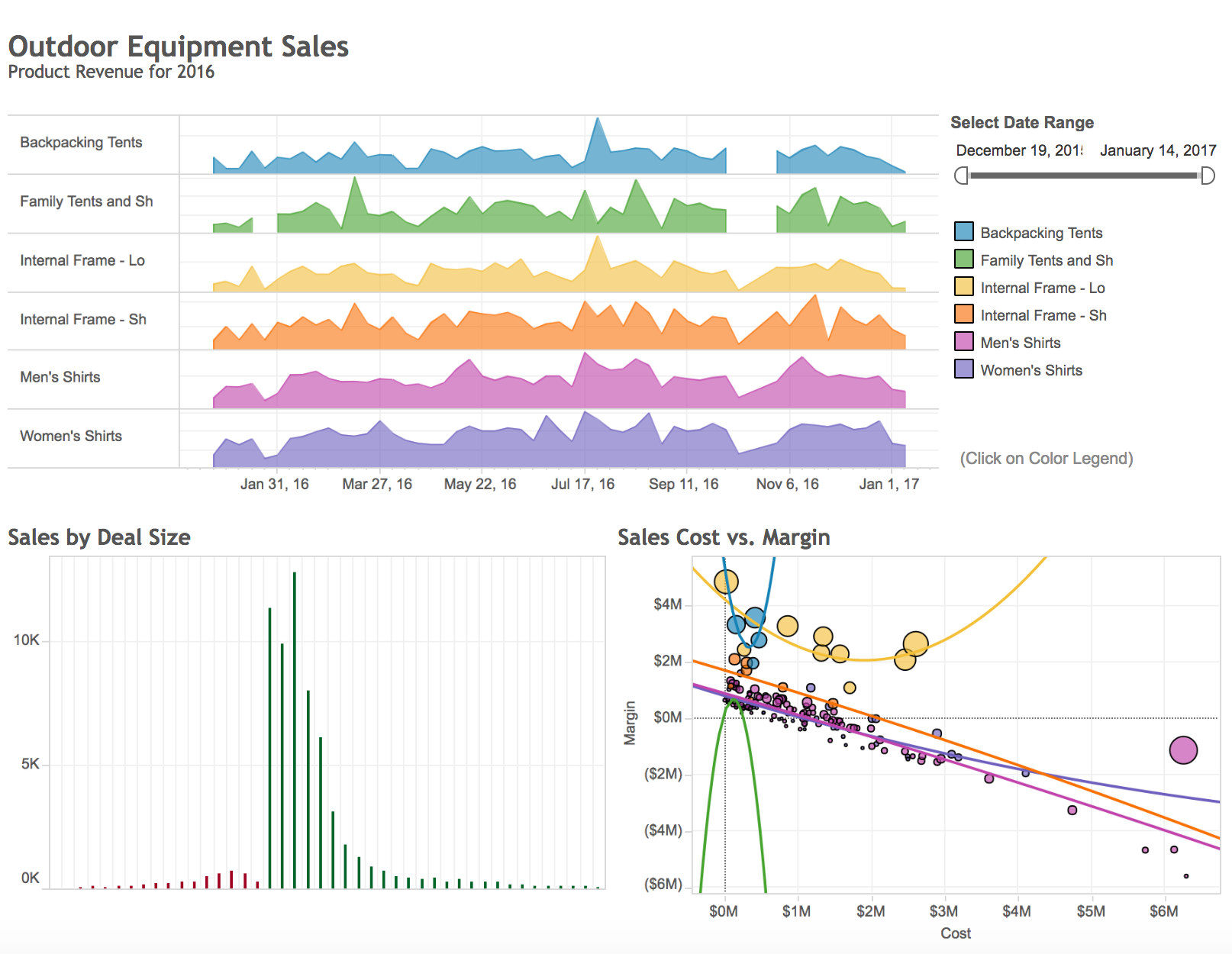
Big data analytics in Tableau
Common Big Data Tool Functionality
Because big data is such a broad term, the functionality of big data tools can vary greatly. Some tools represent robust BI suites that can handle data collection, extraction, cleaning, visualization and more, while others are more stripped down, focusing solely on one aspect of big data analysis.
In general though, here is some of the most common functionality you can expect to find in big data tools:
Pulls raw data from various integrated sources and reformats it all into a similar schema or format for easier analysis. | |
Uses statistics and data modeling to analyze vast amounts of disparate data and identify trends or patterns that connect them. Learn more about data mining here. | |
Visualizes trends in an easy-to-understand graphical form. These visualizations are usually customizable and interactive, allowing users to change various scales and data sources to analyze trends. | |
Applies discovered trends from historical data sets to create models predicting what's likely to happen with that data moving forward. | |
Reporting | Allows users to create and distribute a preloaded set of customized reports or customize their own. |
What Type of Big Data Tool Buyer Are You?
Big data tool buyers generally fall into two categories, each with vastly different needs and priorities:
Leadership buyers. These buyers represent your department managers, your vice presidents, even your CEO. Because they often lack in-depth tech knowledge, these buyers tend to prioritize the ease of use and fast deployment of self-service BI tools over in-depth functionality and customization found in more robust systems. Dashboards are key for these buyers, who want to see meaningful big data trends at a glance.
IT buyers. IT department buyers are more common, and have the technological know-how to dive into complex functions. Ease of use is still a concern, but these buyers prioritize smooth integration with their existing data warehouses and other business applications first and foremost.
Key Considerations When Purchasing Big Data Tools
Simply picking a tool based on good reviews and signing on the bottom line is a surefire way to end up with buyer's remorse. When evaluating different big data tools and talking to software vendors, here are a few things you should keep in mind:
What is your goal with big data? Ultimately, big data tools can't find meaningful patterns if you don't know where to look. That's why it's important for you to define a purpose for your big data tools before investing. According to Gartner, common reasons your company might invest in these tools include enhancing the customer experience, deploying more targeted marketing and increasing process efficiency. (Full content available to Gartner clients.)
BoB or integrated suite? Best-of-breed (BoB) or stand-alone big data tools are robust but require integration with other systems to become useful. In some cases, a customer relationship management or enterprise resource planning suite with built-in analytics may be a better option, especially if you're only looking to gain insights from the data in that one system.
Do you have all the parts in place first? Big data tools can't do it all. You need a secure, organized data warehouse to store your vast amounts of data. You also need skilled staff who are able to manage your systems and interpret the data. Don't put the cart before the horse, so to speak, by buying a big data tool without the right systems and employees to support it.
Other Big Data Tool Resources
If you're ready to find the right big data tool for your needs, call us at (844) 680-2046 for a no-obligation consultation. Our BI tool advisors will ask you a few questions about your business and your software needs and send you a shortlist of best fit products for free.
If you're not ready to take the plunge yet though, that's OK. This is a complicated software market for beginners. Here are a few more resources where you can learn more about big data:
"How Big Data and Healthcare Analytics Boost Value-Based Care." If you're a hospital, this free e-book is for you. In it, we talk to experts to explain how big data can help you reduce costs, increase efficiency and make care more patient-centric.
"A Beginner's Guide to Big Data Recruiting and Hiring." Big data is taking over recruiting in a big way. In this article, we cover everything you need to know about big data recruiting and hiring.
"ETL vs. ELT: How to Choose the Best Approach for Your Data Warehouse." Just as big data looks to overwhelm current data storage capabilities, extract, load and transform (ELT) promises to keep things in check. Learn more about this new data integration approach in our buyer's guide.