


Best Web-based ERP software of 2026

- Popular Comparisons
- Buyers Guide
Compare Products
Showing 1 - 25 of 146 products
Compare Products
Sort by
Reviews: Sorts listings by the number of user reviews we have published, greatest to least.
Average Rating: Sorts listings by overall star rating based on user reviews, highest to lowest.
Alphabetically (A-Z): Sorts listings by product name from A to Z.

ePROMIS FutureGen Enterprise Cloud is an all-in-one cloud platform that provides businesses with comprehensive management functi...Read more about ePROMIS ERP
ePROMIS ERP's Best Rated Features
See All
ePROMIS ERP's Worst Rated Features
See All

Premier Construction Software is a global, AI-powered construction ERP that helps growing general contractors control job costs,...Read more about Premier Construction Software
Premier Construction Software's Best Rated Features
See All
Premier Construction Software's Worst Rated Features
See All

Striven is a cloud-based enterprise resource planning (ERP) solution suitable for many industries and organizations of all sizes...Read more about Striven
Striven's Best Rated Features
See All
Striven's Worst Rated Features
See All

Invoicing software and so much more. With Holded, you can handle electronic invoicing for your business and manage everything e...Read more about Holded
Holded's Best Rated Features
See All
Holded's Worst Rated Features
See All

ProShop is a machine shop and manufacturing process management solution designed for small and midsize manufacturers. It offers ...Read more about ProShop ERP
ProShop ERP's Best Rated Features
See All
ProShop ERP's Worst Rated Features
See All

One word sums up MIE Trak Pro: flexibility. You may be using tired old spreadsheets or an ERP system that can't scale with your ...Read more about MIE Trak Pro
MIE Trak Pro's Best Rated Features
See All
MIE Trak Pro's Worst Rated Features
See All

ERPAG is a cloud-based enterprise resource planning (ERP) solution. It is suitable for small and midsize businesses in various i...Read more about ERPAG
ERPAG's Best Rated Features
See All
ERPAG's Worst Rated Features
See All

BQE CORE is a cloud-based accounting and invoicing software designed for architecture, engineering, and consulting firms. The pl...Read more about BQE CORE Suite
BQE CORE Suite's Best Rated Features
See All
BQE CORE Suite's Worst Rated Features
See All

Extensiv Order Manager powers order fulfillment, inventory operations, and business intelligence for brands and retailers lookin...Read more about Extensiv Order Management
Extensiv Order Management's Best Rated Features
See All
Extensiv Order Management's Worst Rated Features
See All

Statii is a comprehensive, cloud-based MRP (Material Resource Planning) solution, specifically crafted for small to medium-sized...Read more about Statii
Statii's Best Rated Features
See All
Statii's Worst Rated Features
See All

Kechie Distribution Management efficiently manages internal and external resources. Suited for growing businesses, the managemen...Read more about Kechie
Kechie's Best Rated Features
See All
Kechie's Worst Rated Features
See All

aACE is a powerful, comprehensive business management solution designed for companies that have outgrown small-business packages...Read more about aACE

Cloud-based residential real estate brokerage solution including robust real estate accounting, commission automation, transacti...Read more about BoldTrail Back Office
BoldTrail Back Office's Best Rated Features
See All
BoldTrail Back Office's Worst Rated Features
See All

Cloud ERP Software is an enterprise resource planning solution that integrates core business management functions into a single ...Read more about Cloud ERP

ERPNext is an enterprise resource planning (ERP) solution that offers financial accounting, project management, human resources ...Read more about ERPNext
ERPNext's Best Rated Features
See All
ERPNext's Worst Rated Features
See All

Wholesaler or distributor? Zangerine is built to simplify your inventory growth. Go live in 5 sessions. Control your whole busin...Read more about Descartes Zangerine
Descartes Zangerine's Best Rated Features
See All
Descartes Zangerine's Worst Rated Features
See All

Acumatica Cloud ERP is a comprehensive business management system. It caters to a variety of industries, such as finance, manufa...Read more about Acumatica Cloud ERP
Acumatica Cloud ERP's Best Rated Features
See All
Acumatica Cloud ERP's Worst Rated Features
See All

Aquilon Software offers a combined manufacturing, distribution, supply chain, and financial management system that is deployable...Read more about Aquilon ERP
Aquilon ERP's Best Rated Features
See All
Aquilon ERP's Worst Rated Features
See All

Dolibarr ERP & CRM is a cloud-based, open-source enterprise resource planning (ERP) solution. It is suitable for small and midsi...Read more about Dolibarr
Dolibarr's Best Rated Features
See All
Dolibarr's Worst Rated Features
See All

QT9 ERP is a highly-scalable manufacturing platform for connecting and automating business data from multiple systems into one s...Read more about QT9 ERP

Hubble is an integrated financial performance management solution. It can be deployed on-premise and is also available as a clou...Read more about Hubble

Versa is Modern all-in-one Cloud ERP software created for fast growing inventory heavy manufacturing, distribution, and e-commer...Read more about Versa Cloud ERP

SAP Business ByDesign is a cloud-based enterprise resource planning (ERP) solution. It unifies core business functions such as f...Read more about SAP Business ByDesign
SAP Business ByDesign's Best Rated Features
See All
SAP Business ByDesign's Worst Rated Features
See All

Plus & Minus is an integrated enterprise resource planning (ERP) financial solution built around a single-file , single-format s...Read more about Plus & Minus

Sage X3 is a powerful ERP software solution designed for midsized national and global manufacturers, distributors, and after-sal...Read more about Sage X3
Sage X3's Best Rated Features
See All
Sage X3's Worst Rated Features
See All
Popular Comparisons


Buyers Guide
This detailed guide will help you find and buy the right web-based erp software for you and your business.
Last Updated on January 27, 2025As the prevalence of cloud solutions in areas like customer relationship management (CRM), human resources (HR) and accounting has increased, so too has interest in cloud enterprise resource planning (ERP) software. ERP software has been slower to adapt to the cloud trend due the sophistication and computing requirements typical of an ERP system.
That is starting to change, however, as a small but increasing number of ERP vendors begin to offer their system in the software-as-a-service (SaaS), or cloud, model. Although there are relatively few cloud ERP options on the market today, every major ERP vendor offers some form of Web access to their software. We wrote this buyer’s guide to sort through the myriad of Web-based ERP solutions on the market.
Here’s what we’ll cover:
Common Features of Cloud ERP Software
What Is Cloud ERP Software?
Cloud ERP is the software-as-a-service (SaaS) deployment model for enterprise resource planning (ERP) software, which streamlines separate business functions into a single unified system.
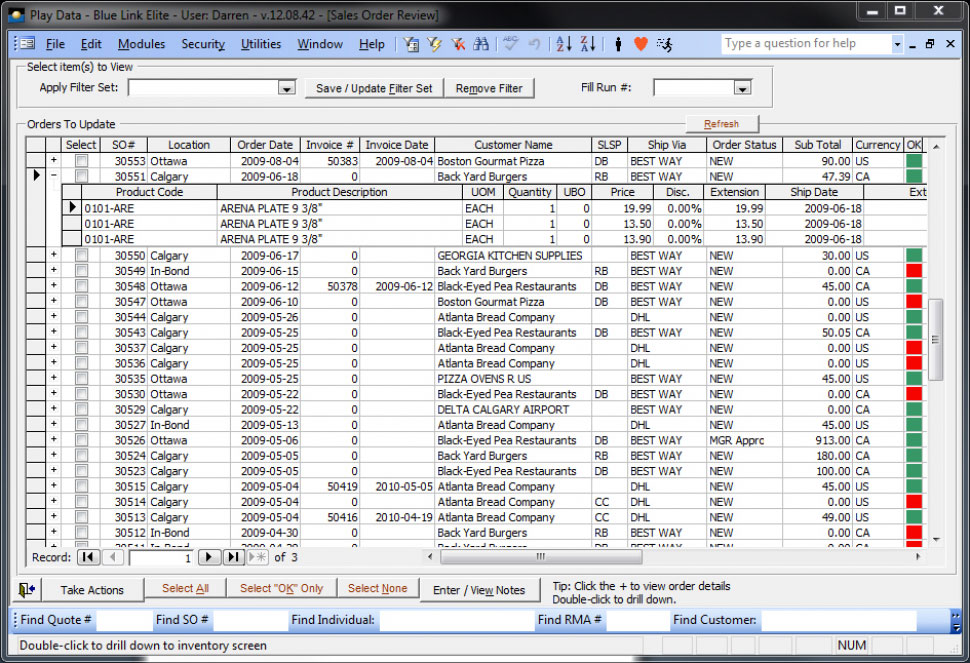
Sales order review screenshot in Blue Link
Generally speaking, ERP software is an umbrella term describing a system that captures and shares information across all departments and business functions. Whereas a traditional ERP system is installed and maintained on location, cloud ERP software is delivered purely through a Web browser via an Internet connection. Note that:
In the cloud model, the software vendor houses and manages the software and buyers pay a subscription price for the software—typically on a monthly or annual basis. This removes the need for businesses to host and maintain the software and data on their own servers.
This model is not to be confused with “Web-enabled” software, which means that the software is still installed on-site but the data is accessible online.
In both cases, system data can be accessed through an Internet connection, enabling employees to remotely access their business data through any device with online capabilities.
Common Features of Cloud ERP Software
Cloud ERP software includes the same features as on-premise ERP solutions, including:
Includes general ledger, accounts receivable, accounts payable and payroll. | |
Used to analyze and report business data to help companies make better decisions. Funtionality includes analytics, data mining, reporting and more. | |
Used to manage interactions with prospects, customers and clients across all departments, including marketing and sales. | |
Manages HR activities such as personnel tracking and benefits administration, as well as new strategic initiatives like talent management and learning management. | |
Helps companies track up-to-date information about their product supply, maintain stock levels and avoid inventory depreciation and overspending. | |
Includes manufacturing resource planning software, manufacturing execution systems (MES), bill of materials (BOM), product life cycle management and more. | |
Tracks goods as they move from manufacturing facilities to distribution centers to retail stores. Includes functionality to adjust inventory with demand changes monitor performance of suppliers and warehouse management. |
What Type of Web-Based ERP Buyer Are You?
Prior to beginning your software selection process, it’s important to know what type of buyer you are. This will help narrow your options and provide a good launching point for deciding which system is best for you. Generally speaking, there are three types of buyers:
Full-suite buyers. These buyers want a single, integrated system to run their entire business. The goal in relying on a single system is to mitigate integration issues and facilitate a smoother flow of information between departments and business functions. These buyers favor cloud ERP suites, such as SAP Business ByDesign, NetSuite Manufacturing Edition and Infor Syteline.
Best-of-breed buyers. These buyers favor purchasing specialize applications that perform a single function, such as an HR system or CRM system. Typically, they’re looking for an application that has more robust functionality than what’s offered in an full-suite package. These buyers favor best-of-breed applications such as Taleo, Salesforce and ADP.
Small business buyer. Historically, there have been few options for small businesses to choose from when it comes to ERP software. That’s changing, however, as the software-as-a-service (SaaS) trend strengthens in the ERP software market. Of course, there are still several on-premise software systems available for small business buyers. Examples include MISys, Exact and Made 2 Manage by Consona.
Benefits and Potential Issues
Web-based ERPs have a number of key benefits over locally installed systems but also have their drawbacks:
Ease-of-use. Since Web-based ERP is delivered via a Web browser, the interface will have the familiar look and feel of a Web page. This means that it will be fairly intuitive to use and should reduce the need to invest in employee training.
Reduced IT costs. Because the software vendor hosts and maintains the software—performing maintenance, upgrades and back-ups—there is less need to invest in an in-house IT team.
Connectivity requirements. The biggest concern with a Web-based system is that it relies on a strong, consistent Internet connection. If you have an unreliable Internet connection, then you may want to resolve connectivity issues before pursuing a Web-based system.
Customization difficulties. Since every business receives the same version of the software, it is typically more difficult to customize a cloud ERP solution. However, this is starting to change as technology advances.