


Best Utility Billing Software of 2026
Updated March 16, 2026 at 10:21 AM
- Popular Comparisons
- Buyers Guide
Compare Products
Showing 1 - 25 of 70 products
Compare Products
Sort by
Reviews: Sorts listings by the number of user reviews we have published, greatest to least.
Average Rating: Sorts listings by overall star rating based on user reviews, highest to lowest.
Alphabetically (A-Z): Sorts listings by product name from A to Z.

Rural Billing makes utility management simple, affordable, and stress-free. Designed for small to mid-sized utilities, it grows ...Read more about Rural Billing
Rural Billing's Best Rated Features
See All
Rural Billing's Worst Rated Features
See All

Tridens Monetization enables service providers to quickly launch innovative digital subscription and usage-based services that d...Read more about Tridens Monetization


ExpenseLogic is a cloud-based expense management software that allows the accounts payable team to view invoices and expenses wh...Read more about ExpenseLogic
ExpenseLogic's Best Rated Features
See All
ExpenseLogic's Worst Rated Features
See All

AMCS Utility Billing is a cloud-based, full-featured, and affordable SaaS application for water, sewer, and electricity billing....Read more about AMCS Utility Billing


EnergyCAP’s comprehensive software platform has been empowering organizations to take full control of their energy data, optimiz...Read more about EnergyCAP


EnergyCAP's Best Rated Features
See All
EnergyCAP's Worst Rated Features
See All

Muni-Link is a cloud-based utility billing solution designed for utilities providers for municipal authorities, boroughs and cit...Read more about Muni-Link

OUR PROMISE Starnik is on a mission to make utility operations effortless. With more than 20 years of ind...Read more about Starnik

Expedite Commerce is a cloud-based Revenue Operations and Management platform that serves sophisticated businesses in SaaS, Manu...Read more about Expedite Commerce


MuniBilling is a utility billing solution for governments and private utility providers. It offers features such as a customer p...Read more about MuniBilling


JadeTrack is a cloud-based energy management software that delivers real-time insights, data automation, and savings opportuniti...Read more about JadeTrack

Ampstun is a cloud-based utility billing system that enables users to switch to a complete paperless billing system, receive ema...Read more about Ampstun

Accu-Trax SERVICES Accu-Trax is the most advanced route event tracking, customer management, and billing software platform on th...Read more about Accu-Trax Office

Submeter Billing is a cloud-based solution that helps businesses create tenant invoices and automate the reading of meters/...Read more about Submeter Billing
Submeter Billing's Best Rated Features
See All
Submeter Billing's Worst Rated Features
See All

The Silverblaze Customer Portal is a self-service web portal solution that integrates billing, online payments, customer history...Read more about SilverBlaze Customer Portal

Software Solutions VIP Suite public sector software was designed to manage public finances with easy and security. It runs on VI...Read more about Visual Intelligence Portfolio Suite
Visual Intelligence Portfolio Suite's Best Rated Features
See All
Visual Intelligence Portfolio Suite's Worst Rated Features
See All

NovaVue is a cloud-based electrical, energy, and utility monitoring, analysis, reporting, and alarming solution. It is used by l...Read more about NovaVue

MetalEZ is an integrated hybrid enterprise resource planning (ERP) and business process management (BPM) solution from ABIS. Key...Read more about ABIS

WAM Software is a waste management and public works software that helps private or government landfills, transfer stations and r...Read more about WAM Software


Invoiced is a cloud-based accounting solution suitable for mid-market to enterprise-level businesses across a range of industry ...Read more about Invoiced

Invoiced's Best Rated Features
See All
Invoiced's Worst Rated Features
See All

**SkyBill is a modern utility billing platform built on Microsoft Dynamics 365 Business Central.** Designed for utility provider...Read more about Skybill Utility Billing


ioTORQ UBM software automates the processing of bills from hundreds of utility suppliers. Advanced dashboarding and trending all...Read more about ioTORQ UBM

Simple Billing is a complete billing automation solution that helps improve operations, customer satisfaction and reduce costs. ...Read more about Simple Billing


SMART360 is an Al-enabled Smart Utility Platform designed to meet the needs of small and mid-sized utilities. It is a unified pl...Read more about SMART360

VertexOne is the leading provider of cloud-based SaaS software solutions powering the next generation of customer experience for...Read more about VertexOne

Oracle Utilities is a cloud-based and on-premise solution designed to help small to large businesses in the utility sector, prov...Read more about Oracle Energy and Water

Popular Comparisons


Buyers Guide
This detailed guide will help you find and buy the right utility billing software for you and your business.
Last Updated on October 01, 2025In order to accurately and efficiently bill customers for their utility consumption, usage data must be collected and converted into billable units. However, this data collection process is very time consuming when done repeatedly for all customers. For this reason, utility providers of all sizes often turn to utility billing software to automate key tasks.
In this Buyer's Guide, we'll look at what capabilities utility billing software offers and the benefits associated with deploying it. We'll also look at specific considerations for different sized providers and some market trends you need to know about.
Here's what we'll cover:
What Is Utility Billing Software?
Common Features of Utility Billing Software
Benefits of Utility Billing Software
What Is Utility Billing Software?
Utility billing software helps providers track usage of the utility services they offer, e.g., water, gas, electricity, wastewater and sanitation. It then helps these providers manage the billing process based on the usage data collected.
Different systems offer a range of functionalities such as meter management, invoice management and payment processing to manage the entire billing process. These software systems can be deployed either on your premises or in the cloud.
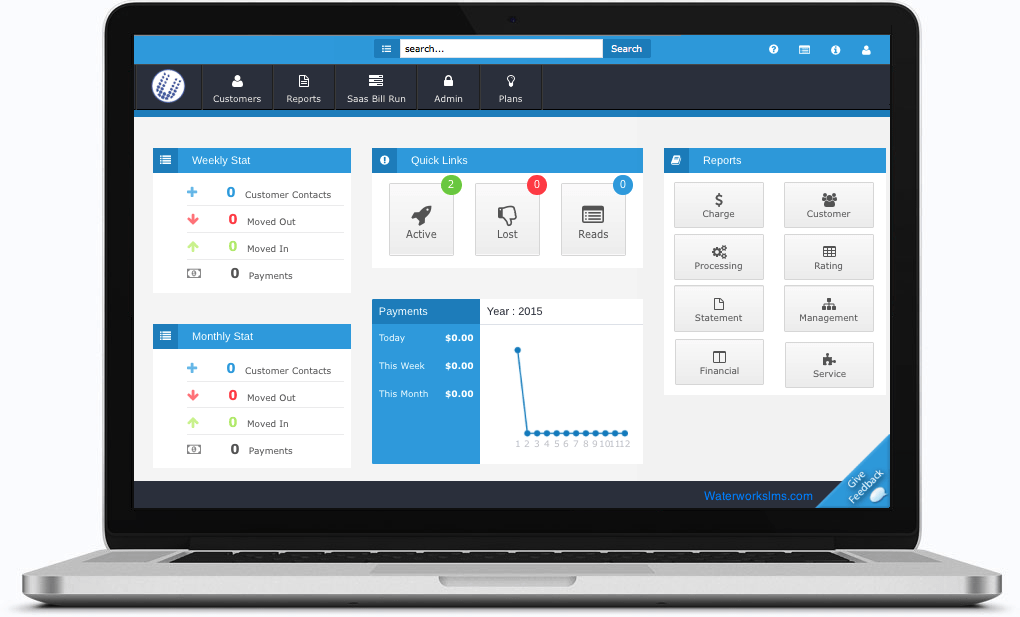
Home dashboard of Waterworks water billing software
Common Features of Utility Billing Software
Vendors offer a variety of functional breadth and depth in their utility billing software. Here are some of the most common capabilities:
Account management | Store searchable account information with searchable with fields such as customer names, addresses, phone numbers and any other user-defined fields. The account page can be customized to the utility provider's specific needs. |
Meter management | View the complete usage history for any specific meter in both graphical and chart form, along with the option to print the bill. |
Customer management | Centralized customer database that includes account notes, billing and interaction history and usage statistics. Enables customer service agents to provide quick and efficient service to customers and ultimately enhance customer relations. |
Metered billing | Upload meter readings automatically from various electronic meter reading devices to the system and charge customers based on their usage. Meter devices are usually managed by the utility service provider, and the software is designed to integrate with commonly used devices. |
Nonmetered billing | Enables billing for utilities offered through flat rates or fixed one-time charges. Nonmetered flat rates are usually higher than metered rates, and are often intended for higher volume usage customers. |
Rate management | Manage complex utility rate calculations (such as different rates in different areas or varying normal and peak hour rates) and multiple pricing options. Create separate rate schedules and tier blocks for different areas and times of day. |
Move in and move out | Move-in/move-out capabilities track the date when a customer moves in or out of the location where the meter reading device is installed to ensure you are billing the correct customer. |
Online payment processing | Allows providers to offer flexible online payment options to their customers. Includes features such as emailed receipts, single payment for multiple bills etc. Maintains a record of all past payment transactions. |
Penalty/cut-off processing | Allows users to define and create penalties based on multiple calculation methods for customers who make payments after the due date. |
What Type of Buyer Are You?
Before you start evaluating different utility billing systems, you'll want to know what buyer category you belong to and which features are most suited to your situation. You'll likely fall into one of the categories below:
Small utility service provider (fewer than 50 customers). These buyers have a relatively small number of customers in just one area. They'll require a simple utility billing system that manages their usage tracking and billing needs. Such buyers should look for solutions with basic features such as account management, meter management and metered billing.
Medium utility service provider (50 to 250 customers). These buyers have a growing number of customers that may be spread across more than one location, and they need a solution that will help them scale. They should opt for systems that offer additional features such as more robust customer management, nonmetered billing, move-in/move-out and online payment processing to make their overall processes more efficient.
Large utility service provider (more than 250 customers). These buyers have a high volume of customers across multiple locations. They require a system that efficiently manages their complex requirements. Such buyers should be looking for features such as nonmetered billing, rate management and penalty/cut-off processing.
Benefits of Utility Billing Software
Some of the more general benefits of introducing software to automate key tasks should already be apparent from this discussion. However, some of the specific benefits of implementing utility billing software include the following:
Identification of customer usage patterns. With this software, users can view the usage history of all customers in either graphical or chart form. This helps users identify customers that are heavy consumers of a utility service and take measures to maintain and enhance those relationships by offering discounts or other benefits. In addition, users can study the patterns to scale their business in heavy usage areas.
Managing multiple client locations. For a single customer with properties in multiple locations, utility billing software can help users manage billing either on a single invoice or separate bills, according to the customer's preference.
Data security. Cloud-based utility billing software offers encrypted data backups on a regular basis. Most of these systems are Payment Card Industry Data Security Standard (PCI DSS) compliant and offer bank-level encryption through multiple servers. Safe and secure transactions help users build better customer relations since they can ensure all personal data remains safe.
Market Trends to Understand
Businesses looking to invest in utility billing software should keep the following market trends in mind as they evaluate systems:
Software-as-a-Service (SaaS) model becomes more widespread. SaaS, or subscription-based software, is becoming more common for nearly all types of utility billing systems. The benefits of these cloud-based systems are quite compelling; they include quicker and easier implementation, lower upfront cost and are often designed to have user-friendly interfaces.
Demand for tailored utility billing software. Currently, there is a wide range of utility billing software options that serve different sectors such as water, sewage, gas, cable, electricity, telecommunications and internet. Demand for exclusive products that cater to specific needs of these niche end-use areas is rising. Buyers are looking for utility billing software that is tailored to meet their needs, while improving operational efficiency and regulatory compliance.
Key Considerations
Here are a couple of important factors to think about before you purchase utility billing software:
Deployment options. Utility billing software is available in both on-premise and cloud-based options. Typically, the upfront costs associated with cloud-based software are much lower than they would be with an on-premise solution.
Integration requirements. Before purchasing new software, check whether the utility billing system you are considering integrates with other business tools you use, such as QuickBooks, Microsoft Excel, PayPal etc.
Payment compliance. As utility billing systems involve payments from customers, check whether the system complies with industry standards such as PCI DSS.