


Best Marketing Attribution Software of 2026
Updated March 25, 2026 at 7:04 AM
- Popular Comparisons
- Buyers Guide
Compare Products
Showing 1 - 25 of 126 products
Compare Products
Sort by
Reviews: Sorts listings by the number of user reviews we have published, greatest to least.
Average Rating: Sorts listings by overall star rating based on user reviews, highest to lowest.
Alphabetically (A-Z): Sorts listings by product name from A to Z.

monday.com is a work and project management platform that helps teams of all sizes plan, prioritize, manage, and execute work ef...Read more about monday.com


monday.com's Best Rated Features
See All
monday.com's Worst Rated Features
See All

Wrike is a cloud-based project management platform for teams of 20+ that is suitable for both large enterprises and SMBs. It sup...Read more about Wrike

Wrike's Best Rated Features
See All
Wrike's Worst Rated Features
See All

Funnel is a marketing intelligence platform designed to aggregate data from various marketing channels and provide tools for rep...Read more about Funnel


Liine is an AI-powered call tracking, marketing analytics and ad optimization platform for multisite healthcare practices. Our p...Read more about Liine

Liine's Best Rated Features
See All
Liine's Worst Rated Features
See All

Are you spending your marketing budget effectively? Which products or channels bring in the best long-term customers? What are c...Read more about Lebesgue


Lebesgue's Best Rated Features
See All
Lebesgue's Worst Rated Features
See All

Dreamdata is a B2B Activation & Attribution Platform that provides the most complete B2B customer journey map anywhere. This em...Read more about Dreamdata

Dreamdata's Best Rated Features
See All
Dreamdata's Worst Rated Features
See All

SocialClimb helps healthcare organizations grow by understanding the impact of their marketing tactics so they can put their mar...Read more about SocialClimb
SocialClimb's Best Rated Features
See All
SocialClimb's Worst Rated Features
See All

CTM is a conversation analytics software designed to provide tracking and insights for sales and marketing teams. It helps organ...Read more about CTM

CTM's Best Rated Features
See All
CTM's Worst Rated Features
See All

lc.cx is an URL Shortener management platform for Marketers and growths hacker to manage all links, short links, pixel retargeti...Read more about lc.cx

lc.cx's Best Rated Features
See All
lc.cx's Worst Rated Features
See All

HockeyStack is web analytics and attribution platform that helps businesses collect and analyze marketing, product, revenue and ...Read more about HockeyStack

Salespanel provides specialized marketing analytics, account intelligence, and first-party intent data tracking software designe...Read more about Salespanel

Track, optimise & automate your marketing advertising with a tracking software that improves your conversion rate and acquisitio...Read more about CPV Lab Pro


CPV Lab Pro's Best Rated Features
See All
CPV Lab Pro's Worst Rated Features
See All

Swaarm provides innovative and easy-to-use ad-tracking software that helps leading global agencies, advertisers, and partner net...Read more about Swaarm

Swaarm's Best Rated Features
See All
Swaarm's Worst Rated Features
See All

Roivenue is an all-in-one marketing platform that helps businesses track the return on investment (ROI) of marketing campaigns. ...Read more about ROIVENUE
ROIVENUE's Best Rated Features
See All
ROIVENUE's Worst Rated Features
See All

Factors.ai is an account intelligence, analytics & attribution platform that helps sales & marketing teams at high-growth B2Bs t...Read more about Factors.ai
Factors.ai's Best Rated Features
See All
Factors.ai's Worst Rated Features
See All

Measured is a cloud-based attribution & media incrementality solution that provides small to large enterprises with business int...Read more about Measured


Marketo Measure is an industry-leading B2B marketing attribution tool that enables marketers to measure the impact of campaigns,...Read more about Marketo Measure


AppsFlyer is a cloud-based attribution platform that provides businesses across all industries with the tools to analyze and enh...Read more about AppsFlyer

AppsFlyer's Best Rated Features
See All
AppsFlyer's Worst Rated Features
See All

Affise is an affiliate marketing and mobile attribution platform that helps businesses manage, attribute, and scale performance ...Read more about Affise
Affise's Best Rated Features
See All
Affise's Worst Rated Features
See All

AITA: Artificial Intelligence Tool for Advertisers AITA is an AI-powered Marketing Mix Model (MMM) that revolutionizes media in...Read more about AITA


Clear Ring is designed to provide businesses with advanced tracking tools for calls, forms, and live chats. With Clear Ring, you...Read more about Clear Ring


SAS Customer Intelligence 360 is a multichannel marketing hub for the modern marketing organization. Offering a suite comprised ...Read more about SAS Customer Intelligence 360


Get instant answers to your marketing questions with data through Google sheet add-on. It takes less than 2 minutes to get start...Read more about EasyInsights
EasyInsights's Best Rated Features
See All
EasyInsights's Worst Rated Features
See All

Black Crow AI helps DTC marketers and lifecycle managers acquire, recognize, and retain customers using predictive analytics and...Read more about Black Crow AI


Cinch is a marketing automation platform—built on an enterprise-level customer data platform. Why does that matter? Because the ...Read more about Cinch


Buyers Guide
This detailed guide will help you find and buy the right marketing attribution software for you and your business.
Last Updated on January 27, 2025Customers interact with your brand through various channels and touch points—for example, your website, social media, phone calls, online inquiry forms, television commercials, radio ads, and digital marketing channels. But do you know which one of these contributes the most to your sales numbers?
That’s a tough question to answer because a sale or conversion usually involves customers interacting with your business via many of these touch points. Thus, it’s difficult to understand which marketing channel has the highest impact on a customer’s purchase decision and leads to the final sale.
Marketing attribution software assigns credit to customer touch points across marketing channels to determine their influence on conversions. It analyzes data such as customer views, clicks, and actions to determine the impact each touch point has on the final sale. The software commonly integrates with marketing automation, customer relationship management (CRM), e-commerce, and email marketing platforms to collect marketing and sales data across the customer lifecycle.
There are many marketing attribution tools available on the market, so choosing the right one for your business can be challenging. In this buyers guide, we provide all the information you need to make a well-informed purchase decision.
Here's what we'll cover:
What is marketing attribution software?
Marketing attribution software is a software tool that analyzes large volumes of customer behavior data to identify which touch points led to the sale of a product or service. It assigns credit to any channel or touch point that may have contributed to the conversion based on its influence on customer interactions.
Key functionality of a marketing attribution tool:
Track multiple marketing and communication touch points, and collect customer interaction data from them
Monitor the entire purchase journey of customers to identify how they got converted
Use reports and analytics to check which channels are bringing the highest number of customers
Common features of marketing attribution software
Multitouch attribution | Evaluate the impact multiple marketing touch points have on driving a conversion. These touch points include online ads, campaigns, site search, and website visits. |
Cross-channel attribution | Track all the unique touch points a customer engaged with, and evaluate their overall impact on the final conversion. |
Customer journey mapping | Create a visual timeline of a customer’s interactions with your brand. This helps identify which channel drove the final sale. |
ROI tracking | Measure the impact of different marketing initiatives on your profit and revenue growth. This allows for proper marketing spend management and budget allocation. |
Dashboards | Customize dashboards to track the performance of your marketing initiatives across channels. You can also view reports on total sales, conversion by attribution model, etc. |
Attribution modeling | Determine and define how to assign credit, for a sale or conversion, to the various touch points in a customer’s purchase journey. |
Conversion tracking | Track how well your marketing touch points are driving leads generation, sales conversion, app downloads, email sign-ups, and other key actions for your business. |
Audience segmentation | Divide your target customers into various segments based on product usage trends, demographics, psychographics, communication behaviors, and media usage, among other factors. |
Mobile app attribution | Measure the effectiveness of mobile marketing campaigns based on the number of app installs, in-app purchases, etc. |
Predictive analytics | Analyze historical datasets to predict which marketing channels and touch points will yield maximum revenue in the future. |
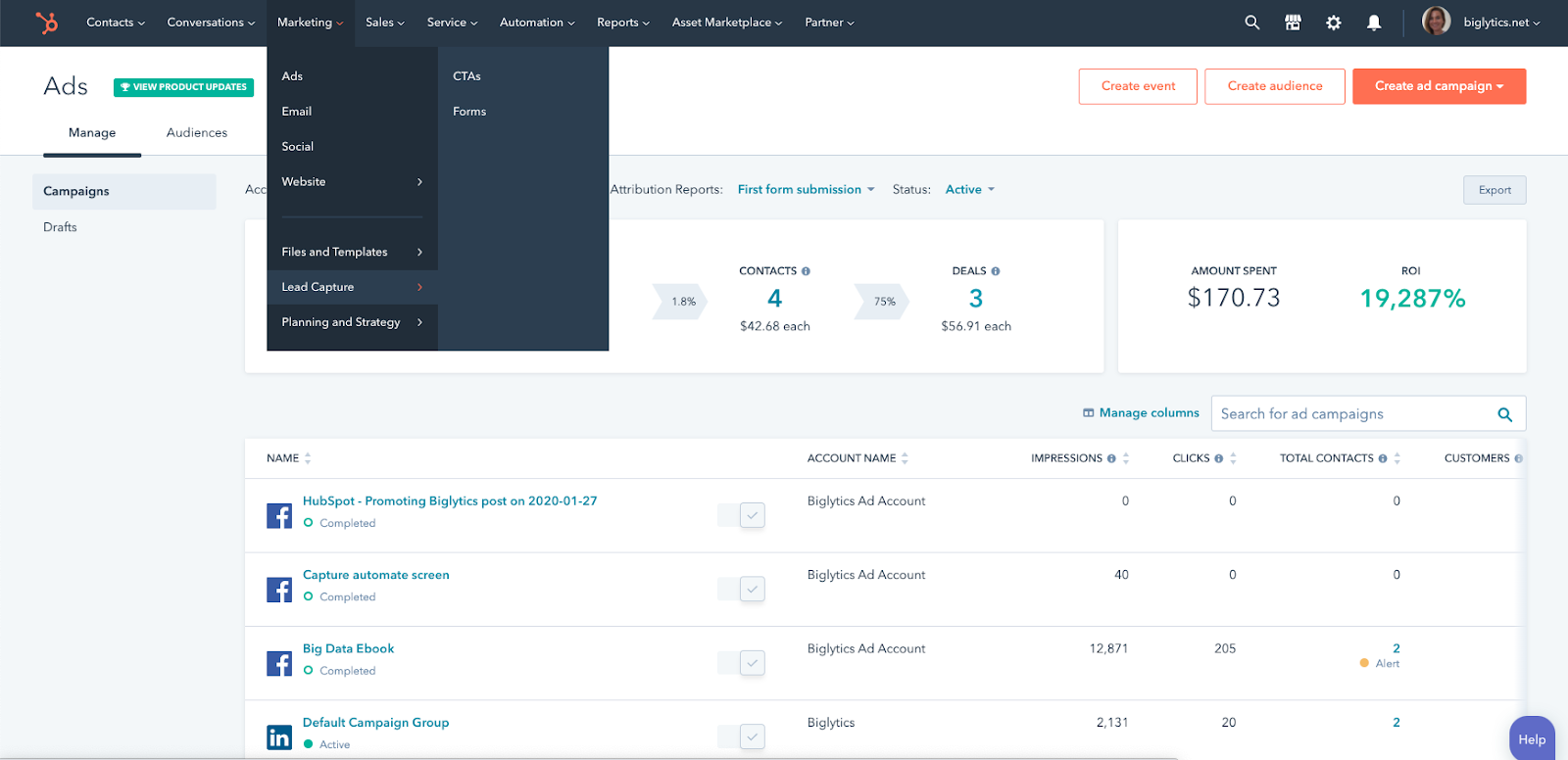
Marketing ROI tracking in HubSpot Marketing Hub (Source)
What type of buyer are you?
Understanding the different types of buyers in the market will help you identify your buyer type to make an informed purchase. The majority of buyers belong to the following categories:
Business-to-business (B2B) buyers: Buyers in this category cater solely to businesses and need software to analyze the impact of their marketing effort on revenue. Their sales cycle is often long, and it can take months to convert a customer, resulting in multiple touch points. They should opt for a tool with account-based attribution to group B2B customers into various accounts and track interaction data to understand which marketing activity is the most ROI-friendly for a particular account.
Business-to-customer (B2C) buyers: Buyers in this category cater to consumers and generally have a shorter sales cycle than B2B enterprises. They need a tool that can help them understand which marketing impressions are creating the strongest customer awareness and driving online interactions as well as in-store purchases. They should choose a fully featured marketing attribution solution to find different ways to optimize the customer experience.
Benefits and potential issues
Let’s take a look at the benefits as well as potential issues of using a marketing attribution tool:
Benefits
Higher brand engagement: An attribution tool helps your marketing team track and identify channels customers are using the most to engage with your brand. You can discard the ineffective channels and focus more on building visibility through channels most frequented by customers. This will lead to better audience engagement and higher chances of conversion.
Better tracking of customer lifetime value: The software offers capabilities to help estimate how much value a buyer will bring to your business during their tenure as a paying customer. These insights help plan how much you should spend on retention for different customers. They also help differentiate one-off buyers from customers more likely to become repeat buyers.
Potential issues
Incorrect attribution tracking due to the use of multiple devices: In today’s digital world, customers have multiple devices via which they can research and evaluate products, connect with the sales team, and then make a purchase. And these actions can be done from any location—be it home, vacation, or work premises. But not all customer devices are supported by marketing attribution tools, which may result in incorrect attribution.
Challenges posed by data regulations: Strict data regulations can make it difficult for companies to track customer data. They have to get permission from customers to track the purchase journey, and some customers may not want to share their details. This can affect the insights generated by the attribution tool, given not all touch points would be considered for analysis.
Market trends to understand
Here’s a marketing attribution software market trend to keep in mind when making your purchase:
Growing demand for AI-enabled marketing attribution software. With a rise in the use of analytics and AI, marketing attribution software vendors are deploying AI at the core of their platforms to enable seamless data collection, analysis of touch points, instantaneous insights, and channel-specific recommendations. AI-enabled attribution platforms can help businesses identify whether there are any breakdowns or gaps in their marketing campaign.
Note: The application selected in this article is an example to show a feature in context and is not intended as an endorsement or recommendation. It has been obtained from sources believed to be reliable at the time of publication.