


Best Integration Software of 2026
Updated October 1, 2025 at 6:28 AM
- Popular Comparisons
- FrontRunners
- Buyers Guide
Compare Products
Showing 1 - 25 of 506 products
Compare Products
Sort by
Reviews: Sorts listings by the number of user reviews we have published, greatest to least.
Average Rating: Sorts listings by overall star rating based on user reviews, highest to lowest.
Alphabetically (A-Z): Sorts listings by product name from A to Z.

SAS Viya is a cloud-native platform designed for data analytics, machine learning and data management. It supports organizations...Read more about SAS Viya


SAS Viya's Best Rated Features
See All
SAS Viya's Worst Rated Features
See All

Funnel is a marketing intelligence platform designed to aggregate data from various marketing channels and provide tools for rep...Read more about Funnel


Clockspring is a state-of-the-art Enterprise Automation Platform that provides a fast and flexible no-code integration capabilit...Read more about Clockspring

ePayPolicy is a payment processing solution designed to help businesses in the insurance sector collect credit card and ACH paym...Read more about ePayPolicy


ePayPolicy's Best Rated Features
See All
ePayPolicy's Worst Rated Features
See All

Skyvia is a cloud-based data integration, backup and management platform for businesses of all sizes. Key features include direc...Read more about Skyvia

Skyvia's Best Rated Features
See All
Skyvia's Worst Rated Features
See All

BroadPeak is a low-code data integration solution designed for energy and commodity trading firms, enabling seamless connectivit...Read more about BroadPeak


Built for healthcare data environments, Iguana is a data integration platform that enables healthcare organizations to improve a...Read more about Iguana


Iguana's Best Rated Features
See All
Iguana's Worst Rated Features
See All

APPSeCONNECT is an intelligent integration platform (iPaaS) that connects applications and automates business processes. The p...Read more about APPSeCONNECT


APPSeCONNECT's Best Rated Features
See All
APPSeCONNECT's Worst Rated Features
See All

Rivery is a cloud-based solution that provides small to large enterprises with business intelligence tools to manage and automat...Read more about Rivery


Hevo is a no-code, bi-directional data pipeline platform specially built for modern ETL, ELT, and Reverse ETL Needs. It helps da...Read more about Hevo


Hevo 's Best Rated Features
See All
Hevo 's Worst Rated Features
See All

Nexla is a hybrid business intelligence (BI) solution that helps analysts, business users and data engineers across various sect...Read more about Nexla

DigitalRoute is a data management platform that helps businesses integrate the platform with any system within a company's IT in...Read more about DigitalRoute
DigitalRoute's Best Rated Features
See All
DigitalRoute's Worst Rated Features
See All

Data Virtuality is a data integration solution that centralizes data from multiple sources. It can be hosted either in the cloud...Read more about Logical Data Warehouse

9Spokes is a data platform that aggregates meaningful data inputs across your business. Think of 9Spokes as a virtual advisor, h...Read more about 9Spokes


ActiveBatch is a cloud-based and on-premise workflow management solution designed on helping businesses implement low-code IT wo...Read more about ActiveBatch


ActiveBatch's Best Rated Features
See All
ActiveBatch's Worst Rated Features
See All

Datorios is a streaming data processing hub, enabling seamless building, deployment, and monitoring of contextual data pipelines...Read more about Datorios


Utilizing the data that's spread across your organization shouldn't be so difficult! With Zuar Runner you can automate the flow ...Read more about Zuar Runner

AtScale is a data warehouse virtualization solution that creates a live connection between people and data without moving it, re...Read more about AtScale

MSIGHTS Platform is a data management software that helps marketers centralize marketing and data operations, providing an objec...Read more about MSIGHTS Platform

Tranzactor is an integrations tool for the logistics and trucking industry, which allows businesses to integrate data from a ran...Read more about Tranzactor

Zapier is an AI orchestration platform designed to automate workflows, agents, and apps across a wide range of applications. It ...Read more about Zapier

Zapier's Best Rated Features
See All
Zapier's Worst Rated Features
See All

InterWeave provides SmartSolutions®, which allows customers to easily connect to any combination of cloud and on-premises applic...Read more about The SmartIntegration Platform for CRM


Devart ODBC Drivers are high-performance connectivity solutions with enterprise-level features for accessing the popular databas...Read more about Devart ODBC Drivers
Devart ODBC Drivers's Best Rated Features
See All
Devart ODBC Drivers's Worst Rated Features
See All

SnapLogic provides self-service applications and data integration platform. It improves business activities, drives better busin...Read more about SnapLogic


SnapLogic's Best Rated Features
See All
SnapLogic's Worst Rated Features
See All

Unify Your Data Stack: Experience the first no-code data pipeline platform and power enlightened decision making. Integrate.io...Read more about Integrate.io

Popular Comparisons



Your Guide to Top Integration Software, August 2025
Software Advice uses reviews from real software users to highlight the top-rated Integration products in North America.
Learn how products are chosenExplore FrontRunners


“Usability” includes user ratings for Functionality and Ease of Use.
“Customer Satisfaction” includes user ratings for Customer Support, Likelihood to Recommend and Value for Money.
Reviews analysis period: The reviews analysis period spans two years and ends the 15th of the month prior to publication.
Buyers Guide
This detailed guide will help you find and buy the right data integration tools software for you and your business.
Last Updated on October 01, 2025The data universe is expanding. It's no secret that the data businesses create, capture and analyze has been growing in volume and diversity, with no signs of slowing down.
The ubiquity of data in today's business environment dictates that even small businesses should be thinking of how they can use data for a competitive advantage. Increasingly, tools are becoming available to help with the collection and analysis of this data.
In this guide, we'll cover:
What Are Data Integration Tools?
Data integration is simply the process by which data is collected from multiple sources, normalized and prepared for analysis. Data integration software are tools that collect and transform the data for common storage, typically in a data warehouse, from which it can be extracted for analysis, as depicted in the diagram below:
Traditionally, this is done through the extract, transform, load (ETL) process by a database administrator (DBA), who sets up the criteria the data should adhere to prior to storage. The criteria the DBA sets up, or defines for the data, are based on the most critical insights a business seeks to derive from the data.
The ETL process is an involved one in which data is collected, or "extracted" from the original sources, which often exist in widely varying formats. These include not only .CSV and XML files, but also online sources such as social media.
Once the data is extracted from the original source, it is "transformed" into a format that fits the parameters the DBA has defined for the data warehouse, or wherever the data will reside.
Conversely, the ELT (extract, load, transform) process manages the process in a different order—one in which the data is loaded into the database, where it's transformed (as opposed to having predetermined rules set up within the database, such as a data cube).
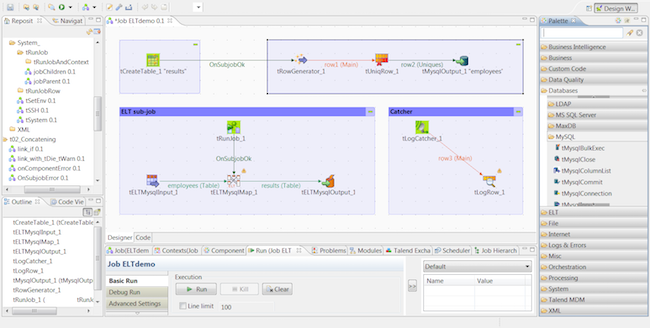
Data integration environment in TIBCO Jaspersoft
Increasingly for large enterprises, data lakes are becoming a popular data storage strategy for those dealing with big data.
The data is then integrated with other transformed data for like comparisons and analysis.
Common Features of Data Integration Tools
As a baseline, data integration tools should offer the following:
ETL (extract, transform, load) | Collects data from outside sources, transforms it and then loads it into the target system (a database or warehouse). Because primary data is often organized using different schemas or formats, analysts can use ETL tools to normalize it for useful analysis. |
ELT (extract, load, transform) | Collects data from outside sources, loads it into the database or warehouse and then transforms it to conform to requests for analysis. This feature allows the data to be manipulated/integrated within the warehouse itself, rather than prior to migration. |
Data capture/connection | Allows software to "connect" to multiple—and sometimes disparate—data sources (including relational databases, XML, .CSV, data lakes, Hadoop, SQL etc.) for the purposes of data extraction. |
Data transformation | Normalizes data across disparate sources by standardizing data, converting values and correcting numeric values to conform to minimum and maximum values. |
Data quality management | Helps organizations maintain clean, standardized and error-free data. Standardization is especially important for BI implementations that integrate data from diverse sources, as this ensures that later analyses are correct. |
Some data integration software offers additional features, including more self service options (such as drag-and-drop development for citizen data analysts).
What Type of Buyer Are You?
Typically, data integration resides in the realm of the DBA, who sits in the IT department.
Small businesses. These are businesses with little to no IT department. While traditionally, they have less need to manage vast amounts of data in a data warehouse, this trend is shifting, given the explosion of data in recent years. More and more tools designed to help "citizen" data administrators extract, integrate and manage data without the need for extensive programming knowledge are becoming available today.
Midsize businesses. These buyers are still likely to benefit from data integration tools that offer some level of self-service functionality, so that a robust IT department isn't required to architect complex data storage solutions. Real-time data demands and ad hoc granular data analysis are becoming the norm.
Enterprise businesses. These buyers will have a robust IT department capable of handling the traditional ETL process, which involves time and effort. Ironically, these larger enterprises may have more of a demand for real-time delivery of multistructured data as opposed to the “batch" delivery methods ETL is associated with. Increasingly, tools are becoming more and more sophisticated, with broader functionality sets from delivery to governance, to meet these demands.
Benefits of Data Integration Tools
Data Integration software provides two clear benefits to users:
Single source of truth. The principal benefit of data integration software is arriving at a single source of truth for businesses, especially those that deal in a variety of data sets from multiple, and often incongruous, sources. The "truth," or insight sought after, is typically a key performance indicator (KPI) defined by the business. Data integration aligns the data to best reveal this truth.
Apples to apples. The additional benefit is that organizations both large and small can not only define what they need from the data to make the most important business decisions, but confidence in those insights. Integration of data into a consistent, predetermined view ensures to some degree that like-comparisons are being made. In short, integration allows for the best "apples-to-apples" comparison disparate data sources can provide.
Market Trends to Understand
Data integration as a field is undergoing some change. According to Gartner, data integration and quality tools as a market grew 2.5 percent in 2016 to $4.4 billion, though more traditional data integration tools, which serve merely as "connectors" for batch movement of data, had slower growth (report available to Gartner clients).
This is due in large part to the increasing "mass proliferation" of data according to Gartner, which has put greater demand on data integration tools to expand their offerings to serve various data delivery speeds, deployments and types.
Essentially, slow, plodding, structured data delivery is on the outs. More and more, enterprises are seeing the need for data integration flexibility, including virtual and real-time data delivery, as well as the ability to deal with hybrid data sources (cloud and on-premise). Also, businesses are looking more and more for data integration tools that can handle "multistructured" data, or data that comes in a diverse array of structures.