


Best Capacity Planning software of 2026

- Popular Comparisons
- Buyers Guide
Compare Products
Showing 1 - 25 of 212 products
Compare Products
Sort by
Reviews: Sorts listings by the number of user reviews we have published, greatest to least.
Average Rating: Sorts listings by overall star rating based on user reviews, highest to lowest.
Alphabetically (A-Z): Sorts listings by product name from A to Z.

NetSuite is an AI-powered cloud-based business management suite that incorporates ERP, financial management, CRM and eCommerce f...Read more about NetSuite


NetSuite's Best Rated Features
See All
NetSuite's Worst Rated Features
See All

Global Shop Solutions provides a comprehensive suite of enterprise resource planning (ERP) tools and solutions designed to help ...Read more about Global Shop Solutions


Cetec ERP is a manufacturing enterprise resource planning software built for small and medium sized businesses. Cetec ERP's clou...Read more about Cetec ERP


Cetec ERP's Best Rated Features
See All
Cetec ERP's Worst Rated Features
See All

M1 ERP is a subscription-based enterprise resource planning (ERP) system, available on-premise or via the cloud, that automates ...Read more about M1 ERP


M1 ERP's Best Rated Features
See All
M1 ERP's Worst Rated Features
See All

SyteLine is an enterprise resource planning software created specifically for engineer-to-order, make-to-order, make-to-stock, a...Read more about SyteLine


SyteLine's Best Rated Features
See All
SyteLine's Worst Rated Features
See All

Now more than ever before, executives and other leaders in US manufacturing companies need the best information and controls to ...Read more about HYDRA X

Sage X3 is a powerful ERP software solution designed for midsized national and global manufacturers, distributors, and after-sal...Read more about Sage X3


Sage X3's Best Rated Features
See All
Sage X3's Worst Rated Features
See All

Propel Software accelerates product success for enterprises through a unified cloud platform combining PLM, QMS, PIM, and suppli...Read more about Propel

Propel's Best Rated Features
See All
Propel's Worst Rated Features
See All

Metasystems is a comprehensive ERP software that provides a Quote-to-Production-to-Cash-to-Warranty business flow tailored to in...Read more about Metasystems

Deltek Costpoint is an enterprise resource planning (ERP) and management solution designed to meet the requirements of midsize a...Read more about Deltek Costpoint

Deltek Costpoint's Best Rated Features
See All
Deltek Costpoint's Worst Rated Features
See All

Deacom, an ECI Software Solution, is a comprehensive ERP (Enterprise Resource Planning) platform with a rich set of capabilities...Read more about Deacom ERP


Epicor Advanced MES is a manufacturing execution system that is suited to plastic molders, repetitive manufacturers and those wi...Read more about Epicor Advanced MES
No reviews yet
recommendations

BatchMaster Software offers process manufacturing software solutions for the food, chemical, nutraceutical and pharmaceutical in...Read more about BatchMaster ERP

BatchMaster ERP's Best Rated Features
See All
BatchMaster ERP's Worst Rated Features
See All

MRPeasy is a versatile cloud-based ERP system for small and scaling companies (perfect for up to 200 employees). The software of...Read more about MRPeasy


MRPeasy's Best Rated Features
See All
MRPeasy's Worst Rated Features
See All

Online Computing designs and develops a proprietary ERP software called MasterTools. MasterTools combines all aspects of product...Read more about MasterTools
No reviews yet
recommendations

Connected is a hybrid integrated accounting and enterprise resource planning (ERP) that caters to small and midsize businesses a...Read more about Connected


Visibility ERP is a fully integrated and modern ERP solution designed to meet the unique needs of manufacturers of complex produ...Read more about Visibility ERP

QT9 ERP is a highly-scalable manufacturing platform for connecting and automating business data from multiple systems into one s...Read more about QT9 ERP


OnRamp is an ERP solution built for high-volume discrete manufacturers in the United States and Canada. It supports manufacturer...Read more about Onramp ERP


Royal 4 Enterprise is an integrated enterprise resource planning (ERP) solution with built-in modules for distribution, manufact...Read more about R4 Enterprise

PSI LeanEra is an enterprise resource management (ERP) designed for industrial manufacturing, chemical manufacturing and distrib...Read more about LeanERA
No reviews yet
recommendations

A2000 Apparel Management Software is the best ERP for your fashion business of design, manufacturing, inventory, warehouse, and ...Read more about A2000


A2000's Best Rated Features
See All
A2000's Worst Rated Features
See All

OptiProERP with SAP Business One is a complete ERP solution for small and midsize manufacturers and distributors. SAP Business O...Read more about OptiProERP with Sap Business One

Datacor ERP (formerly Chempax) is an integrated enterprise resource planning (ERP) and customer relationship management (CRM) ap...Read more about Datacor ERP
Datacor ERP's Best Rated Features
See All
Datacor ERP's Worst Rated Features
See All

Guidewheel's manufacturing operations cloud is a plug-and-play system designed to simply and cost-effectively give any manufactu...Read more about Guidewheel
Popular Comparisons


Buyers Guide
This detailed guide will help you find and buy the right capacity planning software for you and your business.
Last Updated on January 27, 2025A wide variety of businesses must grapple with capacity management. Leaders can't simply drop a massive workload on employees and expect to meet a deadline without considering dozens of factors.
In manufacturing production, labor hours, raw materials, tools and equipment, storage and other resources must be carefully assessed before work even begins. All of these moving parts make up capacity—a critical element for production efficiency.
Software can assist companies in applying the complex algorithms to disparate aspects of production operations to meet demand seamlessly. This buyer's guide is designed to help you learn more about the capabilities of capacity planning systems.
We'll cover:
What Is Capacity Planning and Management Software?
Common Functionality of Capacity Planning and Management Software
Benefits of Capacity Planning and Management Software
What Is Capacity Planning and Management Software?
In the most basic terms, capacity planning systems help companies compare production loads with available capacity within a specific time frame. The process of planning for capacity helps avoid bottlenecks in production, which can impact the entire supply chain.
With data about required materials, equipment availability and man hours and costs, the software is able to spread out production needs across available machine capacity in order to meet demand, on time.
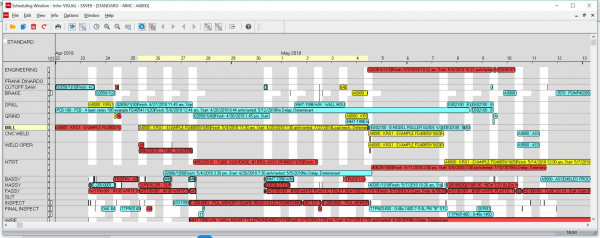
Capacity planning in Infor Visual ERP
There are some important terms related to capacity planning:
Infinite vs. finite capacity planning. These are the foundational concepts of capacity planning—infinite capacity assumes no limits on resources needed to produce enough units to meet demand. However, finite capacity factors in the constraints involved in real-world production situations.
For example, planners may know that a particular machine on a production line is only available for a maximum of, say, 10 hours during a normal shift. This is one kind of limitation that impacts capacity planning.
Thus, capacity planning software helps by scheduling around real-time constraints and other conditions that can impact production, instead of simply planning based on a baseline capacity level.
Production load leveling. Demand isn't always constant for manufacturers. In the case of fluctuating demand, it's necessary to maintain a smooth production workflow, which may include shifting capacity to "level" production across a few days instead of packing it all into one, or by expanding capacity by adding extra shifts or utilizing external capacity to meet demand (by using another manufacturing plant, for example).
Common Functionality of Capacity Planning and Management Software
These systems only have a few individual components, but each one provides useful insights about how to arrange your available capacity to meet production goals. These features often include:
Calendar production view | As orders come in, the system can place work into a schedule, and planners can view and edit schedules by dragging and dropping items on a calendar-style workflow chart. Users can also set priority levels for work orders and assign the total capacity available each day. |
Finite capacity management | As mentioned above, this functionality allows the system to factor in other planned work schedules, inventory, man hours, material levels and other factors to optimize production plans. |
Real-time capacity planning | Users can make on-the-fly changes to work order schedules or priorities if problems occur during production, instead of resetting the entire plan. |
Scenario testing and modeling | Capacity planning tools can help users test unfavorable supply chain scenarios by entering various values to optimize contingency plans. |
Reporting | As a system is used over time, it collects loads of valuable data. Reporting tools can arrange and visualize that data so managers can identify trends in production and address issues. |
What Type of Buyer Are You?
Any software purchase comes with several considerations and questions to ask. Identifying the type of buyer you are helps answer many of those. Below are some of the most common buyer types:
ERP suite buyer. Enterprise resource planning systems (ERPs) are complex platforms to assist manufacturers (and a wide variety of other types of businesses) by integrating data from all departments to gain a holistic view of operations. This software takes into account the many seemingly unrelated factors that can impact production schedules.
Many modern ERP systems offer capacity planning functionality, and use the wealth of collected data to predict potential issues in production that could impact capacity decisions.
MES buyer. Similarly, stand-alone manufacturing execution systems (MESs) typically offer a capacity planning component. Where an ERP gathers and analyzes information about an entire organization, an MES is hyper specific to that company's manufacturing process—maintaining production assets, dispatching production plans and improving quality of the finished product.
Since this type of software is so particular to the manufacturing type, it's often purchased by itself to integrate with an existing ERP. If you're buying an MES, you likely have the capacity planning functionality you need.
Make-to-order manufacturer. These types of companies begin production only after receiving a work order, so capacity planning is more crucial for these organizations than for those that continuously produce units.
In these situations, manufacturers have a short window to plan for capacity, but software can assist with leveling the load and factoring in other available resources necessary to meet production deadlines.
Benefits of Capacity Planning and Management Software
We've talked about the key benefit of automating the complex issue of capacity planning, but the software also offers some complementary benefits:
Optimize the use of assets. Especially for manufacturing plants with a variety of asset types, or different versions of the same type of asset, a capacity planning system can help prioritize jobs. This can lower production costs by shifting jobs to equipment that is less expensive to operate depending on the type and time frame of manufacturing.
Spot production bottlenecks. During capacity planning, the software can help identify specific assets or processes causing slowdowns or inefficiencies. The system's recommendations for prioritizing or spreading out work may reveal these bottlenecks.
Boost the useful life of assets. Because capacity planning helps level the workload, the tasks aren't placed solely on one or two machines, so assets and equipment are likely to operate a good condition for longer.
Note: The applications selected in this article are examples to show a feature in context and are not intended as endorsements or recommendations. They have been obtained from sources believed to be reliable at the time of publication.