


Best Residential Remodeling Estimating Software of 2026
Updated January 27, 2025 at 9:55 AM
- Popular Comparisons
- Buyers Guide
Compare Products
Showing 1 - 25 of 57 products
Compare Products
Sort by
Reviews: Sorts listings by the number of user reviews we have published, greatest to least.
Average Rating: Sorts listings by overall star rating based on user reviews, highest to lowest.
Alphabetically (A-Z): Sorts listings by product name from A to Z.

Houzz Pro is a business solution that streamlines operations for construction and design professionals. The platform offers plan...Read more about Houzz Pro


Houzz Pro's Best Rated Features
See All
Houzz Pro's Worst Rated Features
See All

JobNimbus is a customer relationship management (CRM) and project management solution tailored to meet the needs of contractors,...Read more about JobNimbus


JobNimbus's Best Rated Features
See All
JobNimbus's Worst Rated Features
See All

Designed by contractors for contractors. Take your job from lead to work complete in one comprehensive construction CRM. Want ...Read more about Leap


Leap's Best Rated Features
See All
Leap's Worst Rated Features
See All

Buildertrend is a cloud-based solution designed for the construction industry, aiming to streamline project management, customer...Read more about Buildertrend

Buildertrend's Best Rated Features
See All
Buildertrend's Worst Rated Features
See All

Contractors Software Group (CSG): Smarter Software for Smarter Builders Contractors Software Group offers a powerful suite of in...Read more about Contractors Software Group

Never miss the right job opportunity again. AI-powered estimating built for the busy builder who does it all. Designed for resi...Read more about Buildxact

Buildxact's Best Rated Features
See All
Buildxact's Worst Rated Features
See All

UDA Technologies’ ConstructionOnline offers a web-based, integrated approach to project management, project scheduling, and cust...Read more about ConstructionOnline
ConstructionOnline's Best Rated Features
See All
ConstructionOnline's Worst Rated Features
See All

123worx is a cloud-based construction management software solution that is efficient, flexible, and easy to use. Businesses can ...Read more about 123worx

PlanHub is a construction project and bid management solution. It helps contractors, subcontractors, suppliers and owners stream...Read more about PlanHub

PlanHub's Best Rated Features
See All
PlanHub's Worst Rated Features
See All

Candy helps businesses in the construction industry manage project pricing and planning, quantity take-off, and controlling at t...Read more about RIB Candy

RIB Candy's Best Rated Features
See All
RIB Candy's Worst Rated Features
See All

Projul is everything you need in a construction management tool. Built by construction pros. With honest pricing. • Consolidate...Read more about Projul

Projul's Best Rated Features
See All
Projul's Worst Rated Features
See All

ePROMIS FutureGen Enterprise Cloud is an all-in-one cloud platform that provides businesses with comprehensive management functi...Read more about ePROMIS ERP
ePROMIS ERP's Best Rated Features
See All
ePROMIS ERP's Worst Rated Features
See All

Tradify is job management software that helps organizations track and manage jobs from quote to invoice, in real time. Tradify w...Read more about Tradify

Tradify's Best Rated Features
See All
Tradify's Worst Rated Features
See All

QuickBooks Enterprise is an accounting solution designed for SMBs across different industry verticals such as construction, nonp...Read more about QuickBooks Enterprise

QuickBooks Enterprise's Best Rated Features
See All
QuickBooks Enterprise's Worst Rated Features
See All

Measure Square offers a complete suite of measure estimating software solutions across various trades including Flooring, Tiling...Read more about MeasureSquare
MeasureSquare's Best Rated Features
See All
MeasureSquare's Worst Rated Features
See All

CostOS is a cost estimating software that combines traditional estimating methods with BIM 3D, 2D, and GIS capabilities. With ...Read more about CostOS


ProDBX is an all-in-one construction management software built specifically for pool builders and fence contractors. It connects...Read more about ProDBX

Contractor Foreman is a construction management software designed for contractors. It caters to a wide range of contractors, inc...Read more about Contractor Foreman

Contractor Foreman's Best Rated Features
See All
Contractor Foreman's Worst Rated Features
See All

Estimator360 is a cloud-based platform for construction estimating and management. It is suited for smaller construction compani...Read more about Estimator360

One Click Contracter is a construction estimating solution designed to help businesses in the remodellng industry measure infras...Read more about One Click Contractor
One Click Contractor's Best Rated Features
See All
One Click Contractor's Worst Rated Features
See All

Job-Dox is a project management solution that enables businesses in the construction and home service industry to streamline pro...Read more about Job Dox


Build Hero is a web-based home remodeling software which assists contractors and suppliers with cost estimation and customer acq...Read more about Build Hero

Hyphen HomeFront is a fully integrated Enterprise Resource Planning (ERP) solution for mid to large-size Home Builders. This eas...Read more about Hyphen HomeFront

Welcome to Buildee, your one-stop solution for construction takeoff and estimating that's been simplifying lives since 2018. Wit...Read more about Buildee

BrickControl is a web software in the cloud that helps you manage your construction projects in a very powerful and simple way. ...Read more about BrickControl

BrickControl's Best Rated Features
See All
BrickControl's Worst Rated Features
See All
Popular Comparisons


Buyers Guide
This detailed guide will help you find and buy the right residential remodeling estimating software for you and your business.
Last Updated on January 27, 2025Traditionally, residential remodelers have relied on pen and paper to draw up estimates for their customers. While many remodelers swear by this method, it can be time consuming and can lead to inaccurate estimates. So if you’re looking to streamline your estimating process and put together tighter, more accurate bids, you will want to look into purchasing residential remodeling estimating software.
We put this guide together to help you better understand this type of software. Here’s what we’ll cover:
What Is Residential Remodeling Estimating Software?
Common Features of Residential Remodeling Estimating Software
Residential Remodeling Estimating Software Pricing
Residential Remodeling Estimating Software Deployment
What Is Residential Remodeling Estimating Software?
Cost estimating software helps residential remodeling contractors calculate material and labor costs and produce detailed remodeling proposals. As competition for projects continues to increase and more contractors are pressured to deliver fixed-bid work, buyers are adopting modern systems, including Web-based systems, to deliver accurate and professional proposals. At the same time, owners are using these systems to create their own home remodeling estimates and double check the accuracy of project bids they receive.
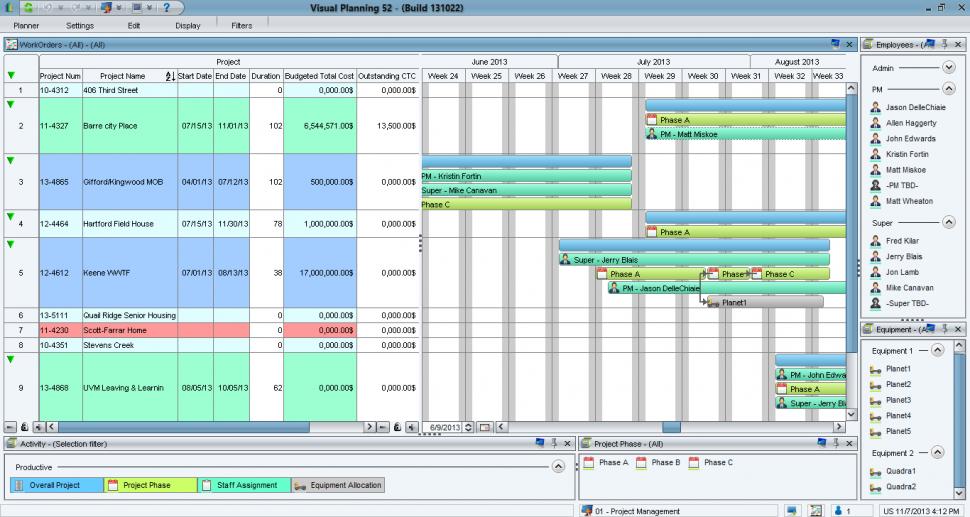
Screenshot of Visual Planning user dashboard
Common Features of Residential Remodeling Estimating Software
When we speak to residential contractors, the two primary criteria they have for estimating systems are: 1) that it be easy to use; and, 2) that it is affordable. There are a number of systems that meet these criteria, but they vary in their feature breadth and sophistication. Below is a table of the top core modules you should look for as you evaluate home estimating systems.
Manage customers | Your system should serve as a basic customer management system. For example, it should track your prospect and client contact information, as well as the notes you create when you interact with them. More advanced programs will help you organize and automate your new project sales pipeline. |
Manage projects | While an estimating system does not function as a construction project management system, it should organize estimates by project and maintain information on each project. You should be able to pull up a client contact, select one of that client’s projects and see the estimates you have developed for that project. |
Track material costs | The core of an estimating system is the ability to maintain an extensive database of materials. This database should be updated regularly with up-to-date prices for materials in your region through a subscription pricing service like RemodelMAX. You should also be able to modify this database yourself. |
Manage assemblies | Rather than specify every 2x4 and nail you need for a job, you’ll want to create assemblies that combine all of the items needed to build a specific unit of work (e.g., a residential interior wall). Vendors should offer pre-built assemblies, as well as the ability to create custom assemblies. |
Build and reuse templates | Templates are like assemblies at the project level. They allow the remodeling cost estimator to start with a completed estimate for a similar job (e.g., kitchen remodel) and then make modifications to make the estimate specific to the job that is being estimated. The system should come with a library of templates, and allow you to create custom templates. |
Reflect change orders | Of course, things change during the pre-construction process and during the project. So, the system should enable you to process change orders in the system. The system should generate a change order report that illustrates the cost impact of the change. Finally, this feature should have a status for accepted, declined, pending etc. |
Generate reports and proposals | The output of your estimating activities should be well-formatted reports, contracts, and proposals that impress your clients with their professional level of detail and polish. The system should make it easy to customize these reports with your company logo and contact information, as well as contract terms specific to how you do business. |
Residential Remodeling Estimating Software Pricing
Residential remodeling estimating software is typically priced in two different ways: subscription pricing and perpetual license pricing.
Subscription pricing: With subscription pricing, users typically pay a monthly fee for as long as they want to use the software. This fee might be determined by the breadth of features you want included, or it can also be determined by the number of remodeling jobs your business does on average.
Perpetual license pricing: With a perpetual license, you pay one large fee upfront and own the software indefinitely. However, with a perpetual license, you may have to pay annual fees for support, maintenance and upgrades.
It is worth noting that some vendors offer “per job” pricing, meaning you’ll only be charged for every individual remodeling job, and typically it’s a small percentage of the remodeling job’s overall price. Some vendors also offer free versions of their software that have limited features, allowing you to try it and out and see if you want to pay for the full version.
Residential Remodeling Estimating Software Deployment
Residential remodeling software is deployed one of two ways: cloud-based and on-premise.
On-premise. With on-premise software, you install the software directly on your own computers or servers. On premise software is typically associated with perpetual license pricing.
Cloud-based. Cloud-based software is accessed through a web browser or a native mobile application and is hosted on the software vendor’s servers. Many residential remodelers prefer to use cloud-based estimating software as it allows them to draw up estimates from their mobile device when they’re on the go.
Other Considerations
It is important to keep in mind that not all estimating software platforms can accommodate residential remodelers. Some platforms are better suited for specific types of estimating work, while others can work as multi-purpose systems that can cover most of your bases.
Also consider vendor viability. We frequently see in the market for construction software smaller vendors getting acquired—and sometimes sunsetted—by bigger vendors. While smaller vendors often have cheaper pricing, you might have less confidence that the vendor will be around for a long time. This is particularly important if the vendor offers a perpetual license and then goes defunct—that can be a bad investment if you end up stuck with “abandoned” software that is no longer being updated.