


Best Insurance Software of 2026
Updated January 27, 2025 at 9:57 AM
- Popular Comparisons
- Buyers Guide
- Related Software
Compare Products
Showing 1 - 25 of 123 products
Compare Products
Sort by
Reviews: Sorts listings by the number of user reviews we have published, greatest to least.
Average Rating: Sorts listings by overall star rating based on user reviews, highest to lowest.
Alphabetically (A-Z): Sorts listings by product name from A to Z.

Functionality Macaw AMS is a cloud-hosted Insurance Agency Management platform that supports end to end functions of Brokers, M...Read more about Macaw


Jenesis is designed specifically for the independent insurance agency, offering a seamless platform to manage various aspects of...Read more about Jenesis Software


Jenesis Software's Best Rated Features
See All
Jenesis Software's Worst Rated Features
See All

EZLynx provides innovative insurance software that streamlines an agency’s workflow and manages the end-to-end policy lifecycle....Read more about EZLynx

EZLynx's Best Rated Features
See All
EZLynx's Worst Rated Features
See All

Salesforce Financial Services Cloud is a customer relationship management (CRM) solution that helps businesses in the finance in...Read more about Financial Services Cloud


Applied Epic is an agency designed to help insurance agencies improve their processes, offering a multitude of benefits and capa...Read more about Applied Epic

Applied Epic's Best Rated Features
See All
Applied Epic's Worst Rated Features
See All

OneLink is a Health, Life & Medicare agency management solution that helps businesses in healthcare, finance, insurance and othe...Read more about OneLink

A unified, cloud-based low-code platform for automating end-to-end processes and comprehensively managing content and communicat...Read more about NewgenONE Digital Transformation Platform
No reviews yet
recommendations


EASA is the leading software tool for those businesses currently using highly developed and complex Excel spreadsheets, includin...Read more about EASA

ePayPolicy is a payment processing solution designed to help businesses in the insurance sector collect credit card and ACH paym...Read more about ePayPolicy


ePayPolicy's Best Rated Features
See All
ePayPolicy's Worst Rated Features
See All

Designed for the insurance industry, Compulife Quote Software is a web-based software that helps businesses with providing quote...Read more about Compulife Quote Software


A1 Tracker Contract Management Software is a cloud-based contract management & lifecycle platform. A1 Tracker's features in...Read more about A1 Tracker


A1 Tracker's Best Rated Features
See All
A1 Tracker's Worst Rated Features
See All

NowCerts is a cloud-based insurance solution designed for insurance agencies of all sizes. Key functionalities include commissio...Read more about NowCerts


NextAgency is the Nation's leading Insurance Agency Management Platform featuring CRM, marketing, and commission tracking tools....Read more about NextAgency

NextAgency's Best Rated Features
See All
NextAgency's Worst Rated Features
See All

Commence CRM is a cloud-based customer relationship management(CRM) solution that caters to small and mid-size businesses and he...Read more about Commence

Commissionly is a cloud based sales commission and compensation solution for ISO's FMO's, Insurance Brokers, Merchant Services C...Read more about Commissionly


FileTrac Evolve is a sophisticated, claims management software designed for independent adjusters and insurance companies, accom...Read more about FileTrac Evolve


Creatio is a new era CRM to manage all customer and operational workflows with no-code and AI at its core. Creatio Sales is an ...Read more about Creatio CRM


Creatio CRM's Best Rated Features
See All
Creatio CRM's Worst Rated Features
See All

AgencyBloc is an agency management platform for life and health insurance agencies looking for a more effective way to increase ...Read more about AgencyBloc AMS+
AgencyBloc AMS+'s Best Rated Features
See All
AgencyBloc AMS+'s Worst Rated Features
See All

Eclipse is an insurance agency management system for independent insurance agents with both on-premise or cloud-based deployment...Read more about Eclipse


Anagram, formerly Patch, is a cloud-based insurance management solution, which assists health centers and medical practitioners ...Read more about Anagram
Anagram's Best Rated Features
See All
Anagram's Worst Rated Features
See All

Sembley redefines the insurance submissions and renewals landscape for commercial property and casualty (P&C) insurance brokers ...Read more about Sembley

Sembley's Best Rated Features
See All
Sembley's Worst Rated Features
See All

Agency Advantage is an agency management software designed to help businesses streamline customer retention and boost sales, pro...Read more about Agency Advantage
Agency Advantage's Best Rated Features
See All
Agency Advantage's Worst Rated Features
See All

With a claims engine as its core, VCA Software (formerly known as Virtual Claims Adjuster) is a global SaaS platform focused on ...Read more about VCA Software

Claimable is customer-first claims management software for businesses looking to streamline their claims processes. We pride ou...Read more about Claimable
Claimable's Best Rated Features
See All
Claimable's Worst Rated Features
See All

Commission Tracker is an on-premise and cloud-based solution that enables insurance agencies to manage policies and calculate ag...Read more about Commission Tracker
Commission Tracker's Best Rated Features
See All
Commission Tracker's Worst Rated Features
See All
Popular Comparisons


Buyers Guide
This detailed guide will help you find and buy the right insurance software for you and your business.
Last Updated on January 27, 2025Despite a slew of challenges in recent years—government regulations being constantly in flux, homeownership rates declining—insurance companies continue to survive in an increasingly competitive and complex industry. In some cases, they're even thriving: The global insurance industry is expected to grow 4.5 percent in 2017 and 2018.
Does that mean it's time to be complacent if you're an insurance carrier, agency or brokerage? No way.
Your business won't last long in this day and age without being able to manage a growing policy volume, while still meeting the increasing demands of digital-savvy customers. In a recent report, global consultancy Ernst & Young said having the right technology in place is vital to gaining a competitive advantage in the insurance industry moving forward:
"To meet changing expectations, insurers need to digitize interactions with customers, employees and suppliers. Building new distribution channels and working closely with existing distribution partners to enhance the customer experience is a strategic imperative."
This is why you should consider investing in insurance software—systems designed with the specific needs of insurance carriers, agencies and brokerages in mind.
In this Buyer's Guide, we'll explain what insurance software is, what common functionality to look out for, how much it costs and everything else your insurance business needs to know before making a purchase decision.
Here's what we'll cover:
Benefits of Insurance Software
Common Insurance Software Functionality
How Much Does Insurance Software Cost?
Key Considerations When Purchasing Insurance Software
What Is Insurance Software?
Insurance software is designed to help insurance carriers, agencies or brokerages manage their day-to-day operations. On the administrative side, these systems can help you keep track of policy and claims information, manage your teams and more. There's a client side to this software as well, which allows your customers to log in and do things such as check their policy information, fill out forms and make online payments.
Combining business process management (BPM) and customer relationship management (CRM) functionality, insurance software can act as the digital hub to facilitate all of your company's primary insurance processes.
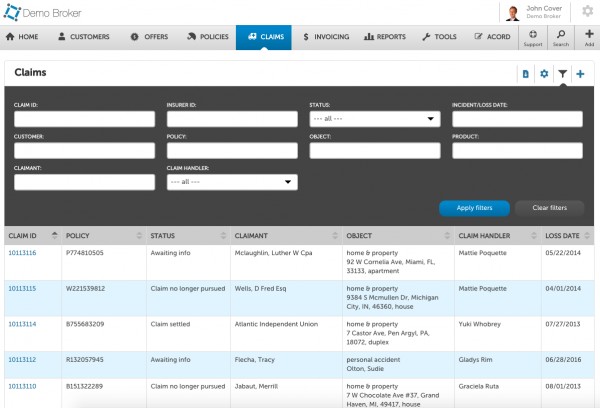
Claims management in Insly
Benefits of Insurance Software
Dedicated insurance software can provide numerous benefits to your insurance company over more manual methods such pen and paper or spreadsheets. With an insurance software system in place, you can expect:
Improved operational efficiency. Being able to house all of your information in one easily searchable database and automate tedious processes related to billing or reporting can save your business a ton of time.
Increased data security. Sensitive customer or carrier information shouldn't be held in easily crackable spreadsheets. Encryption and user authentication capabilities found in insurance software can keep your data safe.
Better regulatory compliance. Staying on top of ever-shifting regulations through manual methods can be an incredible time suck and result in costly errors. Insurance software can automatically highlight any areas that need your attention.
Fewer breakdowns in communication. Features such as task management, automatic notifications and communication tracking can ensure that nothing falls through the cracks working with customers, carriers or otherwise.
The ability to provide superior customer service. Insurance buyers rely on you to provide quick, accurate assessments of their situations, and the ability to perform self-service requests on their own time. Insurance software can allow for this.
Common Insurance Software Functionality
When researching different insurance software systems, you'll find a lot of variance in functionality. Some systems focus on breadth of functionality, acting as comprehensive software suites that can do everything your insurance business needs, while others focus on depth of functionality and being able to do one thing really well.
With that in mind, here is some of the most common functionality you can expect to find:
Create, administer and manage insurance policies for various customers and insurance lines. | |
Manage customer claims information and track the status of claims that are being processed. | |
Billing | Create and send invoices, process insurance payments and manage customer billing information. |
Enter customer information and receive quotes from partnered insurance carriers in real time. | |
Underwriting | Define formal rules for insurance coverage company-wide. Enter prospective client information to determine risk of insuring. |
Analytics and reporting | Analyze trends to discover instances of fraud, risk prevention or revenue opportunity. Generate standardized reports. |
How Much Does Insurance Software Cost?
Another trend you'll notice when researching insurance software is that many vendors aren't completely transparent about pricing on their websites. This happens for a number of reasons—the vendor might be trying to get you on the phone to sell you on their product, or their system might have so many customizable options that the cost varies wildly from customer to customer—but it's frustrating nonetheless.
Most insurance software vendors charge a per-user subscription fee. This means you pay a recurring fee (usually monthly) that changes depending on how many people in your company are using the system. The monthly fee can range from around $30 on the low end to $150+ for more advanced systems.
The license cost isn't the only one to consider either. Vendors may also have recurring support costs or one-time upfront fees for services such as implementation, data migration or training. Be sure to understand all of the various costs, pricing models and payment schedules associated with a specific insurance software system before finalizing the purchase.
Key Considerations When Purchasing Insurance Software
Here are some final key factors you should consider when deciding on the right insurance software system for your carrier, agency or brokerage:
Cloud-based or on-premise? Insurance software deployments are either on-premise (where the software is maintained on company servers) or cloud-based (where the software is maintained on vendor servers and accessed by companies via the internet). There are benefits to each option—on-premise software is more customizable to your needs, while cloud-based software requires fewer IT resources—so weigh your options carefully.
Do you need to integrate? It's likely that your business already has other vital software systems in place, be it CRM software, accounting software or otherwise. Let vendors know which systems you're currently using to ensure a seamless integration between different business processes (e.g., migrating invoice information into the company ledger).
Do you need segment-specific software? Most insurance software vendors can tailor their system to work with multiple insurance segments, be it health, life and annuities (L&A), property and casualty (P&C) or otherwise. That's great news if you want to evaluate a wide variety of options, or if you're a multiline insurance business. If you desire a vendor that specializes in your segment though, they definitely exist. Silvervine, for example, only serves P&C insurance businesses.