


Best Long Term Care software of 2026

- Popular Comparisons
- Buyers Guide
Compare Products
Showing 1 - 25 of 82 products
Compare Products
Sort by
Reviews: Sorts listings by the number of user reviews we have published, greatest to least.
Average Rating: Sorts listings by overall star rating based on user reviews, highest to lowest.
Alphabetically (A-Z): Sorts listings by product name from A to Z.

ECP is a cloud-based electronic health records (EHR) solution that assists living and senior care communities of any size. It is...Read more about ECP


ECP's Best Rated Features
See All
ECP's Worst Rated Features
See All

WellSky Long-Term Care (formerly Experience Care) is a comprehensive EHR platform for skilled nursing, continuing care retiremen...Read more about WellSky Long-Term Care

Eldermark’s comprehensive software is built for the business of senior living. Centralize and connect all your senior living sof...Read more about Eldermark


Eldermark's Best Rated Features
See All
Eldermark's Worst Rated Features
See All

AL ADVANTAGE is a cloud-based senior living software, designed and supported by senior living health care experts. Senior caregi...Read more about AL Advantage

MatrixCare’s Skilled Nursing software is built to meet the specific skilled nursing facilities. Our industry-leading EHR solutio...Read more about MatrixCare Skilled Nursing Facility


Icon is the result of VoiceFriend’s best-in-class communication technology and Caremerge’s leading engagement solutions joining ...Read more about Icon


Life plan community (LPC) EHR software from MatrixCare is a fully managed service designed to meet the specific challenges facin...Read more about MatrixCare Life Plan Community

StoriiCare is an EHR and care management platform for adult day care centers, assisted living/residential providers and home hea...Read more about StoriiCare
StoriiCare's Best Rated Features
See All
StoriiCare's Worst Rated Features
See All

Jotform is a cloud-based form automation solution that enables users to publish online forms and record customer responses. It h...Read more about Jotform


Jotform's Best Rated Features
See All
Jotform's Worst Rated Features
See All

Assisted Living Intelligent Solutions (ALIS) is electronic health records (EHR) software for assisted living and memory care com...Read more about ALIS


AxisCare is an enterprise-level web-based home care scheduling and management platform designed for Personal Care home care agen...Read more about AxisCare

AxisCare's Best Rated Features
See All
AxisCare's Worst Rated Features
See All

SNF Metrics is a cloud-based software designed to streamline the operations of skilled nursing facilities (SNFs). It offers vari...Read more about SNF Metrics


SNF Metrics's Best Rated Features
See All
SNF Metrics's Worst Rated Features
See All

Cliniconex's healthcare collaboration platform triggers over 800,000 HIPAA-compliant engagements for senior care providers and m...Read more about Cliniconex

Therap Services is the national leader in HIPAA-compliant electronic documentation solutions for organizations in Long-Term Serv...Read more about Therap
Therap's Best Rated Features
See All
Therap's Worst Rated Features
See All

MedEZ is a web-based Electronic Health Record (EHR) and revenue cycle management platform designed specifically for behavioral h...Read more about MedEZ


TheWorxHub, designed by Brightly Software specifically for healthcare, is the most user-friendly, cloud-based CMMS solution toda...Read more about TheWorxHub
TheWorxHub's Best Rated Features
See All
TheWorxHub's Worst Rated Features
See All

PointClickCare's cloud-based platform gives you the tools to help you meet the increasing expectations of residents and their fa...Read more about Senior Living Core Platform

Senior Living Core Platform's Best Rated Features
See All
Senior Living Core Platform's Worst Rated Features
See All

Lookout's software makes it as easy for Australian home care providers, and their teams, to provide the highest quality client c...Read more about Lookout


Lookout's Best Rated Features
See All
Lookout's Worst Rated Features
See All

CareRight is a point of care electronic documentation system that allows care facilities to manage residents' health by closely ...Read more about CareRight

SRx (formerly, Intelligent Pharmacy Software or IPS) by SuiteRx was developed by pharmacists for pharmacists to address the need...Read more about SRx

Carecenta offers a wide range of advanced features to enhance the management software experience for various healthcare agencies...Read more about Carecenta


Carecenta's Best Rated Features
See All
Carecenta's Worst Rated Features
See All

Since 2012, ChartPath has been leading long-term and post-acute care (LTPAC) practices with its flagship customizable and intuit...Read more about ChartPath

Covr is a labor management tool that helps businesses manage their employees and schedule shifts. Covr helps businesses optimize...Read more about Covr

PacEHR is an EHR software specifically developed for long-term post-acute care professionals. Users are provided with tools that...Read more about PacEHR

CareSynchrony from Sanvis Health is a comprehensive software suite that has been designed to fit the diverse needs of senior liv...Read more about CareSynchrony
Popular Comparisons


Buyers Guide
This detailed guide will help you find and buy the right long-term care software for you and your business.
Last Updated on January 27, 2025"Long-term care" (LTC) is a term that can refer to any post-acute or extended-care setting: from nursing homes to assisted living facilities to adult day care centers to home health care. The patients who receive care in these settings may be any age or gender, but the modal LTC patient is elderly.
Long-term care software vendors provide products for nursing homes and skilled nursing facilities (SNFs), assisted living facilities, independent living facilities and continuing care retirement communities (CCRCs).
Long-term care software demonstration video from MedTablet®
There are many vendors offering many LTC solutions. We've created this guide to help LTC facilities understand their options and identify the solutions that best meet their needs. Here's what we'll cover:
What Is Long-Term Care Software?
Common Features of Long-Term Care Software
What Is Long-Term Care Software?
Long term care software can be considered to live within the geriatric software umbrella. Products in this category help care facilities automate clinical, financial, marketing and other activities to streamline workflows and operate more efficiently. For example, facilities may need marketing solutions to track leads and referrals. Nursing homes may need electronic medical records (EMRs) to track patients' medical information.
(Some may consider home health to be a part of the long-term care spectrum. For more information on systems designed for other types of LTC organizations, check out our home health software guide or our hospice care software guide.)
Common Features of Long-Term Care Software
Clinical/electronic medical records (EMR) | Long-term care EMR software automates clinical documentation by providing digital storage and access to patients' medical information. The EMR should also be able to send and receive care summaries during transitions of care. |
Clinical—MDS | Clinical applications also usually include support for Minimum Data Set (MDS) assessments, the federally mandated clinical assessment of all residents in Medicare- or Medicaid-certified nursing homes. |
Clinical—eMAR and eTAR | Clinical applications also typically offer medication management in the form of electronic medication administration records (eMAR) and electronic treatment administration records (eTAR). |
Point of care | These solutions can be used at the point of care, to document or access information from the bedside. Point-of-care solutions often help with speed and eliminate the need for double entry. They also allow quick, accurate access to residents’ health status information. |
Patient scheduling | Scheduling solutions allow staff to schedule medical appointments for patients (residents). A scheduling application will facilitate not only the making and editing of appointments, but also quickly searching and finding scheduled appointments. |
Billing | Billing software helps LTC facilities automate repetitive or error-prone billing tasks. For medical biling related to the medical evaluation of patients, implementing a software system often results in improved coding and collections. |
Marketing | Marketing software helps facilities track leads and manage communications. For SNFs, marketing platforms may also help with the mangagement of referrals and preadmissions. |
Of course, different solutions will offer different types of applications, but these are the applications categories we've found to be present in most LTC systems.
](https://software-advice.imgix.net/managed/other_pages/LTC/hi-tech-MDS.jpg)
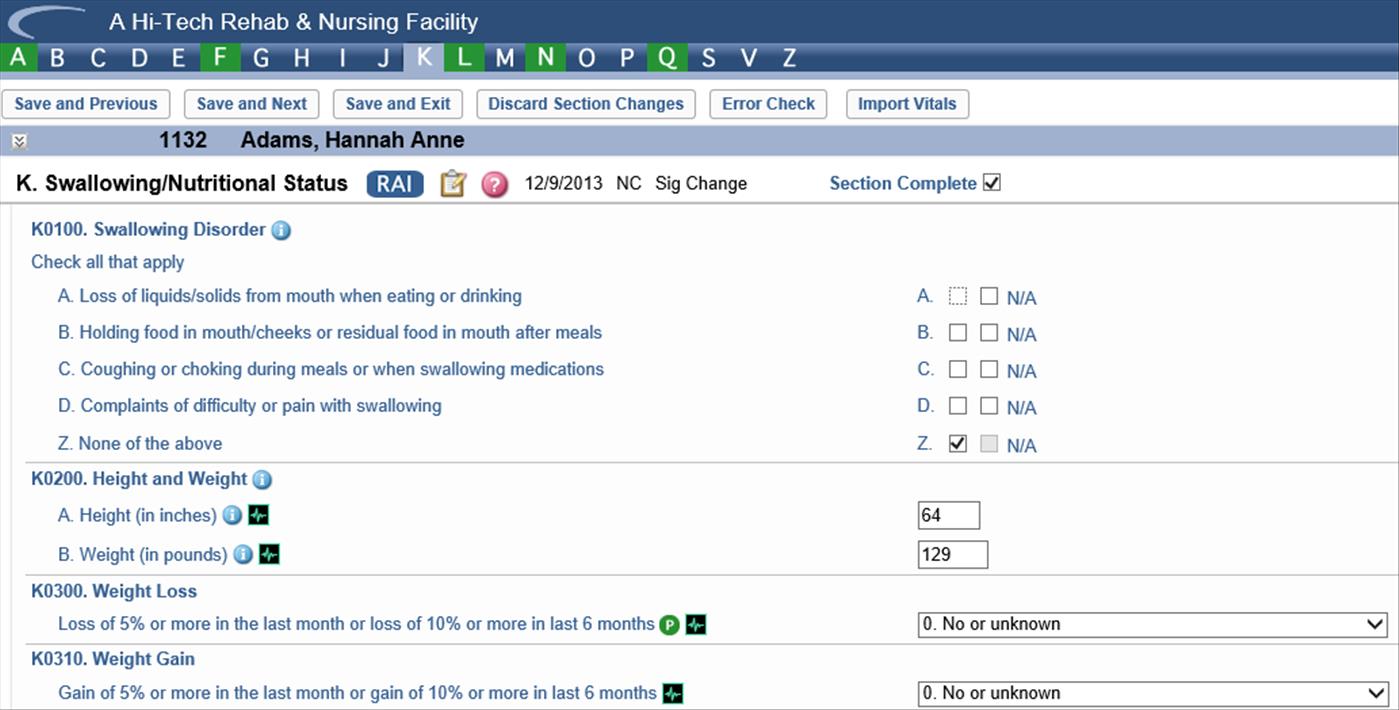
The MDS Section K screen of the Hi-Tech Software system
Deployment Strategies
You’ll have choices when it comes to deploying your LTC software; here are the primary options to consider.
Standalone application or integrated suite. You’ll need to determine up front whether you want to implement a single application for a specific task, or a system that offers multiple applications. A single application purchased on its own—for example, only EMR or only billing—is known as a “standalone” or “best-of-breed” application. Alternatively, you may want to implement one system that contains several applications: what’s known as an “integrated suite.”
We find that most buyers choose an integrated suite. However, a standalone solution might be right for you if:
You don’t want to automate certain parts of your workflow, such as billing;
You already use software for one standalone application, but need to find a different vendor for another application; or
You outsource certain parts of your workflow, such as billing, and don’t wish to bring that function back in house.
On-premise or cloud-based. You’ll also need to determine whether you want to deploy your software “in the cloud,” or on your own servers. Cloud-based deployment is also referred to as “Web-based” or “software-as-a-service (SaaS).” These solutions are deployed “in the cloud” or over the Internet, rather than being hosted on a facility’s own local servers.
This type of deployment is especially popular among LTC facilities, which often don’t have full-time IT staff to manage a system running on internal servers. Cloud-based software vendors also “push” updates out to their users automatically, rather than requiring users to install new or updated versions manually.

The Point of Care interface of the PointClickCare cloud-based system
A cloud-based deployment model typically lowers the upfront cost of implementation, since it requires less investment in servers and other physical infrastructure. Cloud-based systems are typically priced as a monthly subscription, rather than an upfront license fee. Most LTC software vendors offer a cloud-based option.
](https://software-advice.imgix.net/managed/other_pages/LTC/NTT-ADT-snapshot.jpg)
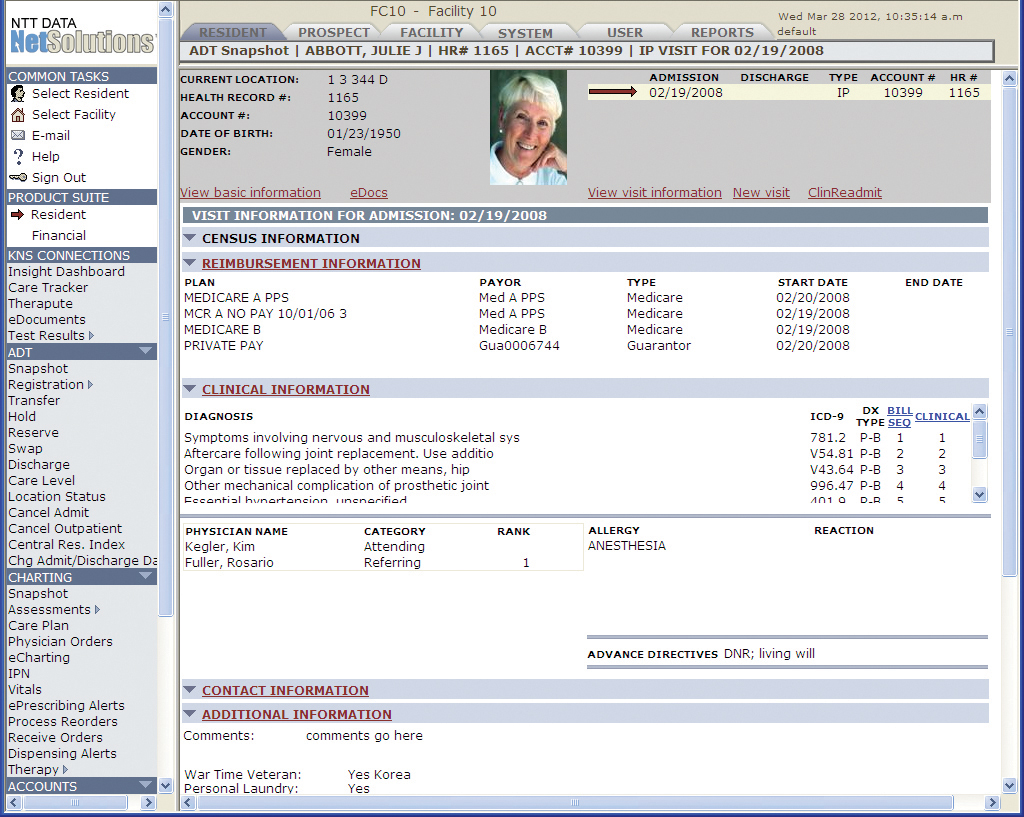
The Admit-Discharge-Transfer (ADT) screen of the NTT Data cloud-based system
On-premise software hosted on a facility’s own servers may be preferable for facilities that do have a dedicated IT team available to manage the system. These systems are typically priced through an upfront fee for a license. Although the initial investment is higher with on-premise systems, the costs tend to balance out over time, since cloud-based costs are spread evenly over the life of the software.
Pricing Structure
Web-based nursing home software is typically priced "per bed day," or in some cases "per patient day." In other words, you’ll most often pay a subscription fee that amounts to some fixed price per day for each bed in your facility (or each patient in your facility, which is usually based on a census average). For assisted living or independent living facilities that don't have a skilled nursing unit, subscription pricing is generally per-resident.
On-premise software is less common, but is typically priced with a perpetual license fee—a fee paid upfront for a license to use the software in perpetuity.
The price of LTC software tends to increase in tandem with the complexity of your requirements, as well as the functional breadth and depth of the system itself. For example, packages on the higher end of the pricing scale will typically offer more robust features, while those on the lower end will include only the most essential functions.
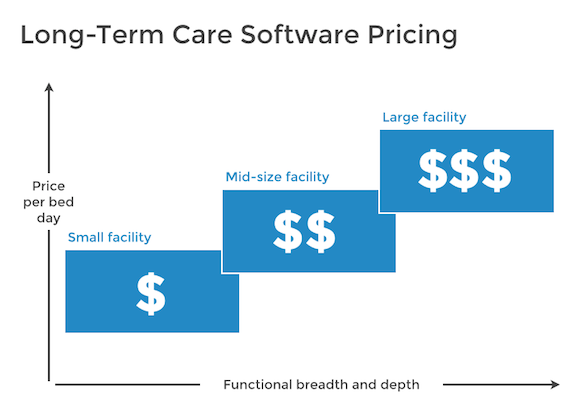
Generally speaking, larger facilities may find they benefit more from the packages on the higher end of the pricing scale, while smaller facilities often find the more basic packages are sufficient to meet their needs.
Software Evaluation Tips
How can you be sure you’re taking the right steps to evaluate nursing home or assisted living software? Software Advice recently surveyed buyers to determine which evaluation tactics work best.
We found that checking vendor references and having an attorney review the vendor agreement are the two most effective tactics for software buyers. We made this determination by evaluating which tactics had the highest impact on the project outcome (meaning software buyers that applied the method experienced a different outcome than those who didn’t), as well as which led to the highest rates of satisfaction with the system selected.
The top-right quadrant in the matrix below depicts which tactics fell into this impact and satisfaction sweet spot and represents the methods we most highly recommend.
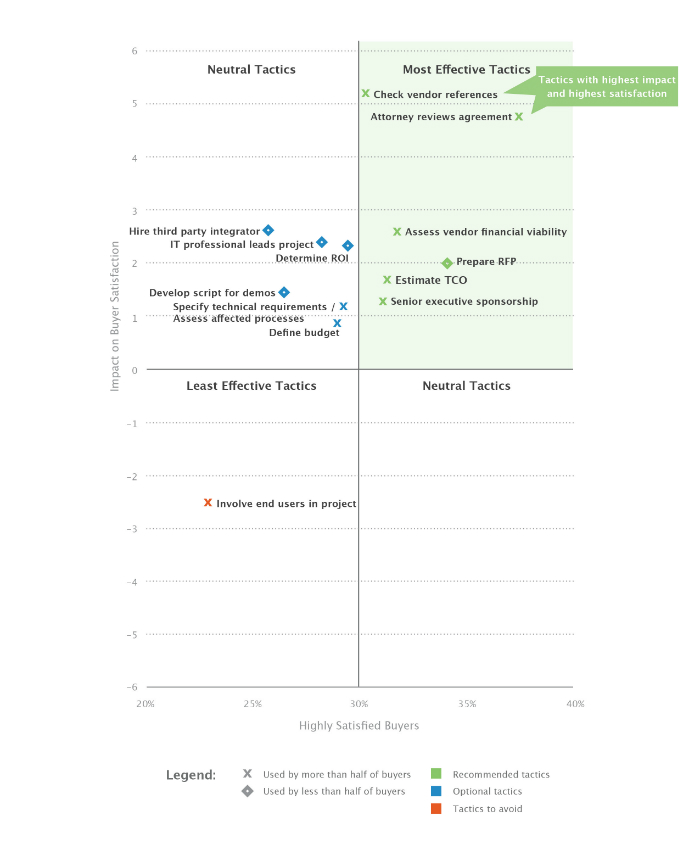
Quadrant indicating where selection tactics fall on the "impact" and "satisfaction" spectrum
Notably, we found that involving end-users in the evaluation process negatively impacted project outcome. In fact, buyers that applied the tactic were more than twice as likely to be very dissatisfied with their selection than those who didn’t involve end users. End-user feedback can create a “too many cooks in the kitchen” situation for buyers, so we’d advise against this tactic.
Other Considerations
There are a few other things LTC facilities should keep in mind when evaluating software, such as whether EMR software is “certified” and whether staff will need (or want) to access the system from mobile devices.
EMR certification. In the long-term/post-acute care (LTPAC) category, EMR systems—also often called “electronic health record (EHR) systems”—have their own certification processes. “Certified” long-term care EHR software will meet stringent requirements for interoperability and security, giving buyers added peace of mind. LTPAC EMRs have two available certifications:
CCHIT: The Certification Commission for Health Information Technology (CCHIT) offered perhaps the best-known certification available for LTC software. As of January 2014, CCHIT no longer certifies software, but its past certifications remain valid. The most recent LTPAC certification program it offered was its 2011 certification, which guarantees that the EMR offers a high degree of functionality and meets robust security requirements. (For more information on CCHIT certified software, see our CCHIT EMR guide.)
ONC-ATCB: The Office of the National Coordinator for Health Information Technology (ONC) has designated a handful of Authorized Testing and Certification Bodies (ATCBs). Collectively, these bodies are known as “ONC-ATCBs.” ONC-ATCBs certify EMR software for Meaningful Use. Though long-term care providers are not eligible for Meaningful Use financial incentives, the EMRs they use can still be certified for Meaningful Use. The benefit to LTC facilities of using this certified software is the assurance that the system adheres to strict quality and safety criteria. (For more information on ONC-ATCB certified software, see our ONC-ATCB EMR guide.)
Mobile support. As the use of smartphones and tablets becomes increasingly common in professional settings, vendors are creating versions of their software that can operate seamlessly on these mobile devices. Many long-term care and assisted living software vendors offer mobile support. Systems that supports tablet use may be especially helpful for caregivers who need to make notes from patients' bedsides.