


Best Auto Body software of 2026

- Popular Comparisons
- Buyers Guide
Compare Products
Showing 1 - 25 of 61 products
Compare Products
Sort by
Reviews: Sorts listings by the number of user reviews we have published, greatest to least.
Average Rating: Sorts listings by overall star rating based on user reviews, highest to lowest.
Alphabetically (A-Z): Sorts listings by product name from A to Z.

Clover is a POS system designed to help small businesses streamline their operations. The system offers a range of features, inc...Read more about Clover


Clover's Best Rated Features
See All
Clover's Worst Rated Features
See All

Stax is an all-in-one payment technology platform built for businesses that have outgrown flat-rate processors. With subscriptio...Read more about Stax

Stax's Best Rated Features
See All
Stax's Worst Rated Features
See All

NetSuite is an AI-powered cloud-based business management suite that incorporates ERP, financial management, CRM and eCommerce f...Read more about NetSuite

NetSuite's Best Rated Features
See All
NetSuite's Worst Rated Features
See All

DaySmart Appointments is a powerful appointment scheduling solution designed to be highly customizable, ensuring a perfect fit f...Read more about DaySmart Appointments


DaySmart Appointments's Best Rated Features
See All
DaySmart Appointments's Worst Rated Features
See All

Running a retail or hospitality business today means balancing endless moving parts: changing customer expectations, new sales c...Read more about LS Retail


Epicor for Automotive provides powerful on-premises or cloud-based business management solutions, including Epicor Eagle for the...Read more about Epicor for Automotive


Combining an intuitive, user-friendly retail application with powerful enterprise functionality, VAI’s S2K Retail Point-of-Sale ...Read more about S2K Enterprise for Retail

Web-Est is a provider of online auto body estimating software for the collision repair community. Web-Est incorporates raw, OEM ...Read more about Web-Est

Fishbowl’s powerful inventory management software is designed to help businesses streamline operations, improve accuracy, and sc...Read more about Fishbowl


Fishbowl's Best Rated Features
See All
Fishbowl's Worst Rated Features
See All

Epicor Vision enterprise software is a powerful solution for automotive aftermarket parts distributors ready to deliver superior...Read more about Epicor Vision
No reviews yet

Acuity Scheduling is a cloud-based appointment scheduling solution that enables business owners to manage appointments online. ...Read more about Acuity Scheduling

Acuity Scheduling's Best Rated Features
See All
Acuity Scheduling's Worst Rated Features
See All

AutoLeap is a cloud-based auto repair platform designed to streamline operations and handle administrative tasks for independent...Read more about AutoLeap


AutoLeap's Best Rated Features
See All
AutoLeap's Worst Rated Features
See All

AutoRepair Cloud is an auto shop management solution designed for auto service and repair shops that can be accessed across vari...Read more about AutoRepair Cloud
AutoRepair Cloud's Best Rated Features
See All
AutoRepair Cloud's Worst Rated Features
See All

Preferred Patron is built for organizations that care about repeat business— from single-location shops to fast-growing multi-lo...Read more about Preferred Patron Loyalty


Preferred Patron Loyalty's Best Rated Features
See All
Preferred Patron Loyalty's Worst Rated Features
See All

ARI (Auto Repair Invoices) is a management application suitable for individual mechanics, auto repair shops and car dealers. It ...Read more about ARI
ARI's Best Rated Features
See All
ARI's Worst Rated Features
See All

Streamline Your Auto Repair Workshop with Autorox: A Comprehensive Garage Management Solution In today's fast-paced world, auto...Read more about Autorox


Autorox's Best Rated Features
See All
Autorox's Worst Rated Features
See All

Drive more business to your shop with KUKUI. The KUKUI All-in-One Success Platform® provides auto repair shops with a branded S...Read more about Kukui


CAMS DMS is a cloud-based auto body platform that can be used by car dealerships to keep track of their inventory, customers, su...Read more about CAMS DMS

Orderry is a cloud-based application suitable for small to midsize businesses specializing in repair and maintenance services. K...Read more about Orderry

Orderry's Best Rated Features
See All
Orderry's Worst Rated Features
See All

Fullbay is a cloud-based shop management solution designed for heavy-duty commercial repair shops. The app allows shop owners, t...Read more about Fullbay
Fullbay's Best Rated Features
See All
Fullbay's Worst Rated Features
See All

Shop4D is a repair shop management system that streamlines every phase of the production pipeline. The solution caters to auto r...Read more about Shop4D

Shop4D's Best Rated Features
See All
Shop4D's Worst Rated Features
See All

Shop Methods is a cloud-based auto repair solution that helps auto service providers such as repair facilities, car detailers, c...Read more about Shop Methods

The Rome Solution provides a complete package for collision center management, including software, consulting, and ongoing educa...Read more about The Rome Solution

BodyShop Booster is an auto body, collision repair and paintless dent repair shop software that allows you to improve shop effic...Read more about Bodyshop Booster

Transform Your Auto Shop Operations with AutoSoftWay! Simplify your repair workflow with our all-in-one platform that automates...Read more about AutoSoftWay

Popular Comparisons


Buyers Guide
This detailed guide will help you find and buy the right auto parts store software for you and your business.
Last Updated on January 27, 2025Here's what we'll cover:
What is auto parts store software?
Auto parts store software is retail sales technology specifically designed for the sale of auto parts.
Auto parts stores outstrip the capabilities of most general retail sales packages. An auto parts store can have inventories of thousands of parts for hundreds of cars and hundreds of thousands of parts available for special order. Auto parts stores also have different categories of buyers, such as do-it-yourselfers, repair shop owners and dealers, with each category having a different discount level. Even identifying a part to sell can be challenging. One customer might come in and say “I need a Bosch vacuum pump for a 1994 Mercedes Benz S320.” The next may come in with a greasy piece of metal and a request, “Do you have any of these?”
While dealing with customers is typically done with the help of customer relationship management (CRM), point of sale (POS) and ordering, these modules are different for auto parts stores than for general retailers. The accounts payable, accounts receivable, general ledger and payroll are essentially the same as that for general retailers. What’s important here is that auto parts inventory software should have search functionality and be easy to use.
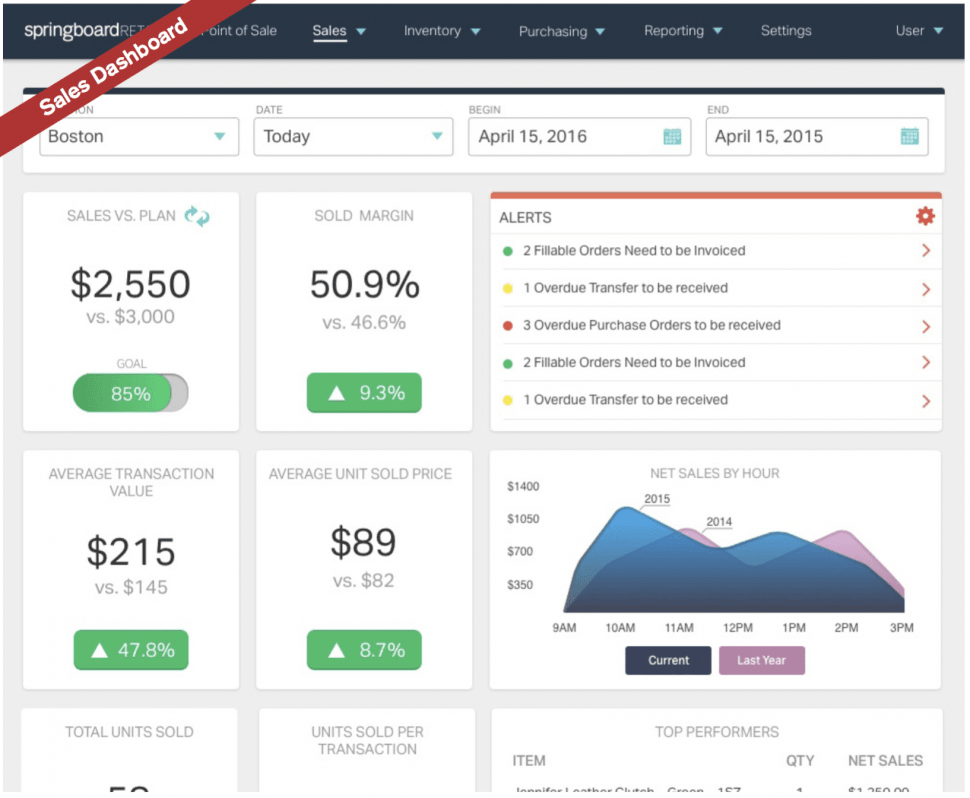
Sales dashboard screenshot in Springboard Retail
Common Features of Auto Parts Store Software
In addition to core business functions, auto parts retailers should evaluate the following functions to meet their unique requirements:
Part lookup by vehicle make, model and year | The system should be able to identify any part for any car based on the vehicle’s make, model and year. The catalog should be either on premises and updated frequently or kept in the cloud by a catalog provider. In addition to finding original equipment manufacturer (OEM) parts, the system should be able to recommend substitute parts. |
Integration with parts and labor catalogs | The system should be able to integrate with parts suppliers’ online catalogs for both OEM and aftermarket parts. Look for compliance with Automotive Aftermarket Industry Association (AAIA) iSHOP as well as integration with major parts vendors. |
Multiple location inventory query | The POS system and the inventory system should be able to see inventory levels at all locations in order to fill a customer’s order. It should check whether the part is available locally. It should also be able to place parts “on hold” for local pick, or trigger a process to transfer the part to the store of the customer’s choosing. Advanced systems will support shipping directly to the customer after payment. |
Seasonal order levels | The system should recommend or order seasonal merchandise; for example, tire chains and windshield scrapers in the winter and automobile detailing kits in the summer. |
Special order tracking | If a customer requires a part that is not in stock, the system needs to locate the part from a supplier and place a special order. The system should notify the customer (or at least a clerk) when the part comes in. |
Lot pricing/em> | Many items sold in an auto parts store, such as oil, cleaners and grease, are sold in lots to repair shops and car dealers. The system should assign the lot pricing and correctly decrease inventory. |
Kit and assembly pricing | Car parts can be combined into kits or assemblies. The system should correctly decrease the individual parts if a kit or assembly is sold. |
Benefits of Adopting Auto Parts Store Software
A properly implemented auto part solution helps retailers. Without the software, managing thousands of different auto parts becomes challenging and further increases chances of human error, which will have a detrimental effect on the store’s image. Auto store platforms prevent these instances of manual errors, reduce overhead tasks and improve business processes by making them time- and cost-effective.
The primary benefits that can be attained by using these solutions are:
Improved point of sale transactions: These solutions help improve the checkout process for both employees and customers by reducing the wait time, automatically managing cash books, tracking stocks and running promotional campaigns. With automated billing and real-time inventory status updates, human errors can be reduced significantly, or even, eliminated completely. In addition, these solutions help facilitate credit card transactions and digital wallet payments.
Streamline inventory management: Every store owner aims to maintain optimum inventory levels because high inventory means incurring additional cost while low inventory means risking stock outs. Advanced solutions provide real-time inventory updates to track stock levels and receive alerts. The reporting feature in auto part software summarizes the overall business and product-based performance metrics to help business owners make timely decisions. With inventory levels optimized, businesses can accomplish better cash flow, prevent stock shortages and manage multiple suppliers.
Personalize customer experience: Auto parts store solutions provide customer relationship management (CRM) modules to automotive retailers. These modules help them customize the client experience, engage customers and run promotional campaigns. Advanced systems can send personalized emails and text messages targeting specific customers based on location, age, gender and other demographics. Moreover, sharing promotional campaigns with clients on occasions, such as their birthdays, anniversaries and festivals, engages clients and helps increase sales. With a centralized database, auto store owners can identify client metrics such as active buyers, inactive buyers, last purchase and the average amount of purchase.
Cost-efficient operations: These solutions enable auto store owners to automate manual data entry, send emails, track inventory, generate bills and manage payments. The barcoding scanning feature facilitates swift checkout for thousands of products, a process that is quite challenging if done manually. The software helps store operators reduce labor costs and utilize them in more important areas.
What Type of Buyer Are You?
Local or single store: Single-store retailers look for a basic POS solution to handle complex retail transactions, improve customer service and manage credit card transactions. Inventory tracking functionality is a value addition to these stores. The platforms in an auto parts store management software also provide basic CRM and accounting functionalities to ease the store operator’s responsibilities.
Multi-store or regional store: Multi-location stores face specific challenges and seek solutions that can address their multi-location and multiple staff requirements. Inventory management is a requisite feature for these businesses as their stores and warehouses are usually located at different places. Automated email and text-sharing capabilities are needed to run promotional campaigns and engage clients. POS platforms to reduce check-outs are also common requirements in these stores.