


Best Fleet Management Software of 2026
Updated January 14, 2026 at 5:46 AM


Talk with us for a free 15-min consultation
Expert advisors like Jacqueline, who have helped 1,000+ companies, can find the right software for your needs.
- All Software
- Software Advice FrontRunners
- Popular Comparisons
- Buyer's Guide
- Frequently Asked Questions
Fleet management software helps businesses efficiently track vehicles, schedule maintenance, and manage dispatch for mobile assets such as cars, trucks, and heavy equipment. With over 300 products available each tailored to different fleet sizes, industries, and operational needs—finding the right solution can be challenging. To simplify your search, I worked with our fleet management software advisors to compile a list of top-recommended productsi and fleet management software FrontRunners based on user reviews. For more details, read my Fleet Management software buyer’s guide.
Fleet Management Software
Sort by
Reviews: Sorts listings by the number of user reviews we have published, greatest to least.
Average Rating: Sorts listings by overall star rating based on user reviews, highest to lowest.
Alphabetically (A-Z): Sorts listings by product name from A to Z.

AUTOsist is a cloud-based fleet maintenance management solution for businesses of all sizes and types. Key features include main...Read more about AUTOsist


AUTOsist's Best Rated Features
See All
AUTOsist's Worst Rated Features
See All

GPS Insight is a web-based solution that transforms the way fleet and field service teams achieve operational efficiency and dri...Read more about GPS Insight


GPS Insight's Best Rated Features
See All
GPS Insight's Worst Rated Features
See All

Azuga Fleet offers a comprehensive fleet tracking system that combines GPS, dash-mounted cameras, vehicle diagnostics, and drive...Read more about Azuga Fleet


Azuga Fleet's Best Rated Features
See All
Azuga Fleet's Worst Rated Features
See All

Geotab is a web-based fleet management solution that is transforming the transportation and logistics industries. From initial a...Read more about Geotab
Geotab's Best Rated Features
See All
Geotab's Worst Rated Features
See All

Samsara is designed to optimize fleet operations and promote business growth by providing real-time visibility and insights into...Read more about Samsara


Samsara's Best Rated Features
See All
Samsara's Worst Rated Features
See All
Software Advice FrontRunners 2026

(878)

(259)

(239)

(210)

(355)

(1685)

(65)

(142)

(239)

(68)
Best for Mobile app
Samsara

- Key FeaturesSamsara's scoreCategory average
GPS
4.674.52 category average
Real-Time Monitoring
4.634.60 category average
Vehicle Tracking
4.714.68 category average
- Screenshots


Best for Customer Satisfaction

One Step GPS

- Key FeaturesOne Step GPS's scoreCategory average
GPS
4.944.52 category average
Real-Time Monitoring
4.734.60 category average
Vehicle Tracking
4.834.68 category average
- Screenshots


Best for User Interface

OptimoRoute

- Key FeaturesOptimoRoute's scoreCategory average
GPS
4.524.52 category average
Real-Time Monitoring
4.754.60 category average
- Screenshots


Best for Usability

ClearPathGPS

- Key FeaturesClearPathGPS's scoreCategory average
GPS
4.864.52 category average
Real-Time Monitoring
4.884.60 category average
Vehicle Tracking
4.924.68 category average
- Screenshots


Most Rated for SMBs

Zonar

- Key FeaturesZonar 's scoreCategory average
GPS
4.664.52 category average
Real-Time Monitoring
4.834.60 category average
Vehicle Tracking
4.914.68 category average
- Screenshots


Most Used By Transportation/Trucking/Railroad

Motive

- Key FeaturesMotive's scoreCategory average
GPS
4.394.52 category average
Real-Time Monitoring
4.424.60 category average
Vehicle Tracking
4.514.68 category average
- Screenshots


Best for Integrations

Truckbase

- Key FeaturesTruckbase's scoreCategory average
GPS
3.04.52 category average
Real-Time Monitoring
4.04.60 category average
- Screenshots


Most Used By Non-Profit Organization Management

Routific

- Key FeaturesRoutific's scoreCategory average
GPS
4.804.52 category average
Real-Time Monitoring
4.894.60 category average
- Screenshots


Most Used By Construction
GPS Insight

- Key FeaturesGPS Insight's scoreCategory average
GPS
4.584.52 category average
Real-Time Monitoring
4.294.60 category average
Vehicle Tracking
4.804.68 category average
- Screenshots


Best for Setup onboarding implementation

Momentum IoT

- Key FeaturesMomentum IoT's scoreCategory average
GPS
4.644.52 category average
Real-Time Monitoring
4.684.60 category average
Vehicle Tracking
4.784.68 category average
- Screenshots


Azuga Fleet

- Key FeaturesAzuga Fleet's scoreCategory average
GPS
4.474.52 category average
Real-Time Monitoring
4.454.60 category average
Vehicle Tracking
4.534.68 category average
- Screenshots


AUTOsist

- Key FeaturesAUTOsist's scoreCategory average
GPS
5.04.52 category average
Real-Time Monitoring
5.04.60 category average
- Screenshots


ISAAC

- Key FeaturesISAAC's scoreCategory average
GPS
4.524.52 category average
Real-Time Monitoring
4.474.60 category average
Vehicle Tracking
4.634.68 category average
- Screenshots


eLogii

- Key FeatureseLogii's scoreCategory average
GPS
4.314.52 category average
Real-Time Monitoring
4.504.60 category average
- Screenshots

MIR-RT

- Key FeaturesMIR-RT's scoreCategory average
GPS
4.704.52 category average
Real-Time Monitoring
4.754.60 category average
- Screenshots
Methodology
The research for the best Fleet Management software list was conducted in October 2025. We evaluated data (user reviews and demand signals) from the past 24 months as of the research date. Read the complete methodology.
Popular Fleet Management Comparisons


Buyer's Guide
This detailed guide will help you find and buy the right fleet management software for you and your business.
Last Updated on February 04, 2025Here's what we'll cover:
What you need to know about fleet management software
What is fleet management software?
Essential features of fleet management software
Benefits and competitive advantages of using fleet management software
How to choose the best fleet management software for your business
Software related to fleet management
More resources for your fleet management journey
What you need to know about fleet management software
Fleet management software facilitates vehicle and logistics management for businesses. Last year, we spoke with over 1,700 software buyers, finding that 66% prioritize dispatch and scheduling while 48% focus on route planning and optimization. [1] This shows a high demand for features that improve efficiency and flexibility in fleet operations, especially in industries, such as transportation, delivery services, and logistics where efficient scheduling and route optimization are crucial to manage operating costs and meet customer delivery expectations.
To give you an idea about the fleet management market, we have 479 products on our site and have gathered more than 2,800 verified user reviews in the past year. [2] This extensive data pool means access to numerous software options tailored to meet diverse operational needs, from small businesses to large enterprises, for decision-makers in the transportation and logistics sectors.
Pricing for fleet management software varies based on feature depth and scalability. Entry-level plans start at $128, mid-tier plans at $512, and high-end solutions can cost up to $856. [3] Understanding these price points helps buyers budget accordingly and choose a plan that best fits their operational scale and feature requirements.
First-time fleet management software buyers must select a system that complements their operational needs. These key considerations include vehicle tracking, dispatch management, GPS functionality, inspection management, and route optimization. When assessing these factors, buyers should reach out to vendors and ask the questions that can help them gauge the right software, such as:
How effectively does the software track fleet vehicles in real time?
What features are available for dispatch management to ensure efficient scheduling?
Does the GPS functionality offer precise and timely route information?
How comprehensive is the inspection management, and does it integrate with maintenance schedules?
Can the software optimize routes to reduce operational costs and enhance delivery times?
Selecting the right fleet management software from hundreds of options can be challenging. This guide simplifies your decision by detailing key features and providing step-by-step selection advice. Benefit from the expertise of our advisor, Ian Oehlke, who has guided many buyers through the process over seven years, ensuring you find the perfect match for your needs. Reach out to schedule a consultation with them or any of our other advisors.
What is fleet management software?
Fleet management software helps businesses track shipments and inventory, optimize delivery routes, and schedule shipments efficiently. It is designed to minimize operational costs, reduce fuel consumption, and shorten delivery times.
Fleet management software offers essential features such as vehicle tracking, dispatch management, GPS navigation, inspection management, and route optimization. These tools improve fleet performance by streamlining route scheduling, improving dispatch accuracy, and ensuring timely deliveries—key benefits that support operational efficiency and cost reduction for businesses relying on transportation and logistics.
A common misconception among buyers, as highlighted by Oehlke, is the confusion between fleet and transportation management systems. "Many come to me thinking they need a solution for managing common carriers and choosing between them. But they really need a robust tool for internal scheduling and dispatching, which is the strength of fleet management systems," says Oehlke. Understanding this difference is key for businesses that own and operate fleets, as the right software ensures efficient management of these essential operations.
Essential features of fleet management software
Choosing the right fleet management software involves understanding its core and common features. Every fleet management software provides core features like vehicle tracking and routing, which are essential for managing fleet movements and logistics. Based on extensive reviews and discussions with software providers, we've identified several common features that complement these core functionalities.
Core fleet management software features
Vehicle tracking: | Essential for monitoring vehicles in real time. It allows you to see their location, speed, and route. Critical to 94% of users, this feature enhances safety and operational control. |
Routing: | Automates the planning of daily routes, optimizes schedules, and ensures accurate directions are provided. |
This involves tracking and managing the upkeep of vehicles and equipment, which is crucial for maintaining high operational standards and preventing costly downtime. |
Common fleet management software features
GPS: | Offers precise navigation and positioning to ensure optimal routing and vehicle use. 84% of users regard it as highly critical for its accuracy and reliability. |
Inspection management: | Facilitates regular checks of vehicles and equipment to ensure they meet safety and operational standards, with 69% of users considering it vital for compliance. |
Route optimization: | Analyzes multiple factors to find the most efficient routes, reducing fuel costs and delivery times, and is valued by 63% of users for its cost-saving potential. |
Dispatch management: | Manages and schedules the deployment of personnel and resources effectively, crucial for maintaining service levels and operational readiness. |
Driver management: | Tracks driver qualifications and activities, ensuring compliance with regulations and enhancing safety measures. |
Employee management: | Oversees schedules and performance, optimizing workforce allocation and enhancing productivity. |
Monitors fuel usage, identifying opportunities to improve efficiency and reduce expenses. | |
Keeps track of parts and supplies, ensuring availability and minimizing delays in operations | |
Reporting and statistics: | Collects and analyzes data to produce actionable insights into fleet performance, aiding strategic decision-making. |
Vehicle Identification Number (VIN) lookup: | It uses a vehicle's unique identifier to access detailed information about its history and specifications. |
Streamlines creating, assigning, and tracking maintenance and repair tasks. | |
Alerts/notifications: | This function sends timely updates and notifications about important events or potential issues, helping to manage operations more effectively. |
After exploring the core and common features, it's essential to further refine your understanding by differentiating between features that buyers often request and those truly critical for operational success.
Buyers usually request features like dispatch and scheduling, but key insights reveal that features like GPS tracking and route optimization are often more crucial for operational success. Oehlke elaborates on a common oversight, saying, "While many seek scheduling and dispatching tools, they often overlook the need for integrated GPS tracking, which not every dispatch system offers. It's crucial to ensure that the software matches both these needs, as GPS functionality is vital for comprehensive fleet management."
The chart below clearly shows this difference, helping you focus on what will actually improve your fleet management capabilities. Review to ensure your final software choice aligns closely with these critical features.

Benefits and competitive advantages of using fleet management software
Oehlke has observed from his extensive conversations with software buyers that one of the most significant advantages of adopting fleet management software is its ability to support business expansion and operational scaling. He explains, "I have recently spoken to a small company that had been managing with a single dispatcher manually. As they expand, they’re adding more dispatchers due to increased load volume. A structured platform to manage these workflows becomes essential to ensure new staff is set up for success and the business can handle the growing workload."
In addition to these operational improvements, our analysis of more than 500 user reviews over the past year highlights several other significant benefits of fleet management software: [2]
Enhanced operational efficiency: Fleet management software simplifies complex logistics operations, allowing for real-time management and coordination of vehicles. Users appreciate how this leads to smoother operations and reduces manual scheduling and tracking time.
Improved navigation and route efficiency: Users benefit from advanced GPS navigation that directs drivers accurately and adjusts routes in real time to avoid delays. This precision significantly cuts down travel times and fuel costs.
Comprehensive asset management: This software helps businesses extend the lifespan of their vehicles and equipment by keeping a detailed and accessible record of all fleet assets. It also improves maintenance scheduling and usage tracking.
Seamless system integration: Integrating fleet management software with other business systems enhances data accuracy and reduces administrative overhead. Users report that this integration supports better decision-making across their operations.
Optimized route planning: Sophisticated algorithms enable businesses to minimize mileage and fuel usage, lowering operating costs and boosting profitability. This tool is highly valued for its ability to enhance logistical efficiency.
How to choose the best fleet management software for your business
1. Define your requirements
Understanding and identifying your specific requirements is crucial when choosing fleet management software because it ensures your selected solution aligns perfectly with your operational needs. This clarity helps prevent overspending on unnecessary features and focuses your search on products that benefit your fleet operations.
Identify your operational scope
Consider the types of vehicles you manage, their usage patterns, and the geographic areas they cover. Our data reveals that the trucking and delivery services industries are the primary users of fleet management software, accounting for 26% and 15%, respectively. [1] Insights from our discussions with over 1,700 buyers show that 52% of businesses using fleet management software manage fleets of up to 9 vehicles. [1] Understanding these metrics helps tailor your search to solutions that cater to your operational scale and industry needs.
Gauge the cost as per your needs
Most fleet management software uses subscription-based pricing, which varies depending on the depth of features and scalability. Entry-level plans typically start at $128, mid-tier plans at $512, and high-end solutions can reach up to $856. [3]
When evaluating these options, it's essential to consider the upfront and recurring costs. Upfront costs consist of initial expenses to set up and implement the software. In contrast, recurring costs are ongoing expenses for maintaining and operating the software, such as monthly or annual subscription fees. Knowing these costs will help you assess the total cost of ownership and ensure that the software fits within your budget over the long term.
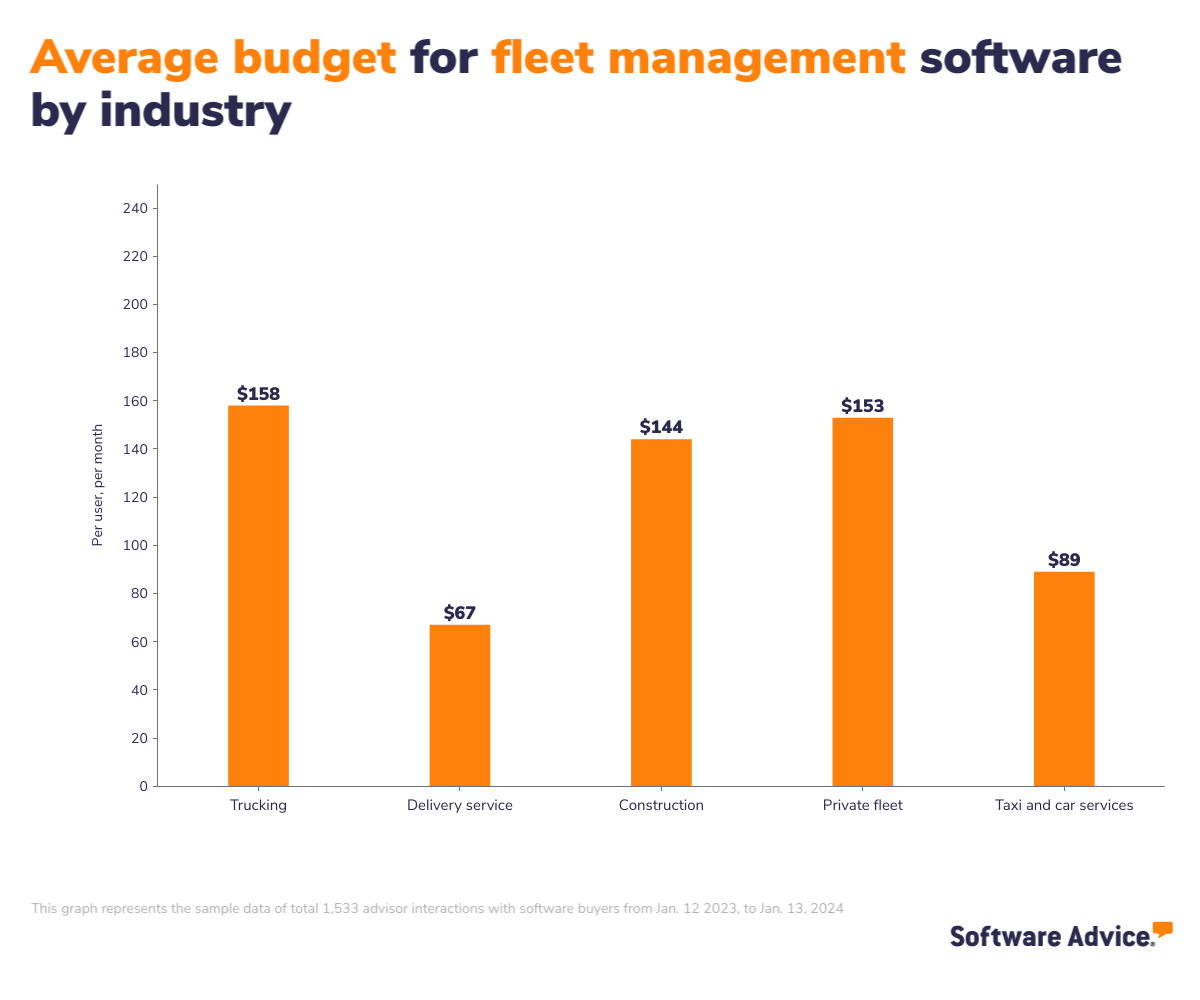
Similarly, understanding industry-specific costs is crucial for setting realistic budget expectations when selecting fleet management software. Different sectors such as trucking, delivery services, construction, private fleet operations, and taxi and car services may require varied financial commitments due to their unique operational demands.
The image below shows the average budget for fleet management software in various industries, giving you a better idea of potential costs. This can help you match your budget expectations with industry standards and maximize your investment.
Know all the possible drawbacks
Despite fleet management software's significant advantages, certain drawbacks may hinder your operations. Our analysis of more than 500 reviews from buyers who have substantial experience with these systems over the past year highlights several common issues, including contract complications, challenges with logging and mileage tracking, limited phone support, unexpected software changes, and difficulties in invoice tracking.
These issues can disrupt the smooth functioning of fleet operations if not addressed. Here are some ways to mitigate these challenges:
Work with providers to include provisions allowing adjustments or cancellations without severe penalties.
Choose systems that offer multiple support channels, including phone, email, and live chat, to ensure comprehensive and accessible support.
Check for software offering 24/7 phone support and online troubleshooting.
Invest in software with customizable dashboards and features catering to your tracking and logging needs.
Engage with user communities and subscribe to update notifications to effectively prepare for and adapt to software changes.
Utilize software with integrated AI to enhance invoice and mileage tracking accuracy, reducing manual data entry and errors.
Evaluate integration capabilities
When selecting fleet management software, ensuring smooth integration with existing systems is as crucial as the software's core functionality.
From discussions with over 1,700 software users last year, 65% preferred an integrated suite—software that combines multiple needed functions into a single, cohesive platform. [1] This preference underscores the importance of a unified solution that can streamline various operational processes without needing multiple separate tools.
Moreover, 87% of users preferred web-based fleet management solutions. [1] This trend highlights the growing demand for software accessible from anywhere and compatible with various devices, enhancing the flexibility and responsiveness of fleet operations.
As businesses strive to integrate their fleet management systems with other crucial business software, they often encounter specific challenges. Oehlke provides insight into one such critical area, noting, "Many fleet management systems include invoicing capabilities and must integrate seamlessly with accounting programs to ensure financial data flows directly into the general ledger. This integration is essential for accurate financial tracking and streamlining the management of invoicing processes."
Understanding these integration needs is crucial for businesses to select software that effectively enhances their operational workflows and adheres to their technological and strategic requirements.
Ensure regulatory compliance
Ensuring your fleet management software complies with industry regulations is essential for legal and operational integrity. Compliance requirements can vary by location and operations, often involving vehicle safety, emissions controls, driver hours, and maintenance record-keeping.
While discussing compliance, it's also important to address common misconceptions about the capabilities of fleet management software, especially regarding driver certifications and licensing. Oehlke clarifies, "Many expect fleet management software to handle driver certifications, licensing, and training, but these functions are typically managed by learning management systems designed for tracking compliance." Understanding this ensures you choose software that meets your compliance needs and fits your fleet’s operational requirements.
2. Make a shortlist of fleet management software
Creating a shortlist of fleet management software is essential when facing numerous options. This focused approach ensures you spend your time evaluating software that aligns with your business needs and operational goals, streamlining your selection process.
Get expert help from an advisor
Finding the right fleet management software can be overwhelming. Our advisors at Software Advice, such as Ian Oehlke, specialize in helping businesses navigate the vast market. With their expertise, they offer 1:1 personalized consultations to identify software that fits your needs and budget quickly. You can easily start a chat online or schedule a call to begin narrowing down your choices effectively.
Explore our list of fleet management FrontRunners
Before you speak with an advisor, you might want to explore your options independently to come to the consultation with informed questions. Our FrontRunners report is an excellent place to start. This list features only the highest-rated fleet management software based on user feedback and usability. To appear on this list, a product must:
Accumulate at least 20 unique user reviews over the past 24 months.
Demonstrate essential functionality, as evidenced by publicly available sources like the vendor’s website.
Include all core features, such as vehicle tracking, routing, maintenance management, and the most common features.
Check out our full methodology description for more details on compiling the report.
3. Pick your best option
Choosing the best fleet management software is more than features and pricing—it's about finding a solution that perfectly aligns with your business's specific needs and operational workflow. Here's how to ensure that your final choice is the most suitable for your fleet's requirements.
Prepare for vendor demos
Vendor demos are a vital opportunity to see fleet management software in action. To get the most out of these demonstrations:
List specific functionalities you want to see, particularly those unique to your fleet operations, such as real-time tracking or advanced route optimization.
Ensure that all decision-makers, especially those who use or interact with the software daily, are present during the demo to provide their perspectives.
Present real-world scenarios your fleet encounters and ask the vendor to demonstrate how their software would handle these situations.
Assess efficiency and functionality
Our analysis of user pain points for fleet management software over the past year reveals that 45% of users cite efficiency and 29% highlight functionality sufficiency as crucial concerns, making these aspects critical to assess when picking the best option [1]:
Efficiency evaluation: Explore how the software automates complex processes like route optimization or integrates seamlessly with other operational tools to save time and reduce errors.
Functionality depth: Ensure the software comprehensively covers crucial operations, such as detailed compliance tracking for regulatory requirements or advanced analytics for fleet performance monitoring.
Evaluate long-term adaptability
Choosing fleet management software that adapts to your evolving needs is crucial. Essential factors to consider include scalability for handling more complex operations as your fleet grows, modularity to add new features as needs evolve, and technological flexibility to integrate advancements like IoT and autonomous vehicles. These elements are vital for sustaining operational efficiency and compliance over time.
One of the unique capabilities that set fleet management software apart, as Oehlke points out, is its sophisticated route optimization tools designed specifically for commercial vehicles. Unlike standard navigation systems, fleet management software provides route planning that considers the specific needs of large commercial vehicles. "These tools are not just about navigating like a simple Google Maps system; they take into account the dimensions and restrictions of commercial vehicles, ensuring routes are optimal for things like fuel efficiency, toll avoidance, and legal compliance with road use," explains Oehlke. This attention to detail in route planning is crucial for fleets to maintain efficiency and cost-effectiveness as they scale up.
This focus on specialized route optimization highlights the importance of selecting software that meets current operational needs and evolves with technological advancements and industry demands.
4. Make the most of your fleet management software
Once you've selected and purchased your fleet management software, the next step is implementation and maximizing its true potential. Whether you're transitioning from another system or adopting digital management for the first time, focus on these considerations to optimize your investment:
Detailed training programs: Implement comprehensive training sessions for all users, from drivers to fleet managers. Ensure that everyone understands how to use the software's features effectively, focusing on modules most relevant to their roles.
Data migration: Carefully plan the migration of existing data into the new system. This may involve transferring vehicle information, maintenance records, and driver data. Ensure data integrity is maintained during the transition and consider employing a phased approach to reduce operational disruptions.
Role-specific customization: To improve efficiency and user adoption, customize user interfaces and functionalities to meet the specific needs of different roles within your organization, such as dispatchers, fleet managers, and maintenance teams.
Proactive maintenance scheduling: Use the software’s features to set up proactive maintenance alerts based on vehicle usage patterns and historical data. This can help prevent breakdowns and extend vehicle life.
Software related to fleet management
As you explore options for the ideal fleet management software, you might encounter various related software types that perform similar functions or could be integrated with your fleet management system. These solutions can enhance your operations by focusing on specific fleet and transportation management aspects.
Equipment maintenance software: Helps manage the upkeep and repair of equipment, ensuring operational readiness and extending asset life.
Fleet maintenance software: Specialized software designed to streamline the maintenance of vehicles, including scheduling repairs and tracking expenses.
Maintenance management software: Provides a comprehensive toolset for managing all maintenance activities, improving reliability, and reducing operational downtime.
Towing software: Tailored for businesses that operate towing services, offering features like dispatching, impound lot management and invoicing.
Transportation dispatch software: Optimizes the scheduling and dispatch of vehicles and drivers, enhancing communication and efficiency in transportation operations.
Transportation management software: Facilitates the planning and execution of the physical movement of goods, optimizing supply chain operations.
Trucking software: Designed specifically for the trucking industry, this software supports freight management, dispatch, compliance, and tracking.
More resources for your fleet management journey
About our contributors
Author
Shubham Gupta is a writer at Software Advice, specializing in project management. His focus is to guide project managers from planning to execution and beyond. His expertise also spans construction, manufacturing, and other related topics.
Shubham’s research and writing for Software Advice is informed by nearly 200,000 authentic user reviews and more than 10,000 interactions between Software Advice software advisors and project management software buyers. Shubham also regularly speaks to project managers and PMO leaders so he can provide the most up-to-date and helpful information to small and midsize businesses purchasing software or services.
Outside work, Shubham likes to explore the depth of Urdu poetry and enjoys his time with his dog.
Editor
Parul Sharma is a content editor at Software Advice with expertise in curating content for various niches, including SaaS, digital marketing, and search engine optimization. With over half a decade of experience in content writing and editing, Parul has the expertise to simplify complex terms into engaging, valuable content for targeted audiences. She completed her graduation and post-graduation in English literature from Delhi University and was awarded the Dr. Asha Sahni Memorial Award for being the highest scorer in her graduating class.
Parul has contributed to the news, lifestyle, education, and health verticle of DNA India, India’s premier media channel. Outside of work, she can be found curating healthy recipes, coloring in mandala books, and spending quality time with her family.
Advisor
Ian Oehlke is a senior software advisor. He joined Software Advice in 2018 as a software advisor. He is based in Austin, Texas.
Ian works directly with small business leaders to connect them with best fit software providers. He assesses the technology needs of small businesses seeking fleet management software through one-to-one conversations and provides a short list of potential matches. His favorite part of being a software advisor is helping those who are struggling to make sense of what software market to be looking into.
Ian holds a bachelor’s degree in business management.
Sources
Software Advice advisor call notes: Findings are based on data from telephonic conversations that Software Advice’s advisor team had with small-to-midsize businesses seeking fleet management tools. For this report, we analyzed phone interactions from October 11, 2023, to October 11, 2024. Read the complete methodology.
Software Advice reviews data: Software Advice reviews are collected from verified users for individual software products. For this report, we analyzed reviews from October 2023 to October 2024. Read the complete methodology.
Software Advice software pricing data: Only products with publicly available pricing information and qualified software products within the category, as of May 2024, are included in the pricing analysis.
Fleet Management FAQs
- What is fleet management software?
Fleet management software helps businesses monitor and improve their vehicle operations. It includes vehicle tracking, maintenance scheduling, fuel management, and route optimization.
- What is the best fleet management software to choose from?
According to our analysis of products with high market demand and reviews, AUTOsist had the highest overall rating from verified reviewers on Software Advice.
- How much does fleet management software cost?
Fleet management software usually uses a subscription model. Basic plans start at $128, mid-level plans at $512, and premium options can go up to $856. Prices may vary depending on the features and scalability needed.
- How do you manage fleet maintenance?
Managing fleet maintenance effectively requires organized check scheduling, real-time monitoring of vehicle conditions, and quick response to repair needs. Fleet maintenance software can simplify these tasks by automating schedules, tracking repairs, and keeping detailed vehicle histories.
- How do you create a fleet management plan?
A fleet management plan should outline your goals, evaluate fleet requirements, and establish rules for buying, maintaining, and disposing of vehicles. It must also include strategies for managing costs, training drivers for safety, and following regulations. Regularly reviewing and updating the plan as your fleet and business change is essential for continued success.