


Best Medical Inventory software of 2026

- Popular Comparisons
- Buyers Guide
Compare Products
Showing 1 - 25 of 70 products
Compare Products
Sort by
Reviews: Sorts listings by the number of user reviews we have published, greatest to least.
Average Rating: Sorts listings by overall star rating based on user reviews, highest to lowest.
Alphabetically (A-Z): Sorts listings by product name from A to Z.

Sortly is an inventory management software designed to help businesses track and organize physical inventory, supplies, material...Read more about Sortly


Sortly's Best Rated Features
See All
Sortly's Worst Rated Features
See All

NetSuite is an AI-powered cloud-based business management suite that incorporates ERP, financial management, CRM and eCommerce f...Read more about NetSuite


NetSuite's Best Rated Features
See All
NetSuite's Worst Rated Features
See All

Timly is a cloud-based inventory management solution designed for small and large businesses. The tool digitizes inventory proce...Read more about Timly


Timly's Best Rated Features
See All
Timly's Worst Rated Features
See All

eTurns TrackStock is a modern VMI app distributors can use to replenish their customers' stockroom and truck inventory in an opt...Read more about eTurns

eTurns's Best Rated Features
See All
eTurns's Worst Rated Features
See All

CyberStockroom is a cloud-based inventory management solution targeting small, growing businesses. Key features include applicat...Read more about CyberStockroom


Tecsys’ Elite™ provides a series of cloud-based supply chain management solutions suitable for midsize to large distribution com...Read more about Tecsys Elite


The AccuShelf Inventory Management System standardizes workflows, enhances patient safety, saves time, & supports 340B complianc...Read more about AccuShelf


Netstock is a cloud-based supply and demand planning platform that optimizes inventory management. It forecasts demand, minimize...Read more about Netstock

Netstock's Best Rated Features
See All
Netstock's Worst Rated Features
See All

EZO is a cloud-based asset management software designed to help organizations track, manage, and maintain physical assets from a...Read more about EZO


EZO's Best Rated Features
See All
EZO's Worst Rated Features
See All

Your Guiding Light in Healthcare Procurement - Hybrent Embark on a journey of streamlined healthcare procurement with Hybrent...Read more about Hybrent


Hybrent's Best Rated Features
See All
Hybrent's Worst Rated Features
See All

FlexScanMD is the medical industry's premier, cloud-based, inventory management system that works for all medical specialties, o...Read more about FlexScanMD


FlexScanMD's Best Rated Features
See All
FlexScanMD's Worst Rated Features
See All

Bellwether Purchasing Software is an easy-to-use, cloud-based purchasing and inventory management solution ideal for SMB custome...Read more about Bellwether Purchasing Software

Bellwether Purchasing Software's Best Rated Features
See All
Bellwether Purchasing Software's Worst Rated Features
See All

Looking for an inventory and order management system for your small or medium-sized business? inFlow is used in over 90 countrie...Read more about inFlow Inventory


inFlow Inventory's Best Rated Features
See All
inFlow Inventory's Worst Rated Features
See All

Flowtrac is a cloud-based and on-premises warehouse management solution that helps companies manage their Inventory, Assets, War...Read more about Flowtrac


Flowtrac's Best Rated Features
See All
Flowtrac's Worst Rated Features
See All

GET FREE TRIAL FOR 3 MONTHS. Think Aisle is a cloud-based platform designed to help businesses in the hospital, fashion, industr...Read more about Think Aisle

Think Aisle's Best Rated Features
See All
Think Aisle's Worst Rated Features
See All

Pulse's Buy & Bill Module streamlines the management of injectables, infusions, vaccines, and more. Clinics using Pulse see a re...Read more about Pulse
Pulse's Best Rated Features
See All
Pulse's Worst Rated Features
See All

Datapel is a cloud-based warehouse management system (WMS) designed to optimize warehouse operations. It offers real-time tools ...Read more about Datapel
Datapel's Best Rated Features
See All
Datapel's Worst Rated Features
See All

MedSupply Software is an inventory management tool for the healthcare industry, which offers tools for tracking inventory such a...Read more about MedSupply

InventoryCloud allows users to easily transition from error-prone manual processes and antiquated systems to a modern, feature-r...Read more about Wasp Inventory
Wasp Inventory's Best Rated Features
See All
Wasp Inventory's Worst Rated Features
See All

Built for growing product-selling businesses using QuickBooks, Acctivate is a premium inventory management & multi-channel order...Read more about Acctivate Inventory Management
Acctivate Inventory Management's Best Rated Features
See All
Acctivate Inventory Management's Worst Rated Features
See All

Fishbowl’s powerful inventory management software is designed to help businesses streamline operations, improve accuracy, and sc...Read more about Fishbowl
Fishbowl's Best Rated Features
See All
Fishbowl's Worst Rated Features
See All

ProActive Inventory Manager by Accuware is a cloud-based inventory management solution that offers a configurable tool that can ...Read more about ProActive Medical Inventory
No reviews yet

Liberty is a pharmacy management solution that offers an integrated workflow, inventory management, task management and document...Read more about Liberty

DocVilla is a HIPAA-compliant Cloud-based software for medical practices. DocVilla offers integrated EHR (Electronic Health Reco...Read more about DocVilla
DocVilla's Best Rated Features
See All
DocVilla's Worst Rated Features
See All

Order Time Inventory is an inventory control and order management solution. It is cloud-based and integrates with QuickBooks Ent...Read more about Order Time Inventory

Order Time Inventory's Best Rated Features
See All
Order Time Inventory's Worst Rated Features
See All
Popular Comparisons


Buyers Guide
This detailed guide will help you find and buy the right medical inventory software for you and your business.
Last Updated on January 27, 2025Medical inventory software is tailored to track healthcare specific products such as medications, surgical supplies, wheelchairs and more. Inventory tracked can range from pharmaceuticals to lab kits to MRI machines. The program can track medicine expiration dates, the maintenance schedule for equipment, store Diagnostic and Statistical Manual of Mental Disorders (DSM) information and manage the stock levels and location of individual items.
What Is Medical Inventory Software?
Medical inventory software is used to track medical supplies and prescription drugs within a single practice or an entire hospital system.
Main features typically include tracking and receiving, dispensing, storage, maintenance and recall of products. Many systems will place replenishment orders, track purchase orders, be configurable to keep your practice HIPAA compliant and integrate to your other business systems.
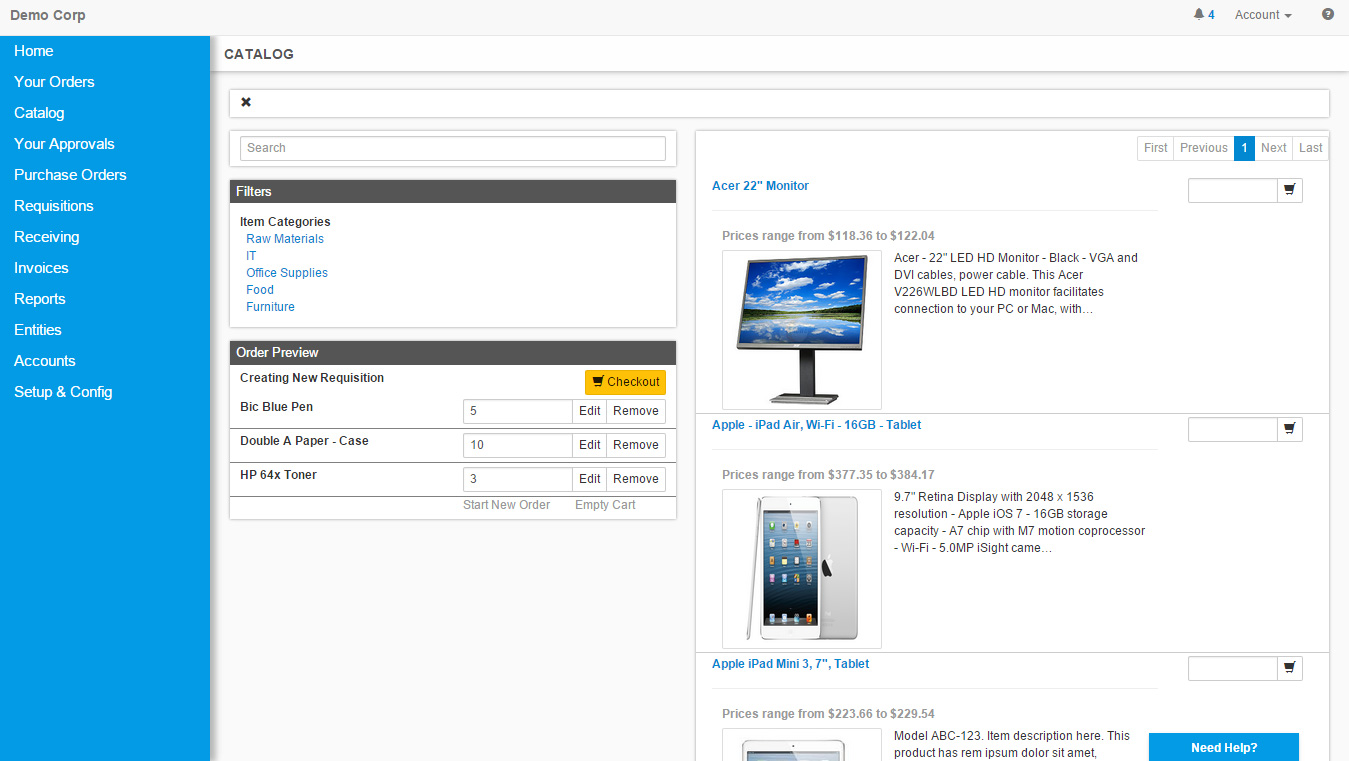
The catalog page in Bellwether (Source)
Benefits of Medical Inventory Software
The general benefits of any medical inventory system are increased operational efficiency, reduced time and labor and improved practice profitability. These benefits stem from different features and impact organizations in different ways.
For example:
Control costs by buying the right amount of the right product at the right time. Reduce overstocks and products expiring before use.
Accurately track drug/item details and location to reduce misuse.
Automatically alert employees to product recalls; the software provides a report of the item's location and details to ensure compliance with recalls.
Manage inventory across the business with improved visibility into stock levels, item details and other pertinent information to make informed decisions.
Cardinal Health reports that one in four operating room doctors and nurses feel that “automated systems free up time to focus on patients and support better outcomes" and 39 percent agree that "automation reduces costs."
Competitive Advantages of Using Medical Inventory Software

Business Sizes Using Medical Inventory Software
This software is used by pharmacies, hospitals and private practices across a variety of specialties—there's no "typical" business size. The requirement to accurately manage inventory in the health industry makes the need for software universal.
For business size, you'll generally fall into one of the following categories:
Single user. The smallest businesses consist of only one owner/employer such as real estate agents, freelancers or independent contractors.
Small business buyer. These are companies with 2 to 100 employees that have no IT department.
Midsize business buyer. These are companies that have 101 to 1,000 employees and a dedicated IT department.
Large business buyer. These are large companies that have more than 1,000 employees and a dedicated IT department.
Common Features of Medical Inventory Software
The range of features offered in medical inventory software varies greatly; it's important to know which features you need before signing a contract with any vendor. Below are what we consider core features of an inventory system.
Item Details | Store expiration dates, warranty information, maintenance/cleaning notifications and other details for drugs, medical supplies and/or machines. Other key features include assigning SKUs, and tracking bin/shelf location, dates received and who received the shipment. |
Reporting | Track stock levels, costs and item use trends. Reports range from “out of the box" (i.e., standardized and designed by the vendor) to fully custom reports to provide clear visuals of the data points in your system. |
Automated Inventory Workflows | Generate purchase orders and approvals automatically. Receive notifications for product replenishment based on a customized threshold. When integrated with your supplier's system, you'll be able to track the shipment of orders placed to know when to expect deliveries. |
Prescription Management | Automate product replenishment based on upcoming prescriptions. Send patient refill reminders. |
Third-Party Integrations | Integrate with your accounting program to further automate purchase order processing and financial planning. Some systems also integrate with IT ticketing systems such as Zendesk, allowing you to submit service requests for equipment. |
How Medical Inventory Software is Priced and Hosted
Pricing models vary greatly from vendor to vendor, but monthly or annual subscriptions are typical.
Vendors with Software-as-a-Service (SaaS) products can charge per user or by the number of times you access the system. Some vendors offer free trials and some don't even require a credit card to start using their product.
Be sure to get a complete and clear breakdown of the pricing, including implementation and ongoing costs. It is ideal to calculate a three-year total cost of ownership; the vendor should be able to provide most of this information.
Hosting Options
Software-as-a-Service (SaaS)
Web-based or SaaS (cloud-based) systems offer several advantages such as lower upfront costs, reduced IT and support costs, remote accessibility and more. Moving to the cloud is the clear trend across all industries; however, rural practices may not have the broadband capability to efficiently run web-based software.
Mobile Apps
Healthcare providers find themselves increasingly on the go and therefore need to access systems from multiple offices, home and mobile devices. If you want to use your medical inventory system on a smart device, we suggest choosing a vendor that has developed a native app for your device.
What is a native app? A native app means it was built specifically for mobile devices, not just optimized to display smaller on your phone. The home screen, navigation and forms are designed for your phone or tablet. An example would be when you open your banking account from the icon on your phone versus when you go to the website on your desktop.
A native app should also be able to store information gathered while offline and then sync the data when WiFi is available.
What Questions Should I Ask Vendors When Evaluating Medical Inventory Products?
Is your product HIPAA compliant?
Not all medical inventory software products provide HIPPA compliance features such as required user permission restrictions and an audit log. HIPAA compliance is complex with myriad requirements, so make sure you and the vendor are clear on expectations.
Check out the HIPAA Journal's compliance checklist for more information.
Are the medical device reports (MDRs) FDA-approved?
As in the above question, it is important to ask the vendor for proof of compliance if your business is a required to provide FDA-approved reports for medical devices.
Read the requirements of FDA-approved reports on their site.
Can I see the software in action?
Always ask the vendor for two demos:
The initial demo is typically performed by your sales agent and will walk you through the user interface and core features.
The second demo should address specific questions you had after the first demo, and include both your IT resource and the vendor's technical resource. Give the vendor a heads up that you will have your technical team with you so they know to invite theirs as well to answer any technical questions, especially related to implementation.
Does this product integrate with my accounting software?
Their answer should include the specific name of your accounting software. While the vendor may be able to build an integration, you don't want to be the guinea pig for a new one.
How many active clients do you have that are a similar size and business type as mine, and could you provide a reference?
Each practice, hospital and pharmacy has varying needs based on complexity and size. It is important to know the vendor supports at least one other client as similar to yours as possible.
Is anything I'm asking for “custom code?"
Ask for a list of each function included in the “out of the box" solution and the ones that are add-ons. Be on the lookout for features you may not need that are being added on. Ask how easy it would be to add additional features to your system in the future.
What is your customer support model?
Each vendor will offer a different customer service model and service-level agreement. Make sure their model matches your needs. For example, do you want a representative available 24/7, or online chat capability?
What are the set-up costs for the software?
Most vendors will price medical inventory software based on a “per user, per month" model, but there are frequently up-front costs that come with implementation.
How likely are we to require tech support in order to set up, implement and/or use the software?
If you have a small or no IT department, it's important to know whether or not you'll require (potentially costly) tech support in order to implement and maintain the software.
What Are Some Drawbacks I Should Watch Out For?
If you are currently using manual methods to track inventory, it's possible you will need to purchase hardware in order to take advantage of features such as barcode scanning.
Not all vendors will offer FDA-approved MDR documentation, such as for material or manufacturing changes. HIPAA compliance is another aspect not offered in all programs and it typically must be customized for your business. Be sure you've identified your requirements before getting final pricing from the vendor as these could be charged as add-ons.
Medical inventory software isn't a cure-all for practices that have problems due to ineffective workflows or business processes. For inventory software to work successfully, you need to make sure that the teams and individuals who will use the software are properly trained and receive ongoing training.
Related Articles
"EHR Security Measures, Explained (Or: How I Learned to Stop Worrying and Love the Software)"
"Best Practices for Avoiding HIPAA Violations in Healthcare"