


Best Succession Planning Software of 2026
Updated January 27, 2025 at 9:57 AM
- Popular Comparisons
- Buyers Guide
Compare Products
Showing 1 - 25 of 84 products
Compare Products
Sort by
Reviews: Sorts listings by the number of user reviews we have published, greatest to least.
Average Rating: Sorts listings by overall star rating based on user reviews, highest to lowest.
Alphabetically (A-Z): Sorts listings by product name from A to Z.

UKG Pro Human Capital Management (HCM) software is a workforce management solution designed to align people strategy with busine...Read more about UKG Pro


UKG Pro's Best Rated Features
See All
UKG Pro's Worst Rated Features
See All

HiBob is a human resources management platform that combines HR, talent management, payroll, and financial planning tools in one...Read more about HiBob

HiBob's Best Rated Features
See All
HiBob's Worst Rated Features
See All

Dayforce is an AI-powered people platform, delivering simplicity at scale with a full-suite HCM solution. Designed as a single, ...Read more about Dayforce HCM

Dayforce HCM's Best Rated Features
See All
Dayforce HCM's Worst Rated Features
See All

Motivosity is an employee recognition and rewards platform designed to enhance engagement, streamline HR processes, and support ...Read more about Motivosity

Motivosity's Best Rated Features
See All
Motivosity's Worst Rated Features
See All

Workzoom is the all-in-one HR, Workforce, Payroll, and Talent solution that consolidates and automates your people management. B...Read more about Workzoom

MentorcliQ is an employee mentoring software designed to help organizations create, manage, and measure mentoring programs. It i...Read more about MentorcliQ
MentorcliQ's Best Rated Features
See All
MentorcliQ's Worst Rated Features
See All

Mitratech Perform is a performance management platform that helps organizations run fair, consistent, and engaging reviews. It s...Read more about Trakstar Perform

PerformYard is an AI-powered employee performance toolkit that streamlines performance reviews, check-ins, goals, continuous fee...Read more about PerformYard
PerformYard's Best Rated Features
See All
PerformYard's Worst Rated Features
See All

Spidergap is a cloud-based 360 degree feedback tool designed for businesses of all sizes. You can use out-of-the-box templates...Read more about Spidergap 360 Feedback

Spidergap 360 Feedback's Best Rated Features
See All
Spidergap 360 Feedback's Worst Rated Features
See All

Together is a cloud-based mentorship management solution that helps users to set up and administer a mentorship program. It help...Read more about Together Mentoring

Together Mentoring's Best Rated Features
See All
Together Mentoring's Worst Rated Features
See All

Workleap Pingboard will help you deliver a better employee experience to drive engagement. From one platform, automate your onbo...Read more about Workleap Pingboard
Workleap Pingboard's Best Rated Features
See All
Workleap Pingboard's Worst Rated Features
See All

Ingentis org.manager is a leading solution for people and organizational analytics, org charts and organizational design trusted...Read more about Ingentis org.manager

Ingentis org.manager's Best Rated Features
See All
Ingentis org.manager's Worst Rated Features
See All

ClayHR is a comprehensive cloud-based human resource management solution that helps mid to large enterprises manage the entire e...Read more about ClayHR


ClayHR's Best Rated Features
See All
ClayHR's Worst Rated Features
See All

StaffCircle is a cloud-based employee performance management, engagement and culture solution that helps businesses in software...Read more about StaffCircle

StaffCircle's Best Rated Features
See All
StaffCircle's Worst Rated Features
See All

ChartHop connects and visualizes people data to empower organizations through insights, alignment, and action. It offers a unifi...Read more about ChartHop
ChartHop's Best Rated Features
See All
ChartHop's Worst Rated Features
See All

Quantum Workplace is the all-in-one HR platform that helps you build better managers, identify top talent, and keep your best pe...Read more about Quantum Workplace

Quantum Workplace's Best Rated Features
See All
Quantum Workplace's Worst Rated Features
See All

Acorn Performance LMS (PLMS) is the dynamic AI-powered platform for Learning and Development (L&D) experiences synchronized to b...Read more about Acorn


Acorn's Best Rated Features
See All
Acorn's Worst Rated Features
See All

Bullseye’s Employee Development Solutions enable organizations to align individual and organizational development needs. The int...Read more about BullseyeEngagement Employee Development Solutions

OrgChart is a cloud-based and on-premise solution designed to help organizations in any industry manage operations for workforce...Read more about OrgChart
OrgChart's Best Rated Features
See All
OrgChart's Worst Rated Features
See All

The most complete, robust and secure all-in-one 360º Human Capital management software on the continent, which covers each of th...Read more about Rankmi
Rankmi's Best Rated Features
See All
Rankmi's Worst Rated Features
See All

Nakisa Workforce Planning (previously HR Suite) is cloud-native software for workforce planning, organizational design, org char...Read more about Nakisa Workforce Planning

Beamery's mission is to put talent transformation at the heart of every business. Our Talent Operating System (TOS) lets compani...Read more about Beamery


AG5 is a cloud-based plug-in-play skills management platform that allows HR, Operations, and Team managers to centralize and org...Read more about AG5 Skills Management Software


Eightfold.ai delivers the Talent Intelligence Platform, an AI-powered solution that empowers enterprises to acquire, engage, and...Read more about Eightfold.ai


Sage People is a human resources information system (HRIS) software. It helps organizations manage their workforce, regardless o...Read more about Sage People

Sage People's Best Rated Features
See All
Sage People's Worst Rated Features
See All
Popular Comparisons


Buyers Guide
This detailed guide will help you find and buy the right succession planning software for you and your business.
Last Updated on January 27, 2025No business wants to lose its best employees. When employees retire or quit, it creates a workflow imbalance, resulting in lower productivity until their replacement is found. While this may not impact large businesses as much, small businesses like yours bear the brunt of it the most.
For that reason, you need to plan ahead to minimize this productivity loss and ensure stability in the structure and processes, despite attrition. You can do this by identifying valuable skill sets or potential in the current workforce to replace outgoing employees.
The process of identifying, nurturing and retaining employees for future roles is known as succession planning.
With the help of a succession planning tool, HR teams can aggregate vital data about employee performance, potential and development. This data can help them make decisions about how to replace outgoing executives and high-value employees.
But it's not always easy to find the right succession planning software on your own. You need a detailed understanding of the software features. Fully realizing the benefits of these features will help you purchase the right software. This guide will help you understand succession planning software, its features and benefits.
Here's what we'll cover:
What Is Succession Planning Software?
Common Features of Succession Planning Software
Benefits of Succession Planning Software
What Is Succession Planning Software?
Succession planning software helps HR managers make decisions about how to replace employees who are retiring or resigning. For business continuity, it's crucial to fill these employment gaps as quickly as possible.
The software helps in the following ways:
Defines the competencies required to undertake the required roles.
Identifies employees who have the potential to fill a given role.
Assesses employees against set criteria.
Trains employees to move into new roles by primarily leveraging the right experiences.
Builds a database that can be used to make future staffing decisions for key roles.
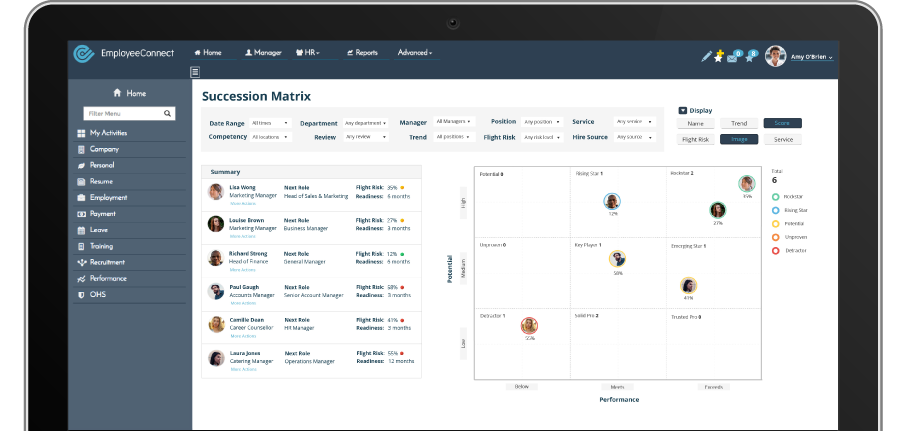
Succession planning in EmployeeConnect (Source)
Common Features of Succession Planning Software
In this section, we cover the key software features that a buyer should be aware of before they purchase a solution. Most small businesses will need some (or all) of these features in their succession planning software:
Competency modelling | Provides a framework of the skills, knowledge, ethics and values that are required for different departments and functional areas. |
Talent pools | Uses a talent database to help users locate the desired and most suitable talent for given roles. The feature lists the employees according to their capabilities and competency levels. |
Goal management | Allows users to create and assign employee goals that are aligned with the larger business objectives. Managers can track the status of employee goals and provide their feedback in real time. |
360-degree feedback | Lets you collect employee performance feedback from peers, supervisors, line managers and other stakeholders, and store it in a centralized database. |
Reporting and analytics | Helps users create employee performance reports based on the 360-degree feedback. These reports can help you identify performance trends, list the issues and make decisions regarding workforce planning. |
Training management | Lets users evaluate employee feedback evaluation reports to identify employees' key strengths and weaknesses. Based on these reports, managers can develop personalized training development plans for their employees. |
What Type of Buyer Are You?
Before you start shortlisting vendor options for succession planning software, you need to understand your buyer type. This will help you analyze your requirements and prioritize software features into "must-have" and "optional" for your business.
This section breaks down the most common buyer types. Here are the two main categories of buyers:
Small and midsize businesses (SMBs): They typically operate with a few resources and employees on tight budgets. Succession planning software can help them better manage their resources and employees, avoid disruptions in the workflow and sustain the business for a longer duration of time. The main features that these buyers need in a succession planning tool are goal management, talent pool and training management.
Large businesses: They operate in a complex hierarchy, with employees spread across different locations. Large businesses significantly benefit from a talented workforce that is keen to take on leadership roles in the future. They need a comprehensive approach to ensure that future leaders have the essential industry expertise. Succession planning software should help their talent climb up the career ladder. The primary features they will need are competency modelling and training management.
Benefits of Succession Planning Software
Here are some of the benefits of using succession planning tools in your business:
Centralized database to store, track employee data: Storing employee data in a central database allows HR managers to view, edit or update employee information easily. It also lets them pull talent metrics from the database for different jobs and filter employees based on location, skills, role and other criteria.
Periodic performance evaluations: Succession planning software allows HR managers to evaluate employees on a regular basis (weekly, monthly or yearly). The feedback helps managers identify the top talent in the organization.
Identification of skill gaps: By mapping employee skills to desired competencies, HR managers can identify employees' key strengths and weaknesses. They can then provide leadership training to the top performers and personalized training or individual development plans for those who lack the desired skills.
Business continuity: Irrespective of their size or industry, all businesses need succession plans to prepare for sudden resignations and terminations. Thirty-five percent of businesses have a structured succession planning process and 34 percent verified that their succession planning was highly effective. The top reasons to implement succession planning in their business are to identify and prepare future leaders (89 percent) and ensure business continuity (72 percent).
Key Considerations
Picture this: You find a succession planning solution that has all the relevant features, but lacks the option for integration. This could hamper your business in the future. Unfortunately, such instances aren't uncommon and require a thorough check before purchasing a solution. Here are some things you should keep in mind:
Support services: Before you start assessing succession planning tools, consider your employees and the type of support (email, phone or chat) they would prefer. In case, a support option isn't available, check if the vendor provides support forums and discussion boards to help employees resolve their queries.
Speed of implementation: The implementation time will depend on the type of software you choose—an integrated system or standalone software. Integrated tools require a significant investment of time and resources compared with standalone ones. Check with the vendor about the time it'll take to implement the tool and train users.
Data transfer services: When migrating from a legacy system, businesses need to transfer the data to the new system. Most vendors include a data transfer option in the software license cost, while others charge extra for it. If data transfer services aren't included, you may need to hire a third party, which would further increase your budget.
Scalability: Choose a tool that is scalable in terms of the number of licenses or users. This will help you prepare for future growth as you will be able to add new users as and when needed. You should also ensure that there aren't any hidden costs or fees before you purchase a solution.