


Best MRM Software of 2026
Updated January 27, 2025 at 9:58 AM
- Popular Comparisons
- Buyers Guide
Compare Products
Showing 1 - 25 of 45 products
Compare Products
Sort by
Reviews: Sorts listings by the number of user reviews we have published, greatest to least.
Average Rating: Sorts listings by overall star rating based on user reviews, highest to lowest.
Alphabetically (A-Z): Sorts listings by product name from A to Z.

Smartsheet is a work execution platform and collaboration tool with a familiar spreadsheet-like interface that helps teams plan,...Read more about Smartsheet


Smartsheet's Best Rated Features
See All
Smartsheet's Worst Rated Features
See All

monday.com is a work and project management platform that helps teams of all sizes plan, prioritize, manage, and execute work ef...Read more about monday.com
monday.com's Best Rated Features
See All
monday.com's Worst Rated Features
See All

Wrike is a cloud-based project management platform for teams of 20+ that is suitable for both large enterprises and SMBs. It sup...Read more about Wrike

Wrike's Best Rated Features
See All
Wrike's Worst Rated Features
See All

Brandfolder is a cloud-based asset management solution that provides various processes to organize, store and retrieve media ass...Read more about Brandfolder

Brandfolder's Best Rated Features
See All
Brandfolder's Worst Rated Features
See All

Narrato is a platform for content marketing teams for content creation, planning, collaboration & project management platform. ...Read more about Narrato Workspace


Narrato Workspace's Best Rated Features
See All
Narrato Workspace's Worst Rated Features
See All

Screendragon is an enterprise work management and orchestrated intelligence platform built for complex marketing and agency oper...Read more about Screendragon
Screendragon's Best Rated Features
See All
Screendragon's Worst Rated Features
See All

Factors.ai is an account intelligence, analytics & attribution platform that helps sales & marketing teams at high-growth B2Bs t...Read more about Factors.ai


Factors.ai's Best Rated Features
See All
Factors.ai's Worst Rated Features
See All

Papirfly is a digital asset management and content creation platform. It helps brands organize their assets and create on-brand ...Read more about Papirfly


Planful for Marketing is a marketing planning solution that helps businesses manage and track marketing goals, campaigns, budget...Read more about Planful for Marketing


SAS Customer Intelligence 360 is a multichannel marketing hub for the modern marketing organization. Offering a suite comprised ...Read more about SAS Customer Intelligence 360


Allocadia Marketing Performance Management is planning, budgeting, and performance measurement software built for revenue-driven...Read more about Allocadia


Uptempo provides enterprise marketing teams with software to manage planning, productivity and performance. Our mission is to he...Read more about Uptempo


Bynder is the industry-leading, cloud-based Digital Asset Management (DAM) platform trusted by 4,000+ global brands including Pu...Read more about Bynder
Bynder's Best Rated Features
See All
Bynder's Worst Rated Features
See All

Ontrack Workflow is a cloud-based digital asset management solution that offers a resource portal, workflow management, brand co...Read more about OnTrack Workflow


CoSchedule's Marketing Suite is a family of agile marketing products that helps you coordinate your process, projects, and teams...Read more about CoSchedule Marketing Suite
CoSchedule Marketing Suite's Best Rated Features
See All
CoSchedule Marketing Suite's Worst Rated Features
See All

Marvia is a distributed marketing automation software. It helps businesses centralize their brand resources and empower their pa...Read more about Marvia
Marvia's Best Rated Features
See All
Marvia's Worst Rated Features
See All

Percolate is a cloud-based content marketing solution for midsize and large companies. Primary features include content manageme...Read more about Percolate

Sprinklr is a cloud-based customer experience management solution designed for businesses of all sizes. It offers social experie...Read more about Sprinklr
Sprinklr's Best Rated Features
See All
Sprinklr's Worst Rated Features
See All

SAP Customer Experience is a cloud-based customer relationship management solution that helps small and mid-size businesses mana...Read more about SAP Customer Experience
SAP Customer Experience's Best Rated Features
See All
SAP Customer Experience's Worst Rated Features
See All

BrandMuscle simplifies and scales digital and physical marketing execution, enabling brands to acquire and retain the best custo...Read more about BrandMuscle
No reviews yet

Filecamp is a cloud-based Digital Asset Management (DAM) software solution that helps companies organize and share their digital...Read more about Filecamp
Filecamp's Best Rated Features
See All
Filecamp's Worst Rated Features
See All

Dreamdata is a B2B Activation & Attribution Platform that provides the most complete B2B customer journey map anywhere. This em...Read more about Dreamdata

Dreamdata's Best Rated Features
See All
Dreamdata's Worst Rated Features
See All

IntelligenceBank is a cloud-based Digital Asset Management (DAM) solution that helps businesses to streamline marketing processe...Read more about IntelligenceBank
IntelligenceBank's Best Rated Features
See All
IntelligenceBank's Worst Rated Features
See All

Ethos is a cloud-based platform that leverages artificial intelligence (AI) technology to help organizations manage brands. Desi...Read more about Ethos
Ethos's Best Rated Features
See All
Ethos's Worst Rated Features
See All

Zoho Sprints is a cloud-based product roadmap solution for businesses of all sizes. The solution is designed to be used by agile...Read more about Zoho Sprints
Zoho Sprints's Best Rated Features
See All
Zoho Sprints's Worst Rated Features
See All
Popular Comparisons


Buyers Guide
This detailed guide will help you find and buy the right marketing resource management (mrm) software for you and your business.
Last Updated on January 27, 2025These days, marketers are faced with a growing number of digital channels they can use to engage with customers at a much quicker pace than ever before.
Because of this, there are more moving parts to track over shorter periods of time when organizations are planning and measuring marketing campaigns. To keep pace in today’s digital environment, marketers must use their internal resources wisely.
This is where marketing resource management (MRM) comes in. MRM acts as the "administrative backbone" for day-to-day marketing operations by helping companies track and use their marketing resources more efficiently.
This guide will help you learn more about MRM software systems so you can make the right purchase decision for your business.
Here's what we'll cover:
What Is Marketing Resource Management Software?
Common Marketing Resource Management Software Functionality
Benefits of Marketing Resource Management Software
What Is Marketing Resource Management Software?
In a nutshell, MRM software helps users manage the back-end process of marketing. It allows companies to more efficiently plan, manage and execute on marketing programs and campaigns. It also helps companies make sure they maintain a consistent brand image across marketing and communication channels.
An MRM system typically includes capabilities for planning, budgeting and tracking marketing activities, as well as tools for managing digital brand assets, workflows and approval processes.
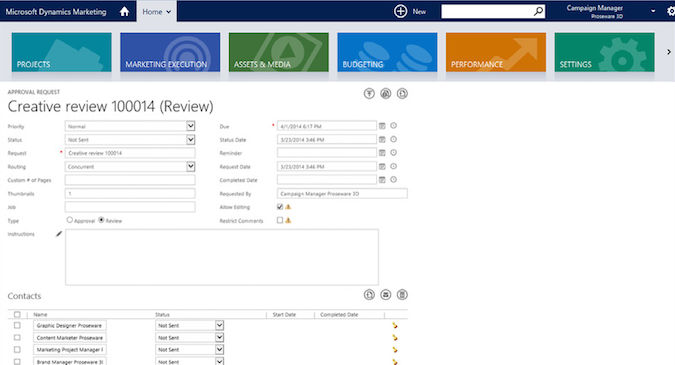
Microsoft Dynamics' marketing resource management interface
Common Functionality of Marketing Resource Management Software
MRM software typically offers functionality for strategic planning and financial management, asset and project management and, to some degree, reporting and analysis. The exact functionality offered may vary from vendor to vendor.
Common Functionality of Marketing Resource Management Software
Financial planning | Tracks expenses, schedules and resources needed to execute campaigns. Users can link marketing objectives to expected results for each program and campaign. |
Organizes the marketing production process and allows users to report their progress and view upcoming activities. | |
Workflow automation | Automates common tasks, such as content approvals and cost and expense tracking, to help organizations work more efficiently. |
Calendaring | Offers a shared view of marketing activities with associated time frames. |
Digital asset management | Stores and provides shared access to marketing assets, such as images, videos, documents, marketing materials and logos. |
Reporting and analysis | Provides reports on marketing efficiency, campaign performance, resource allocation and more. |
Benefits of Marketing Resource Management Software
There are many benefits to using an MRM system, including the following:
Brand asset consistency. MRM systems often provide asset management to ensure that all marketing content is brand-compliant and meets usage specifications. It also helps marketing teams avoid inconsistencies in brand image and communication by allowing them to share materials and keep them out of silos.
Illumination of bottlenecks. A common challenge in any organization is identifying and eliminating bottlenecks. MRM software improves efficiency by tracking the resources used and their effectiveness at supporting a given campaign. This helps companies identify and resolve bottlenecks.
Shortened cycles. With functionality for shared planning and visibility, MRM software helps companies spend less time managing communications between different departments and functions. This shortens campaign cycles and helps launch marketing campaigns more quickly.
Reduced costs. MRM software helps companies see where their marketing team is overspending or under-investing so they can quickly reallocate marketing dollars to the best-performing initiatives. This reduces spending on media, production and materials that have a low return on investment (ROI).
Nuanced view of ROI. MRM software tracks every dollar spent and each resource allocated to marketing campaigns, showing how each contributes to the overall ROI. This helps companies make real-time adjustments and assess how to improve resource allocation in future campaigns.
Businesses will see additional benefits by combining an MRM system with marketing automation software and other marketing tools, such as:
These tools reduce time spent on manually managing people, assets and content and help create a holistic, integrated view of marketing operations and campaign health.
Market Trends to Understand
Here are a few market trends you should consider before selecting a marketing resource management software platform:
Trend toward of cloud-based solutions. Cloud-based solutions, also known as software-as-a-service (SaaS), provide flexibility in terms of investment in the digital infrastructure, which further reduces strain on the IT budgets of small and midsize businesses (SMBs). Cloud-based software is usually available on a subscription basis with monthly or annual billing models.
Marketers in SMBs prefer cloud-based solutions, as they provide data security and disaster recovery modules at prices that suit their limited budgets. Cloud-based models enable organizations to embrace technology initiatives, such as bring your own device (BYOD) and bring your own phone (BYOP).
Integration of reporting and analytics tools. Advanced analytics solutions generate real-time dashboards and reports to enable data-driven decisions. As a result, marketers are gaining interest in using analytics tools to monitor customer behavior, track campaign performance and draw insights. They are also looking for intuitive data visualization capabilities to create data summary reports and presentations. Software vendors are responding to these requirements by providing analytics tools that are easy to use and require no external IT support for data analysis.
Use of mobile devices. Marketers are seeking solutions that offer mobile access, which helps organize processes and review campaign performance from anywhere. Moreover, advanced applications offer live chat collaboration features that help team members communicate on-the-go. This functionality also enables team managers to review documents and share feedback from remote locations.
Social media marketing. Successful use cases involving social media as a marketing tool have created demand among marketers to use this channel to promote products and services. Platforms such as Facebook, LinkedIn and Twitter enable marketers to filter their audience into niche segments and target each segment based on their distinct tastes and preferences. Software vendors are updating their solutions with social media marketing functionalities or integrating them into existing tools.
It is important to keep the messaging and branding consistent across social media marketing campaigns to spread awareness and engage customers. In addition, social media tools enable marketers to organize promotional campaigns to retain customers with regular brand communication.