


Best Optometry Software of 2026
Updated March 25, 2026 at 7:40 PM
- Popular Comparisons
- Buyers Guide
Compare Products
Showing 1 - 25 of 43 products
Compare Products
Sort by
Reviews: Sorts listings by the number of user reviews we have published, greatest to least.
Average Rating: Sorts listings by overall star rating based on user reviews, highest to lowest.
Alphabetically (A-Z): Sorts listings by product name from A to Z.

Nextech is redefining what’s possible in specialty healthcare. As an award-winning technology partner for specialty practices an...Read more about Nextech EHR & PM


Nextech EHR & PM's Best Rated Features
See All
Nextech EHR & PM's Worst Rated Features
See All

IMS (Intelligent Medical Software) by Meditab Software is an Electronic Health Records (EHR) and Practice Management solution th...Read more about Intelligent Medical Software

RevolutionEHR is a cloud-based electronic health record (EHR) solution built specifically for optometry practices. RevolutionEHR...Read more about RevolutionEHR


RevolutionEHR's Best Rated Features
See All
RevolutionEHR's Worst Rated Features
See All

Compulink Healthcare Solutions is a practice management platform offering electronic health records, billing, patient engagement...Read more about Compulink


Compulink's Best Rated Features
See All
Compulink's Worst Rated Features
See All

Eye Cloud Pro is a cloud-based Electronic Medical Records software designed for optical professionals. Features include e-prescr...Read more about Eye Cloud Pro
Eye Cloud Pro's Best Rated Features
See All
Eye Cloud Pro's Worst Rated Features
See All

Sightview is a practice management solution built for ophthalmologists and optometrists. Key features include fully customizable...Read more about Sightview

MaximEyes.com is an all-in-one cloud-based eye care EHR, practice management, optical point-of-sale, ophthalmic image management...Read more about MaximEyes
MaximEyes's Best Rated Features
See All
MaximEyes's Worst Rated Features
See All

LiquidEHR is a cloud-based electronic health record (EHR) solution suitable for small and midsize optometry practices. It offers...Read more about Liquid EHR
Liquid EHR's Best Rated Features
See All
Liquid EHR's Worst Rated Features
See All

iTRUST is the leading global software provider for optometrists, opticals, eye hospitals, colleges, and enterprise eye health sy...Read more about iTRUST
iTRUST's Best Rated Features
See All
iTRUST's Worst Rated Features
See All

Anagram, formerly Patch, is a cloud-based insurance management solution, which assists health centers and medical practitioners ...Read more about Anagram
Anagram's Best Rated Features
See All
Anagram's Worst Rated Features
See All

EyePegasus is a cloud-based electronic health record (EHR) and practice management system specifically designed for eye care. It...Read more about EyePegasusEHR

OD Link is a practice management and EMR/EHR software for optometry practices. This is a comprehensive solution that helps manag...Read more about OD Link

Optosys – Designed for Eye Care Professionals Who Want More Time for Patients, Less Time on Admin Optosys is a powerful practice...Read more about Optosys
Optosys's Best Rated Features
See All
Optosys's Worst Rated Features
See All

Crystal PM is a practice management and EHR software solution designed to support the full range of daily operations in an eyeca...Read more about Crystal Practice Management


Uprise is a cloud-based practice management and electronic health recording (EHR) solution that helps manage both patient care a...Read more about Uprise

Visual-Eyes is an electronic medical record (EMR) management solution that helps Optometry organizations streamline processes re...Read more about Visual-Eyes

MacPractice 20/20 is a comprehensive software solution designed specifically for optometry practices. It provides a Mac-based pl...Read more about MacPractice 20/20

Practice Director EHR is an Electronic Health Record (EHR) and practice management solution designed for eye care practices. The...Read more about Practice Director EHR

Eyefinity Encompass® is a comprehensive platform designed to help eye care professionals streamline their daily operations. Usin...Read more about Eyefinity Encompass

Eyefinity Encompass's Best Rated Features
See All
Eyefinity Encompass's Worst Rated Features
See All

Demandforce is the all-in-one practice growth solution made to attract new patients, and keep them coming back. With fully-integ...Read more about Demandforce

Demandforce's Best Rated Features
See All
Demandforce's Worst Rated Features
See All

For 23 years, Solutionreach has been helping vision, dental, and medical organizations of all sizes implement technology that su...Read more about Solutionreach
Solutionreach's Best Rated Features
See All
Solutionreach's Worst Rated Features
See All

DrChrono is a cloud-based healthcare platform that combines electronic health records, practice management and medical billing i...Read more about DrChrono


DrChrono's Best Rated Features
See All
DrChrono's Worst Rated Features
See All

Acuity Scheduling is a cloud-based appointment scheduling solution that enables business owners to manage appointments online. ...Read more about Acuity Scheduling


Acuity Scheduling's Best Rated Features
See All
Acuity Scheduling's Worst Rated Features
See All

MidexPRO is one of the UK's leading providers of private practice management software. The intuitive system enables individuals,...Read more about MidexPRO

MidexPRO's Best Rated Features
See All
MidexPRO's Worst Rated Features
See All

Adit is a practice management software designed for healthcare practices such as dental, optometry, chiropractic, and orthodonti...Read more about Adit

Adit's Best Rated Features
See All
Adit's Worst Rated Features
See All
Popular Comparisons


Buyers Guide
This detailed guide will help you find and buy the right optometry emr software for you and your business.
Last Updated on January 27, 2025Here’s what we’ll cover:
What Is Optometry Medical Software?
Common Features of Optometry EMR Software
Key Considerations for Optometry EMR Software
What Is Optometry Medical Software?
Optometry electronic medical record (EMR)/electronic health record (EHR) software can help optometrists work efficiently by helping diagnose and treat eye and vision conditions ranging from astigmatism to glaucoma. With templates and easy access to insurance codes, EMRs can also help optometrists make informed decisions by providing a deeper understanding of patient histories—displaying the right information at the right time.
For example, leading optometrist EMR software systems will feature a display screen that shows the changes in a patient’s intraocular pressure (IOP) values over time. This screen can help the optometrist evaluate glaucoma risk.
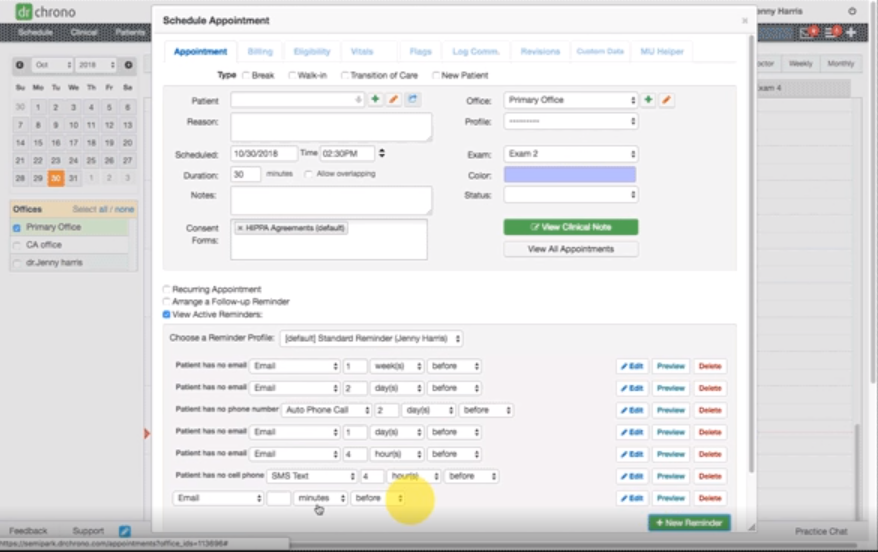
DrChrono appointment scheduling
These systems can also integrate a patient’s prescription history and display the exact medication a patient was on when a corresponding IOP measurement occurred. This shows the patient why compliance is important in maintaining their health.
Common Features of Optometry EMR Software
Top EMR software can help you improve patient care by showing you—at once—all the key information you need to follow up with and manage patients. EMR software for optometrists will also include generic features useful to most health care providers, such as the ability to provide E&M coding advice, e-prescribe, scan documents/images and provide clinical reminders. These solutions may be available either as a standalone EMR or as a complete EMR and practice management (PM) system that helps you manage billing and patient scheduling.
We recommend considering the following factors in your optometry EMR software:
Office workflow management | Workflow management features can take you and your patient through booking the appointment and visual field exam and/or eye exam. Additionally, it can manage your diagnosis and recommendation for treatment with medicine or corrective lenses, along with scheduling follow-up visits and sending appointment reminders. |
Intraocular pressure (IOP) tracking | Specialty optometry EMRs may have screens that display a patient’s intraocular pressure (IOP) values as they’ve changed over time. These displays can assist you in evaluation of patient glaucoma risk, and can be a useful tool to visually demonstrate the importance of compliance to your patient. |
Optometry templates | Specialty EMRs have SOAP note templates specifically designed for your practice. An optometry EMR will include templates for eye exams, blurred or lost vision, conjunctivitis, glaucoma, macular degeneration, diabetic retinopathy and more. |
Vision and eye exam device integration | Vision and eye exam device integration With device integration, information from your practice’s autorefractor and keratometer can populate your workflow template to further support diagnosis. |
Prescription & coding assistance | Because readings from devices can be integrated, the software can help you use the proper ICD-10/CPT code and recommend prescriptions. This can assist in reducing chances of undercoding or misprescribing diagnoses, lenses or other treatments. |
Point-of-sale capabilities | One of the things that separates optometrists from many other medical specialties is the associated retail sales. Some optometry EMRs may offer point-of-sale (POS) capabilities, which can make selling and managing your inventory of glasses and contact lenses faster and easier. |
Key Considerations for Optometry EMR Software
When you begin the software evaluation process, you need to assess prospective optometry EMR solutions based on your specific requirements. Below are some of the parameters that will help you identify a solution that checks all your boxes:
Number of unique features: You must evaluate features that are unique to your optometry EMR practice based on your specific needs. Some of these features include ability to track contact lens information for patients; integration with visual field machines, autorefractors, keratometers and other ophthalmic tools; compatibility with digital pen technology; POS to facilitate the sale of eyeglasses and contact lenses; and the inclusion of diagrams that graphically document ocular occlusions and various other eye problems.
Size of your practice: Currently, there are optometry EMR software solutions for every practice size available in the market. Since optometry software is designed for a certain type and number of users—and has scope for further scalability—you need to ensure that the final solution takes into consideration the total number of optometry doctors and physicians working in your practice.
Type of systems architecture: You can either install the optometry EMR software on-site on your local servers installed in your practice or in the cloud. An on-premise solution allows practices to be in control of data on individual systems, while a cloud-based solution provides the freedom of accessing data online from any location.
Certification from agencies: Before choosing an optometry EMR software solution, make sure that it is certified and tested by an ONC-Authorized Testing and Certification Body (ONC-ATCB). The Office of the National Coordinator for Health Information Technology (ONC) creates various EMR certification standards and approves vendor EMR products. An ONC-ATCB certification is a guarantee that an EMR software solution has met the required objectives and measures for Meaningful Use (MU). Hence, you should check these certifications before you purchase a solution.
As a buyer, you must see to it that all your core requirements are met and provisions are in place to address the secondary needs later.
Market Trends to Understand
As you begin the process of software comparison and evaluation, here are some emerging market trends in the field of optometry that you must consider:
Rise of molecular technology and genomics: The field of optometry is poised to witness the rise of new technologies, such as molecular technology and genomics, which are expected to drastically change the game. This will enable optometrists to use gene chip analysis to detect and treat eye diseases in a more accurate manner and improve the prescription of antibiotics.
Expanded presence of optometrists: Doctors of optometry (ODs) and other practicing optometrists are expected to expand their presence by enabling third-party payers. In addition, they will allow the use of EHRs, such as Physician Quality Reporting Systems (PQRS) and e-prescribing.
Refractive lasers and femtosecond lasers: Doctors of optometry are expected to move to refractive lasers and femtosecond lasers for more applications such as glaucoma surgery, thin LASIK and grafting corneas.
The above trends will help you understand the latest developments in the field of optometry and guide you in selecting the ideal software solution.