


Best Automatic Call Distribution Systems Software of 2026
Updated March 20, 2026 at 3:09 PM
- Popular Comparisons
- Buyers Guide
Compare Products
Showing 1 - 25 of 107 products
Compare Products
Sort by
Reviews: Sorts listings by the number of user reviews we have published, greatest to least.
Average Rating: Sorts listings by overall star rating based on user reviews, highest to lowest.
Alphabetically (A-Z): Sorts listings by product name from A to Z.

Five9 is an all-in-one cloud contact center solution for inbound, outbound, blended and omnichannel contact centers world-wide. ...Read more about Five9


Five9's Best Rated Features
See All
Five9's Worst Rated Features
See All

Zendesk is a cloud-based help desk management solution offering customizable tools to build customer service portal, knowledge b...Read more about Zendesk Suite


Zendesk Suite's Best Rated Features
See All
Zendesk Suite's Worst Rated Features
See All

Dialpad is an AI-enabled customer communications platform that includes a phone system, video conferencing, cloud contact center...Read more about Dialpad
Dialpad's Best Rated Features
See All
Dialpad's Worst Rated Features
See All

CallTools offers an advanced predictive dialer and inbound call center management solution that streamlines and optimizes call c...Read more about CallTools
CallTools's Best Rated Features
See All
CallTools's Worst Rated Features
See All

Readymode is a cloud-based outbound customer engagement platform for call centers and sales teams. Our all-in-one platform empow...Read more about Readymode


Readymode's Best Rated Features
See All
Readymode's Worst Rated Features
See All

DialedIn is a cloud-based Contact Center as a Service (CCaaS) solution designed to optimize outbound, inbound, and blended call ...Read more about DialedIn CCaaS

DialedIn CCaaS's Best Rated Features
See All
DialedIn CCaaS's Worst Rated Features
See All

Ringover is the no.1 business phone system that gives you unlimited calls to 110 countries, video conferencing, SMS and group me...Read more about Ringover
Ringover's Best Rated Features
See All
Ringover's Worst Rated Features
See All

Phonexa is an enterprise-grade tracking software for performance, affiliate and partner marketing. The Phonexa Suite is the unde...Read more about Phonexa

Phonexa's Best Rated Features
See All
Phonexa's Worst Rated Features
See All

XCALLY is an on-premise and cloud-based contact center solution that handles multiple channels including voice, chat, SMS, email...Read more about XCALLY

XCALLY's Best Rated Features
See All
XCALLY's Worst Rated Features
See All

VICIdial is an open-source, cloud-based contact center solution suitable for small to large call centers in a variety of industr...Read more about VICIdial

VICIdial's Best Rated Features
See All
VICIdial's Worst Rated Features
See All

Primo Dialler is a cloud-based call center solution that offers a predictive dialer, integrated voice response (IVR) and reporti...Read more about Primo Dialler

Ricochet360 is a cloud-based, integrated call center, customer relationship management and marketing automation solution. Design...Read more about Ricochet360


Ricochet360's Best Rated Features
See All
Ricochet360's Worst Rated Features
See All

Bright Pattern is a cloud-based contact center software solution which helps businesses manage multichannel service including in...Read more about Bright Pattern
Bright Pattern's Best Rated Features
See All
Bright Pattern's Worst Rated Features
See All

CTM is a conversation analytics software designed to provide tracking and insights for sales and marketing teams. It helps organ...Read more about CTM
CTM's Best Rated Features
See All
CTM's Worst Rated Features
See All

AVOXI is a global communications provider specializing in cloud-based contact center and virtual number solutions. Their platfor...Read more about AVOXI
AVOXI's Best Rated Features
See All
AVOXI's Worst Rated Features
See All

Calabrio ONE is a workforce performance software that helps contact centers work smarter, faster, and better. The true-cloud pla...Read more about Calabrio ONE
Calabrio ONE's Best Rated Features
See All
Calabrio ONE's Worst Rated Features
See All

ZIWO is a cloud-based call center workforce management solution that helps streamline customer interactions via virtual phone nu...Read more about ZIWO
ZIWO's Best Rated Features
See All
ZIWO's Worst Rated Features
See All

wolkvox is the most innovative, reliable, easy to use and fast to deploy all-in-one cloud contact center solution on the market....Read more about wolkvox


wolkvox's Best Rated Features
See All
wolkvox's Worst Rated Features
See All

VoIPstudio is a cloud-based call center management solution designed for businesses of all sizes. It offers features that includ...Read more about VoIPstudio
VoIPstudio's Best Rated Features
See All
VoIPstudio's Worst Rated Features
See All

UJET is a cloud-based call center application that integrates with customer relationship management (CRM) solutions. It offers b...Read more about UJET
UJET's Best Rated Features
See All
UJET's Worst Rated Features
See All

Omnichannel contact center software that offers streamlined end-to-end communication solutions. Its effective use of data in cus...Read more about HoduCC

HoduCC's Best Rated Features
See All
HoduCC's Worst Rated Features
See All

VirtualPBX is a cloud-based phone solution that caters to all-sized businesses. VirtualPBX enables companies to streamline and i...Read more about VirtualPBX
VirtualPBX's Best Rated Features
See All
VirtualPBX's Worst Rated Features
See All

Convoso is an AI-powered virtual agent software designed to help automate customer interactions for call centers across various ...Read more about Convoso
Convoso's Best Rated Features
See All
Convoso's Worst Rated Features
See All

Talkdesk is a cloud-based call center solution that helps businesses improve customer satisfaction while simultaneously reducing...Read more about Talkdesk
Talkdesk's Best Rated Features
See All
Talkdesk's Worst Rated Features
See All

Zoho Desk is a cloud-based help desk solution from Zoho Corporation, catering to businesses of all sizes. Key features include m...Read more about Zoho Desk
Zoho Desk's Best Rated Features
See All
Zoho Desk's Worst Rated Features
See All
Popular Comparisons


Buyers Guide
This detailed guide will help you find and buy the right automatic call distribution systems software for you and your business.
Last Updated on January 27, 2025Most callers don’t like being placed in a queue, but consider the alternative: to simply let them wait indefinitely on hold. Most of us can guess what the outcome of that strategy will be.
Moreover, if the call is placed to one of your business’s main numbers rather than an employee’s dedicated number, how will you ensure that the call on hold is answered by one of your available employees?
Automatic call distribution is a capability both of integrated call center suites and standard business phone systems that solves these problems by enabling call queueing and rules for routing calls from the queue to your employees.
We’ll answer the following questions you might have about automatic call distribution:
What is an Automatic Call Distribution System?
Which Kinds of Systems Offer ACD?
Common Functionality of Automatic Call Distribution Software
What is an Automatic Call Distribution System?
Essentially, a phone system or call center system with ACD capabilities parks incoming calls in a "call queue" and then routes them to call center agents or employees as they become available.
This ensures that calls get answered in the order that they come in, minimizing the time that callers wait on hold.
Moreover, because calls are routed to available personnel instead of being blindly routed to a line regardless of whether someone is there to answer, ACD ensures that your business answers far more calls.
Which Kinds of Systems Offer ACD?
Without ACD, you don’t have the option of call queueing—all callers will have to wait on hold. Because of this, ACD is used in nearly any business with a main company number or a toll-free number answered by multiple employees.
ACD is included in nearly all business phone systems, except for the most basic and stripped-down small business offerings on the market.
Call centers, in which large groups of agents spend long shifts answering inbound calls, have specialized ACD requirements. Thus, call center suites offer far more advanced ACD capabilities than most business phone systems, particularly when it comes to call routing.
Let’s take a look now at some of the specific features of advanced ACD systems.
Common Functionality of Automatic Call Distribution Software
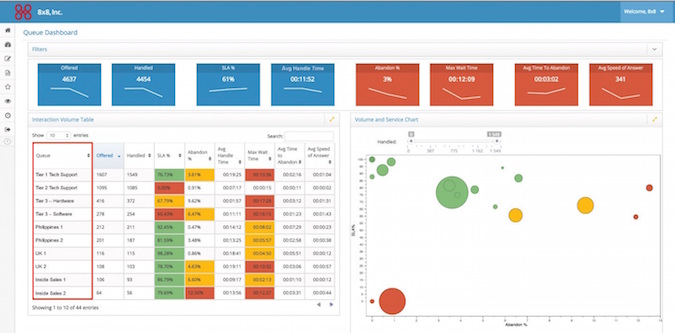
A queue dashboard in 8x8 tracks metrics for calls in various queues (highlighted in red)
The core functionality of an advanced ACD system is to route calls based on pre-defined rules, whereas simpler ACD systems merely route the caller who’s waited the longest to the first available employee.
One common form of ACD used in call centers. With skills-based routing in place, call center agents are first assigned to groups based on skills (e.g., a sales team, a billing support team, a technical support team etc.). When a caller selects that they need “sales” or “support” in the system’s menu, the call is then routed to the right team, instead of just being sent to the first available agent in any team.
How ACD Directs Incoming Calls
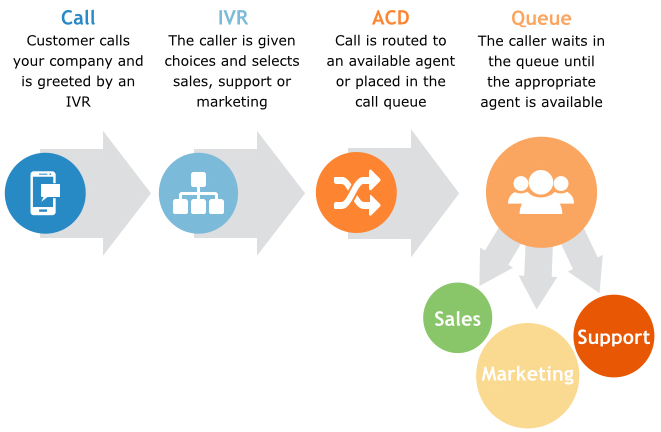
Even more advanced systems are capable of routing calls based on algorithms that factor in historical data collected by the call center system. For instance, calls can be routed to the best-performing agents (as determined by historical metrics), or to the agent who’s been waiting the longest between calls if multiple agents are available.
Factors used to route calls can include:
The number the caller dialed
Caller selections within the company’s interactive voice response (IVR) system
Caller profile data stored in the company’s CRM or call center system
Agent skills
Agent idle time
Agent performance metrics
Caller ID data
Geographical information
Time of day or day of week
Call center ACD systems also offer advanced options when it comes to reporting and queueing, such as:
Usage data capture | Allows users to gather data such as the number of incoming and outgoing calls, average time on call, average wait time and more. This information can be analyzed for reporting and used to populate agent scorecards. |
Virtual queueing | Allows callers to avoid waiting on hold by entering their numbers to receive a callback when it’s their turn. This reduces customer frustration and wait times. |
Differentiated call queues | ACD software users can create multiple call queues and have the ability to transfer callers between them. For example, a company may create one queue for support and one for sales, then transfer callers based on the purpose of their calls. |
Virtual queueing, also known as callback, offers a dramatically improved waiting experience for callers, as we explain in our report on the subject. However, it’s still far from being a universally included feature in ACD modules, so make sure to mention it in your Request for Information (RFI).
What Type of Buyer Are You?
At the very least, most businesses are going to need basic ACD. Thankfully, the ability to create call queues is a nearly universal feature in business phone systems.
The need for an advanced ACD system depends on a company’s volume of calls and whether those calls need to be routed in a specific way. Almost all buyers of advanced ACD solutions are call centers.
Here are some specific recommendations about the kinds of ACD capabilities that different businesses will need:
• Small businesses with fewer than 10 employees needing to place calls in queues can simply use a small business phone system. Small business systems generally offer ACD or at least “hunt groups,” i.e. the capability to group lines together so that multiple lines ring at once for a single inbound call.
Very small call centers can get by with basic hunt groups rather than advanced ACD by using a “round-robin” approach. In this routing scheme, calls are delivered sequentially to different employees. For instance, once employee A’s line rings, the next call is sent to employee B, then C etc.
Alternatively, some small call centers send calls to all agents at once, on the assumption that competition over who gets to answer is a motivating factor.
• Call centers fielding a high volume of calls should implement an ACD system to manage a queue and distribute calls based on time-on-hold, caller data, agent skills and more.
• Outbound and inbound call centers with an IVR should use an ACD to route calls. Outbound campaigns utilizing IVR menus require that you have ACD in place in order to properly route calls based on recipients’ IVR selections.
• Complex sales and support teams that need calls to be routed to various departments should use an ACD’s skills-based routing capabilities.
Virtually all of the call center systems listed on Software Advice offer an ACD system, in addition to the standard business phone systems we list. Explore our product profiles to find the solution that works best for your needs.