


Best Ecommerce CRM Software of 2026: which is right for you?

- Popular Comparisons
- Buyers Guide
Compare Products
Showing 1 - 25 of 369 products
Compare Products
Sort by
Reviews: Sorts listings by the number of user reviews we have published, greatest to least.
Average Rating: Sorts listings by overall star rating based on user reviews, highest to lowest.
Alphabetically (A-Z): Sorts listings by product name from A to Z.

Claritysoft is a cloud-based customer relationship management (CRM) solution designed for midsize and large enterprise businesse...Read more about Claritysoft CRM


Claritysoft CRM's Best Rated Features
See All
Claritysoft CRM's Worst Rated Features
See All

Supercharge your sales process with Sales Hub, a powerful and easy-to-use sales CRM that includes sales engagement tools, config...Read more about HubSpot Sales Hub

HubSpot Sales Hub's Best Rated Features
See All
HubSpot Sales Hub's Worst Rated Features
See All

CallProof is built for leaders who manage outside and field sales teams and want a simple way to know what’s really happening in...Read more about CallProof


Pipeliner has revolutionized CRM with our unique visual interface, no-code workflow automation engine, and instant, dynamic insi...Read more about Pipeliner CRM


Pipeliner CRM's Best Rated Features
See All
Pipeliner CRM's Worst Rated Features
See All

monday CRM is a sales platform that helps businesses streamline sales cycle. The platform caters to a range of industries, such ...Read more about monday CRM

monday CRM's Best Rated Features
See All
monday CRM's Worst Rated Features
See All

BNTouch Mortgage CRM is a fully integrated digital mortgage system, CRM, marketing, and POS tool offering a comprehensive mortga...Read more about BNTouch Mortgage CRM

BNTouch Mortgage CRM's Best Rated Features
See All
BNTouch Mortgage CRM's Worst Rated Features
See All

Shape's cloud-based solution offers tools designed to manage online marketing and promotions, capture leads from online sources,...Read more about Shape

Shape's Best Rated Features
See All
Shape's Worst Rated Features
See All

LeadMaster is a SaaS-based all-in-one lead management solution that offers capabilities to capture, track and follow up with lea...Read more about LeadMaster


SalesNOW by Interchange Solutions Inc. is a cloud-based customer relationship management (CRM) and sales force automation soluti...Read more about SalesNOW
SalesNOW's Best Rated Features
See All
SalesNOW's Worst Rated Features
See All

Thryv is an all-in-one business management solution designed to help small businesses with essential business functions. With Th...Read more about Thryv
Thryv's Best Rated Features
See All
Thryv's Worst Rated Features
See All

Clio provides a cloud-based solution designed to streamline various aspects of law firm operations. Its platform supports essent...Read more about Clio
Clio's Best Rated Features
See All
Clio's Worst Rated Features
See All

LeadSquared is a cloud-based marketing automation and customer relationship management (CRM) solution for businesses of all size...Read more about LeadSquared


LeadSquared's Best Rated Features
See All
LeadSquared's Worst Rated Features
See All

Lofty is an award-winning, all-in-one marketing, lead generation, and customer relationship management (CRM) platform built spec...Read more about Lofty
Lofty's Best Rated Features
See All
Lofty's Worst Rated Features
See All

Zoho CRM is a cloud-based business management platform that caters to businesses of all sizes. It offers sales and marketing aut...Read more about Zoho CRM
Zoho CRM's Best Rated Features
See All
Zoho CRM's Worst Rated Features
See All

MortgageHalo from Halo Programs is a cloud-based customer relationship management (CRM) solution designed for the residential mo...Read more about MortgageHalo


Creatio is a new era CRM to manage all customer and operational workflows with no-code and AI at its core. Creatio Sales is an ...Read more about Creatio CRM

Creatio CRM's Best Rated Features
See All
Creatio CRM's Worst Rated Features
See All

Workbooks is the 'No-BS' CRM. Workbooks designs, develops and implements its own software, which is targeted specifically at m...Read more about Workbooks
Workbooks's Best Rated Features
See All
Workbooks's Worst Rated Features
See All

SAP Customer Experience is a cloud-based customer relationship management solution that helps small and mid-size businesses mana...Read more about SAP Customer Experience
SAP Customer Experience's Best Rated Features
See All
SAP Customer Experience's Worst Rated Features
See All

Sales Cloud is equipped with customer relationship management (CRM) functionality that encompasses lead management, marketing au...Read more about Salesforce Sales Cloud
Salesforce Sales Cloud's Best Rated Features
See All
Salesforce Sales Cloud's Worst Rated Features
See All

CharityEngine's nonprofit CRM software simplifies the fundraising process, so you spend more time on your campaigns and less tim...Read more about CharityEngine

Rock Solid OneView is a Microsoft Dynamics-based citizen engagement platform that helps citizens and local governments work as o...Read more about Rock Solid
No reviews yet
recommendations


An Inc. 5000 fastest growing private company, recognized by Gartner as a top viable vendor for Integrated Revenue and Customer M...Read more about Symphony

Zendesk is a cloud-based help desk management solution offering customizable tools to build customer service portal, knowledge b...Read more about Zendesk Suite

Zendesk Suite's Best Rated Features
See All
Zendesk Suite's Worst Rated Features
See All

RealEstateHalo from Halo Programs is a cloud-based solution for the residential real estate industry. The platform offers built...Read more about RealEstateHalo


SalesOutlook CRM is a comprehensive customer relationship management (CRM) and email marketing system that embeds into Microsoft...Read more about SalesOutlook CRM
SalesOutlook CRM's Best Rated Features
See All
SalesOutlook CRM's Worst Rated Features
See All
Popular Comparisons


Buyers Guide
This detailed guide will help you find and buy the right ecommerce crm software for you and your business.
Last Updated on January 27, 2025Odds are that you've engaged in ecommerce, whether you realize it or not. Boiled down, ecommerce is any form of commercial transaction conducted online—from purchasing a dress on Amazon, to bidding for a rare collectible on eBay or even just ordering a pizza.
As you might imagine, ecommerce is a huge component of business today, accounting for almost 10% of all retail sales, according to the U.S. Department of Commerce. This means that it's not just retail giants like Wal-Mart or Pizza Hut who need to engage in ecommerce, but also small to midsize businesses (SMBs).
Like all forms of selling and sales, ecommerce needs to focus on the needs and preferences of your customers, which is where ecommerce CRM (customer relationship management) software comes in.
Ecommerce CRM software will help your business reach out to more potential customers and clients, keep track of their preferences and determine how you're best suited to meet their needs.
This Buyer's Guide will take you through the process of determining what ecommerce features and systems might be right for your business, so that you can make an informed choice in selecting the best software for you.
Here's what we'll discuss:
What Is Ecommerce CRM Software?
Common Features of Ecommerce CRM Software
Ecommerce CRM Software vs. CRM Software Suites
What Is Ecommerce CRM Software?
In general, CRM software supports the automation of the processes and best practices related to managing an organization's interactions with customers throughout the entire customer life cycle.
In practice, this means storing contact details, tracking interactions, predicting next steps and providing other tools that are useful to sales, marketing and customer support teams when they are dealing with customers.
Ecommerce CRM software, then, provides all of these functions plus features specific to the digital sales landscape, such as storing customer history, tracking shipping preferences and suggesting related purchases.
Essentially, the ecommerce CRM system will track your customers' journey through your digital store in order to provide you with a clear map of future marketing and sales opportunities, which it accomplishes through a variety of related features.
Common Features of Ecommerce CRM Software
Below is a table featuring some of the most common features of ecommerce CRM software. Some of these are common to all CRM software, while others are unique to the ecommerce CRM landscape. We will discuss the difference between catch-all CRM suites and dedicated ecommerce CRM systems in the next section.
Data tracking | Track your customers' data as they engage with your website in order to gain an insightful overview of their behavior. |
Store customer contact information in a searchable system. | |
Customer segmentation | Segment individual contacts into lists for categorization and management, particularly in regards to email marketing. |
Interaction tracking | Document conversations held by phone, in person, through live chat, email or other channels. |
Forecasting/reporting/analytics | Track and aggregate data (often visually) regarding performance and productivity, in order to facilitate the generation of predictions for future activities. |
Create, launch and track email campaigns. Some systems will integrate with email providers or seperate email marketing tools. | |
Customer support tracking | Create trouble tickets for external customers/clients, routing those tickets to the appropriate people/department and tracking outstanding tickets. |
Grade leads using certain attributes to identify those most likely to result in a sale. | |
Social media integration | Integrate with social media for prospecting, with the ability to add social profiles to contact details |
As with all CRM software, the most important aspect of your ecommerce CRM will be how you track your customers' data as well as interactions you've had with them. Almost all systems will feature a customer contact profile that keeps track of this information for each contact, like the one below.
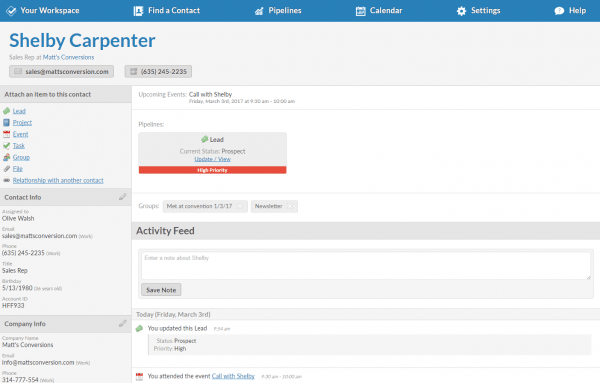
A customer contact profile in Less Annoying CRM
Ecommerce CRM Software vs. CRM Software Suites
Though there are some unique CRM platforms that are specifically dedicated to ecommerce CRM, the most common form of ecommerce CRM software is part of a larger CRM suite. Here are the key differences between these two options:
Ecommerce CRM software: This software is specifically designed for ecommerce business. It may have extra functionality just for this purpose—such as real-time segmentation and analytics, and a marketing focus—but in exchange it may lack some of the broader features of CRM that you might find useful, like sales force automation or customer service and support.
CRM software suite: A CRM suite can be as broad or as specific as you'd like it to be, ranging from SMB-focused CRM software vendors to large systems used by enterprise-level corporations. In exchange for access to the fullest extent of CRM features, you may lose some of the specific, ecommerce-based functions that could be provided by an independent ecommerce CRM system.
Key Considerations
Other factors to take into consideration when picking the best ecommerce CRM software for your business include:
Integration with other systems. Given that it will be constantly exchanging data with your outward-facing, retail-based ecommerce platform, you must ensure that your ecommerce CRM system integrates well with that platform. Similarly, you'll want to check with your vendor to see if/how the system you plan on using will integrate with other important software you rely on, such as any independent sales or marketing software that you use.
Business size. The type of ecommerce platform you choose will rely in no small part on the size of your business. If you have a small, online store where you fulfill most orders personally, but you still want to track your customers' data, then either an independent ecommerce system or else a very basic CRM suite should give you that functionality. For larger businesses, with hundreds or thousands of orders a day, you'll definitely want a more robust ecommerce CRM system, probably as part of a larger CRM suite that you're using for all aspects of your business.
Cloud-based software vs on-premise software. Almost all independent ecommerce CRM system will be cloud-based, meaning that the vendor hosts the software and gives you access to it over the internet. Thus, your startup costs will be low and you won't need to pay for IT resources to help your company implement the software. This is in contrast to on-premise software solutions, which require a company to host the hardware on which the software runs. Though some software today still operates on this model, that is largely only done by enterprise-level organizations, and only something you should consider if you are a large company utilizing an all-encompassing CRM suite.