


Best Hardware and Building Materials Store POS Software of 2026
Updated March 18, 2026 at 6:17 AM
- Popular Comparisons
- Buyers Guide
Compare Products
Showing 1 - 25 of 96 products
Compare Products
Sort by
Reviews: Sorts listings by the number of user reviews we have published, greatest to least.
Average Rating: Sorts listings by overall star rating based on user reviews, highest to lowest.
Alphabetically (A-Z): Sorts listings by product name from A to Z.

Clover is a POS system designed to help small businesses streamline their operations. The system offers a range of features, inc...Read more about Clover


Clover's Best Rated Features
See All
Clover's Worst Rated Features
See All

Rain is an all-in-one point-of-sale, website, and marketing system for small to midsized retailers. Music, dive, sporting goods...Read more about Rain POS


Rain POS's Best Rated Features
See All
Rain POS's Worst Rated Features
See All

GoldTech Retail Manager is a retail management and point of sale system designed for small and midsize retail businesses. It off...Read more about GoldTech Retail Manager
No reviews yet
recommendations

Epicor retail POS and business management solutions are designed to help independent retailers work smarter, not harder. With mo...Read more about Epicor Propello

Pacific Amber’s AmberPOS offers a point of sale software solutions to a variety of retail specialties, ranging from small to mid...Read more about AmberPOS

NetSuite is an AI-powered cloud-based business management suite that incorporates ERP, financial management, CRM and eCommerce f...Read more about NetSuite

NetSuite's Best Rated Features
See All
NetSuite's Worst Rated Features
See All

Designed for independent and enterprise retailers, MyPOS Connect is a SOC2 compliant, cloud-hybrid POS solution that allows busi...Read more about MyPOS Connect


MyPOS Connect's Best Rated Features
See All
MyPOS Connect's Worst Rated Features
See All

RockSolid MAX is a cutting-edge software platform designed to revolutionize the way hardware store and home center businesses op...Read more about RockSolid MAX
RockSolid MAX's Best Rated Features
See All
RockSolid MAX's Worst Rated Features
See All

Spruce software provides advanced point-of-sale and business management solutions for lumberyards, hardware stores, and building...Read more about Spruce
Spruce's Best Rated Features
See All
Spruce's Worst Rated Features
See All

POS Nation is built to support retailers, including specialty businesses such as convenience stores, liquor, wine and beer store...Read more about POS Nation for Retail

POS Nation for Retail's Best Rated Features
See All
POS Nation for Retail's Worst Rated Features
See All

Running a retail or hospitality business today means balancing endless moving parts: changing customer expectations, new sales c...Read more about LS Retail


Lightning Retail POS is a cloud-based point of sale (POS) solution that caters to a variety of retail segments such as wine and ...Read more about Lightning Online

Rapid Garden POS is a point of sale (POS) solution designed to assist users with managing their greenhouse, garden centers, nurs...Read more about Rapid Garden POS

Agiliron is an all-in-one Retail Management System which allows you to manage all orders, inventory and CRM records, from all ch...Read more about Agiliron

Agiliron's Best Rated Features
See All
Agiliron's Worst Rated Features
See All

PayPal is a digital payment platform that enables businesses and individuals to pay and accept payments through an online portal...Read more about PayPal


PayPal's Best Rated Features
See All
PayPal's Worst Rated Features
See All

PayPal Here is a mobile application that allows retailers and merchants to process transactions. The application uses a card rea...Read more about PayPal Point of Sale

PayPal Point of Sale's Best Rated Features
See All
PayPal Point of Sale's Worst Rated Features
See All

RetailEdge is an on-premise, retail POS solution designed for small and midsize businesses. It offers mobile POS, multi-location...Read more about RetailEdge

RetailEdge's Best Rated Features
See All
RetailEdge's Worst Rated Features
See All

PHP POS is a hybrid point of sale (POS) solution that helps small and startup retail businesses across various industries to man...Read more about PHP Point of Sale

PHP Point of Sale's Best Rated Features
See All
PHP Point of Sale's Worst Rated Features
See All

CashFootprint is a retail management solution that offers point of sale (POS), inventory management, customer management, loyalt...Read more about CashFootprint Point-of-Sale

Android Pay is a cloud-based secure digital wallet application designed for processing payments using tablets and smartphone dev...Read more about Google Pay
Google Pay's Best Rated Features
See All
Google Pay's Worst Rated Features
See All

Aravenda is a cloud-based consignment management software that enables resale businesses of all sizes to create, run and manage ...Read more about Aravenda Consignment Software
Aravenda Consignment Software's Best Rated Features
See All
Aravenda Consignment Software's Worst Rated Features
See All

WooPOS is a Windows-based and Hybrid solution that helps small to midsize businesses in the retail industry manage inventory and...Read more about WooPOS
WooPOS's Best Rated Features
See All
WooPOS's Worst Rated Features
See All

AB POS is a cloud-based point of sale system that assists small to large-sized restaurants, bars and clubs with menu creation, s...Read more about AB POS


Mi9 Retail is a retail management solution suitable for businesses in a variety of industries. Key features include point of sal...Read more about Mi9 Retail Suite

MicroBiz is an inventory and retail management system designed for retailers with brick-and-mortar stores. The system sync...Read more about MicroBiz Cloud POS
Popular Comparisons


Buyers Guide
This detailed guide will help you find and buy the right hardware and building materials store pos software for you and your business.
Last Updated on January 27, 2025Hardware stores specialize in the retail of household goods and materials, including:
Tools
Lawn and garden equipment
Plumbing and electrical
Cleaning supplies
Specialty hardware stores may also sell items such as farm or ranch equipment and even hunting supplies.
POS software for hardware and building materials stores helps business owners automate nearly every aspect of their business, from managing inventory to customer checkout and balancing the books.
These systems offer increased visibility into business operations, allowing owners to track trends and relationships that impact profitability. As such, these systems play an integral role in the success of retail stores of all size, from mom-and-pop hardware shops to enterprise-level home improvement retail chains.
With the emergence of new digital technologies such as iPads, credit card processors and electronic barcoding solutions it’s easier than ever for hardware and building materials stores to maintain accurate shop records.
We’ve created this guide to help business owners evaluate and compare the various solutions on the market and make a more informed purchase decision.
Here’s what we’ll cover:
What is Hardware POS software?
Common Features and Capabilities of Hardware POS Software
Expected Benefits of Using Hardware POS Software
What is Hardware POS software?
Hardware POS software supports the business processes unique to hardware stores, such as:
Unified point of sale (POS) dashboard: Track sales made in both brick-and-mortar and online stores
Inventory management: Know the status of every piece of merchandise, whether it’s in stock or on backorder, and be able to pull up the price and available discounts upon request
Physical inventory counting process: Some of the products sold by a hardware store must be accompanied by a material safety data sheet (MSDS)
Reporting and trends analysis: Create customized dashboards to track sales and profitability, customer trends and more or export data as a report to take a snapshot of current standing.
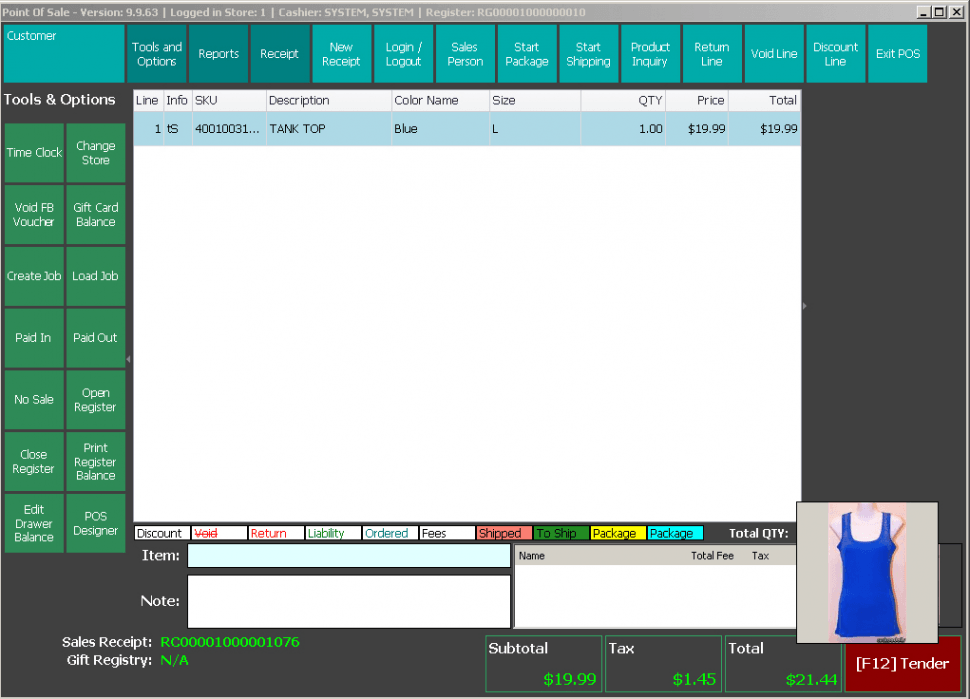
Point of sale dashboard in RetailSTAR
Additional “back office” or administration requirements include:
There are some peculiarities for the customer relationship management (CRM) and POS. These are primarily in the areas of job costing and estimating. They affect both contractors and do-it-yourselfers.
Common Features and Capabilities of Hardware POS Software
When evaluating POS software, hardware store owners should keep the following functions in mind to ensure the new system meets their unique business and industry requirements.
Common Hardware POS Features
Integrated parts database and UPC catalog | Because of the large number of hardware items, the system needs to provide a catalog of products and UPCs. The catalog must be updated frequently or better yet, available online. |
Sell by measure | Hardware stores sell many bulk items that are sold in cut portions. Examples include lumber, chain, rope and wire. The system should handle selling by measure for these items. The inventory should be accurately tracked, including accounting for all scrap. |
Shelf and bin location | The inventory and POS systems should support locating products by shelf and bin location. In addition to providing better customer support, having inventory location assists with the physical inventory process. |
Estimating | The POS and inventory system should allow estimates to be prepared. If the customer accepts the estimate, the system should be able to generate a customer order easily. It should generate orders for stock not on hand and special orders as necessary. |
Contractor sales | The system should support contractor sales. It should calculate discounts, track terms and provide billing. It should also track lines of credit and notify the customer and back office staff when credit thresholds are reached. |
Job costing | The system should be able to track multiple jobs, for both contractors and do-it-yourselfers. The job costing should be part of the POS. A single transaction should be able to be split over multiple jobs. The job should include the customer’s job number. Each customer should be able to have multiple jobs concurrently. |
Seasonal orders | The system should recommend or order seasonal merchandise; for example, salt and holiday decorations for the winter and barbecue grills in the summer. The system should also support inventory sell-versus-store decisions at the end of each season. |
Kit sales | Hardware stores often sell plans and materials as single kits; for example, to build a storage shed or a play set. The system should correctly decrease the individual parts inventory counts when a kit is sold. |
Special orders | The system should handle special orders. It should track deposits, integrate with order entry to place orders and notify the customer when the order is received. |
Work orders | Many hardware stores offer special services. Examples include rescreening and engraving. The system needs to track the work orders, post deposits and notify the customer when the work is complete. |
Material safety data sheet (MSDS) handling | OSHA requires that the required MSDS for a product to be delivered by the seller, but only for certain customers. The systems should have a repository of MSDS The POS and CRM systems should printout required data sheets at the time of sale. |
Common Hardware POS Capabilities
Gift registry | For a variety of reasons, hardware stores are starting to maintain gift registries. Customers should be able to register for desired merchandise by name and event. The system should track which items have been purchased and what is still on the list. |
Rental management | The system should have a rental management module. It should track costs, billing, maintenance and equipment lifecycle management. |
Lookup by description | Since many hardware items are similar, the POS needs a look up by description, which can narrow the range of items. The the clerk or customer then can select from a limited list. |
Inventory images | The system must show pictures of the items. The images should be available during ordering, receiving, selling and physical inventory. |
Case/unit breakdown | Many hardware parts are ordered in cases and sold in as cases, boxes or singles. The POS system should decrease the inventory properly how ever the items are sold. |
Physical inventory system | The system should support physical inventory. It should interface with handheld devices to record the count. It should create physical inventory sheets by location as well as item number. The count sheets should have the option to display the image. |
Expected Benefits of Using Hardware POS Software
Investing in POS software can benefit your business in several ways, including:
Improved workflows: Prior to POS software, sales associates had to physically check the stockroom and sales floor to answer customer inquiries about pricing or inventory levels. Now, associates can respond to questions about product levels, cost and more simply by checking their POS dashboard. This not only creates a smoother customer experience, but employees can special order a part for a customer or check inventory levels at other store locations on the spot.
Better employee management: Using your POS for scheduling can help ensure proper staffing levels so employees are neither over or under worked. Use historical staffing data to anticipate increased staffing needs around holidays to ensure you have enough people scheduled to work at that time.
Enhanced customer service: Create a customer database to provide a more personalized shopping experience. Sales associates can use purchase history to help with current sales. For example, if the customer is looking for a lawn mower part, the associate can look up what model lawn mower they bought to help locate the part more easily.