


Best Document Management Software of 2026
Updated January 14, 2026 at 5:38 AM

Written by Olivia Montgomery, PMP
Associate Principal Analyst

Edited by Caroline Rousseau
Senior Editor

Reviewed by Chris Soltani
Senior Advisor

Talk with us for a free 15-min consultation
Expert advisors like Jacqueline, who have helped 1,000+ companies, can find the right software for your needs.
- All Software
- Software Advice FrontRunners
- Popular Comparisons
- Buyer's Guide
- Frequently Asked Questions
Document management software helps businesses organize, store, and securely track documents, improving collaboration, compliance, and efficiency while reducing the risk of errors or data loss. With over 800 tools covering varied operational models, integration needs, or regulatory contexts, choosing the right system can be daunting. To help you narrow it down, I worked with our document management software advisors to curate a list of recommended productsi and a list of the document management software FrontRunners based on user reviews. For further information, read my document management software buyer's guide.
Document Management Software
Sort by
Reviews: Sorts listings by the number of user reviews we have published, greatest to least.
Average Rating: Sorts listings by overall star rating based on user reviews, highest to lowest.
Alphabetically (A-Z): Sorts listings by product name from A to Z.

Revver is a cloud-based document management solution that helps businesses organize, find, sign and share digital documents on a...Read more about Revver


Revver's Best Rated Features
See All
Revver's Worst Rated Features
See All

Klyck is a modern AI-powered content and document management platform designed to eliminate confusing folder systems and scatter...Read more about Klyck


Klyck's Best Rated Features
See All
Klyck's Worst Rated Features
See All

FileHold Enterprise: Powerful Document Management for Large Organizations! FileHold Enterprise is a comprehensive document mana...Read more about FileHold


FileHold's Best Rated Features
See All
FileHold's Worst Rated Features
See All

Square 9 is a document management solution that helps businesses handle and automate human resource processes. Teams can create ...Read more about Square 9


Square 9's Best Rated Features
See All
Square 9's Worst Rated Features
See All

DocStar Enterprise Content Management helps midsize and large organizations securely capture, store, organize, and share documen...Read more about DocStar ECM

DocStar ECM's Best Rated Features
See All
DocStar ECM's Worst Rated Features
See All
Software Advice FrontRunners 2026

(28370)

(12499)

(5612)

(5380)

(21671)

(272)

(110)

(416)

(979)

(439)
Best for Collaboration


- Key FeaturesGoogle Drive's scoreCategory average
Document Editing
4.434.62 category average
Document Storage
4.794.68 category average
Secure Data Storage
4.704.65 category average
- Screenshots


Highly Rated for Mobile app

OneDrive

- Key FeaturesOneDrive's scoreCategory average
Document Storage
4.684.68 category average
Secure Data Storage
4.664.65 category average
- Screenshots


Highly Rated for Security and Access Control

Box

- Key FeaturesBox's scoreCategory average
Document Editing
4.204.62 category average
Document Storage
4.694.68 category average
Secure Data Storage
4.724.65 category average
- Screenshots


Highly Rated for Integrations


- Screenshots


Highly Rated for Automation


- Key FeaturesDropbox Business's scoreCategory average
Document Editing
5.04.62 category average
Document Storage
4.704.68 category average
Secure Data Storage
4.714.65 category average
- Screenshots


Highly Rated for Seamless Upgrades

M-Files

- Key FeaturesM-Files's scoreCategory average
Document Storage
4.714.68 category average
Secure Data Storage
4.684.65 category average
- Screenshots


Best for Usability

Clinked

- Key FeaturesClinked's scoreCategory average
Document Storage
5.04.68 category average
Secure Data Storage
4.924.65 category average
- Screenshots


Most Rated for SMBs

Glasscubes

- Key FeaturesGlasscubes's scoreCategory average
Document Storage
4.824.68 category average
Secure Data Storage
4.784.65 category average
- Screenshots


Most Used By Marketing and Advertising

Bitrix24

- Key FeaturesBitrix24's scoreCategory average
Document Editing
5.04.62 category average
Document Storage
4.044.68 category average
- Screenshots


Most Used By Information Technology and Services


- Key FeaturesProgress ShareFile's scoreCategory average
- Screenshots


- Key FeaturesZoho WorkDrive's scoreCategory average
Document Editing
4.04.62 category average
Document Storage
4.584.68 category average
Secure Data Storage
4.534.65 category average
- Screenshots


DocuWare

- Key FeaturesDocuWare's scoreCategory average
Document Storage
4.694.68 category average
Secure Data Storage
4.794.65 category average
- Screenshots


Square 9

- Key FeaturesSquare 9's scoreCategory average
Document Storage
4.694.68 category average
Secure Data Storage
4.674.65 category average
- Screenshots


Revver

- Key FeaturesRevver's scoreCategory average
Document Editing
5.04.62 category average
Document Storage
4.564.68 category average
Secure Data Storage
4.644.65 category average
- Screenshots


Fluix

- Key FeaturesFluix's scoreCategory average
Document Storage
4.634.68 category average
Secure Data Storage
4.334.65 category average
- Screenshots


- Key FeaturesPlumsail Documents's scoreCategory average
Document Storage
4.504.68 category average
Secure Data Storage
4.504.65 category average
- Screenshots


- Key FeaturesQualityze Suite's scoreCategory average
Document Storage
5.04.68 category average
Secure Data Storage
5.04.65 category average
- Screenshots

Klyck

- Key FeaturesKlyck's scoreCategory average
Document Storage
5.04.68 category average
Secure Data Storage
5.04.65 category average
- Screenshots


Methodology
The research for the best document management software list was conducted in October 2025. We evaluated data (user reviews and demand signals) from the past 24 months as of the research date. Read the complete methodology.
Popular Document Management Comparisons


Buyer's Guide
This detailed guide will help you find and buy the right document management software for you and your business.
Last Updated on October 16, 2025Here's what we'll cover:
What you need to know about document management software
What is document management software?
Essential features of document management software
Benefits and competitive advantages of using document management software
How to choose the best document management software for your business
Software related to document management
More resources for your document management journey
What you need to know about document management software
Document management software (DMS) streamlines and centralizes the organization, storage, and tracking of files, securely and quickly. Our analysis of nearly 11,300 user reviews from the past year finds that DMS improves team collaboration and increases productivity. Users say that documents are easier to search and retrieve, reducing their time spent on manual tracking or sifting through emails.
Our experienced software advisor, Chris Saltoni, shares that “a common misconception about DMS is that it is an external file-sharing tool for sharing and signing documents with clients. And while many solutions can do that, DMS is designed to be a secure system for storing and managing internal documents.”
For example, an IT team can use DMS to store configuration files, system logs, and software documentation in a centralized, secure location. With version control, team members can easily access the latest file versions, track changes, and collaborate on troubleshooting and development efforts.
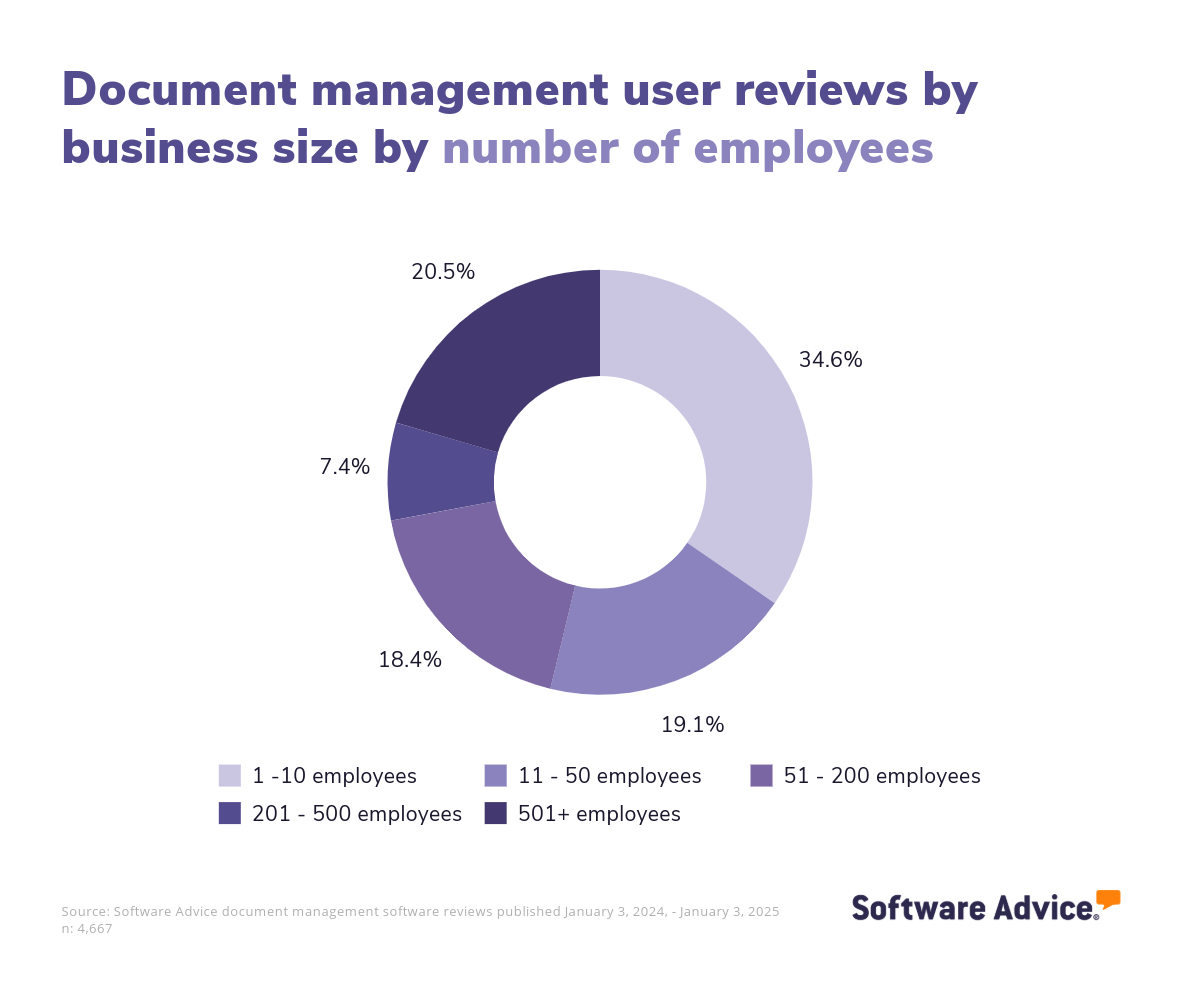
To give you an idea of the market, we have 901 different document management products on our site, and we’ve published 11,238 reviews for 390 products since January 2024. The majority of user reviews (54%) come from small businesses with 50 or fewer employees, and another 25% of reviewers have 51 - 500 employees. Information technology (IT) is the largest industry represented, followed by computer software and education management. [1]
Most document management systems are priced on a “per-month” basis. [2] Entry-level plans cost an average of $110 per month and offer basic features, such as document storage and collaboration for up to 10 users. Mid-tier and high-end plans cost an average of $296 and $880 per month, respectively, and may include additional features such as electronic signature and audit trails.
If you’re a first-time buyer, consider your use cases, features, budget, number of users, and required integrations. Discuss requirements with stakeholders to gather questions you should ask vendors during an evaluation. Our software advisors, Tyler Cole and Saltoni, share the following questions to get you started:
Does the tool support the types of files you store, such as videos or spreadsheets?
Can you securely and easily share documents externally with your clients and partners?
Does the tool integrate with the specific systems you need it to, such as your project management and/or accounting software?
If you would prefer to speak with one of our experienced purchase order software advisors like Cole or Saltoni, schedule a call or chat with us.
What is document management software?
Document management software, which falls within the larger content management systems (CMS) category, helps business users digitally upload, track, and archive documents while keeping them secure. Many document management systems include workflow tools to manage the life cycle of specific documents, such as articles or legal contracts.
Capterra’s 2025 Software Buying Behavior Survey finds that 52% of respondents bought document management software in the past 12 months, and 37% already had it. This reflects both the scale of information companies today must oversee and the diversity of available solutions. [3]
We've created this buyer's guide to help you better understand this technology and how it works so you can choose the best document management software for your business.
Essential features of document management software
When comparing document management systems, knowing what features you can expect to see is important. Some functionality, like document storage and full-text search capabilities, are core features available in every DMS. Other features, such as collaboration tools, file sharing, and access controls and permissions, are commonly offered. We analyzed over 4,500 reviews from the past year to determine what we believe are the core and most important features of document management software. [3]
Document management software provides businesses with the following functionality:
Core document management features
Secure data storage | Securely stores data to prevent data loss or breaches. 90% of our reviewers rate this feature as critical or highly important. |
Document storage | Store and organize documents in a centralized system, minimizing the risk of losing or damaging records. 88% of our reviewers rate this feature as critical or highly important. |
Full-text search | Search for specific words or phrases within a document or database. 77% of our reviewers rate this feature as critical or highly important. |
Document capture | Scan, move, or upload electronic files within the software's repository. 76% of our reviewers rate this feature as critical or highly important. |
Common document management features
File sharing | Public or private sharing of digital files such as documents, audio/video, images, etc. 86% of our reviewers rate this feature as critical or highly important. |
Search/filter | Search and filter data across systems to locate required information by entering keywords or certain criteria. 83% of our reviewers rate this feature as critical or highly important. |
Access controls/permissions | Define authorization levels for access to specific files or systems. 82% of our reviewers rate this feature as critical or highly important. |
Collaboration tools | Provides a channel for team members to share media files, communicate, and work together. 82% of our reviewers rate this feature as critical or highly important. |
Document generation | Custom forms to streamline repetitious aspects of a document. 80% of our reviewers rate this feature as critical or highly important. |
Electronic signature | Digitally sign online documents. 74% of our reviewers rate this feature as critical or highly important. |
Document management software is also helpful for companies seeking to implement rules-based workflow processes, such as reviewing and approving documents before publication and/or release.
Businesses that frequently use and/or maintain records containing sensitive personal information, such as those in the medical or financial industries, may especially benefit from document control software. These solutions can help industry-specific document compliance while providing the appropriate users with quick, reliable access to records.
Benefits and competitive advantages of using document management software
Our analysis of 4,503 user reviews from the past year shows that document and team collaboration, office productivity, file sharing, and, of course, document management are the top-rated benefits of document management software. These features directly address the core needs of document management, including securely maintaining and organizing documents so that the right people can access the right files when needed.
Here’s an overview of the top benefits, listed in order from the highest user sentiment rating.
Document collaboration: Improve teamwork and efficiency by allowing multiple users to edit and comment on documents at the same time, reducing the time spent on revisions and improving overall quality.
Team collaboration: Centralizes communication, including comments, approvals, and document sharing, making it easier for teams to stay aligned and access the latest updates.
Office productivity: Streamline daily tasks through features like word processing and spreadsheets, boosting efficiency and enabling employees to focus on higher-value activities.
File sharing: Simplify access and distribution of documents, ensuring all stakeholders have the latest information, which improves decision-making and project execution.
Document management: Organize and secure documents, improving compliance and accessibility while reducing the risk of data loss, thus providing a strategic advantage in managing information assets.
How to choose the best document management software for your business
Step 1: Define your requirements
Before selecting a document management system, start by defining your specific requirements, such as the volume and types of documents you need to manage. Consider the software's functionality, budget constraints, training needs, data migration capabilities, and necessary integrations. These requirements will guide you toward a system that aligns with your current document management processes and supports your long-term goals.
What is the cost of document management software?
Document management software is generally offered on a monthly subscription model, with costs dependent on the features and number of users the business requires. Entry-level plans, averaging $110 per month, provide fundamental functionalities like document storage and collaboration for up to 10 users, making them suitable for smaller teams or businesses with basic needs.
For more comprehensive solutions, mid−tier plans average $296 per month, while high-end plans can cost up to $880 monthly. These advanced plans often include enhanced features such as e-signatures and audit trails, catering to businesses with more complex document management requirements and a need for compliance and security measures. [2]
Integration considerations for document management software
Integration is a key consideration when choosing document management software. Many businesses need their DMS to work with other tools like customer relationship management (CRM), enterprise resource planning (ERP), or project management software systems. For example, integrating with a CRM system allows teams to attach relevant documents to client profiles. These integrations enhance collaboration, reduce miscommunication, and help stakeholders have access to the most up-to-date documents.
Different industries may have specific integration needs. For instance, legal firms often require integration with case management systems, while healthcare organizations benefit from linking document management systems with electronic health records (EHR) to ensure compliance and improve patient care.
Be aware of potential drawbacks
While document management software offers numerous benefits, there are potential pitfalls to be aware of:
Complexity: Some document management systems can be complex, with a steep learning curve. This complexity may overwhelm new users, particularly in smaller businesses without dedicated IT staff, leading to confusion and underutilizing key features.
Integration challenges: Integration with other business systems can sometimes lead to data silos or inconsistencies, complicating workflows and requiring manual intervention, which undermines the efficiency the software is meant to provide.
Step 2: Make a shortlist of document management software
With numerous document management software options available, selecting the best one for your business can be challenging. Here are some tips to make the process easier.
Get qualified help from an advisor
At Software Advice, our advisors have experience helping businesses identify solutions that match their needs and budgets. You can chat online with an advisor or schedule a phone call if you need guidance. In a few minutes, your advisor will help you identify a shortlist of options that align with your document management needs.
For further assistance after your consultation, check out After Your Advisor Call: 4 Tips To Keep Your Software Purchase on Track.
Explore our list of document management FrontRunners
If you’re not ready to speak to an advisor, start compiling your shortlist with our FrontRunners report. Only products with top user ratings make this list. Check out our methodology for details on how we compile the report.
For more help creating a shortlist and a free, downloadable comparison chart, check out The Ultimate Software Vendor Evaluation Guide. This guide will help you compare software evaluation criteria for each prospective vendor by tracking functionalities, training and support offerings, costs, and deployment options.
Step 3: Pick your best option
After narrowing down your options, vendor demos are the next step. These sessions allow you to explore features and ask questions to make an informed investment. Being well-prepared is essential to maximize the benefits of these demos.
How to prepare for vendor demos
Once you’ve compiled your shortlist, schedule demo sessions with each vendor to learn more about their product. The demo is your opportunity to ask questions about features, pricing, technical support, training, and other factors critical to choosing the right document management system for your needs.
Consider asking the following questions during demos:
How customizable is your software to fit our specific document processes?
Every business has unique document management needs, so it's important to know if the software allows for customizing workflows, templates, and reporting formats. Ask if the system can be tailored to suit your specific document lifecycle processes without requiring complex coding or technical expertise.
What integrations does your software support?
Understanding available integrations ensures the document management software can connect with your current tools. This question helps you assess whether the software will enhance productivity by centralizing document data and eliminating manual entry. Clarify whether required integrations are out-of-the-box or custom options and whether the vendor will perform and maintain them.
How is ongoing support and training provided?
Effective onboarding and ongoing support are crucial for smooth adoption and troubleshooting. Ask about the types of training provided, such as live sessions or tutorials, and the availability of customer support. Knowing what resources and help are available will give you confidence in your team’s ability to leverage the software fully in the long term.
For more help and additional questions to ask during the demos, check out How To Cut Through the Sales Pitch During Software Demos. This guide helps you prepare for the personalized, real-time software demonstration the vendor will show you—not the initial discussions or video walkthroughs found online.
Step 4: Successful implementation of the new document management software
Once you’ve selected and signed the contract for a new document management system, the implementation process begins. Whether transitioning from another tool or manual processes, there are key considerations to focus on during this phase:
Establish clear change management communication: Develop a communication plan detailing the implementation process, benefits, and workflow changes. Ensure all team members know key dates, training sessions, and milestones. Transparent communication reduces resistance and prepares the team for a smoother transition.
Provide training and change support: Schedule hands-on training for all users, covering both basic and advanced features that enhance efficiency. Clearly explain how the tool will impact workflows and set expectations for its use. Ongoing support, including Q&A sessions, can ease adoption and minimize resistance.
Ensure data accuracy and migration: Before fully implementing the new document management system, thoroughly review and clean existing document data to ensure accuracy. Plan and execute a careful data migration process to transfer documents into the new system, verifying that all information is correctly imported. This step minimizes errors and ensures a seamless transition to the new platform.
For more details on ensuring a smooth transition, check out our 5 Critical Steps to a Successful Software Implementation Plan guide.
Software related to document management
When searching for document management solutions, buyers may see related software types, such as content management systems (CMS) and digital asset management tools. These tools offer overlapping functionalities like data organization and workflow automation. These systems can often be integrated with document management software to enhance overall efficiency and streamline business processes.
Content management software: Keep internal sites organized and up to date by allowing you to structure, plan, and publish fresh content dynamically without touching any underlying code.
Digital asset management software: Store and organize media files and protect brand assets. It also lets users collaborate and distribute files internally and with people outside the organization.
Entity management software: Helps businesses efficiently manage and maintain comprehensive records of legal entities, including compliance, governance, and corporate data.
Forms automation software: Create digital versions of paper forms, including applications, surveys, contracts, work orders, etc.
IT asset management software: Manage IT tasks by providing a single repository for all information relating to hard and soft technologies, plus other inventory that falls under the purview of the IT department.
Knowledge management software: Collect data in a central knowledge base, contextualize it, and make it easily searchable so that users can find the information they need on their own.
Legal document management software: A form of document management software made specifically for lawyers, law firms, or any entity operating in the field of law.
Proposal management software: Proposal management software is a tool that streamlines the creation, organization, and tracking of business proposals, supporting collaboration and efficiency throughout the proposal development process.
More resources for your document management journey
About our contributors
Author
Olivia Montgomery is an associate principal analyst at Software Advice, covering program and project management with a focus on the strategic alignment of IT and operations to optimize digital transformation. Drawing from her experience as a former IT PMO leader and her background in humanities studies, Olivia delivers data-driven insights that empower business leaders to drive business growth through projects.
Olivia’s research and analysis is informed by nearly 200,000 authentic user reviews on Software Advice and over 10,000 interactions between Software Advice software advisors and project management software buyers. Olivia also regularly analyzes market sentiment by conducting surveys of project managers and PMO leaders so she can provide the most up-to-date and helpful information to small and midsize businesses purchasing software or services.
Her expertise is featured in Forbes, Bloomberg, CIO Dive, and TechRepublic, as well as in podcasts, such as The Digital Project Manager. Recently, she presented her research on emotional intelligence (EQ) and decision-making at PMI's Global Summit conference, shedding light on the crucial role of EQ in driving project success. When she's not analyzing tech trends, you can find Olivia horseback riding or re-watching Jurassic Park.
Editor
Caroline Rousseau is a senior content editor at Software Advice.
A former content analyst, Caroline has, for the past five years, built, written, and edited research reports about technological trends, opportunities, and challenges with an SMB audience in mind. Her content has been featured in French Tier 1 media including Le Monde, L’Express, and Le Figaro, among other publications.
Her previous experience as a graphic designer, translator, and LQA specialist in various industries converged into a skill set that allows her to create compelling content about today’s business matters. Caroline’s personal interests include literature and art and she has a passion for Albert Camus, graphic novels, and drawing.
Advisor
Tyler Cole is a senior advisor manager. He joined Software Advice in 2013 as a software advisor, and now he manages a team of 5 software advisors. He is based in Austin, TX.
Tyler and his team help about 5,000 small businesses find the right medical and legal software for their needs each year. They’re able to do this through one-to-one conversations designed to narrow down the list of potential tools to only those that are the best fit.
His favorite part of being a Software Advice advisor team manager is stepping into a buyer’s selection process and helping point them in the right direction, setting them up for success.
Chris Soltani is a senior advisor. He joined Software Advice in 2013 as a software advisor, and he is based in Austin, TX.
As part of the software advisor team, Chris helps accounting, project management, and supply chain industry professionals find budgeting, collaboration, inventory management, and billing and invoicing tools. He provides a short list of personalized technology recommendations based on budget, business goals, and other specific needs.
Chris’s favorite part of being a software advisor is truly helping buyers overcome challenges when they’re researching the hundreds of software options online.
Document Management FAQs
- Which tool is best for document management?
According to our analysis of products with high market demand and reviews, Google Drive has the highest overall rating for document management software based on ratings from verified reviewers on Capterra. According to reviews, DocuWare is rated best for functionality in document management software.
- What is an example of document management software?
An example of document management software is Google Drive. According to our analysis of products with high market demand and reviews, Google Drive received the highest overall rating for document management software based on ratings from verified reviewers on Capterra, highlighting its popularity and effectiveness in managing documents efficiently.
- Is Office 365 a document management system?
Microsoft Office 365 is not exclusively a document management system (DMS) but includes document management features through SharePoint and OneDrive. For those seeking a new DMS, Google Docs is highly recommended as the best free DMS based on Capterra reviews, offering helpful document management capabilities like collaboration and real-time editing.
- What is the best way to manage documents?
The best way to manage documents is by using reliable document management software. According to our analysis, Google Drive received the highest overall rating for document management based on verified Capterra reviews, while PandaDoc is rated best for ease of use. These tools streamline document storage, collaboration, and accessibility, making them excellent choices for efficient document management.
- Is a document management system secure?
Yes, document management software (DMS) is generally secure, offering features such as encryption, access controls, and audit trails to protect sensitive information. However, security levels can vary by vendor. Choosing a DMS with robust security measures and regularly updating security protocols is important to ensure data protection and compliance with industry standards.
- What is the best document management software for free?
According to our analysis of products with high market demand and reviews, Google Docs is the best free document management software based on ratings from verified reviewers on Capterra. Our analysis of the 349 reviews for Google Docs in the past year finds users most appreciate the team and document collaboration features and mobile access.
- How do you evaluate document management tools?
To evaluate document management software, consider key factors like ease of use, collaboration features, file-sharing capabilities, and customization options. Read user reviews on Capterra, ask about customer support, and make sure the tool fits your team’s size, budget, and workflow needs. Always test with a free trial if possible.