


Best Therapy Notes software of 2026: which is right for you?

- Popular Comparisons
- Buyers Guide
- Related Software
Compare Products
Showing 1 - 25 of 65 products
Compare Products
Sort by
Reviews: Sorts listings by the number of user reviews we have published, greatest to least.
Average Rating: Sorts listings by overall star rating based on user reviews, highest to lowest.
Alphabetically (A-Z): Sorts listings by product name from A to Z.

AdvancedMD is a unified suite of software designed for independent laboratories, medical, physical therapy and mental health pra...Read more about AdvancedMD for Mental Health

TheraNest is an HIPAA-compliant web-based mental health solution used by solo practitioners, large mental health practices, and ...Read more about TheraNest


TheraNest's Best Rated Features
See All
TheraNest's Worst Rated Features
See All

RXNT’s cloud-based, ONC-certified medical software—Billing, Practice Management, EHR, and more—improves clinical outcomes & reve...Read more about RXNT


RXNT's Best Rated Features
See All
RXNT's Worst Rated Features
See All

Valant EHR Suite is an electronic health record system designed for behavioral health practices. It supports clinical documentat...Read more about Valant EHR Suite
Valant EHR Suite's Best Rated Features
See All
Valant EHR Suite's Worst Rated Features
See All

Transform the way you run your behavioral health practice with Opus. Our all-in-one platform is built for Behavioral Health, Men...Read more about Opus


Opus's Best Rated Features
See All
Opus's Worst Rated Features
See All

TherapyNotes is a cloud-based mental/behavioral health software system that includes electronic health records (EHR), a patient ...Read more about TherapyNotes, LLC
TherapyNotes, LLC's Best Rated Features
See All
TherapyNotes, LLC's Worst Rated Features
See All

Healthie is a true, all-in-one practice management platform designed to simplify and enhance the way healthcare clinicians run t...Read more about Healthie


Healthie's Best Rated Features
See All
Healthie's Worst Rated Features
See All

SimplePractice is an EHR and all-in-one practice management solution that helps health and wellness providers access everything ...Read more about SimplePractice

SimplePractice's Best Rated Features
See All
SimplePractice's Worst Rated Features
See All

MedEZ is an electronic health record (EHR) and billing suite suitable for most medical facilities, particularly behavioral healt...Read more about MedEZ


CR Essentials is the all-in-one ABA software designed to help growing practices run smarter and more efficiently from day one. M...Read more about CR Essentials

Alleva offers an Electronic Medical Record (EMR) solution fine-tuned to the demands of the behavioral health sector, assisting o...Read more about Alleva


Alleva's Best Rated Features
See All
Alleva's Worst Rated Features
See All

CentralReach is the leading AI-powered EMR and practice management platform purpose-built for autism and IDD care. Trusted by 4,...Read more about CentralReach
CentralReach's Best Rated Features
See All
CentralReach's Worst Rated Features
See All

ClinicTracker is a fully customizable EHR, billing and practice management software designed to automate your clinic workflows, ...Read more about ClinicTracker

ClinicTracker's Best Rated Features
See All
ClinicTracker's Worst Rated Features
See All

EHR YOUR WAY is an electronic health record (EHR) software designed for mental health professionals, clinical health providers, ...Read more about EHR YOUR WAY
EHR YOUR WAY's Best Rated Features
See All
EHR YOUR WAY's Worst Rated Features
See All

Kipu offers a cloud-hosted platform specifically designed for large-scale, multi-provider behavioral and addiction therapy cente...Read more about Kipu


Kipu's Best Rated Features
See All
Kipu's Worst Rated Features
See All

Foothold offers a federally-certified mental health EHR that is fully interoperable with other systems and HIEs. AWARDS is HIPAA...Read more about Foothold
Foothold's Best Rated Features
See All
Foothold's Worst Rated Features
See All

Designed to improve collaboration across mental/medical health professionals and administrators, teachers, and parents, BIPTrack...Read more about BIPTrack
No reviews yet
recommendations

PracticeQ is a secure and cloud-based practice management software that assists healthcare practitioners with onboarding, managi...Read more about PracticeQ

PracticeQ's Best Rated Features
See All
PracticeQ's Worst Rated Features
See All

myEvolv is an ONC-certified electronic health record (EHR) with comprehensive clinical, financial and operational features. It w...Read more about myEvolv

The myAvatar system, developed by Netsmart, serves as a dedicated electronic health record (EHR) platform catering to entities d...Read more about myAvatar

myAvatar's Best Rated Features
See All
myAvatar's Worst Rated Features
See All

Noteable is a complete solution for behavioral services companies including community-based counseling providers, group homes, a...Read more about Noteable
Noteable's Best Rated Features
See All
Noteable's Worst Rated Features
See All

Qualifacts InSync streamlines essential healthcare functions like charting, billing, scheduling, medication management, and tele...Read more about Qualifacts Insync
Qualifacts Insync's Best Rated Features
See All
Qualifacts Insync's Worst Rated Features
See All

VOTED BEST VALUE AWARD By Capterra!!! Top Choice for Practice Management! Personalized. Efficient. Complete. Online practice ma...Read more about CounSol.com

CounSol.com's Best Rated Features
See All
CounSol.com's Worst Rated Features
See All

Jotform is a cloud-based form automation solution that enables users to publish online forms and record customer responses. It h...Read more about Jotform

Jotform's Best Rated Features
See All
Jotform's Worst Rated Features
See All

IntakeQ is an online forms intake platform designed to help healthcare professionals convert existing forms, manage client notes...Read more about IntakeQ

IntakeQ's Best Rated Features
See All
IntakeQ's Worst Rated Features
See All
Popular Comparisons


Buyers Guide
This detailed guide will help you find and buy the right therapy notes software for you and your business.
Last Updated on January 27, 2025To mental and behavioral health care providers, therapy notes are essential for documenting patient encounters. What’s more, therapy notes are consistently cited as a top-requested electronic health records (EHR) software functionality by buyers who contact Software Advice.
There are hundreds of solutions that offer therapy notes for practitioners looking to make a first-time or replacement purchase. To help you narrow down your options and better understand what’s available in today’s market, we put together this buyer’s guide.
Here’s what we’ll cover:
What Is Therapy Notes Software?
Common Functionality of Therapy Notes Software
Benefits of Electronic Therapy Notes
Deployment Strategies and Pricing
What Is Therapy Notes Software?
“Therapy notes” can refer to several different kinds of medical forms that are needed to document patient encounters in mental and behavioral health care settings.
These can include:
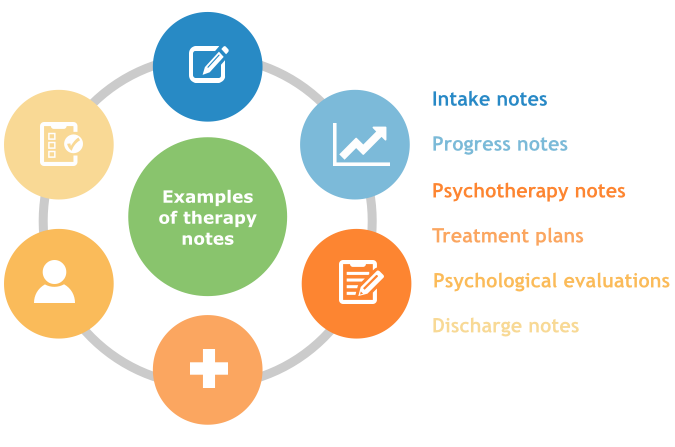
These types of mental health progress notes are essential for practitioners to record patient assessments, treatments and results over time. The data can also be used for tracking and coordinating care to achieve healthy outcomes. And in some cases, these notes serve as the official record of the patient relationship and may be subpoenaed in court.
In light of all this, it’s extremely important for therapy notes to be as comprehensive, up-to-date and secure as possible. Indeed, the right software ensures notes are legible and automatically marked with time and date stamps. Drop-down menus and templates make it easy for practitioners to enter detailed patient observations. Plus, electronic files are generally more secure than paper-based records.
Common Functionality of Therapy Notes Software
Specialty-specific notes templates | Most systems should offer notes templates for a range of specialties, such as psychotherapy, psychiatry and behavioral health. Some allow users to customize templates with additional fields/terminology. Templates usually offer drop-down menus and click-boxes. |
Note management | Allows users to easily view/retrieve notes and assessments, in order for human services specialists to access old notes and review previous sessions. |
Outcomes tracking | Allows users to turn therapy notes data into reports, for gauging health outcomes across patient populations. (Measuring care outcomes is recommended by the Diagnostic and Statistical Manual of Mental Disorders, Fifth Edition [DSM-5].) |
Coding tools | Help users select and enter codes in note templates and billing modules from a pre-programmed menu or searchable database. These clinical documentation codes may include CPT, ICD and/or DSM codes. |
Staff management | Users are assigned roles within the system (e.g., site administrators, clinicians or billers) that provide different levels of access (e.g., clinicians can only see the notes for their own patients). Supervisors can receive missing notes reports and notifications for notes that need approval. Standard functionality for systems aimed at larger organizations. |
Benefits of Electronic Therapy Notes
Some of the benefits of electronic therapy notes should already be clear from our discussion, but here’s a complete listing:
No double-entry. When you enter data electronically, you don’t need to bother with digitizing it down the road.
Paperless office. By using electronic therapy notes, you’re one step closer to achieving the ecological nirvana (and the cost-savings) of a paperless office.
Improved organization. Electronic therapy notes are automatically organized by time/date and patient - no hunting through file-cabinets.
Patient analytics. As we’ve seen, electronic therapy notes can feed historical reports that track patient progress over time. Do you really plan to turn all your old paper notes into charts?
Easier coding. ICD 10 codes are a pain, and we all know the DSM V tends to make coding more painful rather than less. Thankfully, these tools offer features to assist with the tedious task of coding.
Deployment Strategies and Pricing
Stand-alone or “best-of-breed” programs can be implemented to create, edit and store different kinds of therapy notes. Vendors of this type of software often offer tiered pricing plans.
For example, at the first, most basic tier, buyers might pay a monthly fee allowing a small pool of users access to basic functionality and services, such as progress notes templates, document storage and limited email support from the vendor.
At the higher-priced tiers, buyers might be able to add more users to the system and/or to access more advanced functionality or services beyond what the lower tiers provide. These additional capabilities might include reporting and analytics, electronic claims submissions or live phone support from the vendor.
Buyers seeking a more comprehensive deployment strategy can implement a therapy software suite that includes other capabilities in addition to therapy notes. For example, an EHR suite may also offer billing, patient scheduling and human resources applications. Pricing for these suites can be much more expensive, as they offer a greater breadth of both clinical and practice management functionalities.
Your choice between a best-of-breed system or integrated suite will come down to the size of your practice, your budget and whether you want your solution to integrate with other software.
Market Trends to Understand
You will likely come across some of the following market trends as you begin your search for therapy notes software:
Cloud-based deployment. One of the most important choices buyers need to consider is whether they’d like a cloud-based or an on-premise solution. The cloud model provides Software-as-a-Service (SaaS), in which the system is hosted on external servers and accessed remotely through the Web. In on-premise systems, the software is hosted on the practice’s own servers and must be updated and maintained locally.
Cloud-based EMR mental health systems are becoming increasingly popular. Not only do they offer the flexibility of remote access, they also involve lower upfront costs, and updates and maintenance are handled by the vendor.
Mobile device support. Support for wireless devices, such as smartphones and tablets, is becoming common among mental and behavioral health software vendors. The convenience and portability of such devices makes them ideal for reviewing progress notes and managing scheduling changes on the go. Some vendors are even introducing HIPAA-compliant native applications for Windows, Android and/or iOS devices. What's more, a report conducted by Software Advice finds that mobile users cite higher levels of satisfaction and fewer challenges with their EHR than non-mobile users.