


Best Occupational Therapy Software of 2026
Updated March 18, 2026 at 2:21 PM
- Popular Comparisons
- FrontRunners
- Buyers Guide
Compare Products
Showing 1 - 25 of 72 products
Compare Products
Sort by
Reviews: Sorts listings by the number of user reviews we have published, greatest to least.
Average Rating: Sorts listings by overall star rating based on user reviews, highest to lowest.
Alphabetically (A-Z): Sorts listings by product name from A to Z.

TheraOffice is an integrated physical therapy EMR software that seamlessly manages patient intake, scheduling, documentation, bi...Read more about TheraOffice

zHealth is an industry-leading, all-in-one chiropractic software with features - custom SOAP notes, integrated billing, scheduli...Read more about zHealth

zHealth's Best Rated Features
See All
zHealth's Worst Rated Features
See All

StrataPT combines your EMR & Billing into one automated system to achieve a 99.99% reimbursement rate for PT, OT and Speech Clin...Read more about StrataPT
StrataPT's Best Rated Features
See All
StrataPT's Worst Rated Features
See All

Fusion by Ensora Health is a leading all‑in‑one EHR built specifically for occupational, physical, and speech therapists. Desig...Read more about Fusion
Fusion's Best Rated Features
See All
Fusion's Worst Rated Features
See All

Ambiki is a practice management platform built from the ground up for pediatric therapists—speech-language pathologists, occupat...Read more about Ambiki

Ambiki's Best Rated Features
See All
Ambiki's Worst Rated Features
See All

Practice Pro is a fully integrated, web-based EMR and Practice Management solution for outpatient physical therapy, pediatric th...Read more about Practice Pro


Practice Pro's Best Rated Features
See All
Practice Pro's Worst Rated Features
See All

CentralReach is the leading AI-powered EMR and practice management platform purpose-built for autism and IDD care. Trusted by 4,...Read more about CentralReach
CentralReach's Best Rated Features
See All
CentralReach's Worst Rated Features
See All

Everything you need to run a better practice. Noterro is an online clinic management tool for Massage Therapists, Physiotherapis...Read more about Noterro

Noterro's Best Rated Features
See All
Noterro's Worst Rated Features
See All

Theralytics is an all-in-one ONC Certified and SOC 2 Type II compliant practice management and data collection software designed...Read more about Theralytics
Theralytics 's Best Rated Features
See All
Theralytics 's Worst Rated Features
See All

As an ABA practice owner, efficiently managing your operations is essential to providing quality care for your patients. AlohaAB...Read more about AlohaABA

AlohaABA's Best Rated Features
See All
AlohaABA's Worst Rated Features
See All

SPRY Therapeutics, Inc. is the inventor of SPRY EMR, an integrated practice management solution that enables rehab therapy profe...Read more about SPRY

SPRY's Best Rated Features
See All
SPRY's Worst Rated Features
See All

HelloNote is a web-based therapy practice management solution that helps businesses handle patient scheduling, document generati...Read more about HelloNote

Cliniko is a cloud-based practice management solution designed to help businesses in the healthcare sector manage appointment sc...Read more about Cliniko

Cliniko's Best Rated Features
See All
Cliniko's Worst Rated Features
See All

PtEverywhere transforms rehab therapy practices with its comprehensive growth solution. Designed for physical, occupational, and...Read more about PtEverywhere


PtEverywhere's Best Rated Features
See All
PtEverywhere's Worst Rated Features
See All

AgileEMR is a cloud-based solution designed to help physical therapists manage and streamline various administrative processes r...Read more about AgileEMR

Zanda is a practice management system for allied health practices, offering tools that streamline practice management. Features ...Read more about Zanda
Zanda's Best Rated Features
See All
Zanda's Worst Rated Features
See All

TherapyPM is a medical practice management software that includes features such as custom tagging, auth management, payroll, tel...Read more about TherapyPM

TherapyPM's Best Rated Features
See All
TherapyPM's Worst Rated Features
See All

SimplePractice is an EHR and all-in-one practice management solution that helps health and wellness providers access everything ...Read more about SimplePractice
SimplePractice's Best Rated Features
See All
SimplePractice's Worst Rated Features
See All

Systems 4PT is an outpatient rehab solution that offers electronic patient intake, scheduling, EMR, outcome tracking, management...Read more about Systems 4PT

HENO is an integrated, cloud-based solution suitable for physical therapy/rehab and speech therapy practices of all sizes. Key f...Read more about HENO

HENO's Best Rated Features
See All
HENO's Worst Rated Features
See All

SynergyPT is a web-based electronic medical records (EMR) solution for physical therapy practices. It is compatible with mobile ...Read more about SynergyPT

Planetrehab offers physical and occupational therapists a turnkey solution that offers integrated practice management, billing a...Read more about Planetrehab

Raintree is a complete business and Physical Therapy EMR/EHR software for Pediatric & Adult Therapy & Rehab PT, OT, SLP and ABA ...Read more about Raintree Systems


Healthie is a true, all-in-one practice management platform designed to simplify and enhance the way healthcare clinicians run t...Read more about Healthie

Healthie's Best Rated Features
See All
Healthie's Worst Rated Features
See All

vcita is a cloud-based, all-in-one business management solution designed especially for service-based micro and small businesses...Read more about vcita

vcita's Best Rated Features
See All
vcita's Worst Rated Features
See All
Popular Comparisons



Your Guide to Top Occupational Therapy Software, April 2024
Software Advice uses reviews from real software users to highlight the top-rated Occupational Therapy products in North America.
Learn how products are chosenExplore FrontRunners


“Usability” includes user ratings for Functionality and Ease of Use.
“Customer Satisfaction” includes user ratings for Customer Support, Likelihood to Recommend and Value for Money.
Reviews analysis period: The reviews analysis period spans two years and ends the 15th of the month prior to publication.

Buyers Guide
This detailed guide will help you find and buy the right occupational therapy software for you and your business.
Last Updated on January 27, 2025As an occupational therapist, you strive to help people overcome mental or physical issues that keep them from performing their best at work and in everyday life. But as someone who works in a healthcare domain that doesn't rely on medicinal or surgical interventions, your technology requirements will not likely align with what general medical software provides.
For that reason, you'll want to evaluate solutions that are specific to occupational therapy, but selecting one occupational therapy solution from among the hundreds on the market can be overwhelming. That's why we've created this buyers guide to detail everything you need to know before making the final purchase decision.
Here's what we'll cover:
What is occupational therapy software?
An occupational therapy solution allows therapists to use specific note templates, flowsheets, and tests to treat their patients. The software platforms are designed to meet the specific needs of therapists who treat patients with a physical, sensory, or cognitive disability to help them regain skills for daily tasks.
Occupational therapy software offers very different functionality from software programs geared towards primary care and related specialties, although some features do overlap.
Such software offers a range of tools that facilitate everything from clinical documentation and patient scheduling to medical billing and insurance claims submission. The software provides therapists with each patient's health details, progress status, and billable particulars.
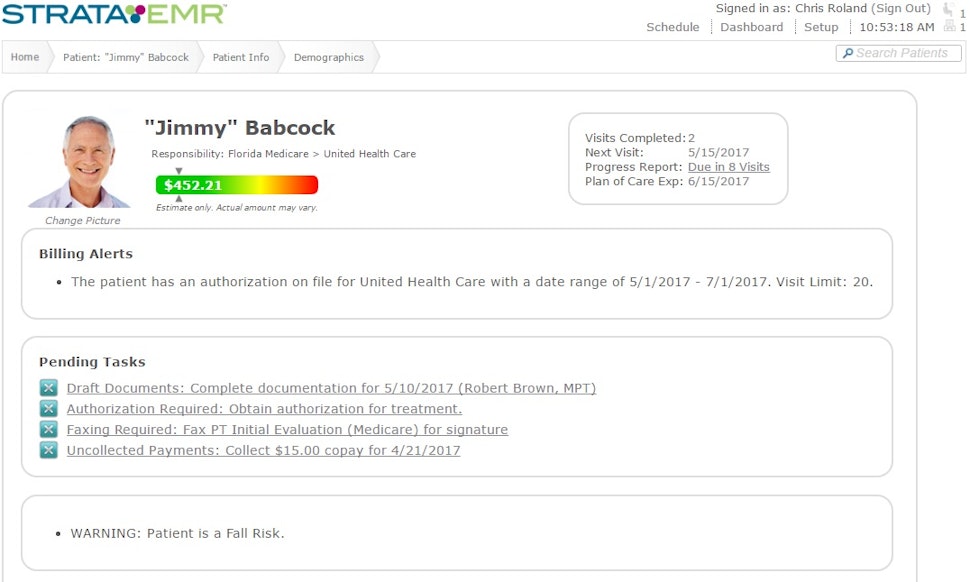
Patient info and billing alerts in StrataEMR (Source
Common features of occupational therapy software
Different vendors offer different features in their occupational therapy software. Selecting the right occupational therapy software for your practice is easier when you know the common features and what they do.
Patient charting | Create and record each patient's medical data and history in a single chart. |
Specialty-specific notes templates | Use specific note templates for activities of daily living (ADL), disabilities of the arm, shoulder, and hand (DASH), instrumental activities of daily living (IADL), etc. Some vendors offer provisions for customizable templates, drop-down menus, click boxes, and electronic signatures. |
Outcomes/progress tracking | Turn data in occupational therapy notes into reports for gauging the health outcomes or progress of a patient. |
Patient scheduling | Automate scheduling tasks, identify scheduling conflicts, and send out appointment reminder notifications. |
Medical billing | Manage patient payments and claims submissions. Functions include claims management, insurance eligibility checks, and payment processing. |
Case management | Manage the delivery of comprehensive healthcare services for each patient. Provide healthcare services as per each patient's requirements, while controlling the costs. |
Coding tools | Select and enter codes in notes, bills, and claims from pre-programmed menus. Clinical documentation codes usually include Current Procedural Terminology (CPT) and International Classification of Diseases (ICD) codes. |
To further understand these features and learn about occupational therapy software vendors, call our advisors at 855-998-8505 for free, no-obligation help. They'll help you narrow down your options by listening to your requirements and recommending the best-suited solutions for your practice.
What type of buyer are you?
Before you start evaluating occupational therapy software options, you'll want to know what buyer category you belong to. We believe most buyers will fall into one of the below categories:
Solo therapists: These buyers are either practicing therapists that are transitioning from paper charts to digital platforms or have just started their practice. They would be looking for an affordable system with features such as patient charting, templates, and outcome tracking to efficiently handle their patients.
Small practices with two to four therapists: These buyers often look to improve their practice efficiency and care coordination. They may also want to integrate the occupational therapy system with existing healthcare systems, such as EHR and practice management. They deal with a fair number of patients on a daily basis and would require additional features such as patient scheduling and medical billing.
Practices with more than five therapists: These buyers are usually healthcare practices with dedicated departments for occupational therapy. They prefer a complete EHR suite with an integrated occupational therapy module. They handle a large volume of patients, and would benefit from billing functionality and patient scheduling capabilities in their EHR suite.
Benefits of occupational therapy software
While some of the benefits of occupational therapy software may be clear from our discussion above, we've called out the most notable ones below:
Efficient patient care: Occupational therapy software will help you limit your manual efforts so you and your staff can stay focused on patient care. The software will take care of patient scheduling, billing, and offer you ready-made templates for different occupational therapies such as activities of daily living (ADL), disabilities of the arm, shoulder, and hand (DASH), and instrumental activities of daily living (IADL).
Increased revenue: Occupational therapy software allows you to treat more patients than you would be able to treat without software, increasing your practice revenue. In addition, the software would handle claim submissions, patient insurance eligibility checks, and payment processing—all without the threat of human error. This would allow therapists to plug holes through which they usually lose money.
Key considerations
Here are some important things to consider before you purchase occupational therapy software:
Mobile support: If you want to access your occupational therapy software on your iPad, iPhone, or Android device, ask your shortlisted vendors if they offer mobile apps.
Scalability: Ask your shortlisted vendors about the scalability of their tools. You'll need a solution that supports your practice as it grows and is able to handle your expanding needs. For instance, if you plan to add another specialty (such as neurology) to your occupational therapy practice that's currently dealing with just psychiatry, the software must be able to accommodate your requirements.
Customer support: Find out if the occupational therapy software vendor offers support 24/7, only during business hours, or not at all. Also, ask about available support options, such as email, phone, or live chat.
Note: The applications selected in this article are examples to show a feature in context and are not intended as endorsements or recommendations. They have been obtained from sources believed to be reliable at the time of publication.