


Best Warehouse Management Software of 2026
Updated February 23, 2026 at 4:51 AM

Written by Molly Burke
Senior Specialist Analyst

Edited by Caroline Rousseau
Senior Editor

Reviewed by Bryan Dengler
Senior Advisor

Talk with us for a free 15-min consultation
Expert advisors like Jacqueline, who have helped 1,000+ companies, can find the right software for your needs.
- All Software
- Buyer's Guide
- Software Advice FrontRunners
- Frequently Asked Questions
- Popular Comparisons
Warehouse management systems (WMS) track inventory, coordinate fulfillment, and streamline logistics. With over 400 products on Software Advice, it’s easy to feel lost. To help you narrow it down, I worked with our warehouse management software advisors to curate a list of recommended productsi and a list of the warehouse management software FrontRunners based on user reviews. For further information, read my warehouse management software buyer's guide.
Warehouse Management Software
Sort by
Reviews: Sorts listings by the number of user reviews we have published, greatest to least.
Average Rating: Sorts listings by overall star rating based on user reviews, highest to lowest.
Alphabetically (A-Z): Sorts listings by product name from A to Z.

NetSuite is an AI-powered cloud-based business management suite that incorporates ERP, financial management, CRM and eCommerce f...Read more about NetSuite


NetSuite's Best Rated Features
See All
NetSuite's Worst Rated Features
See All

Focus X is an all-inclusive enterprise resource planning (ERP) system that helps you connect every aspect of your business opera...Read more about Focus X
Focus X's Best Rated Features
See All
Focus X's Worst Rated Features
See All

Item is a cloud-based solution that streamlines supply chain, order, and warehouse management. Real-time visibility is at the co...Read more about Item


Item's Best Rated Features
See All
Item's Worst Rated Features
See All

Extensiv 3PL Warehouse Manager is a cloud-based warehouse management system designed for third-party logistics companies to mana...Read more about 3PL Warehouse Manager

3PL Warehouse Manager's Best Rated Features
See All
3PL Warehouse Manager's Worst Rated Features
See All

The CoreIMS Inventory Management System (CoreIMS™) is a cost-effective inventory management system that provides flexibili...Read more about CoreIMS


Software Advice FrontRunners 2026

(1870)

(1289)

(504)

(88)

(414)

(1080)

(35)

(357)

(157)

(70)
Best for Usability
NetSuite

In our analysis of Warehouse Management products with the most market demand, NetSuite is the highest rated for its usability out of the most popular tools.
NetSuite is best for organizations prioritizing usability in their ERP, particularly those seeking an intuitive platform for financial and operational management. Our reviewers say the interface is easy to navigate and new users can quickly become proficient, streamlining onboarding and daily workflows.
- Reviewers Perspective
"NetSuite allowed our business to reevaluate process and streamline existing ones, while serving as a single location to house our financial, banking, and CRM data."
SCSydney Clouatre
Controller
Used for 2+ years
We analyzed 772 verified user reviews for NetSuite to find out what actual users really think.
Features
Managing ERP, CRM, project management, HR, and automation in one platform supports business growth. New functionalities are introduced regularly, though leveraging all features may require expertise.
Accounting and Financial Management
General ledger, accounts payable/receivable, tax management, and financial reporting are streamlined. Multi-entity consolidation and real-time reporting improve accuracy and decision-making.Data Management
Financial, operational, and customer data are consolidated in a single platform. Automation and robust reporting reduce errors and support cross-departmental collaboration. - Key FeaturesNetSuite's scoreCategory average
Inventory Management
4.214.55 category average
Inventory Tracking
4.314.52 category average
Order Management
4.224.52 category average
- Screenshots


Best for Customization

Odoo

According to our user reviews, Odoo is the most requested by users for customization out of the most popular tools.
Odoo is ideal for businesses seeking the best customization capabilities in an ERP platform. Our reviewers say its highly customizable modules and intuitive interface allow companies to tailor workflows and features to specific operational needs, supporting efficient and scalable processes.
- Reviewers Perspective
"The fact that everything is integrated into one system – sales, accounting, inventory, and marketing – really helps make workflows smoother and improves overall visibility into operations."
GMGustavo Medina
Manager
Used for 1-2 years
We analyzed 568 verified user reviews for Odoo to find out what actual users really think.
Customer Support
Accessing Odoo’s support means using videos, tickets, and direct assistance. Small businesses often encounter slow responses and inconsistent service quality, especially on lower-tier plans or in certain regions.Customization
Tailoring Odoo modules and workflows lets businesses adapt the platform to their needs. Open-source code and Odoo Studio enable advanced personalization, though technical expertise may be required for complex adjustments.Modules
Adding, removing, or customizing modules allows organizations to manage CRM, accounting, inventory, HR, and more from one platform. Community-developed apps support specialized requirements, but some modules lack maturity. - Key FeaturesOdoo 's scoreCategory average
Inventory Management
4.164.55 category average
Inventory Tracking
4.204.52 category average
Order Management
4.144.52 category average
- Screenshots


Best for Customer Satisfaction


inFlow Inventory is the highest rated for customer satisfaction out of the most popular tools.
inFlow Inventory is best for SMBs seeking high customer satisfaction in inventory management software. Our reviewers point out its intuitive interface, ease of onboarding, and efficient inventory tracking, which help teams save time and quickly adapt to the system.
- Reviewers Perspective
"We've been able to set up BOMs, track inventory, handle parts sales, etc., all with real time updates."
KFKarla Folstad
Corporate Office Liaison and Compliance Analyst
Used for 2+ years
We analyzed 352 verified user reviews for inFlow Inventory to find out what actual users really think.
Inventory Management
Managing stock, BOMs, job costing, and multiple currencies is streamlined. Automation and comprehensive reporting reduce manual errors and support informed purchasing decisions.Ease of Use
New team members adapt quickly thanks to a logical structure and clear interface. Daily operations are efficient, and customization fits diverse business needs without extensive setup.Customer Support
Support responses are prompt and solutions clear. Accessible help resources and community forums assist troubleshooting and contribute to a positive user experience. - Key FeaturesinFlow Inventory's scoreCategory average
Inventory Management
4.654.55 category average
Inventory Tracking
4.624.52 category average
Order Management
4.734.52 category average
- Screenshots


Most Used By Business Supplies and Equipment

ShipHero

Of the products listed on our FrontRunners report, ShipHero is the most requested by users in business supplies and equipment out of the most popular tools.
ShipHero is most used by business supplies and equipment companies that need robust shipping and fulfillment tools. Our reviewers say it offers seamless onboarding for warehouse staff and efficient pick/pack workflows, making daily operations smoother and reducing errors.
- Reviewers Perspective
"ShipHero is one of the very few feature-rich and intuitive WMS platforms."
AJArsen Janikyan
CEO
Used for 2+ years
We analyzed 68 verified user reviews for ShipHero to find out what actual users really think.
Ease of Use
Teams quickly learn ShipHero’s user-friendly interface and iOS apps. Features like historic log views and quick edit options support efficient inventory tracking and daily management.Features
Automation, invoicing, and fulfillment tools streamline operations. Businesses benefit from technology that adapts to evolving needs, though some features may require refinement.Shipping
Managing shipments with multiple carriers is simplified. Printing labels, tracking shipments, and same-day delivery are supported, though international carrier integration can be challenging. - Key FeaturesShipHero's scoreCategory average
Inventory Management
4.194.55 category average
Inventory Tracking
4.714.52 category average
Order Management
4.294.52 category average
- Screenshots


Most Rated for SMBs


According to our user reviews, Zoho Inventory is the most requested by small businesses out of the most popular tools.
Zoho Inventory is most rated for SMBs looking for an accessible and feature-rich inventory management solution. Our reviewers say it streamlines inventory tracking, automates key processes, and integrates well with other business tools, supporting efficient operations for growing businesses.
- Reviewers Perspective
"It has simplified my work at Leader Sat Africa by automating the update of inventory, consequently saving me hours of trying to reconcile manually on a monthly basis."
CTClara Tate
Accountant
Used for 2+ years
We analyzed 288 verified user reviews for Zoho Inventory to find out what actual users really think.
Inventory Management
Tracking stock levels, automating updates, and monitoring inventory across warehouses and channels streamlines workflows. Detailed reporting and automated reordering help maintain optimum stock levels.Ease of Use
Managing products, categories, and tags is easy with Zoho Inventory’s logical layout. The software adapts well to different business types and is accessible for staff at various skill levels.Integrations
Connecting Zoho Inventory with e-commerce platforms, shipping providers, and other Zoho products simplifies data sharing. Seamless integration with tools like Shopify and Zoho Books enhances workflow. - Key FeaturesZoho Inventory's scoreCategory average
Inventory Management
4.524.55 category average
Inventory Tracking
4.884.52 category average
Order Management
4.504.52 category average
- Screenshots


Highly Rated for Quick Adoption/Easy Adoption

Fishbowl

According to our user reviews, Fishbowl is the highest rated for easy adoption out of the most popular tools.
Fishbowl is highly rated for quick adoption, making it a strong fit for businesses needing fast onboarding and minimal disruption. Our reviewers say its intuitive setup and helpful training resources enable teams to get up and running efficiently, improving inventory control from the start.
- Reviewers Perspective
"What I liked most about Fishbowl is its powerful inventory and order management features, which make tracking stock, processing orders, and maintaining accuracy across multiple locations incredibly efficient and reliable."
MMManuele Mazzanti
CFO
Used for 1-2 years
We analyzed 572 verified user reviews for Fishbowl to find out what actual users really think.
Inventory Management
Tracking inventory items and automating reorder points streamlines operations. Real-time visibility across locations and compatibility with sales channels and accounting platforms support reliable inventory control.Training and Learning Curve
Onboarding resources, videos, and trainers help new users master Fishbowl’s extensive features. Revisiting training materials and ongoing support improves productivity, though initial complexity requires effort.Customer Support
Fishbowl’s support team assists throughout onboarding and ongoing use. Businesses benefit from clear communication and patient issue resolution, though expanded support hours would help global operations. - Key FeaturesFishbowl's scoreCategory average
Inventory Management
4.284.55 category average
Inventory Tracking
4.364.52 category average
Order Management
4.254.52 category average
- Screenshots


Best for Quick Implementation

RF-SMART WMS

Of the products listed on our FrontRunners report, RF-SMART WMS is the most requested by users for quick implementation out of the most popular tools.
RF-SMART WMS is best for organizations seeking quick implementation of warehouse management solutions. Our reviewers say the platform is user-friendly, supports rapid onboarding, and offers responsive support, enabling teams to streamline warehouse operations soon after deployment.
- Reviewers Perspective
The mobile application architecture is stable and responsive, and the system offers configurable workflows that can be adapted to evolving business processes.
BCBobby Chinta
IT Support Admin
2+ years
We analyzed 34 verified user reviews for RF-SMART WMS to find out what actual users really think.
- Key FeaturesRF-SMART WMS's scoreCategory average
Inventory Management
4.734.55 category average
Inventory Tracking
4.574.52 category average
Order Management
4.694.52 category average
- Screenshots


Most Used By Logistics and Supply Chain


According to our user reviews, Wasp Inventory is the most requested by users in logistics and supply chain out of the most popular tools.
Wasp Inventory is most used by logistics and supply chain professionals who need efficient, accessible inventory management. Our reviewers say it offers real-time tracking, easy reporting, and a straightforward interface, helping teams improve accuracy and workflow efficiency.
- Reviewers Perspective
"I like the easy functionality of adding/ removing inventory and making it as detailed as I want with establishing par levels and notifications of low inventory."
LGLino Galaviz
Night Facilities Operations Supervisor
Used for 2+ years
We analyzed 252 verified user reviews for Wasp InventoryCloud to find out what actual users really think.
Inventory Management
Tracking and consolidating inventory across locations is streamlined. Customizable alerts and detailed reporting reduce manual errors, supporting efficient audits and quick updates.Ease of Use
Setting up and operating InventoryCloud is quick for new and experienced staff. Managing multiple SKUs and adapting the system requires minimal effort, enabling smooth transitions.Training and Learning Curve
Onboarding and training are manageable with tutorials and support. Teams become productive soon after implementation, though some users want more comprehensive resources. - Key FeaturesWasp Inventory's scoreCategory average
Inventory Management
4.594.55 category average
Inventory Tracking
4.664.52 category average
Order Management
4.284.52 category average
- Screenshots


Highly Rated for User Interface

MRPeasy

MRPeasy is the highest rated for user interface out of the most popular tools, based on our analysis of Warehouse Management products with the most market demand.
MRPeasy is highly rated for its user interface, making it well-suited for manufacturing SMBs seeking an intuitive MRP/ERP solution. Our reviewers say the system is easy to navigate, with clear workflows that simplify onboarding and daily production management tasks.
- Reviewers Perspective
"We've been using MRPeasy to manage production and inventory, and it’s been a great tool for streamlining our workflow."
BHBeth Hansen
Office Manager
Used for 6-12 months
We analyzed 125 verified user reviews for MRPeasy to find out what actual users really think.
Customer Support
Ticketing and email support resolve most queries quickly. Onboarding consultants and resource libraries aid setup and troubleshooting, while ongoing communication helps users navigate updates.Production Process
Planning, scheduling, and tracking manufacturing activities are managed from procurement to distribution. Detailed inventory and bill of materials management improve operational visibility and efficiency.Inventory Management
Stock control features enable accurate purchasing, production planning, and order management. Cloud-based access and mobile functionality support multi-location workflows and customization. - Key FeaturesMRPeasy's scoreCategory average
Inventory Management
4.594.55 category average
Inventory Tracking
4.474.52 category average
Order Management
4.424.52 category average
- Screenshots


Most Used By Home Furnishings

STORIS

According to our user reviews, STORIS is the most requested by users in home furnishings out of the most popular tools.
STORIS is most used by home furnishings businesses that require specialized retail and inventory management. Our reviewers say it offers industry-specific tools, strong support, and organized workflows that help streamline sales, inventory, and customer management processes.
- Reviewers Perspective
"STORIS has an all-inclusive CRM that provides a great point of sale process, inventory control, logistical scheduling, seamless delivery management."
JJJerome James
IT Director
Used for 2+ years
We analyzed 63 verified user reviews for STORIS to find out what actual users really think.
Sales and Customer Management
Managing sales, customer relationships, inventory, and logistics is streamlined with STORIS. Special ordering, multiple fulfillment options, and item tracking maximize profitability and keep operations organized.Customer Support
Client advocates and support resources help resolve technical and operational issues. Ongoing relationships and training libraries ensure timely solutions and strong partnerships.Training and Learning Curve
Onsite training, tutorials, and help sections ease the transition to STORIS. Responsive support and hands-on guidance help users adapt quickly, making system complexity less daunting. - Key FeaturesSTORIS's scoreCategory average
Inventory Management
4.874.55 category average
Inventory Tracking
4.634.52 category average
Order Management
4.334.52 category average
- Screenshots


SKULabs

- Reviewers Perspective
"As a small company, we immediately saw a significant impact—right from the start, we were able to eliminate a position on our order fulfillment team thanks to the efficiency the system provides."
ZOZach Osterberg
VP of Operations
Used for 1-2 years
We analyzed 59 verified user reviews for SKULabs to find out what actual users really think.
Order Management
Operations teams use color-coded statuses and activity logs to streamline order fulfillment. Customizable workflows simplify tracking, reduce errors, and support high order volumes for retail and ecommerce businesses.Customer Support
Managers rely on SKULabs’ support staff for quick issue resolution and guidance. Onboarding and ongoing operations benefit from attentive service, enhancing confidence and continuity for scaling businesses.Shipping
Warehouse teams manage shipping tasks in one platform, validate addresses, and select cost-effective options. Integration with sales channels and carriers improves fulfillment efficiency, though some seek more vendor choices. - Key FeaturesSKULabs's scoreCategory average
Inventory Management
4.364.55 category average
Inventory Tracking
4.634.52 category average
Order Management
4.714.52 category average
- Screenshots


CartonCloud

- Reviewers Perspective
"The automation of workflows, mobile accessibility, and seamless integrations with accounting software like Xero and QuickBooks."
IOIsrael Olaleye
Supervisor
Used for 6-12 months
We analyzed 73 verified user reviews for CartonCloud to find out what actual users really think.
Customer Support
CartonCloud’s support team helps with onboarding, routine inquiries, and complex requirements. Businesses benefit from responsive guidance and tailored solutions that ensure operational continuity.Order and Invoicing
Teams automate order management and invoicing, reducing manual paperwork. Features like history logs and real-time notifications improve workflow efficiency and record accuracy.Integrations
Organizations connect CartonCloud with accounting and business systems to automate workflows. Mobile accessibility and expanding API capabilities support real-time updates across devices. - Key FeaturesCartonCloud's scoreCategory average
Inventory Management
4.704.55 category average
Order Management
4.904.52 category average
- Screenshots


ERPAG

- Reviewers Perspective
"It helped us streamline operations, track inventory, manage orders, and improve productivity."
THTINNUS HATTINGH
C.O.O
Used for 1-2 years
We analyzed 249 verified user reviews for ERPAG to find out what actual users really think.
Features
Organizations centralize operations with ERPAG’s broad feature set, covering manufacturing, document management, and notifications. This flexibility supports evolving business requirements.Inventory Management
Teams manage inventory across locations, monitor raw materials, and handle tasks like bill of materials and serial tracking. Integration with purchasing and sales improves supply chain control.Integrations
ERPAG links with QuickBooks Online, Xero, and Shopify to reduce duplicate data entry. However, limited integration options and lack of open API can restrict compatibility. - Key FeaturesERPAG's scoreCategory average
Inventory Management
4.614.55 category average
Inventory Tracking
4.764.52 category average
Order Management
4.694.52 category average
- Screenshots


- Reviewers Perspective
"The ability to customize Acumatica to fit our industry's workflow is a driving factor for why we chose them."
RWRyan Woodhead
System Admin
Used for 2+ years
We analyzed 110 verified user reviews for Acumatica Cloud ERP to find out what actual users really think.
Customization
Users adjust Acumatica Cloud ERP to fit industry-specific workflows, dashboards, and fields without heavy coding. This flexibility allows businesses to adapt processes and improve operational efficiency, though advanced changes may require technical expertise.Cloud Accessibility
Teams access business data and processes from anywhere with an internet connection. This supports remote work, cross-team collaboration, and scalability, reducing dependence on on-premise servers.Reporting
Organizations use Acumatica Cloud ERP’s built-in tools to create financial and operational reports. While custom dashboards are possible, some essential reports are missing and building new ones can be complex without technical support. - Key FeaturesAcumatica Cloud ERP's scoreCategory average
Inventory Management
4.134.55 category average
Inventory Tracking
4.144.52 category average
Order Management
4.224.52 category average
- Screenshots


- Reviewers Perspective
"SAP S/4HANA Cloud has advanced Ai capabilities which enables efficient automation of manual process and optimization of financial operations."
LBLucia Bergoglio
HR Manager
Used for 2+ years
We analyzed 226 verified user reviews for SAP S/4HANA Cloud to find out what actual users really think.
Data Management
Businesses consolidate and process large data volumes in SAP S/4HANA Cloud, enabling efficient reporting and decision-making. Real-time access and automation features help reduce manual errors and streamline operations.Integrations
SAP S/4HANA Cloud links business modules and external tools, supporting both SAP and non-SAP integrations. This flexibility allows organizations to synchronize data and adapt to diverse business needs.Business Processes
Companies automate and optimize finance, manufacturing, and other processes using industry modules and pre-configured workflows. This improves transparency, reduces manual work, and enhances control over business functions. - Key FeaturesSAP S/4HANA Cloud's scoreCategory average
Inventory Management
4.634.55 category average
Inventory Tracking
4.634.52 category average
Order Management
4.684.52 category average
- Screenshots


Sage X3

- Reviewers Perspective
"Sage X3 is a robust and flexible ERP system that excels in managing complex business operations across multiple departments, locations, and even countries."
PTPreci Thomas
Representative
Used for 6-12 months
We analyzed 57 verified user reviews for Sage X3 to find out what actual users really think.
Management
Organizations manage accounting, workflows, and operations across departments and locations. Sage X3 supports digitalizing internal processes and adapting to diverse management needs.Inventory and Manufacturing
Companies handle inventory, manufacturing, purchasing, and finance in one platform. Sage X3 supports complex stock systems, product lifecycle tracking, and reliable traceability.Ease of Use
Teams find Sage X3 intuitive for accounting and daily operations. The interface and search features help new users become proficient quickly, supporting a range of experience levels. - Key FeaturesSage X3's scoreCategory average
Inventory Management
4.274.55 category average
Inventory Tracking
4.04.52 category average
Order Management
4.384.52 category average
- Screenshots


- Reviewers Perspective
"Using SAP has made checking inventory of certain parts, organizing service calls for our technicians and correcting billing issues on the back-end incredibility straightforward."
CECydrina Espinosa
Technical Service Helpdesk
Used for 1-2 years
We analyzed 204 verified user reviews for SAP Business One to find out what actual users really think.
Inventory Management
Organizations consolidate inventory, purchasing, and sales functions, making it easier to generate reports and manage just-in-time inventory. This reduces manual errors and supports business growth.Small and Medium Business
SMBs use SAP Business One’s suite of features to automate processes and improve efficiency. The system’s scalability and modular approach support growing organizations with limited resources.Customization
Businesses tailor dashboards, workflows, and modules to fit specific requirements. While some customizations need technical expertise, available tools address a wide range of operational needs. - Key FeaturesSAP Business One's scoreCategory average
Inventory Management
4.324.55 category average
Inventory Tracking
3.904.52 category average
Order Management
4.314.52 category average
- Screenshots


Datacor ERP

- Reviewers Perspective
"For a complex system, the tool is fairly intuitive and allows me to find what I need in due time."
DBDerek Brown
VP, Supply Chain
Used for 2+ years
We analyzed 56 verified user reviews for Datacor ERP to find out what actual users really think.
Customer Support
Users receive timely help and insightful guidance from technical teams. The support group addresses issues, implements system changes, and ensures smooth installation and ongoing use.User Interface
Staff adapt Datacor ERP’s layout to fit workflow and industry needs. Fast navigation is supported, though some screens can be cluttered and certain controls limited.Navigation
Teams locate information quickly using portals and barcoding. Improved navigation features support daily operations and make it easier to access relevant data. - Key FeaturesDatacor ERP's scoreCategory average
Inventory Management
4.164.55 category average
Inventory Tracking
4.644.52 category average
Order Management
4.384.52 category average
- Screenshots


WarehouseOS

- Reviewers Perspective
"Overall WarehouseOS has improved our operation and fulfilment speeds, it has made it very easy to train new team members on our systems, and it has had little to no issues since we have integrated it."
KAKacie Arena
Operations Supervisor
Used for 1-2 years
We analyzed 35 verified user reviews for WarehouseOS to find out what actual users really think.
- Key FeaturesWarehouseOS's scoreCategory average
Inventory Management
4.624.55 category average
Inventory Tracking
4.754.52 category average
Order Management
4.714.52 category average
- Screenshots


Cin7 Core

- Reviewers Perspective
"It is really helping us get out inventory system fine tuned and will help us track and get our purchasing in line with the ability to finally run real reports on our sales and inventory."
GHGretchen Heller
Warehouse Operations Manager
Used for 6-12 months
We analyzed 492 verified user reviews for Cin7 Core to find out what actual users really think.
Inventory Management
Businesses track stock levels, manage multiple warehouses, and streamline order fulfillment. Automation and real-time visibility help avoid stockouts and support complex inventory scenarios.Ease of Use
Staff adapt quickly to Cin7 Core’s clean interface and logical navigation. Tutorials and documentation support onboarding, enabling efficient daily operations without extensive training.Integrations
Organizations connect Cin7 Core with e-commerce, accounting, and shipping platforms. Integration setup is generally straightforward, reducing manual data entry and saving time. - Key FeaturesCin7 Core's scoreCategory average
Inventory Management
4.414.55 category average
Inventory Tracking
4.404.52 category average
Order Management
4.474.52 category average
- Screenshots


- Reviewers Perspective
"I like that Skuvault Core allows me to control multiple warehouses, all with different layouts, in one platform."
RMRyan McMullin
Operations Manager
Used for 2+ years
We analyzed 65 verified user reviews for SkuVault Core to find out what actual users really think.
Inventory Management
Teams maintain inventory accuracy and prevent stockouts across sales channels using barcode scanning, lot tracking, and multi-location management. This streamlines processes and reduces manual errors.Customer Support
Organizations receive timely assistance and clear guidance from SkuVault Core’s support team. Help articles, tutorials, and onboarding programs support issue resolution and smooth adoption.Training and Learning Curve
New staff benefit from professional training and clear communication. Training videos and guides ease the initial learning curve, making daily use intuitive and efficient after setup. - Key FeaturesSkuVault Core's scoreCategory average
Inventory Management
3.414.55 category average
Inventory Tracking
3.804.52 category average
Order Management
3.474.52 category average
- Screenshots


Methodology
The research for the best Warehouse Management software list was conducted in October 2025. We evaluated data (user reviews and demand signals) from the past 24 months as of the research date. Read the complete methodology.
Popular Warehouse Management Comparisons


Buyer's Guide
This detailed guide will help you find and buy the right warehouse management software (wms) for you and your business.
Last Updated on October 16, 2025Here's what we'll cover:
What you need to know about warehouse management software
What is warehouse management software?
Essential features of warehouse management software
Benefits and competitive advantages of using warehouse management software
How to choose the best warehouse management software for your business
Software related to warehouse management
More resources for your warehouse management journey
What you need to know about warehouse management software
Warehouse management software (WMS) tracks and automates warehouse management processes, helping to reduce errors, increase accuracy, and boost efficiency. This software commonly comes with features for receiving and scanning new stock, organizing, locating, and quantifying inventory, managing supplier relations, picking routes, and tracking orders shipped to customers.
We have over 462 warehouse management products listed on our site, and we’ve published over 6,700 verified reviews in the past two years. [1] While businesses of all sizes can benefit from this category's core features—inventory management, receiving, and order management—the size of your business, the level of automation you want, and your list of must-have features all help determine which tool is your best option.
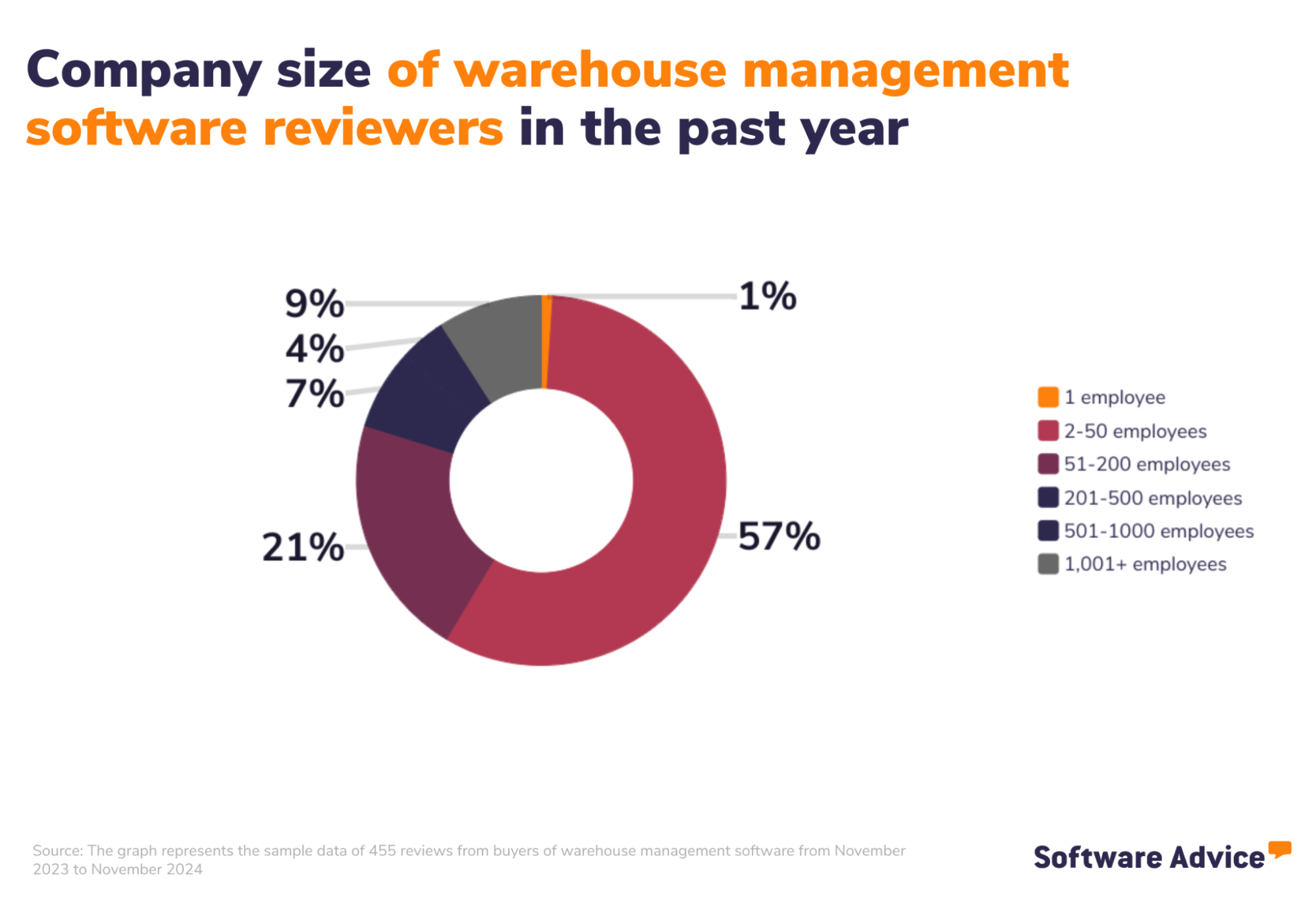
Your budget also plays a role in narrowing in on the best-fit tools for your business. Entry-level pricing for warehouse management software averages $146 per month, while mid-tier and advanced products average $234 and $868 per month, respectively. [2]
Buyers should consider the following critical questions when evaluating systems based on their needs:
Does the software support the number of warehouses we currently manage? Can it support us during a growth phase?
Do employees find the software easy to use?
Is the software mobile-friendly?
Which features does our business need, and which features would be nice to have?
Does the software integrate well with our existing systems for accounting, transportation management, ERP, eCommerce, and/or shipping?
With so many products to choose from, it can be difficult to make a decision. In this guide, you’ll learn about essential features and functions of warehouse management software, with step-by-step guidance on how to find the right tool for your business. For personalized help finding WMS, schedule a chat with one of our experienced advisors like Bryan Dengler, who has helped businesses across industries find warehouse management software.
What is warehouse management software?
Warehouse management software is made to help users track inventory and supplies more efficiently as they move through a warehouse or distribution center. WMS also makes certain processes, such as receiving, picking, and putting away products faster and more accurate.
Common features of WMS include inventory management, order management, barcoding/RFID, supplier management, workflow management, and status tracking. In addition to improving warehouse workflows, reviewers say this software is easy to use and supports productivity and growth.
Essential features of warehouse management software
When selecting warehouse management software, it’s important to know what features are included and how they’ll support your business. Every warehouse management system comes with a few core features: inventory management, receiving, and order management. Other common features support other aspects of managing warehouse operations, such as barcoding, supplier management, and order status tracking.
Check out the following lists to learn about the core and common features of warehouse management software. Some of these features have been rated “highly important” or “critical” by verified reviewers over the past two years.
Core warehouse management software features
Inventory management | Track and manage inventory levels to maintain proper supply. 97% of our reviewers rate this feature as critical or highly important. |
Order management | Manage and track customer orders for goods, investments, or any other purchases. 94% of our reviewers rate this feature as critical or highly important. |
Receiving | Manage all receiving processes within a warehouse. |
Common warehouse management software features
Inventory tracking | Track and monitor inventory items, such as raw materials, unfinished goods, and ready-to-sell items. 94% of our reviewers rate this feature as critical or highly important. |
3PL management | Outsource and manage third-party logistics. |
Barcoding/RFID | Identify and track items using barcode tags or RFID (radio-frequency identification) tags. |
Compliance management | Track and manage adherence to policies for any service, product, process, or supplier. |
Dock management | Manage all inbound and outbound activities relating to each dock. |
Labor management | Manage the attendance, schedule, and payroll of the labor workforce. |
Order tracking | Track orders throughout the fulfillment process. |
Picking and routing | Pick and route items from inventory locations to their designated destinations. |
Returns management | Track and facilitate returns of products sold. |
Shipping management | Manage and track orders being shipped to customers. |
Supplier management | Manage all supplier data and operations. |
Supply chain management | Manage the planning and execution of supply chain activities. |
Benefits and competitive advantages of using warehouse management software
WMS tools help businesses unlock efficiency and growth. Take it from an expert like Software Advice advisor Bryan Dengler, who helps businesses from a wide range of industries find software for manufacturing, project management, and supply chain management, including warehouse management software.
Dengler says that when buyers are looking for a warehouse management solution, their main goal is to increase the efficiency and organization of their warehouse. Some are first-time buyers, but many are “using something that’s not good enough, and they need to upgrade and find something that’s more specialized,” says Dengler. Buyers typically ask, “Can this [WMS solution] help me organize things in a way that makes sense? Is it maximizing our time?”
Our review data shows that WMS is highly rated for efficiency. Users note that tracking KPIs on customizable, mobile-friendly dashboards helps increase visibility and accuracy, making it easier to see where warehouse operations could be improved.
In addition to increased efficiency, WMS benefits businesses directly in other ways, including:
Improved productivity: WMS helps businesses do more with their time by automating inventory management processes, suggesting better picking routes, and locating stock in real time.
Support for growth: With greater efficiency and productivity, businesses can process higher volumes of stock without significantly increasing operational costs.
More accurate reporting and forecasting: WMS automatically tracks inventory levels and can automate reordering as stock is depleted, reducing the risk of stockouts or overstock. With accurate reporting on which products are selling versus sitting in their warehouse, businesses can make better decisions about what to replenish.
In short, taking advantage of WMS's customization options and automation can save businesses time and money on number-crunching, manual errors, and uninformed forecasting decisions.
How to choose the best warehouse management software for your business
Step 1: Define your requirements
Before buying WMS, spend some time to figure out what your business needs, so you can find the tool that you’ll benefit from the most. Here are a few straightforward steps to finding the right software, with important considerations that’ll help you along your research journey.
Determine whether you need warehouse management software or a different kind of software
Because WMS has overlapping functionality with other software categories, businesses aren’t always sure whether they need WMS or something else. Often, they’re trying to decide whether they need WMS or inventory management software.
As Dengler explains, “You can find a lot of inventory management functionality within a WMS, but there’s a lot within a WMS that inventory management software can’t do.” Often, he says, the decision of which software to choose “comes down to digging into what they actually need and cutting through buzzwords” commonly used to market both types of software.
Does your business need help managing inventory and picking, packing, and shipping? Do you need a detailed way to organize products by aisle, bin, or row number so you can locate them more quickly? Do you need a better way to manage docks and receiving? If so, you need a WMS solution.
What’s in your warehouse, and who buys it, should guide your decision
One way to determine the kind of software you should buy is to take stock of what’s required in order to effectively manage the products you keep in your warehouse, and who your customers are. For example, if you’re an eCommerce business, you’ll want a WMS tool that offers precision order management and returns processing. On the other hand, if your warehouse stores perishable products like food and beverages, you’ll want a tool that tracks product freshness and supports temperature-controlled facilities, perhaps with IoT temperature sensors to ensure food safety.
Whether you sell directly to consumers, to other businesses, or distribute products on behalf of other businesses, there is a WMS product that can support your business’s unique needs—which in many cases comes down to the types of products you store.
Your business’s size also plays a role in your decision
The size of your business plays a big role in determining the kind of warehouse management software that would be the best fit.
Small businesses (fewer than 250 employees) often have tighter budgets, so they may be looking for affordable or free WMS solutions that cover the basics. They also look for simpler software that’s easy to use without extensive training. They may not need the same advanced features that a larger business would deem essential. Core features of the WMS category, like inventory management, order tracking, and receiving, may be enough. Finally, SMBs should choose software they can use both before and after a growth phase, so they don’t have to buy a new system later on.
Mid-size businesses (250 to 999 employees) may have reached a point in their growth where they need more advanced features or customizations to fit their workflows. They may also need their WMS solution to integrate with other complex software, like a customer relationship management (CRM) or enterprise resource planning (ERP) system.
Large enterprises (1,000 or more employees) need powerful, often customized software that can handle high volumes of transactions and complex operations across multiple locations. They also need detailed insights and analytics to find opportunities for growth and cost savings. With more complex software comes the need for more extensive user training. Additionally, security features are more essential, as large businesses tend to manage more data.
Anticipate the cost of warehouse management software
Before you begin to narrow your options, know what you’re willing to pay for WMS. Compared to other software, these products can be expensive. That said, most users find that the value WMS offers in terms of time savings, cost savings, and data-driven insights make it worth the money.
Most warehouse management software is priced on a per-month basis. On average, you can expect to pay around $146 per month for a tool with basic features and functionality, $234 for a premium tool, and $868 for an advanced tool. Multiple factors determine subscription price, including features, customization, number of users, and recurring fees for things like maintenance and support. [2]
Decide what level of automation you’ll need
WMS software tends to come with a variety of automated functions, but not all tools have the same capabilities. Ask yourself and your team where automation would most benefit your business: order processing, inventory auditing, real-time data collection, or all of the above? Keep these in mind as you check out different WMS options.
Be aware of potential drawbacks
Warehouse management software, like anything, comes with its own set of potential drawbacks. Here are a few to watch out for:
Cost, both upfront and long-term: Implementing WMS can be expensive, especially for small businesses. There are costs for the software itself, as well as potential expenses for hardware, installation, and ongoing maintenance. Any budget you create for this software needs to include both short- and long-term costs to avoid surprises.
Implementation challenges: Some WMSs are complex and may require significant time and effort to learn. This might mean investing in training for your team, which can be both time-consuming and costly. Setting up a WMS can also take a while, especially if it needs to be customized to fit your specific needs. This can disrupt operations, at least temporarily.
Limited scalability: Not all WMS solutions scale easily with business growth. If your business expands, you might find that your current software can't keep up, requiring another investment. Discuss with the vendors how their tools are equipped to support businesses through growth phases.
Dengler notes that the decision to invest in WMS often occurs when a business is experiencing a growth phase, when “they may be using inventory management software or maybe they have an ERP with a light WMS. But let’s say they’re growing, or building a new warehouse. They want to make sure they lay the groundwork for a really efficient setup. That’s when they’re going to be looking for a more robust, standalone warehouse management software.”
Plan around integration options
As mentioned above, depending on your business's size and complexity and your existing tech stack, you may need to integrate your warehouse management solution with other software. Dengler says businesses commonly integrate WMS with their enterprise resource planning (ERP) system or transportation management software (TMS).
Other common integrations for WMS include accounting, eCommerce, shipping, and barcoding/RFID software. However, many WMS solutions include features for one or all of the above functions. When researching your options, make sure the tools on your list are compatible with your existing tools, and that you’re only paying for what you need.
Step 2: Make a shortlist of WMS options
With 462 highly-rated WMS solutions to choose from on Software Advice alone, it can be challenging to select the right software for your business. Here’s how we recommend you narrow down your options.
Get qualified help from an advisor
Software Advice advisors like Bryan Denger have experience helping hundreds of businesses find WMS solutions that support their needs and budgets. For advice from an expert like him, you can chat online with us right now or schedule a phone call. During your conversation, an advisor will help you identify a shortlist of options that align with your requirements.
Explore our list of WMS FrontRunners
Not ready to speak with one of our advisors just yet? Take a look at our WMS FrontRunners report. Only products that earn top user ratings make this list. To be eligible for consideration, a product must:
Have at least 20 unique user reviews from the last 24 months
Be a stand-alone WMS product
Offer these core features: inventory management, order management, and receiving
Check out our full methodology for a more detailed understanding of how we compiled the FrontRunners list.
Step 3: Pick your best option
Once you have your shortlist of options, it’s time to get to know the software better through vendor demos. During a vendor demo, you’ll explore features, get pricing information, and determine whether the software is right for your business. Knowing what to expect is half the battle.
Schedule vendor demos and ask the right questions
Once you’ve put together a shortlist of WMS options, you should schedule demo sessions with each vendor. You’ll want to use the demos to get personalized answers about features, cost, technical support, training resources, and anything else about the product or vendor that will help you make a final purchase decision.
Here are some questions you should ask during demo sessions:
What kind of customer support do you offer?
Support from your vendor, particularly during onboarding, can make or break a software investment. Ask vendors what forms of support and training they offer during the implementation process.
How frequently do you update your software?
Get specific about the kinds of updates vendors make to their WMS software, how often updates occur, and whether they’re free for existing customers. It’s a good sign if the vendor says they update the software frequently without charging customers for added functionality. Bonus points if they can discuss details about how any upcoming updates will change the performance or user experience of the software.
How can we customize our dashboards?
Understand the level of customization offered for data analytics and reporting. Know which KPIs you’ll want to track with your new software, and determine whether you can display them in one centralized dashboard if the dashboard is mobile-friendly, and how many user seats are included in each pricing tier.
Don’t drag out the decision
Our research shows that software buyers are satisfied with their purchases when they take three months or less to evaluate their options, while those who regret their purchases spend at least five months mulling over their options. [3]
If you’ve gotten this far and you’ve done the right research—meaning that you’ve identified high-quality products that fit your budget and specific business needs, and you’ve participated in demos and used the software—you should go ahead and make a decision. The sooner you do so, the sooner you can start benefiting from a more efficient WMS solution.
Step 4: Make the most of your warehouse management software
Now that you’ve bought a WMS tool, it’s time to implement it. You may be onboarding your first formal WMS solution, or you might be upgrading from an existing system. Either way, here are some important things to keep in mind during the process:
Data migration is annoying but necessary: In order to run most efficiently, your new WMS solution needs existing information about products, warehouses, suppliers, and order history. It’s time-consuming to validate your old data and move it over to your new system, but it’s a vital piece of the implementation process.
You’ll need to train users: There’s not much point in having a powerful new WMS tool if nobody in your organization knows how to use it. Your vendor should be leading training sessions to get your staff up to speed on the new software.
Marketing the software internally pays off: You need to communicate to your staff and suppliers that you’re onboarding a new WMS solution. Set expectations, reassure teams that delays will be resolved as soon as possible, and get users excited about how the software will improve their day-to-day work.
For more information, check out our five-step guide to a successful software implementation.
Software related to warehouse management
As you search for warehouse management software, you may find related or complementary types of software that perform similarly to or could be integrated with your WMS solution.
Inventory management software tracks stock levels across multiple channels in real time, so businesses can quickly view how much inventory they have on hand and make decisions on reordering based on customer demand forecasts. Inventory management is a core feature of all warehouse management software.
Distribution software also has overlapping functionality with WMS; it helps businesses manage a range of processes including inventory tracking, order processing, procurement, and purchasing, and often includes warehouse management features.
Supply chain management software is designed to control end-to-end business processes across the supply chain, perform demand planning and forecasting, and manage supplier relationships. Functionality across systems varies: some tools focus on business intelligence, while others primarily support functions like warehouse management.
Enterprise resource planning (ERP) software unifies a business’s various functions, including manufacturing, logistics, inventory, accounting, sales, billing, and HR, into one system to increase efficiency. Many ERP systems include warehouse management features.
Logistics software equips providers with essential tools to effectively manage and execute their product delivery operations. This primarily includes supply chain management and brokerage and bidding.
More resources for your warehouse management journey
About our contributors
Author
Molly Burke is a senior analyst and writer for Software Advice. She covers customer experience and marketing in the retail and restaurant industries, with a focus on how emerging technology is transforming the way everyday people shop. Her research helps business owners make software investment decisions that will help them navigate the ever-shifting retail landscape.
Molly’s research and analysis is informed by more than 120,000 authentic user reviews on Software Advice and nearly 8,000 interactions between Software Advice software advisors and retail software buyers. Molly also regularly analyzes market sentiment by conducting surveys of retail and restaurant leaders, as well as consumers, so she can provide the most up-to-date and helpful information to small and midsize businesses purchasing software or services.
Her insights on generative AI, social media, and other tech trends have been featured in The New York Times, Vogue, BBC, CNBC, Forbes, and the Financial Times, among other publications.
Editor
Caroline Rousseau is a content editor at Software Advice. A former content analyst, Caroline has, for the past five years, built, written and edited research reports about technological trends, opportunities, and challenges with a SMB audience in mind. Her content has been featured in French Tier 1 media including Le Monde, L’Express and Le Figaro, among other publications.
Her previous experience as a graphic designer, translator and LQA specialist in various industries converged into a skill set that allows her to create compelling content about today’s business matters. Caroline’s personal interests include literature and art and she has a passion for Albert Camus, graphic novels and drawing.
Advisor
Bryan Dengler is a senior advisor. He joined Software Advice in 2022, and is based in Austin, TX.
As part of the software advisor team, Bryan helps professionals from a wide range of industries who are seeking accounting, project management, manufacturing, learning management, and supply chain software. He provides a shortlist of personalized technology recommendations based on budget, business goals, and other specific needs.
Bryan’s favorite part of being a software advisor is knowing he’s made a valuable difference in a buyer’s life with each advising session he holds.
Sources
Software Advice reviews data: Software Advice reviews are collected from verified users for individual software products. For this report, we analyzed reviews from the past year as of the production date. Read the complete methodology.
Software Advice software pricing data: Only products with publicly available pricing information and qualified software products within the category, as of the production date, are included in the pricing analysis. Read the complete methodology.
Software Advice’s 2025 Tech Trends Survey was conducted online in August 2024 among 3,500 respondents in the U.S. (n=700), U.K. (n=350), Canada (n=350), Australia (n=350), France (n=350), India (n=350), Germany (n=350), Brazil (n=350), and Japan (n=350), at businesses across multiple industries and company sizes (five or more employees). The survey was designed to understand the timeline, organizational challenges, adoption & budget, vendor research behaviors, ROI expectations and satisfaction levels for software buyers. Respondents were screened to ensure their involvement in business software purchasing decisions.
Warehouse Management FAQs
- What are the four types of warehouse management systems?
Warehouse management software can be generally divided into four subtypes: cloud-based standalone WMS tools, on-premise standalone WMS tools, WMS features within enterprise resource planning (ERP) suites, and WMS features within supply chain management suites. The type of WMS tool that’s best for your business depends on various factors, including the kinds of products you store in your warehouse and who buys them, the complexities of integration with your existing tech stack, and your preference for remote IT and cloud storage versus in-house IT and on-premise hardware.
- What is the most popular warehouse management system?
According to our analysis of products with high market demand and reviews, Finale Inventory had the highest overall rating from verified reviewers on Software Advice. Finale Inventory is particularly well-suited for eCommerce businesses. For warehouse management tools tailored to other industries, check out our list of highly rated warehouse management software.
- Which software is used for warehouse management?
Businesses use warehouse management software to support warehouse management and operations. They may also use inventory management, enterprise resource planning (ERP), or supply chain management (SCM) software with warehouse management features.
- How do warehouses keep track of inventory?
Warehouses monitor inventory with warehouse management software or inventory management software. This software can be standalone or part of a larger suite, like an enterprise resource management (ERP) system or a supply chain management (SCM) system, and all warehouse management software includes an inventory management feature. Today’s warehouse management software comes with automation to reduce the manual workload involved in warehouse management and improve the accuracy of reporting.
- Is WMS an ERP system?
Warehouse management software and enterprise resource planning (ERP) software have some overlapping features, such as warehouse management, order management, and inventory management, but ERP systems tend to be larger software suites that consolidate other areas of the business under one system, including accounting and financial management, HR, and project management.