

Find the best Web Based Medical Billing Software
Compare Products
Showing 1 - 20 of 323 products
Sort by
Reviews: Sorts listings by the number of user reviews we have published, greatest to least.
Sponsored: Sorts listings by software vendors running active bidding campaigns, from the highest to lowest bid. Vendors who have paid for placement have a ‘Visit Website’ button, whereas unpaid vendors have a ‘Learn More’ button.
Avg Rating: Sorts listings by overall star rating based on user reviews, highest to lowest.
A to Z: Sorts listings by product name from A to Z.


athenaOne
athenaOne
The athenaOne Suite which includes athenaCollector a revenue cycle management solution and athenaClinials an EHR (electronic health records) recently ranked #1 in 2023 Best in KLAS for athenaClinials Ambulatory EMR for 11-75 physi...Read more about athenaOne

RXNT
RXNT
RXNT’s cloud-based, ONC-certified medical software—Billing, Practice Management, EHR, and more—improves clinical outcomes & revenue cycle management. Simple, transparent pricing includes free setup and training, free data transfer...Read more about RXNT

DrChrono
DrChrono
DrChrono’s iPad and iPhone compatible EHR and medical billing platform allows medical practices and healthcare providers to manage patient intake, patient care, clinical charting, billing and revenue cycle management. It includes ...Read more about DrChrono

AdvancedMD EHR
AdvancedMD EHR
AdvancedMD is a unified suite of software solutions designed for mental health, physical therapy and medical healthcare organizations and independent physician practices. Features include practice management, electronic health rec...Read more about AdvancedMD EHR
Talk with us for a free
15-minute consultationSoftware Advice is free because vendors pay us when they receive sales opportunities.
This allows us to provide comprehensive software lists and an advisor service at no cost to you.
This allows us to provide comprehensive software lists and an advisor service at no cost to you.


Meet Eric, a software expert who has helped 1,534 companies select the right product for their needs.
Talk with us for a free
15-minute consultationSoftware Advice is free because vendors pay us when they receive sales opportunities.
This allows us to provide comprehensive software lists and an advisor service at no cost to you.
This allows us to provide comprehensive software lists and an advisor service at no cost to you.
Tell us more about your business and an advisor will reach out with a list of software recommendations customized for your specific needs.
STEP 1 OF 4
How many doctors are in your organization?

ChartLogic EHR
ChartLogic EHR
ChartLogic offers an ambulatory EHR suite that includes electronic medical record, practice management, revenue cycle management, e-prescribing and patient portal. The solution caters to primary care, surgical care and other compl...Read more about ChartLogic EHR

Elation Health
Elation Health
Elation Health is the most trusted technology platform for high-value primary care. Since 2010, the company has delivered clinical-first solutions — built on a collaborative EHR platform — that help practices start, grow, communic...Read more about Elation Health

Compulink Healthcare Solutions
Compulink Healthcare Solutions
Compulink Advantage is an all-in-one database EHR solution for specialty practices such as optometry, ophthalmology, orthopaedics, ENT, mental health, podiatry, and more. Available cloud-based or server, Advantage includes smart f...Read more about Compulink Healthcare Solutions

PrognoCIS
PrognoCIS
PrognoCIS EHR and PrognoCIS Telemedicine have earned a reputation for fast, flexible individual provider workflow. The software package offers a full suite of highly desirable features and functions. PrognoCIS provides a cloud-bas...Read more about PrognoCIS

Nextech EHR & PM
Nextech EHR & PM
For more than 20 years, Nextech has provided a full-featured EMR and Practice Management solution within a single database. This system is a fit for dermatologists, plastic surgeons, ophthalmologists, and physicians, and is used b...Read more about Nextech EHR & PM

ModMed
ModMed
ModMed, also known as Modernizing Medicine®, is an award-winning software company that places doctors and patients at the center of care through an intelligent, specialty-specific cloud platform. Services include electronic health...Read more about ModMed

Practice EHR
Practice EHR
Practice EHR, a medical practice management software, was developed to accommodate the needs of small to mid-size businesses. The platform is customizable to internal medicine practices, chiropractors, physical therapists, family ...Read more about Practice EHR

AllegianceMD
AllegianceMD
AllegianceMD is a cloud-based medical software system that is designed to serve the needs of small and midsize practices, as well as ambulatory surgery centers. The solution includes practice management functionality for billing a...Read more about AllegianceMD

Nexus EHR
Nexus EHR
Nexus EHR is an ONC Certified 2015 Edition Cures Update cloud-based ambulatory EHR and PM platform. It is designed for small to midsize practices and various specialties including orthopedics, neurology, podiatry, cardiology, gene...Read more about Nexus EHR

WebPT
WebPT
Established in 2008, WebPT is the nation’s most trusted outpatient rehab therapy software platform in the country, helping more than 150,000 rehab therapy professionals from all practice sizes and specialties run successful and ef...Read more about WebPT

NextGen Office
NextGen Office
NextGen Office is an award-winning, cloud-based, clinical and billing solution designed for smaller, independent practices (≤ 10 providers). This all-in-one, full-service solution includes specialty-specific EHR content, an easy-t...Read more about NextGen Office

CharmHealth
CharmHealth
CharmHealth is a MU certified, cloud-based EHR, Practice Management and Medical Billing solution that helps healthcare organizations ranging from large multi-specialty groups to small independent medical offices function efficient...Read more about CharmHealth

Valant EHR Suite
Valant EHR Suite
Valant’s Behavioral Health EHR and Practice Management Software includes all the tools you need to provide exceptional individual and group care while running a successful private practice. Unlike other non-specialized EMR softwa...Read more about Valant EHR Suite

RevolutionEHR
RevolutionEHR
RevolutionEHR is a cloud-based electronic health record (EHR) solution built specifically for optometry practices. RevolutionEHR includes a complete EHR, medical billing, patient scheduling, medical accounting and a picture archiv...Read more about RevolutionEHR

zHealth
zHealth
zHealth is an industry-leading, all-in-one chiropractic software with features - custom SOAP notes, integrated billing, scheduling & real-time phone support. The software comes with online appointment scheduling and unlimited rem...Read more about zHealth

Eyefinity EHR
Eyefinity EHR
Eyefinity EHR and Eyefinity Practice Management are a cloud-based, electronic health record and practice management solution designed to meet the unique needs of the optometric industry for single and multi-location practices. ...Read more about Eyefinity EHR
Popular Comparisons


Buyers Guide
Last Updated: March 16, 2023Online medical billing programs use a Web-based interface to provide many of the essential functions medical practices need in order to maximize their invoicing efficiency and/or revenues. Depending on the needs of the practice, this provides several advantages over traditional on-site system installations. This guide will provide an overview of the market and to help buyers in their decision-making process search for the right solutions.
We'll discuss the following topics:
What Is Online Medical Billing Software?
The Online Medical Billing Vendor Landscape
What Is Online Medical Billing Software?
Online medical billing solutions increase collections in medical offices in numerous ways—from ensuring proper claims coding and verifying insurance coverage to posting payments and generating reports. In addition to increasing revenues by identifying previously unbilled claims, invoicing applications automate a traditionally repetitive and error-prone task and frees up staff to focus on other activities.
Most cloud-based medical billing software is designed for the user to submit claims electronically. More advanced systems will provide coding support, and the top-of-the-line systems will scrub claims, post payments, offer alerts and provide for advanced reporting.
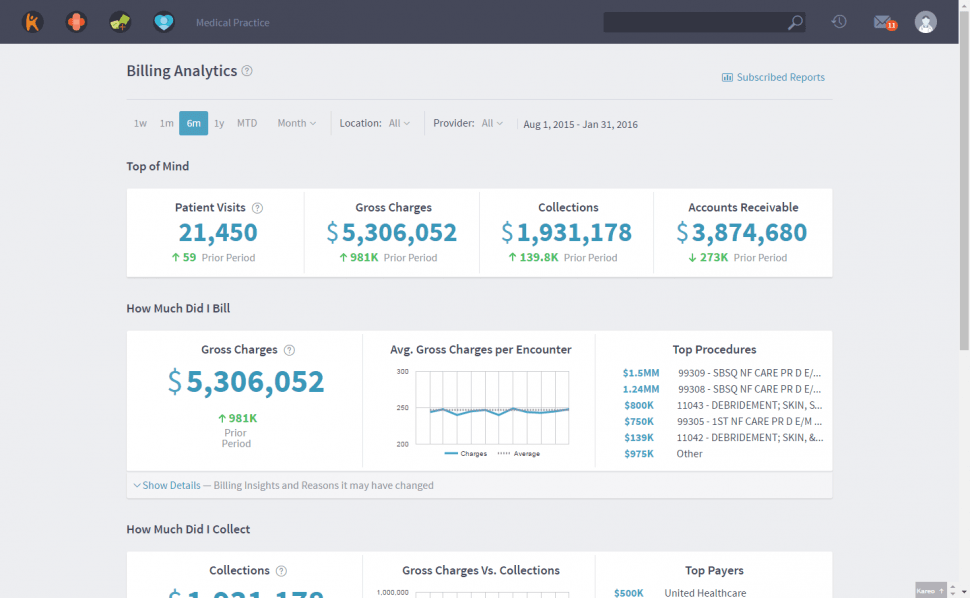
Billing analytics in Kareo Billing
What distinguishes Web medical billing software from other deployment strategies is that the system is available entirely online through a Web browser. This means that the information can be accessed from anywhere with an Internet connection, the user doesn’t have to worry about upgrades or coding updates, and there’s no need for a server or any other kind of IT infrastructure. And in this software-as-a-service (SaaS) model, the user pays a monthly or annual fee rather than upfront purchase cost.
What Type of Buyer Are You?
Most buyers of healthcare invoicing systems fall into one of the following categories:
Integrated suite buyers. This is for buyers who are looking for one integrated suite to manage their entire practice. As well as the invoicing modules, selection will be made based on scheduling, EMR and PACS capabilities, usually with a very targeted focus to the medical specialty.
Inpatient care providers. This includes hospitals and long-term care facilities that submit claims on UB-04 forms. Since this type of form typically requires a system designed for inpatient billing, make sure the product you select has this capability.
Outpatient care providers. Most private practices that submit claims on the CMS-1500 forms fall into this category. Since these buyers are submitting electronic claims to Medicare, Medicaid and private insurance companies, they’ll need something with that level of flexibility in its invoicing and payment structure.
Cash-based providers. You fall into this category if most of your revenues come from customers paying directly with cash, check or a credit card. Since these buyers don’t submit many (if any) claims to insurance companies or to the government, their needs are much more lightweight. Chiropractors, alternative medicine providers and certain kinds of mental health providers are the most common buyers in this category.
Outsourced services. These buyers are third-party companies that submit claims on behalf of providers and receive a percentage of the collections. Typically, their functional requirements will mirror those of their clients, but they may require a very broad-based, flexible system if they bill for clients with varying specialties.
Benefits and Potential Issues
Patient billing software is a project management application that's imperative for mid- to large-size projects. Firms that implement and make use of these systems should realize the following benefits:
Better efficiency: Billing is a notoriously tedious task. Implementing an online medical billing system makes them more efficient at coding, submitting and following up on claims, vastly reducing the time required.
Improved collections and accuracy: As well as being tedious, billing is highly error-prone. Internet-based medical billing software helps users code claims correctly and check them for errors, increasing collection rates and making them better equipped to manage rejections.
Cost amortization: Compared to an on-site solution, a Web-based program will be far less expensive in terms of up-front costs. SaaS also eliminates the need for an IT infrastructure to manage upgrades and to get the product up and running when problems arise.
An important consideration when purchasing a cloud-based patient billing system is the implementation plan. Every user needs to be trained on the product, and often adoption of new technology is met with resistance from people who are comfortable doing things the old way. Therefore, it’s important to get buy-in among all users to get them excited about using it.
Since SaaS programs charge a monthly or annual fee, there is the potential that the user will pay more in the long run than they will for an on-site solution. However, this tends to be the case only for larger companies with bigger budgets and dedicated IT personnel. A more significant drawback would be limited integration to external devices (e.g., ultrasounds and MRIs). If this is a concern, many of the leading client/server systems are available in an application service provider (ASP) model, which means that the system’s server is hosted at a professional data center, which effectively hybridizes the Web-based model with the locally hosted one.
Market Trends to Understand
Consider the following trends as they develop and impact the market:
Mobile computing. Since healthcare providers are increasingly using tablet devices (such as the iPad) or smartphones on a regular basis, more systems are offering mobile compatibility. If your practice could benefit from this kind of mobility, ensure the system you select has strong mobile capabilities.
ONC-ATCB Certification. Government legislation requiring the use of EMRs is impacting the EMR market, but it also affects the practice management market. Since an integrated practice management system has so many benefits, it may be wise to select a program that incorporates all these features—or at the very least supports upgrades and/or integration with EMR systems to be adopted later.
The Online Medical Billing Vendor Landscape
While the market can appear confusing and highly fragmented, the available solutions are differentiated by their appeal to the different buyer types.
This type of buyer... | Should evaluate these systems |
Integrated suite buyers | Allscripts, MedLedger, CareTracker, SuiteMed |
Inpatient care providers | Inpatient care providers Sage Intergy, athenaCollector, NextGen |
Outpatient care providers | AllegianceMD, LeonardoMD, AdvancedMD |
Cash-based providers | MDConnection, MediTouch |
Outsourced services | Practice Admin, AdvancedMD, NueMD |
Costs and Return on Investment
Since the purpose of a medical billing system is to increase collections and decrease the time and effort required to receive them, the traditional measures of effectiveness for SaaS-based medical billing software are average collection timeframe and the ratio of claims accepted to rejected. The biggest benefit to SaaS applications is that they require a much lower upfront cost, since the fees that covers the licensing, technical support and upgrades are all monthly. Therefore, most buyers using this deployment model find the financial return on investment to be almost immediate.