


Best Geriatric Software of 2026

- Popular Comparisons
- Buyers Guide
Compare Products
Showing 1 - 25 of 59 products
Compare Products
Sort by
Reviews: Sorts listings by the number of user reviews we have published, greatest to least.
Average Rating: Sorts listings by overall star rating based on user reviews, highest to lowest.
Alphabetically (A-Z): Sorts listings by product name from A to Z.

CharmHealth is a comprehensive suite of healthcare solutions designed to streamline practice management, revenue cycle managemen...Read more about CharmHealth


CharmHealth's Best Rated Features
See All
CharmHealth's Worst Rated Features
See All

RXNT’s cloud-based, ONC-certified medical software—Billing, Practice Management, EHR, and more—improves clinical outcomes & reve...Read more about RXNT


RXNT's Best Rated Features
See All
RXNT's Worst Rated Features
See All

athenaOne is an integrated solution designed for healthcare practices, offering electronic health records, revenue cycle managem...Read more about athenaOne


athenaOne's Best Rated Features
See All
athenaOne's Worst Rated Features
See All

Tebra helps independent medical practices plug the revenue leaks caused by no-shows, manual processes, and slow reimbursements. ...Read more about Tebra


Tebra's Best Rated Features
See All
Tebra's Worst Rated Features
See All

Advanced Data Systems provides healthcare software designed to streamline clinical and administrative workflows for various medi...Read more about Advanced Data Systems
Advanced Data Systems's Best Rated Features
See All
Advanced Data Systems's Worst Rated Features
See All

AllegianceMD is a cloud-based medical software system that is designed to serve the needs of small and midsize practices, as wel...Read more about AllegianceMD

AdvancedMD is a medical office software suite with cloud-based, integrated physician-patient workflow solutions including: pract...Read more about AdvancedMD Billing Services

Looking to simplify billing, increase efficiency, and maximize revenue? CollaborateMD is a cloud-based medical billing and pract...Read more about CollaborateMD


CollaborateMD's Best Rated Features
See All
CollaborateMD's Worst Rated Features
See All

TotalMD is an extremely affordable, extremely intuitive Practice Management solution that offers small and growing practices the...Read more about TotalMD


TotalMD's Best Rated Features
See All
TotalMD's Worst Rated Features
See All

PrognoCIS EHR and PrognoCIS Telemedicine have earned a reputation for fast, flexible individual provider workflow. The software ...Read more about PrognoCIS


PrognoCIS's Best Rated Features
See All
PrognoCIS's Worst Rated Features
See All

OpenPM is a cloud-based practice management solution designed to help medical organizations manage billing, accounting, patient ...Read more about OpenPM


OpenPM's Best Rated Features
See All
OpenPM's Worst Rated Features
See All

Waystar offers a comprehensive and advanced Healthcare Revenue Cycle Management Solution. The core of the platform is designed t...Read more about Waystar


Waystar's Best Rated Features
See All
Waystar's Worst Rated Features
See All

DaySmart Appointments is a powerful HIPAA-compliant appointment scheduling solution designed to be highly customizable, ensuring...Read more about DaySmart Appointments

DaySmart Appointments's Best Rated Features
See All
DaySmart Appointments's Worst Rated Features
See All

Praxis is an artificial intelligence (AI) based EMR/EHR that has no cumbersome templates. Templates slow charting down, impede m...Read more about Praxis EMR


Praxis EMR's Best Rated Features
See All
Praxis EMR's Worst Rated Features
See All

Benchmark Practice Management streamlines workflows and improves front and back-office operations to reduce errors, improve pati...Read more about Benchmark Solutions Practice Management
Benchmark Solutions Practice Management's Best Rated Features
See All
Benchmark Solutions Practice Management's Worst Rated Features
See All

Klara is a patient communication solution designed for healthcare practices. It helps businesses centralize various communicatio...Read more about Klara


Klara's Best Rated Features
See All
Klara's Worst Rated Features
See All

DoctorConnect is a cloud-based medical solution that helps health care professionals manage their daily operations and interacti...Read more about DoctorConnect


DoctorConnect's Best Rated Features
See All
DoctorConnect's Worst Rated Features
See All

EZClaim Medical Billing is a medical billing software that caters to both single and multi-provider practices. It can be deploye...Read more about EZClaim
EZClaim's Best Rated Features
See All
EZClaim's Worst Rated Features
See All

Sevocity is a cloud-based medical solution best suited to practices seeking a very customizable EHR. The system includes unlimit...Read more about Sevocity


Sevocity's Best Rated Features
See All
Sevocity's Worst Rated Features
See All

NueMD offers a suite of cloud-based software and medical billing services for practices of all sizes. NueMD is an integrated pra...Read more about NueMD

NovoClinical is a completely secure, cloud-based system that can be implemented quickly. Reports and templates can be customized...Read more about NovoClinical
NovoClinical's Best Rated Features
See All
NovoClinical's Worst Rated Features
See All

75Health is a cloud-based electronic health record (EHR) solution that helps medical professionals working in small and midsize ...Read more about 75health

Cliniko is a cloud-based practice management solution designed to help businesses in the healthcare sector manage appointment sc...Read more about Cliniko


Cliniko's Best Rated Features
See All
Cliniko's Worst Rated Features
See All

iTech Workshop provides a suite of products for the healthcare industry. iTech’s mission is to create and deliver standards-bas...Read more about expEDIum Medical Billing
expEDIum Medical Billing's Best Rated Features
See All
expEDIum Medical Billing's Worst Rated Features
See All

Mercury Medical, by CrisSoft, is a practice management solution suitable for a variety of specialties and practices offered on S...Read more about Mercury Medical
Popular Comparisons


Buyers Guide
This detailed guide will help you find and buy the right geriatric software for you and your business.
Last Updated on January 27, 2025Excellent care for the elderly, whether it be in a home health, assisted living, long-term or hospice setting, can be achieved through strong communication, information gathering and streamlined medication capabilities.
Many medical solution providers offer the functionality necessary to provide this level of care—these options give you a wide variety of choices, but finding the best system to fit your specific needs can be a challenge.
This buyer's guide is designed to help with that search, and will cover features, benefits and trends you should keep in mind while considering software.
Here's what we'll cover:
Common Features of Geriatric Software
Benefits of Geriatric Software
What Is Geriatric Software?
Geriatric software is any solution designed to assist long-term or post-acute, home health or hospice senior care professionals. These systems may be used in senior assisted-living communities, rehabilitation centers, home health or skilled nursing settings.
Solutions for geriatric care generally include a few key functional areas—electronic medical/health records, e-prescribing and a practice management suite.
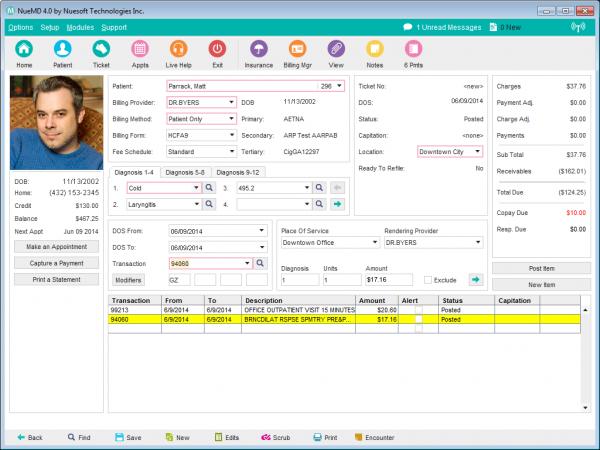
A patient encounter screen in NueMD allows easy data entry
Similar to other medical software, geriatric software helps doctors, nurses and staff members manage clinical tasks and automate billing, scheduling of patients, tracking patient records, storing documents and prescribing medication.
Common Features of Geriatric Software
The following functional areas contain several individual features to assist geriatric care professionals.
Practice management functionality within geriatric care software can include:
Automates medical billing and verifies insurance coverage in real time. | |
Integration with EHR | Enables a connection with an existing electronic health records system to provide enhanced record management. |
Code sets | Facilitates the use of universal medical codes, such as Healthcare Common Procedure Coding System (HCPCS), Common Procedure Coding (CPT) system and International Classification of Diseases (ICD). |
Users can create color-coded schedules for patients with details about the time, date, location, patient history and needs and the health care provider. |
Electronic medical records (EMR) systems function as the centralized location for patients' medical histories, storing important documents and images. This may also be referred to as electronic health records (EHR)—these terms are often used interchangeably.
E-prescribing features in geriatric software may include:
Medication selection | Allows the prescriber to choose from multiple options, such as name brands or generic versions, when using the system to search for medications. |
Prescription creation | Users can create prescriptions directly from the system and send them to the pharmacy, often using order management tools to group prescriptions together and ensure pharmacies receive them. |
Refill requests | Users can send refill requests to health care providers, who can approve them through the system. |
Benefits of Geriatric Software
Successful implementation and training around a geriatric care solution can result in the following benefits:
Easier, quicker access to patient records and documents. With a repository of important documents in the EMR system, nurses and doctors can focus on long-term care of geriatric patients in their rehab centers, hospices or nursing homes instead of searching for paper documents.
Integration makes data sharing simpler. A primary benefit of any integrated software solution is the ease of moving data among users, avoiding time-consuming tasks of exporting or printing documents. Integration also allows the data to be utilized in various functional areas of the system—for example, billing records can easily be analyzed to generate reports.
Faster insurance reimbursement and collections. Using the EMR in geriatric software, practitioners can produce the appropriate claim documents necessary for working with insurance companies, Medicare and Medicaid.
Overall streamlined operations management. Automation in any industry makes daily tasks easier and quicker, and geriatric software is no different. In addition to the efficiencies mentioned above, the process of making notes during patient visits allows doctors and nurses to use codes to document the encounter more accurately.
Deployment Strategies
Two main methods are commonly used to deploy medical, or most other, types of software: on-premise or cloud-based, also known as Software-as-a-Service (SaaS). Each have pros and cons that long-term care providers should evaluate before investing in a solution:
On-premise deployment refers to software that is installed on computers locally within a medical office. This traditional deployment model gives users direct access to the system without the need for an online connection.
An on-premise deployment stores documents and images on the practice's own systems and any upgrades to the software must be done there as well. While the upfront cost for on-premise software is generally higher than cloud-based, the ongoing costs tend to be lower.
Cloud-based or SaaS deployment is the more commonly implemented type of software available today. In a cloud-based implementation, the system is accessed through a browser and no software is installed on local machines.
This offers a couple key advantages:
When upgrades are needed, they can be performed over the internet, often overnight, which avoids costly system downtime.
Many organizations prefer securing sensitive data on the software provider's servers instead of their own, especially if the user's location is more susceptible to theft or natural disaster.
It's also important to consider that cloud-based deployments usually require a smaller upfront cost, but may include additional maintenance or upgrade costs in the future.
Market Trends to Understand
Mobile devices add significant efficiency. Smartphones and tablets are used in several industries today, and medical software vendors are making mobile support a common feature.
These devices add significant value to the geriatric health care setting by freeing doctors and nurses from their desktop computer to consult with residents and patients wherever they are using a tablet in the facility, while maintaining the same capabilities of the full system.
Baby boomers are your newest patients. According to the AARP, 2.5 million baby boomers turned 70 in 2016, and on average, these seniors can still expect about 15 more years of life. And while medical advances will keep them healthier at this age than ever, risks such as Alzheimer's become a more likely condition as they grow older.
This new influx of patients will test the efficiency of geriatric care professionals, but new health care solutions are streamlining daily tasks to enable better care. Finding the best system for your practice can make all the difference.
Elderly care providers' hiring challenge. As a new group of elders reach the age where they need more intensive health care, industry leaders are struggling to meet the demand with enough qualified nurses and home health aides.
In addition, turnover rates of health care employees were about 20 to 25 percent on average. One aspect of the job that shouldn't be frustrating is entering patient information into an EMR or retrieving documents—modern software vendors work hard to offer a user-friendly experience so each task is simplified.