


Best Sales Tracking Software of 2026
Updated March 19, 2026 at 3:46 PM
- Popular Comparisons
- FrontRunners
- Buyers Guide
Compare Products
Showing 1 - 25 of 513 products
Compare Products
Sort by
Reviews: Sorts listings by the number of user reviews we have published, greatest to least.
Average Rating: Sorts listings by overall star rating based on user reviews, highest to lowest.
Alphabetically (A-Z): Sorts listings by product name from A to Z.

Thryv is an AI-powered marketing and sales platform built specifically for small businesses, helping you market smarter, sell mo...Read more about Thryv


Thryv's Best Rated Features
See All
Thryv's Worst Rated Features
See All

Claritysoft is a cloud-based customer relationship management (CRM) solution designed for midsize and large enterprise businesse...Read more about Claritysoft CRM


Claritysoft CRM's Best Rated Features
See All
Claritysoft CRM's Worst Rated Features
See All

LeadMaster is a SaaS-based all-in-one lead management solution that offers capabilities to capture, track and follow up with lea...Read more about LeadMaster

BNTouch Mortgage CRM is a fully integrated digital mortgage system, CRM, marketing, and POS tool offering a comprehensive mortga...Read more about BNTouch Mortgage CRM


BNTouch Mortgage CRM's Best Rated Features
See All
BNTouch Mortgage CRM's Worst Rated Features
See All

Supercharge your sales process with Sales Hub, a powerful and easy-to-use sales CRM that includes sales engagement tools, config...Read more about HubSpot Sales Hub

HubSpot Sales Hub's Best Rated Features
See All
HubSpot Sales Hub's Worst Rated Features
See All

Pipeliner has revolutionized CRM with our unique visual interface, no-code workflow automation engine, and instant, dynamic insi...Read more about Pipeliner CRM


Pipeliner CRM's Best Rated Features
See All
Pipeliner CRM's Worst Rated Features
See All

Shape's cloud-based solution offers tools designed to manage online marketing and promotions, capture leads from online sources,...Read more about Shape

Shape's Best Rated Features
See All
Shape's Worst Rated Features
See All

monday CRM is a sales platform that helps businesses streamline sales cycle. The platform caters to a range of industries, such ...Read more about monday CRM

monday CRM's Best Rated Features
See All
monday CRM's Worst Rated Features
See All

Sales Cloud is equipped with customer relationship management (CRM) functionality that encompasses lead management, marketing au...Read more about Salesforce Sales Cloud
Salesforce Sales Cloud's Best Rated Features
See All
Salesforce Sales Cloud's Worst Rated Features
See All

Clio provides a cloud-based solution designed to streamline various aspects of law firm operations. Its platform supports essent...Read more about Clio
Clio's Best Rated Features
See All
Clio's Worst Rated Features
See All

SalesNOW by Interchange Solutions Inc. is a cloud-based customer relationship management (CRM) and sales force automation soluti...Read more about SalesNOW
SalesNOW's Best Rated Features
See All
SalesNOW's Worst Rated Features
See All

CallProof is built for leaders who manage outside and field sales teams and want a simple way to know what’s really happening in...Read more about CallProof

LeadSquared is a cloud-based marketing automation and customer relationship management (CRM) solution for businesses of all size...Read more about LeadSquared


LeadSquared's Best Rated Features
See All
LeadSquared's Worst Rated Features
See All

Zoho CRM is a cloud-based business management platform that caters to businesses of all sizes. It offers sales and marketing aut...Read more about Zoho CRM
Zoho CRM's Best Rated Features
See All
Zoho CRM's Worst Rated Features
See All

MortgageHalo from Halo Programs is a cloud-based customer relationship management (CRM) solution designed for the residential mo...Read more about MortgageHalo


Rock Solid OneView is a Microsoft Dynamics-based citizen engagement platform that helps citizens and local governments work as o...Read more about Rock Solid
No reviews yet
recommendations


An Inc. 5000 fastest growing private company, recognized by Gartner as a top viable vendor for Integrated Revenue and Customer M...Read more about Symphony

Rolldog is a customer relationship management (CRM) solution, with the perks of sales enablement all rolled into one. Rolldog he...Read more about Rolldog
Rolldog's Best Rated Features
See All
Rolldog's Worst Rated Features
See All

Zendesk is a cloud-based help desk management solution offering customizable tools to build customer service portal, knowledge b...Read more about Zendesk Suite

Zendesk Suite's Best Rated Features
See All
Zendesk Suite's Worst Rated Features
See All

SAP Customer Experience is a cloud-based customer relationship management solution that helps small and mid-size businesses mana...Read more about SAP Customer Experience
SAP Customer Experience's Best Rated Features
See All
SAP Customer Experience's Worst Rated Features
See All

SalesOutlook CRM is a comprehensive customer relationship management (CRM) and email marketing system that embeds into Microsoft...Read more about SalesOutlook CRM

SalesOutlook CRM's Best Rated Features
See All
SalesOutlook CRM's Worst Rated Features
See All

RealEstateHalo from Halo Programs is a cloud-based solution for the residential real estate industry. The platform offers built...Read more about RealEstateHalo


CharityEngine's nonprofit CRM software simplifies the fundraising process, so you spend more time on your campaigns and less tim...Read more about CharityEngine
CharityEngine's Best Rated Features
See All
CharityEngine's Worst Rated Features
See All

Workbooks is the 'No-BS' CRM. Workbooks designs, develops and implements its own software, which is targeted specifically at m...Read more about Workbooks
Workbooks's Best Rated Features
See All
Workbooks's Worst Rated Features
See All

Lofty is an award-winning, all-in-one marketing, lead generation, and customer relationship management (CRM) platform built spec...Read more about Lofty
Lofty's Best Rated Features
See All
Lofty's Worst Rated Features
See All
Popular Comparisons



Your Guide to Top Sales Tracking Software, September 2025
Software Advice uses reviews from real software users to highlight the top-rated Sales Tracking products in North America.
Learn how products are chosenExplore FrontRunners


“Usability” includes user ratings for Functionality and Ease of Use.
“Customer Satisfaction” includes user ratings for Customer Support, Likelihood to Recommend and Value for Money.
Reviews analysis period: The reviews analysis period spans two years and ends the 15th of the month prior to publication.

Buyers Guide
This detailed guide will help you find and buy the right sales tracking software for you and your business.
Last Updated on January 27, 2025Sales tracking software fits into the larger family of sales force enablement and sales force automation software and has many applications in common with traditional sales software and general purpose customer relationship management (CRM) software.
On the whole, the sales force enablement and automation software market is expanding quickly—it grew 12.8 percent to $5.6 billion in 2016. Today, most of the new growth is coming from the successes of Software-as-a-Service (SaaS) vendors entering the market with specialized, focused tools like lead management and, the topic of this guide, sales tracking software. Companies are flocking to these SaaS solutions for three main reasons: To provide better customer experiences and improve customer relationships To streamline sales staff workflows and improve process efficiencies To improve outcomes, close more deals and sell more per deal Sales tracking software can help your company work towards all three of these goals, but it must be chosen correctly and aligned well with your business goals. Those caveats can be especially challenging, especially given the the vast number of solutions available in this quickly growing, rapidly changing software market. This Buyer's Guide will help you make the right choice. In it we explain:
What Is Sales Tracking Software?
Common Features of Sales Tracking Software
What Is Sales Tracking Software?
Believe it or not, a large percentage of companies still track their sales processes manually: in spreadsheets, on whiteboards and even on paper. Manual tracking can work in small offices with very low sales volume, but it's never ideal. It leads to poor performance on the three points listed above: poorer customer experiences, inefficient use of sales staff time and fewer closed deals and lower per-deal revenue.
Sales tracking software helps manage, track and guide all aspects of the sales process. It usually provides set process workflows so salespeople know where each prospect stands at any given point in time and which steps need to be taken next. These days, with better machine learning integrations, some sales tracking software platforms are even able to recommend the single best out of a set number of possible follow-up actions.
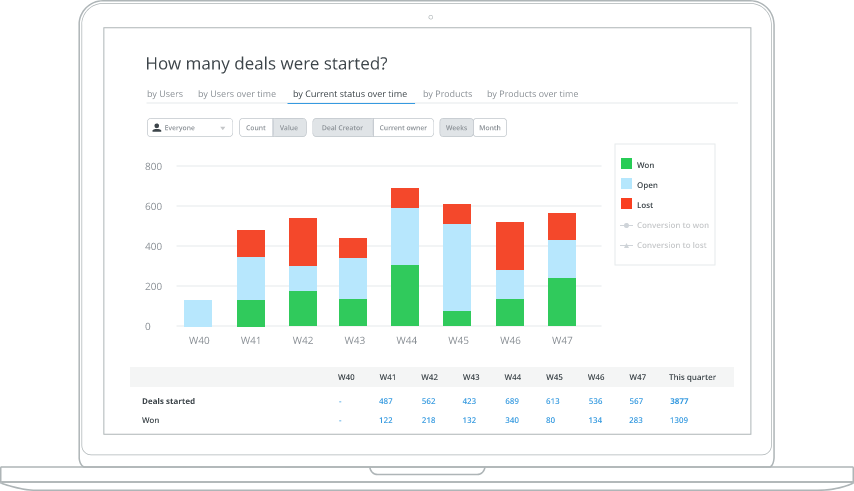
Dashboard overview showing lead origin and deal status in Pipedrive
Salespeople make the most direct use of sales tracking software, but it's also used by team and department managers and executives. For the latter group, it provides insight into the health and status of the sales department's overall operations. It can help also help with sales forecasting, help optimize workforce scheduling and even help determine the best pricing plans and strategies.
Common Features of Sales Tracking Software
Clearly, sales tracking software can accomplish a lot. But how well it helps you achieve your specific goals comes down to the specific applications and features and how well they're aligned with your organization's workflows and goals. Here's a list of common features to look out for in the sales tracking solution you select:
Pipeline management | Manage individual sales prospects from fresh lead and first contact through to deal closure, which lets staff and management parse and prioritize different groups by a variety of internal or external variables. |
Pipeline editor | Define and deploy individual pipelines specific to segmented lead groups, specific products or product lines or different sales teams, providing each with step-by-step workflows. |
Cycle management | Customer-focused process management tool that helps manage sales and buying cycles, which is especially useful for organizations that sell subscription-based products or benefit from post-sales follow ups. |
Next best actions | Helps identify the next best actions to take during multiple stages of the sales processes, increasing buyer engagement and improving sales outcomes. Some platforms make use of predictive analytics to improve suggestions over time. |
Dashboard | Metric tracking visual interfaces for sales staff, management and executives, showing key performance numbers including open and closed deals, volume at various pipeline stages and custom KPIs and values. |
Web-to-lead | Integrates with company's website (or social media channels) to help automatically convert online prospects into trackable leads and prospects, usually with basic segmentation tools. |
Social media integrations | Tools that integrate a company or individual salesperson's social media accounts with backend sales tracking software, saving time, reducing errors, missed opportunities and improving response times. |
Collaboration | Collaboration tools help organize responsibilities in sales environments that have multiple team members working together on the same deals, helping with hand-offs and preventing redundant steps. |
Content management | Provides basic content management functions, either directly or through integrations with a content management system (CMS) to save time looking for sales materials. |
Market Trends to Understand
Since sales force automation and enablement tools play such critical roles in the business world's profitability, they receive tons of attention from software developers. They're some of the first applications to receive updates and integrations of newer technologies like predictive analytics and machine learning.
Current and up-and-coming trends in the sales tracking software industry include:
Better user experience: Gone are the days when updating a lead required a dozen mouse clicks and switching back and forth between multiple screens. Today's sales tracking tools are designed with user experience in mind, streamlining processes on the front end and featuring clearer, more intuitive user interfaces.
Curated account intelligence: Account information and client data both help close deals, but it's easy to have too much of either. What salespeople really need is the right information at the right time, so they know what they need to know exactly when they need it. Curated intelligence tools help manage CRM and sales data and present it only when it's needed.
Just-in-time training: The average sales department is no stranger to turnover and new staff onboarding is a part of operations. Sales tracking apps can speed up onboarding with the better interfaces (mentioned above) as well as with tooltips, automated cues and set workflows that help train new staff as they work.
Predictive analytics: Sales tracking tools have traditionally been systems of record: they'd simply record relevant account and process information. With better predictive analytics tools, they're increasingly answering valuable forward-looking questions, such as: How likely am I to close this deal? What should I do next with this deal?